






















Late-stage and enterprise brands don’t necessarily have budget constraints when it comes to marketing. Still, they do sometimes experience slow growth or even no growth at all.
Such companies face more complex challenges to growth for a variety of reasons, like market saturation or channel proliferation. And on the sidelines, paid media costs rise, creative fatigue sets in, conversion rates flatten, retention becomes harder to improve, and teams need more reliable marketing data to decide where to invest next.
A growth marketing agency can help tackle these challenges–but not just any growth agency–one with the breadth of services, operational capacity, and real enterprise marketing experience to deliver growth for late-stage organizations.
This list will give you exactly that. Unlike other growth marketing lists that focus on how agencies helped up-and-coming brands grow, we looked for agencies that primarily worked with enterprise brands.
Each growth marketing agency included here has been vetted for their ability to support larger marketing needs, complex tech stacks, multi-channel growth strategy, and growth-focused campaigns or projects for established brands.
Whether the goal is demand generation, paid media performance, content marketing, search engine optimization, conversion rate optimization, or experiment-led growth, these agencies have the experience to help enterprise teams scale with more confidence.
| Headquarters | New York, NY |
| Expertise | Strategy, paid media, including paid social, programmatic, search, CTV, and DOOH, influencer marketing, creative strategy and design, measurement |
| Enterprise Clients | Nestle, YouTube, NielsenIQ, Meta |
| Website | fieldtrip.agency |
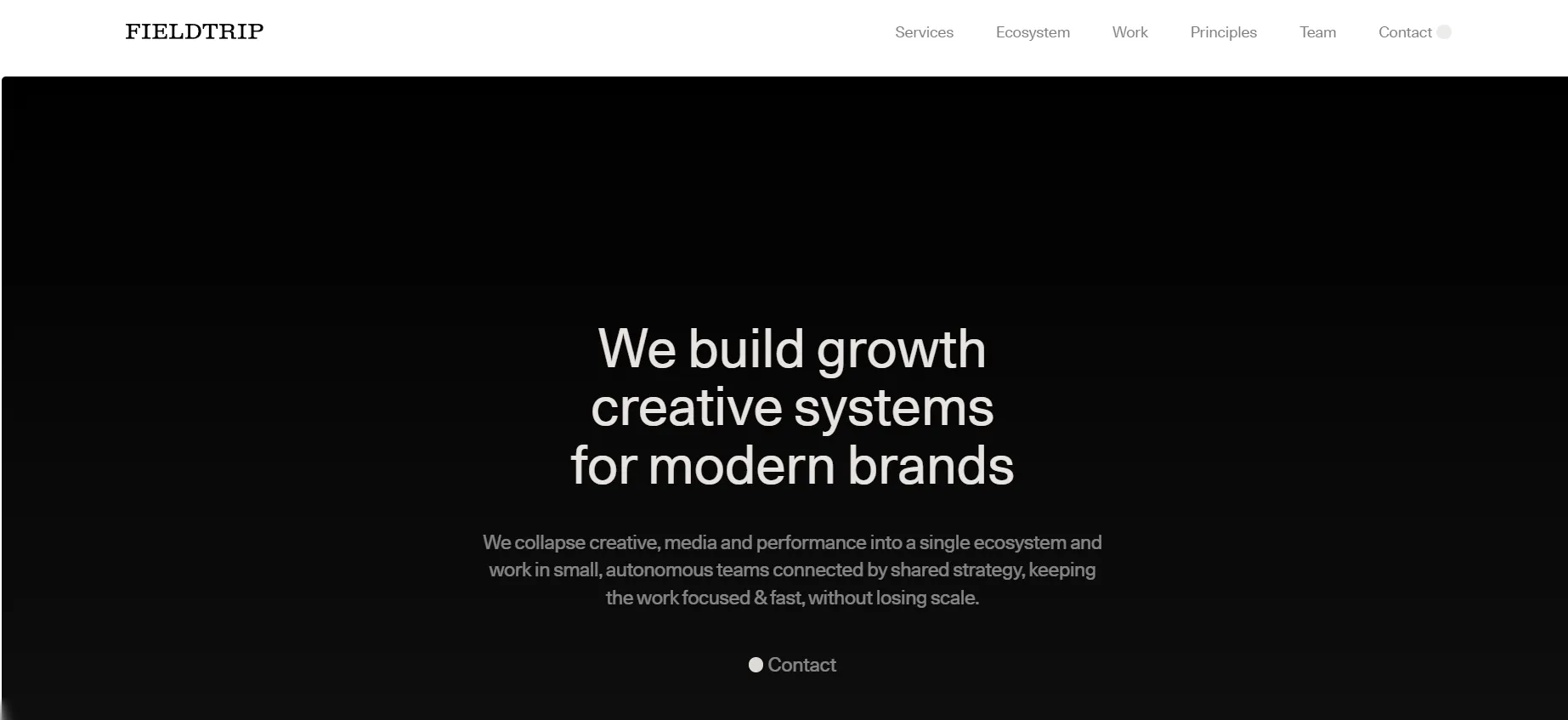
Fieldtrip is a growth agency that specializes in media, creative, performance, and measurement expertise with independent yet highly collaborative teams.
The agency’s ecosystem is perfect for enterprise brands that want unified support across strategy and media, but also for companies that may be lagging behind in specific areas (which is preventing further growth).
They excel at fast content production, performance creative, and influencer content for channels that matter the most for enterprise brands in CPG, beauty, health/wellness, entertainment, and technology.
With many projects handled for big brands, the teams behind the Fieldtrip ecosystem bring agility as well as a deep revenue and growth focus.
| Headquarters | New York, NY |
| Expertise | Commerce, including Amazon and other channels, social media, search, TV, audio, and display, CRO, influencer/affiliate marketing, SMS and email marketing |
| Enterprise Clients | DSW, Rough Country, Dickies, Snapchat, Sony |
| Website | tinuiti.com |
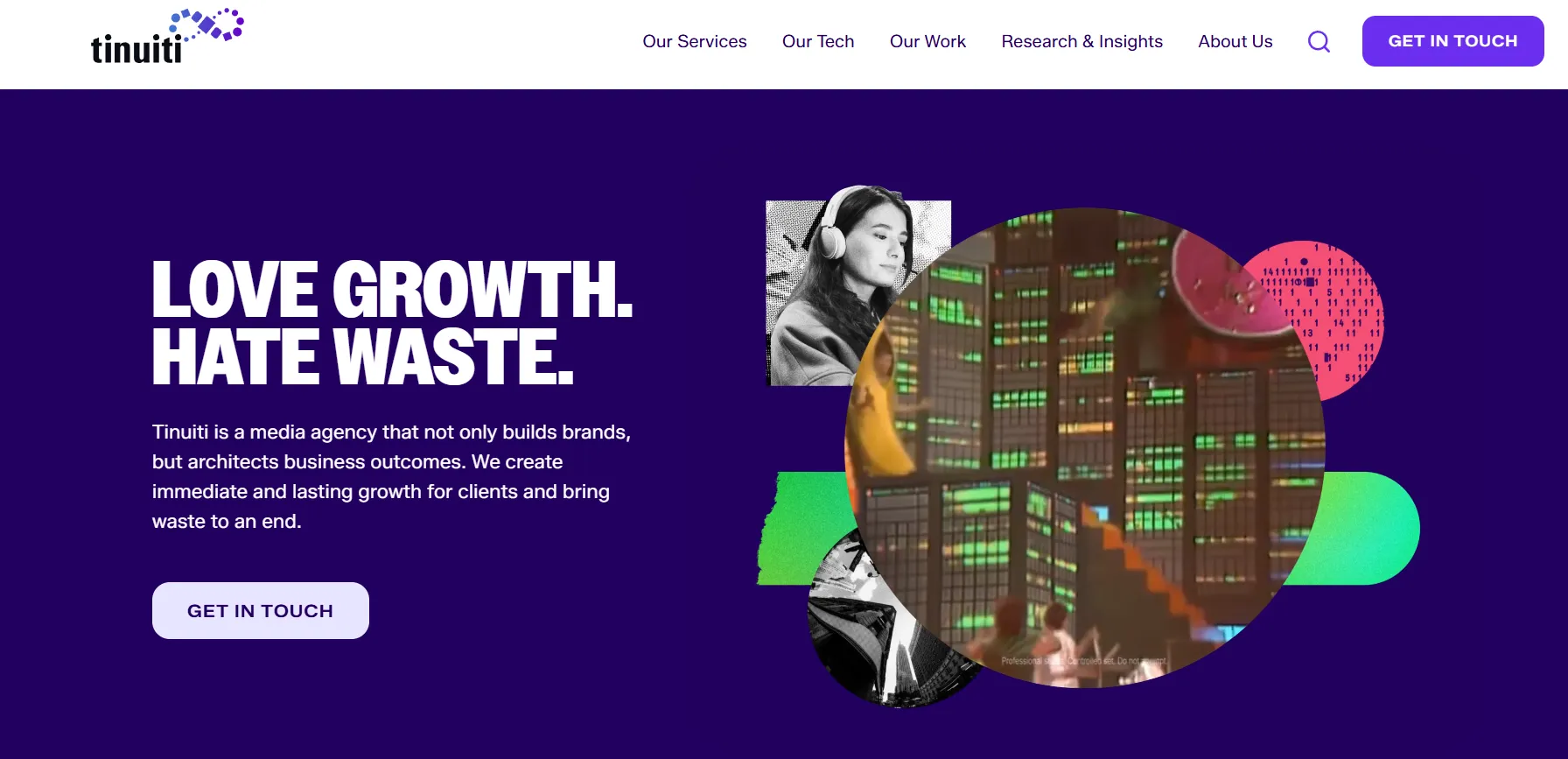
Tinuiti is a performance-focused growth marketing agency for enterprise brands with complex media, commerce, and measurement needs. The agency manages more than $4 billion in digital media and offers services across paid search, paid social, retail media, commerce, and analytics.
The agency has the most variety when it comes to channels, particularly in the digital space. And with all that expertise, they can connect various channels for a solid full-funnel growth strategy. In fact, they have proprietary tech for this called ‘blisspoint.’
Tinuiti is especially relevant for ecommerce, retail, beauty, apparel, and consumer brands that need to improve performance consistently.
| Headquarters | Las Vegas, NV |
| Expertise | Earned media, paid media, creative, data & analytics |
| Enterprise Clients | Levi’s, SoFi, Avianca, Adobe |
| Website | npdigital.com |
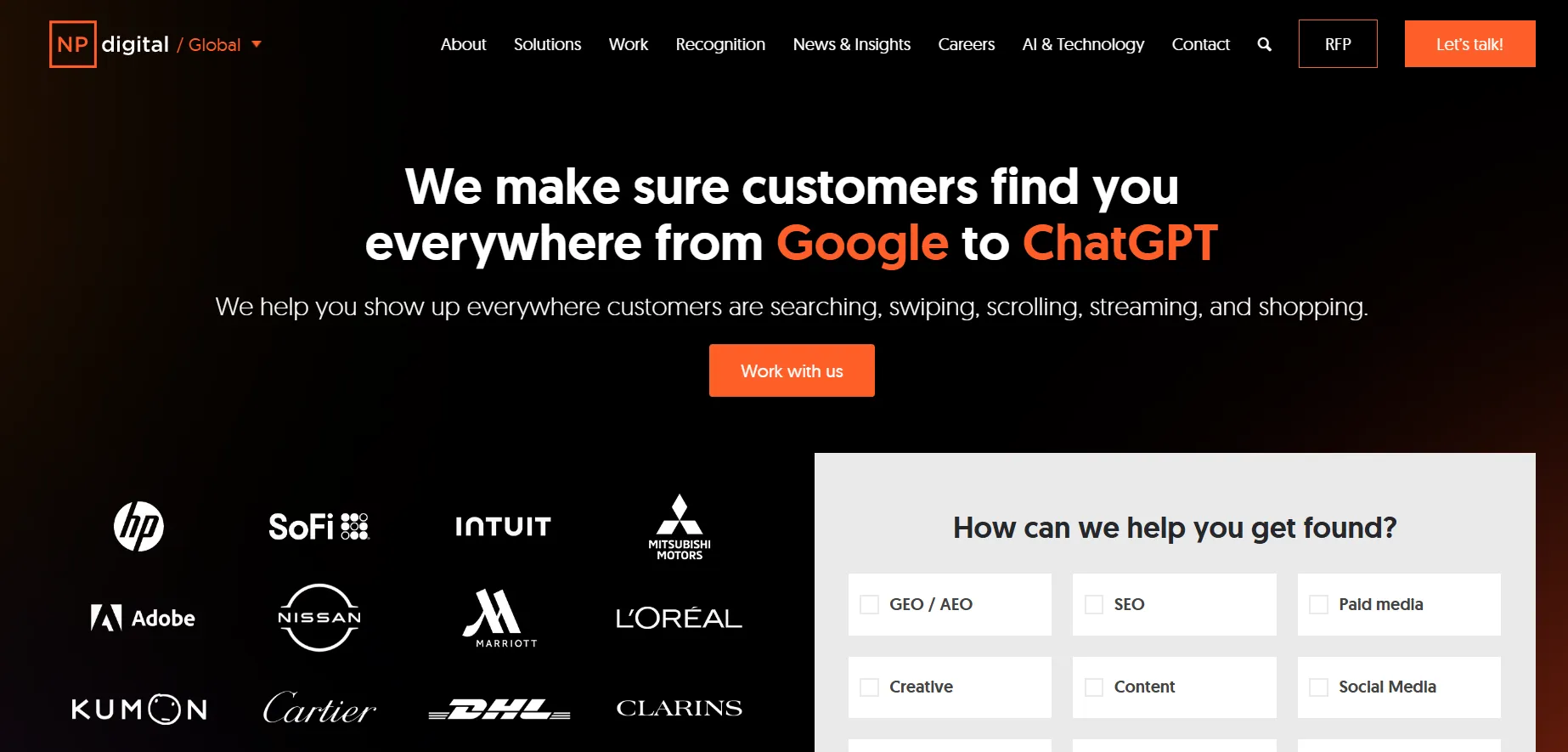
NP Digital is a global growth marketing agency best suited for stronger visibility across search, paid media, content, social, and even AI search channels. They create growth through organic discovery as well as paid amplification, and have extensive experience working with some of the most notable names in the enterprise world.
They have over 500 clients with an average 7:1 ROI. Since they lean more on organic channels, they could be good for enterprises that are vying for more direct customers (like CPGs trying DTC or SaaS solutions for end consumers).
That said, their breadth of services goes way beyond search and covers virtually all digital channels an enterprise brand might be using.
| Headquarters | Amsterdam, Netherlands |
| Expertise | Earned media, paid media, creative, data & analytics |
| Enterprise Clients | PepsiCo, Google, ABN AMRO, NVIDIA |
| Website | deptagency.com |
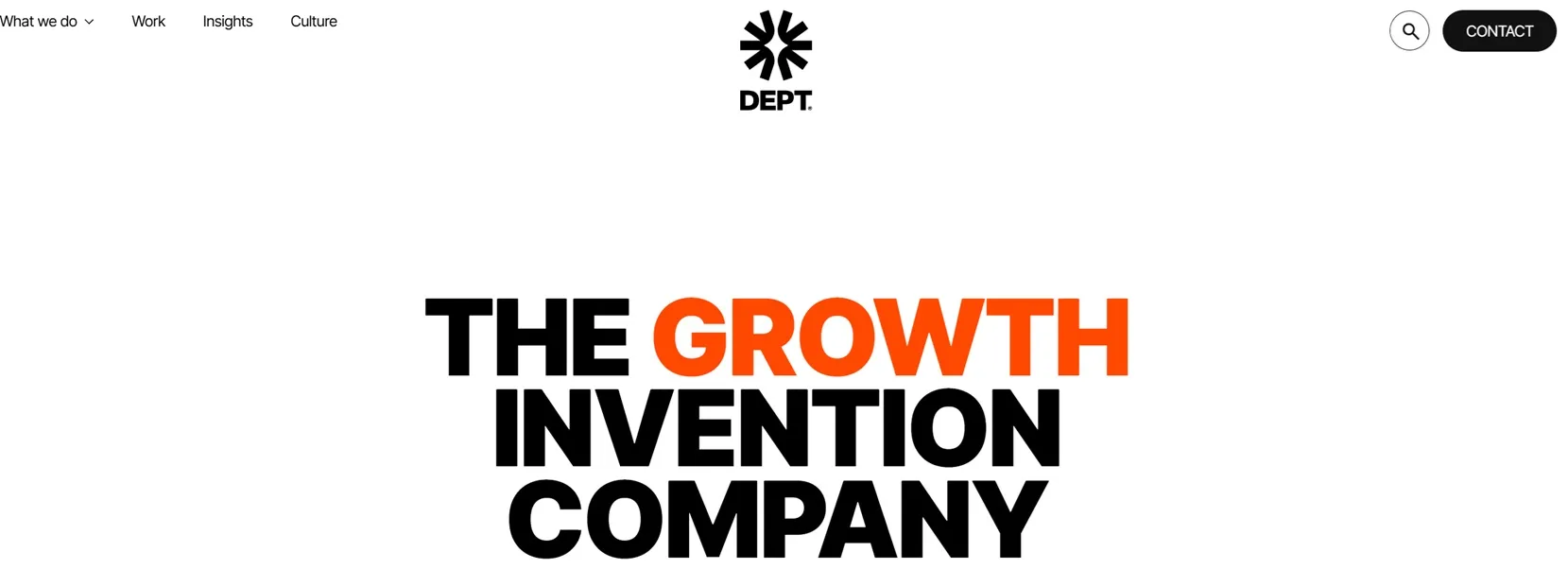
DEPT is a global digital agency built for enterprise brands that need growth strategy, creative, media, technology, data, commerce, and digital experience support under one roof. They call themselves a “Growth Invention” company with 4,000 people across five continents and a 50/50 split between tech and marketing.
The agency has officially partnered with some of the biggest names in technology: Adobe, Google, Amazon, Shopify, and Salesforce. So, they have the technical chops to deliver on transformations and optimizations across branding, advertising, and sales.
DEPT can connect brand, media, customer experience, commerce, and technology into a more modern growth engine. And their minimum project size is over $100K, which shows they primarily work with big clients with massive budgets.
| Headquarters | London, England |
| Expertise | AI visibility, SEO, paid search, paid social, influencer marketing, programmatic & CTV, performance creative, retail media, Google Marketing Platform (GMP) |
| Enterprise Clients | Estee Lauder, Clinique, Henkel |
| Website | brainlabsdigital.com |
Brainlabs is a full-service media agency that takes a more scientific, performance-led approach to media and growth. They link all marketing to revenue and profit, which is what you want when enterprise marketing fails to drive growth.
Since they’re full-service, they cover everything from strategy to creative to analytics. Specifically for growth, the agency focuses more on high-LTV customers than on simply increasing acquisition. They also test new channels before expanding spend.
They train their people in what they call the ‘Test and Earn methodology,' where they are trained to think about revenue growth regardless of the project or channel.
| Headquarters | New York, NY |
| Expertise | Full-funnel creative testing, search, social, CRO, data |
| Enterprise Clients | HSBC, Nestle, Criteo, Meta |
| Website | ladder.io |
Ladder is a growth marketing agency built around creative testing, full-funnel experimentation, and performance improvement. They can be a great fit for companies where the internal marketing teams need help tackling data silos, design speed limitations, and creative slumps that are costing growth.
They are essentially a full-service agency with capabilities across strategy, paid media, creative, analytics, conversion, and retention-focused growth tactics.
And to make things trackable, the agency has a proprietary dashboard (Growth Benchmarks) that lets teams turn data into actionable insights. Although detailed client case studies aren’t public, the agency has worked with some of the most recognizable brands.
| Headquarters | London, England |
| Expertise | Creative, media, technology, strategy, and data |
| Enterprise Clients | Warner Bros., Japan Airlines, Vodafone |
| Website | jellyfish.com |
Jellyfish is an integrated global digital marketing business that works well for enterprises looking to connect media, creative, data, technology, and Generative AI. The last one is essentially their USP, as they use an AI platform (Pencil) to produce creatives 55% faster. That could be a match for large brands struggling to meet the rising demand for assets across different ad platforms.
Their capabilities span paid media, creative production, analytics, cloud, marketing platforms, and digital transformation.
Jellyfish is especially relevant for companies that want to modernize how they plan, produce, measure, and optimize marketing at scale.
| Headquarters | New York, NY |
| Expertise | AEO/SEO, organic + paid social, performance branding, paid search, CRO, marketing analytics |
| Enterprise Clients | MongoDB, Intuit, ByteDance |
| Website | nogood.io |
NoGood is a growth marketing agency that has worked with both startups and established companies, including Fortune 100 companies. They’re built for brands that want fast experimentation, performance-driven creative, and full-funnel growth rather than traditional campaign execution.
Their “growth squad” model makes them a good fit for enterprise teams that need speed, testing discipline, and cross-functional support across acquisition, conversion, and retention.
In terms of industries or niches, NoGood is best suited for SaaS, fintech, healthcare, consumer app, and ecommerce brands that need a growth agency comfortable with both creative and data. Most of their case studies are supported by real results, which is promising.
| Headquarters | New York, NY |
| Expertise | Commerce, retail media (Walmart Connect), programmatic (DSP), consulting |
| Enterprise Clients | Dell, Staples, Publix, Subaru |
| Website | goodwaygroup.com |
Goodway Group is a growth agency for brands in commerce, retail, CPG, and multi-location industries that need to connect media investment to measurable business outcomes. They focus on Connected Commerce, consulting, self-service DSP, and Walmart Connect.
Their Connected Commerce approach is built around linking media, data, retail execution, and real-time decisioning. They reported results like a 41% uplift in connected campaign performance, 2x ad sales revenue growth from 2022 to 2024, and $9.78 ROAS from retail media ecosystem transformation.
Overall, Goodway Group is best for enterprise retail and commerce brands that need a growth agency with deep capabilities in retail media, programmatic, measurement, commerce strategy, and performance analytics.
| Headquarters | Boston, MA |
| Expertise | B2B marketing, SEO, GEO, paid search, content creation |
| Enterprise Clients | Silvon Software |
| Website | brickmarketing.com |
Brick Marketing is a Boston-based digital marketing agency for established B2B companies that need hands-on support across SEO, content marketing, PPC, social media, email marketing, digital advertising, and AI search visibility.
The agency has been around since 2005 and pairs campaign execution with consulting, so it can support companies that want marketing work done while also strengthening their internal team’s strategy and decision-making.
Brick Marketing may not be the right choice for brands that need a large global media operation, but it has a strong lane: helping companies grow through search, content, and lead generation.
Growth marketing looks very different once a company moves from early traction to enterprise scale. At the startup stage, growth typically comes from finding one or two underused marketing channels, increasing paid media spend, or building a repeatable inbound marketing motion. But for late-stage and enterprise brands, most of the obvious growth tactics have already been tested.
In many cases, companies already dominate the market and product category. Simply spending more money on marketing doesn’t bring growth when that happens.
Growth at this stage requires improving performance across a complex funnel, multiple customer segments, more customer lifetime value, or new product/service segment penetration.
A good example of this is Netflix, the streaming giant that has seen immense growth in the last decade. Since it’s a public company, there’s pressure for more growth.
With more than 300 million subscribers, the company can’t rely on subscriber gains alone to keep expanding. Their ad business is still much smaller than YouTube’s; engagement may be harder to grow, and YouTube has already surpassed Netflix in U.S. TV viewing share. At this stage, they need more strategic marketing and perhaps even new business models like creator-style content, as the Wall Street Journal suggests.
Not every company has the budget to keep expanding its marketing operation. Many enterprise marketing teams are being asked to drive more growth with budgets that have barely moved. Gartner’s 2025 CMO Spend Survey found that marketing budgets held steady at 7.7% of overall company revenue, based on responses from 402 CMOs and marketing leaders, most of them from companies with more than $1 billion in annual revenue.
That means these teams are being asked to improve efficiency, prove ROI, and find new growth strategy opportunities inside the same financial constraints.
At this stage, paid media also becomes more difficult to scale profitably. Larger brands often have mature Google Ads, paid social, retail media, and programmatic Advertising programs already in place. As spend increases, the next layer of customers is usually more expensive to reach, less ready to buy, or harder to convert. That puts pressure on conversion rates, cost per lead, funnel quality, website performance, and creative testing.
A growth marketing agency working with enterprise brands cannot just “launch campaigns.” It has to understand media planning, performance creative, analytics, conversion rate optimization, and how each channel affects the sales funnel.
Traditional marketing agencies usually focus on visibility: brand awareness, creative production, media buying, PR, social media, and campaign execution. Their work is often measured by outputs, such as content produced, impressions generated, or placements secured.
Growth marketing agencies focus more directly on business outcomes. They connect channels like paid media, content, email, landing pages, automation, analytics, and CRM to drive traffic, demand, conversions, retention, and customer lifetime value.
Here are the main differences:
| Area | Traditional Marketing Agency | Growth Marketing Agency |
|---|---|---|
| Primary Focus | Brand awareness, creative campaigns, media visibility, and content production | Full-funnel growth, conversion, retention, revenue, and customer lifetime value |
| Model | Campaign-led | Strategy-led |
| Channel Approach | Mostly channel-specific | Integrated across digital and offline channels |
| Measurement | Campaign performance, including ROAS, CPA, sales lift, engagement, etc. | Growth metrics, including revenue growth, conversion rates, retention, churn, and LTV |
| Data Usage | Uses reporting to review results | Uses marketing data to guide testing cadence, optimization, and closed-loop growth strategies |
| Best Fit For | Brands that need visibility, positioning, content, or campaign support | Enterprise brands that need scalable, measurable, cross-channel growth |
A growth marketing agency can support a wide range of marketing needs depending on the company’s stage, internal team, industry, and tech stack. Many growth marketing teams become the extension of the internal team, handling most, if not all, of the marketing efforts. But some focus on specific channels to drive growth.
Common services include:
Building a clear growth strategy based on the brand’s market position, persona research, sales funnel, marketing channels, and revenue goals.
Managing Google Ads, paid social, retail media, programmatic advertising, and other performance channels to improve traffic, cost per lead, and conversion quality.
Developing and testing ad creative, messaging, design variations, hooks, offers, and video production to reduce creative fatigue and improve conversion rates.
Improving landing pages, website performance, calls to action, user experience, and funnel paths to turn more traffic into qualified leads or online sales.
Supporting keyword research, technical SEO, content strategy, link-building, organic traffic growth, and search results visibility.
Helping brands improve visibility across Google AI Overviews with Answer Engine Optimization (AEO).
Building campaigns that improve activation, retention rate, repeat purchases, customer experiences, and customer lifetime value.
Setting up or optimizing workflows in platforms like HubSpot, Marketo, Klaviyo, or Salesforce Marketing Cloud to improve segmentation, nurturing, and sales handoff.
Connecting CRM systems, marketing platforms, analytics tools, and sales workflows so teams can track performance across the full customer journey.
Building dashboards, attribution models, measurement frameworks, and reporting systems that help teams understand which campaigns are driving real growth.
Helping enterprise teams allocate budget across marketing channels based on performance, audience behavior, funnel stage, and global scale.
Auditing the existing tech stack, identifying gaps, improving platform development, and helping teams get more value from their marketing data.
Connecting awareness, acquisition, conversion, retention, and expansion into one closed-loop growth system.
The best growth marketing agency for an enterprise company is usually the one with the right mix of strategic thinking, channel expertise, testing discipline, technical capability, and proof of performance with similar brands.
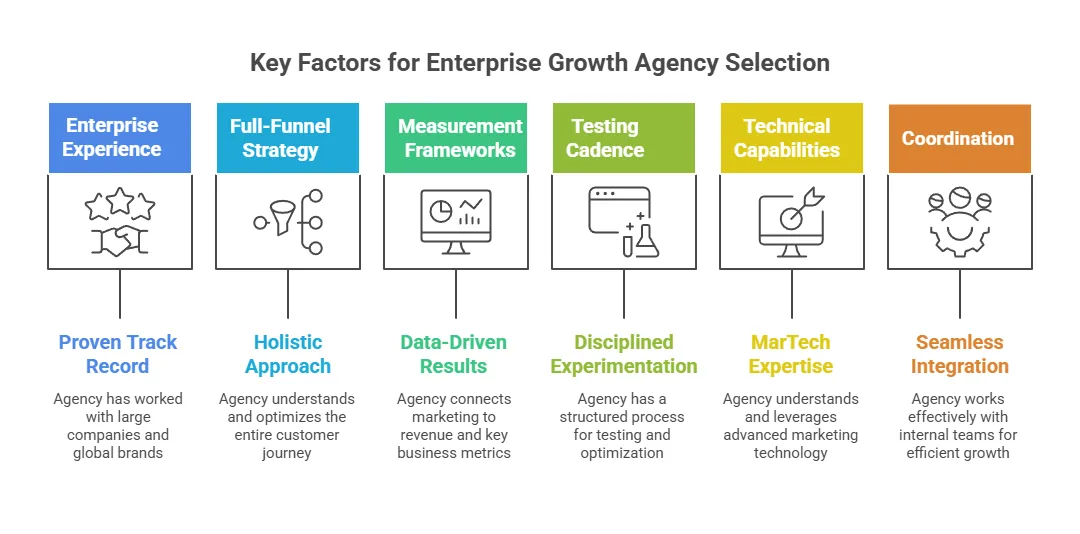
Here are the key factors to evaluate:
A growth agency that works mainly with small businesses or early-stage startups may be excellent at speed and experimentation, but enterprise marketing requires a different operating model. Larger companies have multiple stakeholders, longer buying cycles, stricter brand standards, regional teams, legal review, complex reporting needs, and a larger tech stack.
Look for agencies that have worked with enterprise companies, late-stage startups, or brands operating at global scale. Their client roster, case studies, and industry experience should show that they can handle bigger budgets, cross-functional collaboration, and multi-channel growth strategy.
Many agencies are strong in one area. That can be useful, but enterprise growth usually depends on how well all of these pieces work together.
A strong growth marketing agency should understand the full funnel. Instead of simply reporting that a campaign generated leads, the agency should be able to explain how those leads moved through the sales funnel, how they converted, and what needs to improve next.
Enterprise companies need measurement frameworks that connect marketing activity to revenue, pipeline, sales, retention rate, LTV, and cost per lead.
Before hiring an agency, ask how they measure performance across paid media, organic traffic, content marketing, email marketing, paid social, and demand generation (whatever it is that you’re after).
A good growth agency should be comfortable discussing attribution and should be using sophisticated tech to support it. If the agency cannot explain how it will prove performance, it may not be ready for enterprise-level marketing needs.
Growth marketing is built around experimentation. The agency should have a clear process for creative testing, audience testing, messaging tests, and funnel analysis. For enterprise brands, speed matters, but so does discipline.
The right agency should know how to run experiments without damaging brand consistency or creating operational chaos.
Ask how often they test, what they test first, how they prioritize experiments, and how they decide whether to scale, pause, or refine a growth tactic.
The stronger the tech stack, the more capable the team will be. They should understand CRM systems, marketing automation platforms, content management platforms, analytics tools, data pipelines, and the broader MarTech environment.
This matters because many growth problems are not just media problems. Poor CRM Integrations, broken tracking, slow website performance, disconnected sales workflows, weak analytics infrastructure, or messy customer data can all limit growth.
Your agency partner may need to work with marketing leadership, sales, RevOps, analytics, legal, finance, and even regional teams for specific markets. That’s especially the case if you’re after growth hacking, which is where more teams are involved, not just marketing.
Before hiring an agency, ask how they manage communication, approvals, reporting, and handoffs. The right partner should make internal teams faster, not create more work. They should bring structure, clear ownership, and practical recommendations that fit the company’s existing workflows.
Before choosing a growth marketing agency, enterprise teams should ask:
Remember, the right growth agency should feel like a strategic extension of the internal marketing team. It should bring speed, structure, specialist expertise, and a clear growth playbook made just for your brand.
At Fieldtrip, our multidisciplinary marketing ecosystem allows us to support enterprise teams to make the best of the most profitable marketing channels. That could be programmatic display, influencer marketing, or paid social-any and all channels that bring in even more customers and retain them with consistent experiences.
Schedule a growth strategy session!
Growth marketing is a data-driven marketing approach that increases customer acquisition, retention, revenue, and lifetime value through continuous testing and optimization. Growth marketing uses experiments across channels such as SEO, paid media, email, content, and product experience to identify scalable strategies that drive measurable business growth.
A growth marketing agency for enterprise clients typically costs between $10,000 and $100,000+ per month. Pricing depends on campaign complexity, marketing channels, required expertise, technology, and the size of the engagement. Enterprise retainers can include strategy, creative production, execution, and analytics.
Partnering with a growth marketing agency is recommended when an internal marketing team needs specialized expertise, additional execution capacity, or faster experimentation. Agencies complement in-house teams by providing strategic guidance, advanced channel knowledge, and scalable resources without requiring permanent hires.