






















Digitization across different business functions and processes shouldn’t be seen as a necessary evil. For enterprise marketing teams, it is a core operating strategy. That’s because such teams oversee massive budgets, complex multi-channel campaigns, and demanding workloads.
Large companies are doubling down on digitization, particularly in the wake of new Artificial Intelligence (AI) tools.
That’s indicated by the projections for digital transformation spending, which is set to reach $4 trillion by 2028.
If your marketing teams are still using spreadsheets to track leads or calculate campaign spend, it's time to rethink how you do things and invest in digital tools that automate these processes.
In this blog, we’ll dig deeper into all of that and list tools leading marketing teams and agencies are using today.
P.S. Discover the Top Digital Transformation Agencies Empowering Enterprises.
Marketers are now leaning on integrated platforms to program and nurture campaigns across email, social, and web channels with minimal manual work.
Yes, these marketing technology investments help do the same work faster. But they also enable enterprise teams to build a unified view of performance across channels, measure customer behavior in real time, and adapt to shifting trends through data-driven decision-making.
Some of the most important digital tools for enterprise marketing include:
Enterprise organizations shouldn’t see digital transformation as a technology upgrade. Rather, it should be treated as a strategic reimagining of how marketing teams create value, replace manual, error-prone workflows, and deliver seamless customer experiences in an increasingly competitive B2B and B2C world.
Digital transformation refers to the integration of digital technology into all areas of marketing operations. It reshapes how teams function, collaborate, and serve customers across touchpoints from awareness through conversion and retention.
That’s why 96% of marketers use automation or are planning to.
Here’s how we believe true digital transformation with dependable, cost-effective tools looks like:
Replacing manual, error-prone workflows with automated, auditable systems.
Digital transformation replaces outdated manual processes with automation tools that audit every step and synchronize data in real time. As a result, your team can spend more time on strategy and creativity rather than on repetitive tasks such as handing over files, notifying team members, or writing copy from scratch.
Creating a single performance narrative across channels, regions, and teams.
In a large enterprise marketing environment, data lives in silos. For instance, media buying analytics are separate from CRM insights, and email performance is divorced from website behavior. Digital transformation enables teams to centralize data, unify performance dashboards, and construct a single narrative of campaign impact across regions and channels.
Enabling collaboration without adding coordination overhead.
A major driver of enterprise digital transformation is enabling collaboration tools that connect team members without adding the coordination overhead that traditionally slows enterprise initiatives. Modern project platforms, cloud-based content repositories, and workflow automation systems help distributed teams work cohesively in real-time.
Tightening alignment between marketing, sales, CX, finance, and IT.
Perhaps the most transformative effect of digital strategy on a marketing team is how it aligns traditionally disparate functions. Digital transformation makes it possible for marketing, sales, customer experience (CX), finance, and IT to operate on a shared foundation of data and workflow logic, with shared metrics, shared incentives, and shared data flows.
Marketing can be an incredibly diverse operation in terms of day-to-day responsibilities, data generated and used, and channels covered. We have noticed that at an enterprise level, the complexity and scale rise even further. This typically means several independent units or teams that may need to use a variety of tools to get work done.
Besides the actual platforms for marketing and advertising–search engines, email providers, social media platforms, and programmatic advertising platforms–enterprises also need tools for production, execution, and data analysis.
Let’s see how leading organizations structure their marketing technology stack around key categories that power high performance at scale.
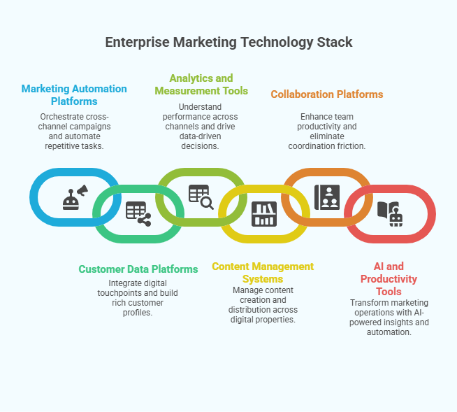
At the heart of digital marketing execution are marketing automation platforms, which orchestrate cross‑channel campaigns and handle repetitive tasks. These platforms automate key processes like lead scoring, nurture programs, and trigger campaigns based on customer behaviors across email, SMS, web, and mobile channels.
With these automations, large-scale marketing operations can be carried out without necessarily increasing team size. For instance, an email marketing platform can automate targeting offers or notifications for consumer action (like order confirmation or delivery tracking).
Here are the leading marketing automation platforms enterprises use:
To integrate digital touchpoints and build rich customer profiles, enterprise teams rely on Customer Relationship Management (CRM) systems and, in some cases, a dedicated Customer Data Platform (CDP).
A CDP consolidates first‑party data from multiple sources into a unified view that can fuel segmentation, personalization, and real‑time decision-making across campaigns. CRMs provide a centralized repository for contact and account data. While they’re more suitable for sales teams, they can essentially support sales and marketing alignment.
And sales and marketing alignment can lead to 38% higher sales and 36% better retention. Most sought-after tools in this category are:
Understanding performance across channels matters even more when your team manages large paid media budgets. At enterprise scale, small blind spots can turn into serious waste. Without reliable analytics, spend decisions drift, and optimization becomes harder to sustain.
Analytics tools are essential for turning raw data into actionable insights that drive data‑driven decisions.
Most platforms include built-in analytics for managing campaigns across channels such as Google Ads, Meta Ads, TikTok Ads, and demand-side platforms like The Trade Desk. Your data experts can carry out a decent analysis to see what’s working and what’s not.
However, native analytics typically have campaign or channel-level limitations. For enterprises, it makes sense to invest in dedicated analytics platforms for marketing and advertising data to see the big picture stuff. Examples include:
This approach gives you clearer answers and more confidence when making budget and strategy decisions.
Effective enterprise-level content marketing requires tools that manage both creation and distribution. Content Management Systems (CMS) handle creation and publishing across digital properties, while Digital Asset Management (DAM) systems centralize creative assets and enforce brand consistency with version control, permissions, and workflow automation.
Below, we have mentioned some enterprise-grade tools that you can use:
Based on our experience working with various enterprise teams, we’ve seen that productivity drops quickly when coordination becomes messy. That’s why to enhance team productivity and eliminate coordination friction, enterprise marketing ops teams need to adopt collaboration and project management tools.
Such platforms offer centralized dashboards, task assignment, timeline views, and approvals, which enable multiple departments and creative teams to work together without siloed communication or version conflicts.
These tools are critical for streamlining workflow across global teams and ensuring campaign execution adheres to schedule and strategy.
Some of the most popular collaboration and project management tools among marketers that we also use at Fieldtrip are:
Finally, AI tools are transforming how enterprise marketers operate, from predictive analytics and generative content creation to workflow automation and segmentation. Increasingly, platforms are embedding AI as a core capability.
Over 80% of marketers already use gen AI for content creation and copywriting.
Tools like Gemini, ChatGPT, and Pexplexity (sometimes embedded in marketing clouds) are used to generate content ideas and automate copy drafting. These gen AI tools, on their own or when integrated into different platforms, essentially increase productivity.
In an enterprise context, investing in digital tools becomes even more important. Of course, it’s a big investment, particularly when you have to purchase licenses or subscribe to various tools. However, this investment pays for itself in more ways than one. Here’s how:
Enterprise marketing teams run hundreds of campaigns across regions, products, and segments simultaneously. That’s the kind of scope that’s not serviceable with spreadsheets and ad‑hoc workflows.
Marketing automation, analytics dashboards, and CRM integrations allow teams to automate repeatable processes, trigger events based on real‑time customer behavior, and ensure consistent execution across channels.
In fact, automation can drive a 14.5% increase in sales productivity while reducing marketing overhead by over 12%, according to industry research.
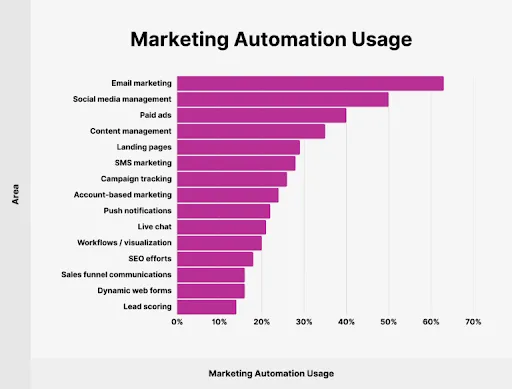
The same applies to workflow management, content creation, and productivity tools that automate small tasks. You’d need fewer people on the team with a higher level of strategic expertise, which would accelerate time to achieve goals and reduce costs.
The true power of digital tools lies in real‑time analytics and attribution that link marketing activity directly to business outcomes such as revenue, customer acquisition, and retention.
Without analytics platforms and centralized reporting, enterprise teams spend excessive time reconciling data from fragmented sources and struggle to make actionable decisions.
Companies adopting data‑driven approaches are 6 times more likely to be profitable year‑over‑year. And they can reduce campaign costs by up to 30 % by optimizing based on performance.
We have observed that with integrated analytics, marketers gain real‑time visibility into campaign performance. Also, they can pivot strategy, make better budgeting decisions, and tie customer behavior back to ROI and enterprise goals.
Enterprise-level marketing requires sophisticated tools that fit well into the overall technology stack you have. We highly recommend investing in platforms with capabilities that essentially help activate your business goals.
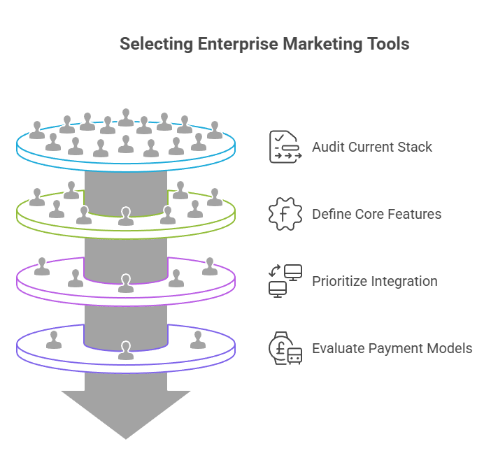
Follow this step-by-step guide to find the tools that work for you (and don’t drain cash).
Before shopping for new technologies, we suggest conducting a thorough audit of your current marketing ops stack and workflows.
Once you’ve defined requirements, determine which features are an absolute must versus “nice to have” additions. Consider features that directly impact your ability to:
Of course, the above suggestions may translate into distinct features for your specific business. So, rank features by priority. That way, you focus on tools that address critical pain points.
Pro tip: Do a side-by-side comparison of core functionalities and features of competitor tools. Most platforms provide such information openly, but be objective with it and research the competitor, too.
A common mistake in evaluating marketing technology stacks is selecting tools solely on feature lists without considering how they fit into your broader ecosystem. Integration matters more than having the “best” isolated tool because connected systems remove hurdles, data duplications, and enable automations.
Look at the out-of-the-box integrations offered and the ones you can realize via APIs. Remember that tools that offer customizable APIs, pre‑built connectors, and easy integrations with your existing stack increase efficiency and reduce overhead.
Enterprise procurement processes must balance capability with budget certainty. When assessing tools, consider:
A tool that looks affordable up front may become expensive if integration costs or required add‑ons aren’t included in the initial quote.
For many enterprise organizations, the complexities of digital transformation, typically for marketing, can be challenging and expensive.
Instead of equipping internal teams with every platform, many enterprises today partner with expert agencies that specialize in consulting, implementing, and optimizing enterprise marketing technology and marketing ops processes.
Working with an agency doesn’t mean bypassing digital tools. In fact, it simply means supplementing your internal capabilities with specialists who can take on some of the responsibility, like strategy, execution, or even measurement.
That specialty also comes with a slew of digital tools that your company may need but won’t have to actively invest in.
That alone may justify the cost of working with a specialty marketing agency. But it’s also the expertise that makes such partnerships profitable.
That’s why many enterprise marketing teams overseeing large campaigns turn to Fieldtrip for our expertise in areas like creator-led marketing and paid media. Our teams collaborate closely with internal stakeholders to plan and execute campaigns focused on conversion and revenue, especially on platforms like TikTok.
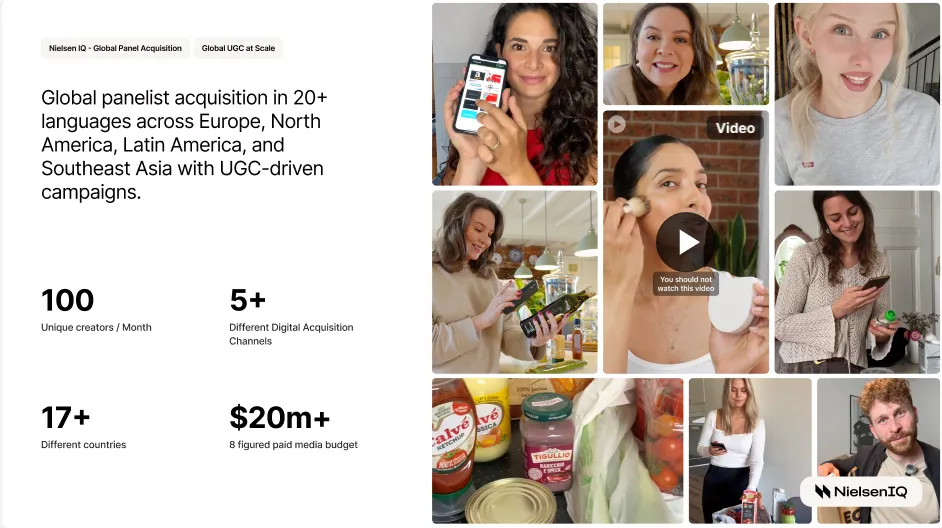
For instance, Nielsen IQ turned to us for executing a hybrid UGC plus paid media campaign to acquire panelists across 17 different markets.
With an eight-figure paid media budget, the UGC and paid media teams at Fieldtrip worked in unison to achieve acquisition goals while keeping costs low.
With this collaboration, Nielsen’s marketing team was able to leverage our global network of highly engaged social media creators and realize a profitable campaign.
Further Reading: Learn how to pick an advertising agency for a global brand.
Our thinking is simple: digital tools make the world go round, at least when it comes to marketing and advertising. We highly recommend that enterprises empower their teams with the tools mentioned and the latest technologies aligned with their needs, processes, and budget.
And where necessary and beneficial, partnering with a dedicated marketing agency like Fieldtrip can really move the needle.
That’s what we’ve seen with many of our clients that have their own marketing teams, but also collaborate with us to tap our expertise in areas like influencer marketing, UGC, and SEO/AEO.
And our expertise comes with the most advanced tech stack, which enables us to deliver with speed and accuracy.
If you’re ready to explore how digital tools and the right partnerships can support your marketing goals, get in touch with us!
Enterprise marketing teams benefit most from tools that support automation, analytics, and collaboration across departments and channels. These include marketing automation platforms, CRM / Customer Data Platforms, analytics and attribution tools, content management and DAM systems, project‑management/collaboration tools, and AI tools for predictive insights and content creation.
Tools can reduce the amount of work a marketing team needs to get done, which can sometimes mean smaller teams. Digital tools can increase productivity and automate menial tasks, thereby reducing workloads across the team. However, tools can’t replace humans entirely, and your enterprise, depending on the size of operations, may still need a sizable team.
Measuring success starts with defining clear KPIs linked to business outcomes, such as lead quality metrics, conversion rates, customer LTV, campaign ROI, and time saved through automation tools. With analytics and attribution systems, enterprise teams can assess performance in real time, compare results across regions and channels, and tie improvements to strategic goals such as increased team productivity or enhanced customer experience.
At Fieldtrip, we use a wide range of tools to support our clients' marketing projects. For managing individual projects, we use ClickUp. For SEO projects, we turn to platforms like Ahrefs, Semrush, and Frase. For creatives, we use a variety of tools like Canva, Figma, and Adobe Premiere. And for analytics, Google Analytics 4 is our go-to.
Fieldtrip can collaborate with enterprise marketing teams on a long-term basis or for individual projects or campaigns. Our ecosystem of individual sub-agencies (each with dedicated teams) allows us to offer several specialties under the Fieldtrip umbrella.
For instance, we can strategize and run paid social campaigns for a specific goal, but we can also run the entire social media marketing apparatus for your brand. Clients have the flexibility to choose how they want to work with us.