
























Full-funnel marketing is the answer to common marketing problems such as high traffic and low conversions, or solid conversions but low overall retention.
The thing is, shoppers don’t move linearly through a traditional marketing funnel or sales funnel. Instead, they’re affected by your social media campaigns, search engine marketing, email newsletters, and even offline experiences as a whole.
In fact, it can take 7 to 13 touchpoints for them to convert.
That’s where full-funnel marketing comes in. It distributes marketing messages based on the stage the potential buyer is in. That’s how more and more people become actual customers.
In this guide, we’ll cover all the important things about this marketing approach, including a variety of adoption frameworks to adopt and successful budgeting.
When done right, full-funnel marketing becomes a compounding growth engine. And you can benefit from that by partnering with the best full-service marketing agencies.
Full-funnel marketing is a strategic approach to marketing that connects every stage of the customer journey, from first touch to retention, around a shared goal, message, and measurement system.
Instead of focusing only on bottom-line conversion, a full-funnel marketing strategy addresses the entire customer journey. It helps you match campaigns, channels, and content to what buyers need at each stage.
This is especially useful in B2B marketing, where prospects usually need several interactions before they’re ready to convert.
Full-funnel marketing can be further divided into stages.
A high-performing full-funnel marketing strategy breaks the customer journey into three core stages: TOFU, MOFU, and BOFU. Each has distinct goals, channels, and KPIs.
And that means you need to optimize each stage to ensure smoother conversions, stronger customer relationships, and, more importantly, better ROI and ROAS.
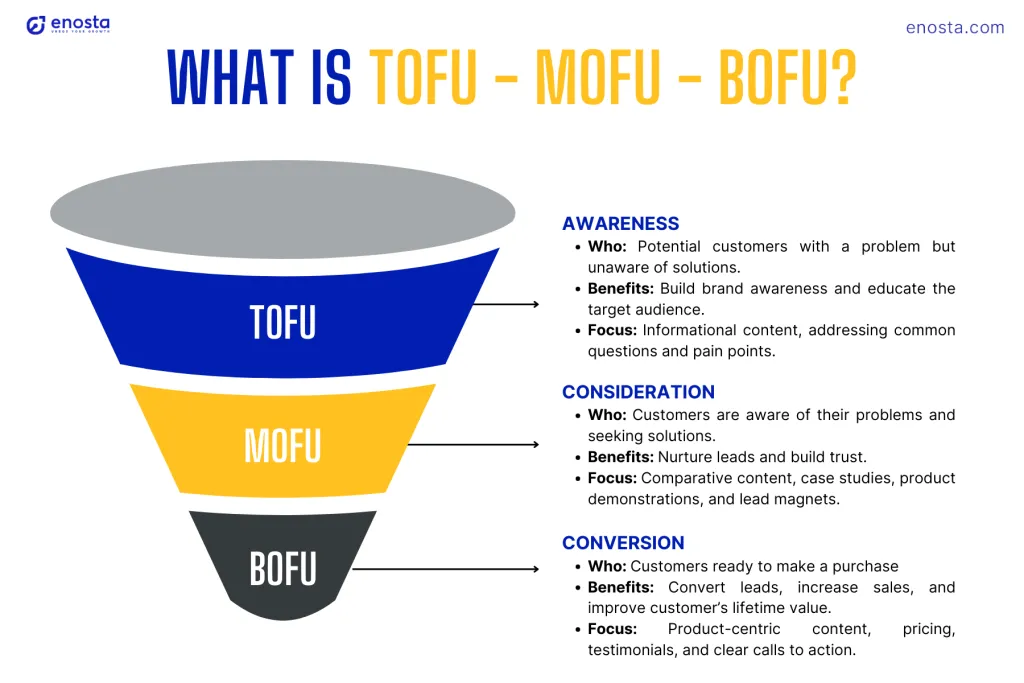
This is the entry point of the customer journey, where they technically enter the funnel. This stage is more about awareness than outright conversion. So, your choice of channels and KPIs reflects that.
Goals:
Common Channels:
Key Metrics:
Here, you’re moving a prospect from awareness to serious consideration. They already know the brand or product. Now, your marketing job is to help them evaluate your offering while building trust through consistent communication and good content.
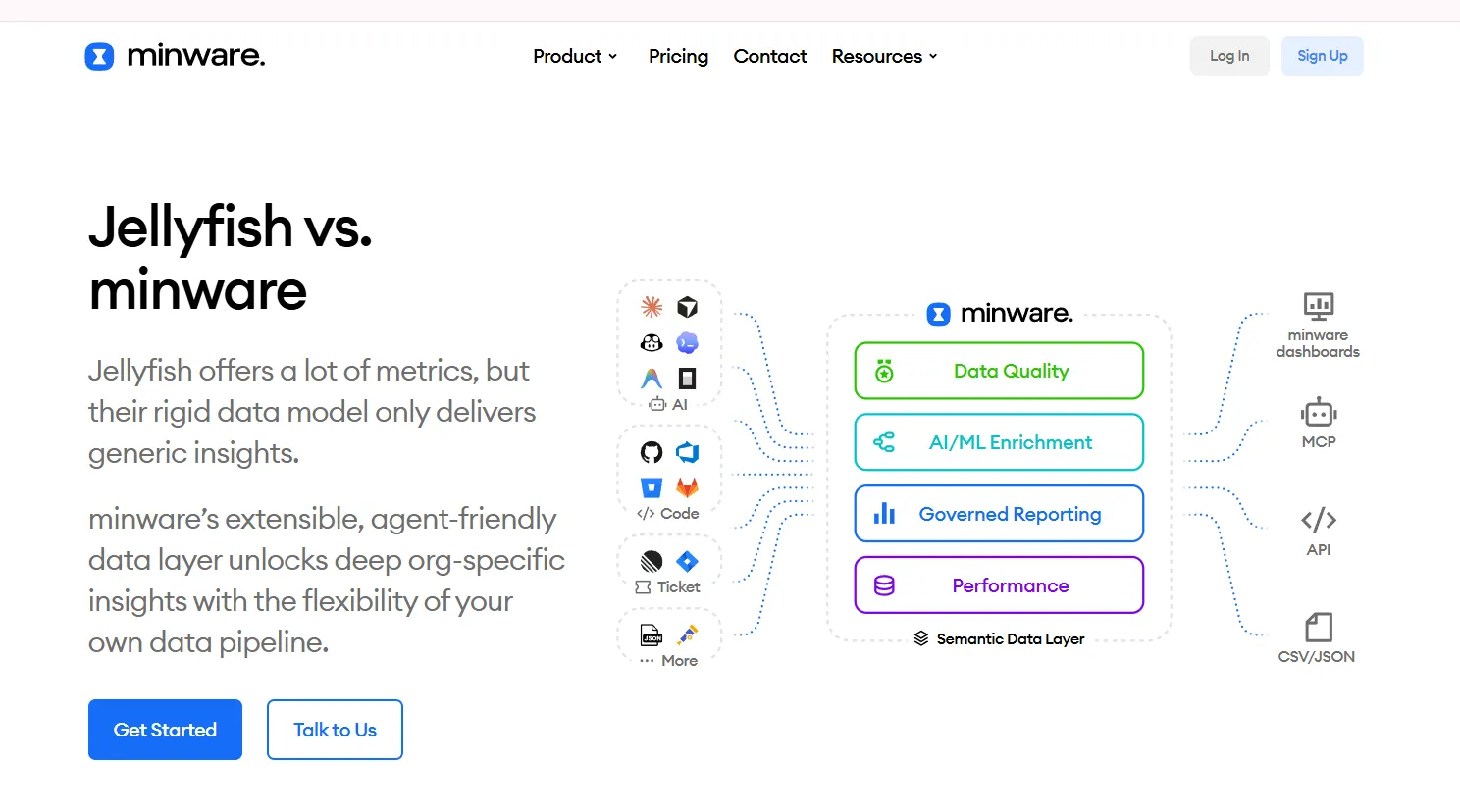
SaaS platform Minware, for example, created this page for people looking for alternatives to the Jellyfish engineering dashboard:
Goals:
Channels:
Key Metrics:
Note: The MOFU stage is what most marketers overlook, even though it can drive up conversions at the final stage. It’s where potential customers drop off because either they’re pushed too early to buy or left too cold to make a decision. As a Reddit user puts it:
“Honestly, the middle of the funnel is where good leads go to die if you don’t have a plan. A lot of teams treat it like “we passed the lead to sales, job done”, but the reality is people often aren’t ready to buy right now. They’re curious, interested, but not urgent.”
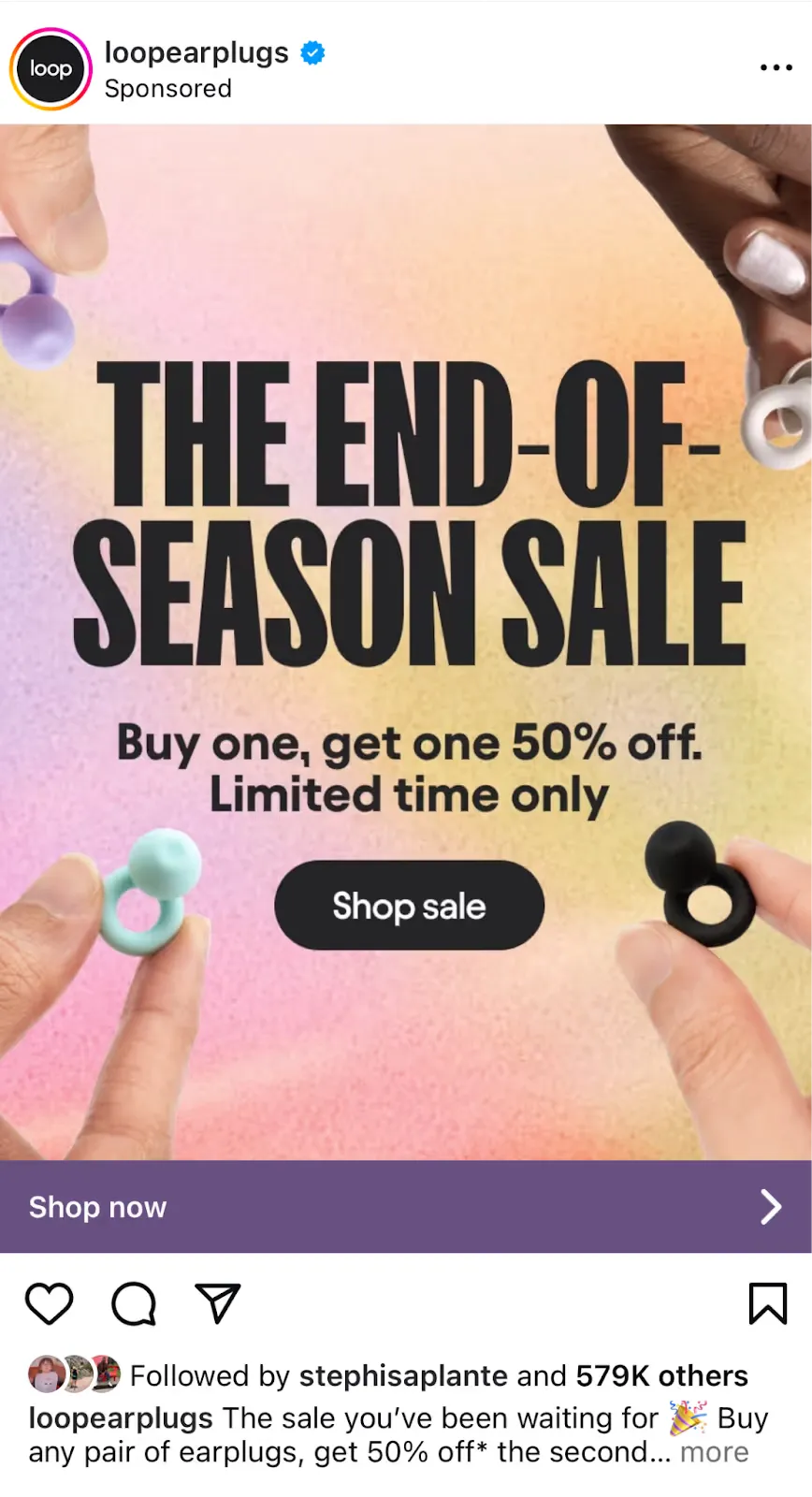
This is where your marketing efforts will bear the ultimate fruit, aka conversion. Here’s where you need strong conversion optimization, effective retargeting, and a seamless website experience that turns intent into sales.
Loop Earplugs offer a solid example with a discount-focused retargeting ad:
Goals:
Channels:
Key Metrics:
Simply put, adopting a full-funnel marketing strategy gives your business a measurable advantage by aligning every stage of the marketing funnel with real customer behavior across the buying journey.
Instead of isolated advertising campaigns with unclear goals and targeting, you create a system that drives consistent growth.
Here’s how that’s just better:
The right framework helps your team structure the customer journey, align marketing and sales, and optimize every touchpoint. There’s no one-size-fits-all for this. Based on your business niche, goals, and budget, you can pick a framework that best fits your situation.
Here’s what most successful marketers typically use:
The AIDA model is one of the most straightforward and practical ways to structure a sales funnel for conversion-focused marketing.
It follows a linear progression: you first capture attention through high-reach channels like display ads and social media campaigns, then build interest through content marketing and SEO to drive website traffic.
As prospects move deeper into the funnel, desire is created through more information (in ads and organic content) that reinforces value and trust. Finally, the action stage focuses on conversion, typically through optimized landing pages, strong call-to-action elements, and frictionless order forms.
When to use it:
Francesco Group, an award-winning UK hairdressing company, used AIDA to launch a new salon. They ran a PR campaign four months ahead of opening to build awareness, used a direct mail campaign offering a free consultation or haircut to generate interest, hosted exclusive local launch events covered by local press and social media to build desire, and placed clear CTAs across Facebook, the website, and local advertising to drive bookings.
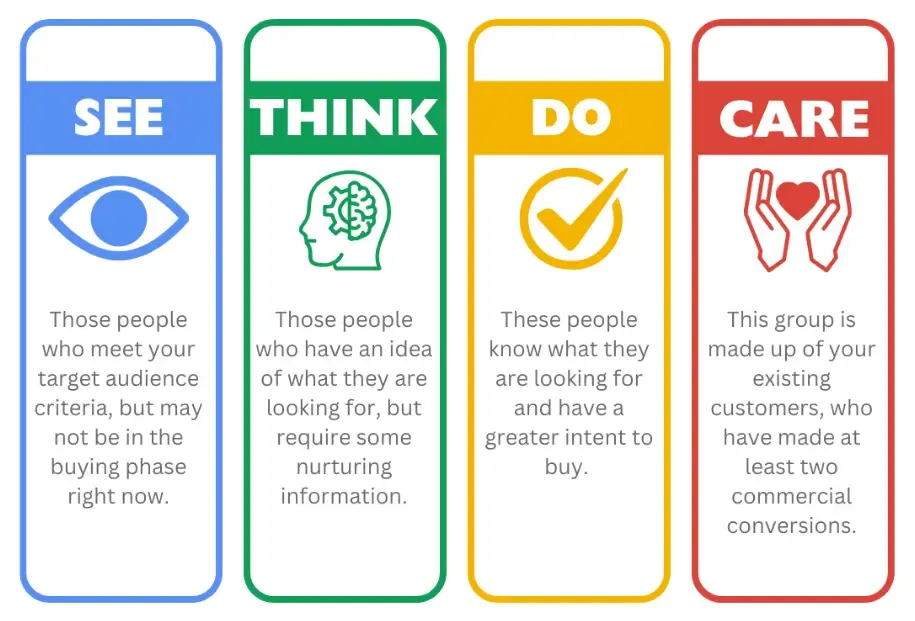
The See-Think-Do-Care framework, developed by Avinash Kaushik, reflects the reality that the consumer buying journey isn’t really linear. Instead of forcing users into a rigid funnel, it segments your audience based on intent.
In the “See” stage, you target the largest possible qualified audience, even those not actively looking. For this, you might use channels like TikTok, streaming TV ads, and programmatic display ads through a demand-side platform like Amazon DSP.
As users move into the “Think” stage, they begin evaluating options. This is where educational marketing content is essential for building trust and increasing engagement.
When users enter the “Do” stage, they become high-intent shoppers, and this is where your ads and content can be more action-focused.
The “Care” stage extends beyond the initial sale and focuses on strengthening customer relationships.
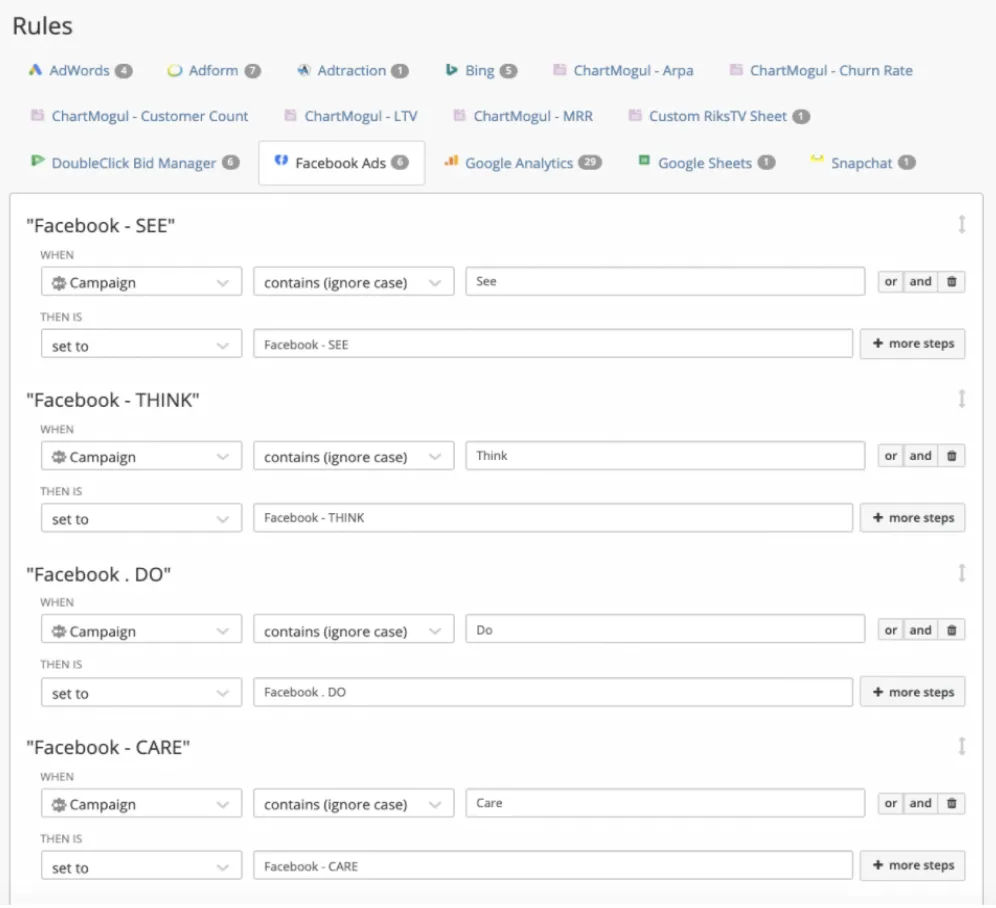
RIKS TV, a Norwegian TV provider, structures their entire customer acquisition journey around See-Think-Do-Care. All campaigns across every platform target one specific section of the funnel, and as their team puts it, "All activity has a purpose, and we label it as such." They built custom dimensions in their reporting platform to group every campaign by STDC stage so they could see budget and performance by funnel stage across channels.
When to use it:
The Jobs-to-Be-Done framework narrowly focuses on intent. It sees the underlying “job” a customer is trying to accomplish and the functional, social, or emotional motivation behind it.
Instead of optimizing purely for conversion, JTBD aligns your marketing strategy with the motivations driving the buying journey.
At the top of the funnel, this means identifying intent signals through SEO and analyzing website data to understand what problems users are trying to solve. In the middle of the funnel, lead nurturing is driven by highly relevant case studies, whitepapers, and webinars that demonstrate how your product fulfills that job. At the bottom of the funnel, messaging becomes outcome-driven, with carefully crafted landing pages and product detail pages.
The classic JTBD case study (Clayton Christensen famously used it) is this:
Basically, researchers studying milkshake purchases discovered a large number were bought in the morning.
Customers wanted a convenient, mess-free, satisfying breakfast they could consume one-handed during a long, boring commute. Bagels and breakfast sandwiches didn’t keep them full or were too messy. This insight transformed how the brand thought about product development, messaging, and store operations.
When to use it:
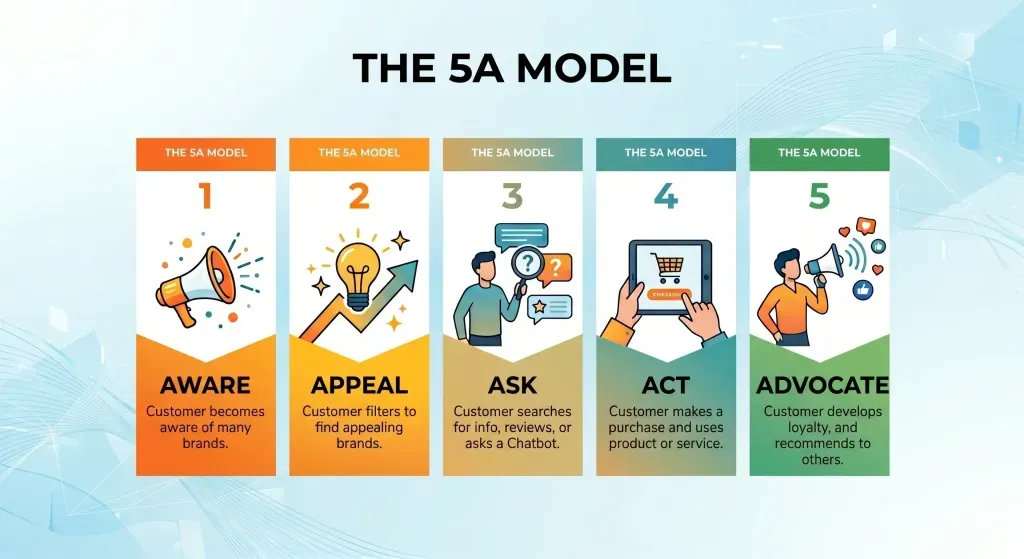
The 5A model, introduced by Philip Kotler, expands the traditional funnel by emphasizing advocacy and customer loyalty. This framework essentially expands the funnel by one more stage, and that’s retention.
It begins with “Aware,” where brand awareness is built through influencer marketing, social media campaigns, and broad-reach advertising campaigns.
In the “Appeal” stage, emotional connection is developed through compelling stories, consistent brand experience, and engaging content.
As prospects move into the “Ask” stage, they actively research and validate their options. This stage can comprise testimonials or detailed blog posts about the product or service.
The “Act” stage focuses on conversion, where optimized call-to-action elements can be incorporated.
Finally, the “Advocate” stage turns satisfied customers into promoters through loyalty programs, referrals, and ongoing customer engagement.
Patagonia builds awareness through environmental activism, appeals to customers with eco-friendly products, encourages questions about its sustainable practices, simplifies the purchase process, and has a loyal customer base advocating for the brand.
When to use it:
The flywheel model, introduced by HubSpot, replaces the traditional marketing funnel with a continuous loop in which growth is driven by customer satisfaction rather than just acquisition. Instead of ending at conversion, the flywheel emphasizes the momentum generated by ongoing customer engagement and retention (similar to the 5A model).
Companies attract users through content marketing, search engine marketing, and inbound traffic, then engage them with lead magnets, email marketing, and retargeting campaigns.
The real differentiator is the “delight” phase, where businesses invest in post-purchase experiences, personalized offers, and proactive communication to increase customer LTV. And it can really work. For example, brands that increase personalization in their loyalty programs see 10% increase in retention.
Then, over time, satisfied customers generate referrals, reducing acquisition costs and improving overall ROAS.
The most authentic flywheel example is HubSpot, since they invented it.
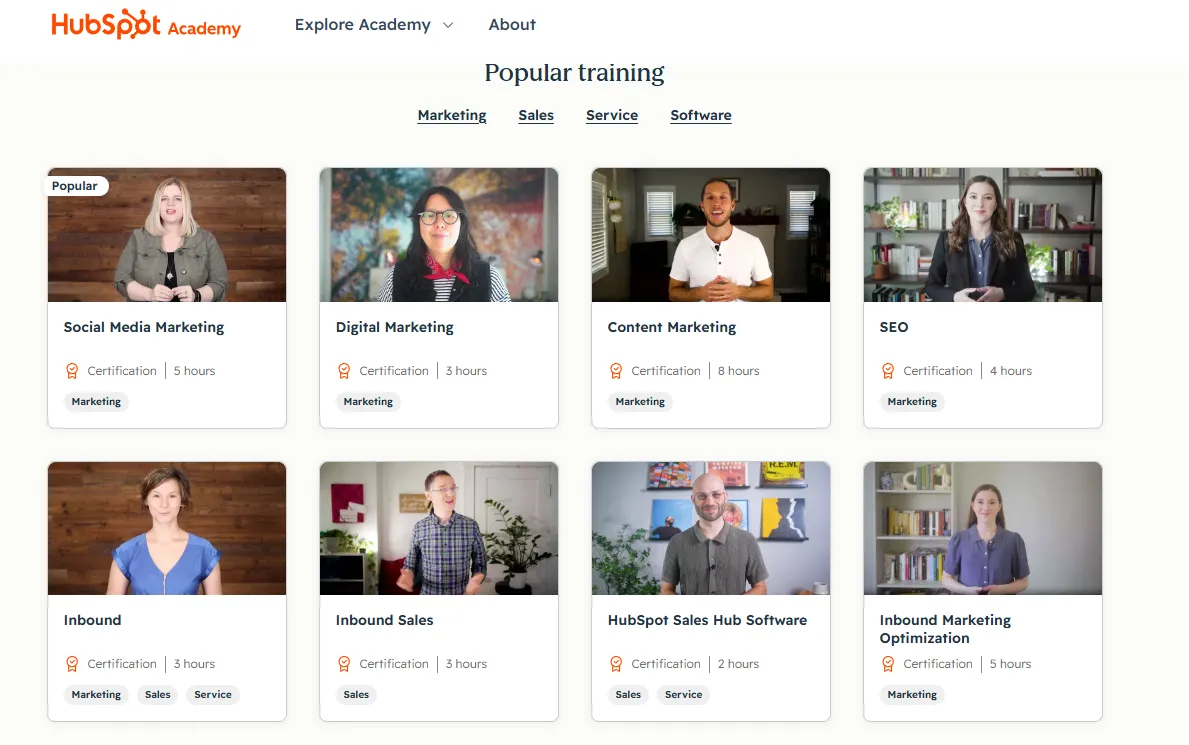
HubSpot, the company that popularized inbound marketing, replaces aggressive sales tactics with educational content (guides, tutorials, and free tools) to attract and retain customers. Their entire HubSpot Academy strategy is education-as-acquisition, where free courses and certifications create a self-reinforcing loop of attracted users who become customers and then advocates.
When to use it:
The next big question is budgeting. How do you go about allocating funds to the channels, campaigns, and activities associated with each funnel?
With budgets sometimes tight, you have to be extra careful with when, how, and where you spend. We’ll discuss all that in the next subsections.
There’s no universal "best" budgeting model. The right one depends on how mature your business is, how predictable your revenue is, and how much scrutiny each line item needs to survive. Here are the three most common options and where each fits.
This is the simplest and most widely used model: you set marketing spend as a fixed percentage of last year’s revenue (or a forward revenue forecast).
Most B2C consumer brands sit in the 8–12% range, while early-stage SaaS companies spend 15–25% or more.
The appeal is obvious.
It’s easy to defend internally, easy to forecast, and it scales naturally as the business grows.
The problem is that it’s fundamentally backward-looking.
You’re sizing future ambition against past results, which means a slow quarter shrinks the very budget you’d need to recover, and a strong quarter can leave money sitting unused on top-funnel channels that have already saturated.
Best for: Mature businesses with stable revenue and predictable growth curves. Avoid it if you’re in a growth phase, entering a new market, or trying to defend share against an aggressive competitor.
This model flips the logic: instead of starting with a budget and figuring out what you can afford, you start with a goal and reverse-engineer the spend required to hit it. It’s the model that aligns most cleanly with a full-funnel strategy, because each funnel stage gets funded according to the specific outcome it’s responsible for delivering.
The math looks like this.
Say your goal is 30% more qualified leads next quarter.
You work backward from your conversion benchmarks:
Each funnel stage then gets a budget tied to a number it has to produce: top-funnel spend funds the traffic target, middle-funnel funds the nurture sequences, bottom-funnel funds the closing channels.
Best for: Teams with clear quarterly KPIs and reliable funnel data. It demands solid attribution and benchmarks; without them, the "reverse engineering" turns into guesswork.
This is the most rigorous of the three. Every line item (every campaign, channel, agency retainer, software subscription) starts at zero each planning cycle and has to be justified from scratch.
Remember: Nothing carries over just because it existed last year.
It’s resource-intensive, which is the main reason many teams avoid it. A full zero-based exercise can take weeks of planning.
But the upside is that it surfaces inefficiencies that other models hide.
A retargeting campaign that’s been running on autopilot for three years and quietly losing efficiency? It dies in a zero-based review. A new TOFU channel that wouldn’t have made the cut under percentage-of-revenue? It can win budget on its merits.
Best for: Mature marketing teams looking to wring more efficiency out of an existing budget, or businesses going through cost pressure where every dollar needs a clear case. Many teams use a hybrid approach, running zero-based reviews once a year and percentage-of-revenue or objective-based for the quarters in between.
A practical note: these models aren’t mutually exclusive. Plenty of mid-sized brands set their total marketing budget as a percentage of revenue, then allocate that pool using objective-based logic, and audit it annually with zero-based reviews. Pick the combination that matches how your team actually plans.
No two businesses should allocate their budget in the same way. Several variables shape how you invest across the funnel.
Channel allocation depends on where your audience spends time and how they move through the buyer’s journey.
Top-of-funnel channels like programmatic, native advertising, Connected TV ads, and paid social are typically optimized for reach and low-cost impressions. These channels drive website traffic and fill the funnel with new prospects.
Mid-funnel channels, such as email marketing, retargeting ads, and content marketing, focus on engagement and lead nurturing.
Bottom-of-funnel channels are where conversion happens. These channels typically command the highest cost per click but deliver the most direct sales impact.
Distribution of budget amongst channels typically depends on business niche, desired outcomes, and their use within the full-funnel. For example, paid social may be used in both the top (awareness ads) and bottom (retargeting ads) funnels, which means it warrants a larger share of the budget.
A common industry benchmark for full-funnel marketing distribution looks like this:
Some brands, typically B2B ones with long sales cycles, split 40-40 between the upper and middle funnels, and dedicate the remaining 20% to the bottom. That’s because they need more marketing to move the prospect through those early stages than to actually convert them.
Don’t overinvest in BOFU. Research says 95% of B2B buyers are not in-market at any given time, meaning over-focusing on bottom-funnel conversion rates limits long-term growth.
If budget allocation determines where you invest, measurement and attribution determine whether your full-funnel marketing strategy actually works. Without the right analytics and attribution model, you risk overvaluing the impact of specific campaigns or even an entire funnel stage.
Effective measurement starts by aligning KPIs with each stage of the marketing funnel.
| Funnel Stage | Primary Goals | Key Metrics | What It Tells You |
|---|---|---|---|
| Top of the Funnel (TOFU) | Build brand awareness, attract audience, drive traffic |
Impressions
Reach
CPM
Website traffic
Video views
Scroll depth
|
Measures how effectively your marketing is generating visibility and capturing attention across early touchpoints |
| Middle of the Funnel (MOFU) | Drive engagement, qualify leads, support lead nurturing |
CTR
Clickthrough rate
Time on site
Engagement rate
Lead quality
|
Indicates how well your campaigns, content, and lead nurturing are moving prospects through the customer journey |
| Bottom of the Funnel (BOFU) | Maximize conversion, generate sales, improve efficiency |
CVR
CPA
ROAS
Revenue per visitor
|
Shows how effectively you’re converting high-intent users into customers and optimizing conversion-focused marketing |
Attribution defines how you assign credit across multi-channel touchpoints in the customer acquisition process.
Last-click attribution gives 100% credit to the final interaction before conversion. While simple, it ignores earlier influences like content marketing or influencer marketing that build intent.
First-click attribution does the opposite, prioritizing initial discovery but overlooking closing efforts like retargeting ads.
We highly recommend multi-touch attribution (MTA). It distributes credit across multiple interactions, providing a more balanced view of funnel influence. For example, a user might discover your brand via TikTok, engage through a blog post, return via email marketing, and finally convert through Google Ads, all of which contribute to the final outcome.
Now, even within MTA, there are different models like time decay, W-shaped, and data-driven attribution. Your choice would depend on various factors like brand type, where the funnel leak is (if there’s one), and your technology stack. You’ll need sophisticated tools for attribution.
Both MMM and MTA aim to measure impact, but they serve different purposes.
Marketing Mix Modeling (MMM) analyzes aggregated data, also including offline channels like DOOH campaigns, to estimate how each channel contributes to overall sales. It’s particularly useful for large organizations with significant brand spend and long sales cycles.
MTA, on the other hand, operates at the user level using website data and first-party data. It’s better suited for digital-heavy marketing environments where you can track individual interactions across different channels and campaigns.
In practice, many companies use both: MMM for strategic budget allocation and MTA for tactical optimization.
Attribution models estimate impact, but incrementality testing proves it.
Incrementality testing measures the true lift generated by a campaign by comparing exposed vs. non-exposed groups. For example, you might pause retargeting campaigns for a segment of your audience to see whether conversion rates drop. If they don’t, you may be over-attributing value to those campaigns.
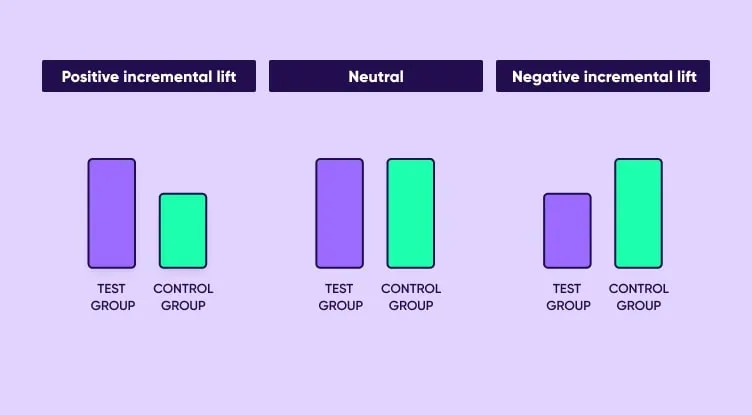
Platforms like Amazon (via Amazon DSP) and AdRoll support these experiments to refine advertising goals and eliminate wasted spend.
On a larger, more complex scale, agency partners can help you with attribution and testing through dedicated teams and tools.
Measurement is only valuable if it informs action. High-performing teams continuously adjust budget allocation based on real-time analytics. There’s essentially a feedback loop between analytics and budgeting for the full-funnel marketing efforts.
If TOFU metrics show strong reach but weak downstream conversion, the issue may lie in MOFU lead nurturing or messaging misalignment. If MOFU engagement is high but BOFU conversion rates lag, optimizing landing pages or call-to-action elements can unlock growth.
Similarly, if BOFU campaigns deliver strong ROAS but website traffic is declining, it’s a signal to reinvest in top funnel channels to refill the pipeline.
Basically, instead of being rigid with budget allocation based on a pre-defined model, you look to data to tweak and shift budget to the stage, channel, or platform that needs it more.
Again, for this to work, you need to track KPIs across the entire marketing funnel and analyze funnel influence. That way, your team can make smarter decisions that improve both short-term response and long-term customer retention.
To plan, execute, and analyze full-funnel marketing frameworks, you’ll need a slew of tools for everything from putting together ad creatives to optimizing website content for SEO to analytics software for measurement/attribution.
A working full-funnel stack typically covers five categories. You don't need a best-in-class tool in every box; in fact, a lot of teams over-tool early and end up with overlapping subscriptions. But, you do need at least one solid option in each.
Many organizations struggle not because of technology, but because of internal execution gaps. You need the right partners, whether agencies, data specialists, or implementation consultants, to operationalize the stack.
This is especially important in organizations with complex internal processes or long sales cycles, where aligning marketing, sales, and data teams is super important.
The takeaway is straightforward: your full-funnel marketing performance is only as strong as the ecosystem supporting it.
And a strong agency partner like Fieldtrip can help create that system to realize the benefits of full-funnel marketing while keeping costs down.
A high-performing full-funnel marketing strategy is about building a system that successfully moves your audience through the entire customer journey, from first interaction to long-term customer retention.
The most effective teams treat the funnel as dynamic. They continuously refine targeting, optimize touchpoints, and reallocate resources based on real-time analytics and performance signals.
But what ultimately separates top-performing organizations is execution discipline. They connect tools, data, and internal processes to eliminate blind spots in customer acquisition, shorten the sales cycle, and improve overall efficiency.
Follow the tips above, and you’ll be able to build a high-ROI full-funnel campaign, too.
A marketing funnel focuses on attracting and nurturing an audience through awareness and engagement, while a sales funnel is centered on closing deals and generating revenue. In a full-funnel marketing approach, both funnels are aligned to create a seamless customer journey.
Top of the Funnel (TOFU) campaigns typically take longer to show direct conversion impact because they focus on brand awareness and early-stage engagement. Most businesses begin to see a measurable lift in traffic and branded search within 4-12 weeks, while the revenue impact may take several months. The timeline depends on your industry, sales cycle length, and execution consistency.
Yes, small businesses can implement full-funnel marketing, but you should start lean by focusing on high-impact channels. For example, combining content marketing, email marketing, and basic retargeting campaigns can cover all stages of the funnel without heavy spend. The key is to prioritize the most relevant touchpoints and scale gradually as resources grow.
To gain buy-in from leadership, tie your marketing strategy to measurable outcomes like customer lifetime value (LTV), pipeline growth, and improved conversion rates. Use analytics and attribution models like multi-touch attribution to prove how TOFU and MOFU efforts influence downstream revenue.
You can identify funnel leaks by analyzing KPIs at each stage of the marketing funnel. For example, a drop in traffic suggests TOFU issues, but high traffic and low conversion indicate a problem with BOFU. Similarly, low engagement points on your website or social media point to MOFU gaps.
%2520(1).png)