






















Most global brands rarely need a full reset, but they do need more frequent realignment than they expect. As your markets expand and product lines shift, your identity typically falls out of sync faster than expected.
Now, a refresh can help you realign without breaking recognition. But deciding how far to go and how to apply those choices across dozens of teams and regions quickly becomes a high-stakes call.
So this article focuses on how a refresh becomes a practical lever inside a global brand strategy instead of a mere cosmetic update. You’ll see where it drives impact and how to judge its scope.
First, let’s keep things simple and start with the basics.
A brand refresh updates your brand identity without replacing its core. It adjusts your visual system, messaging, and experience so they match how your company now operates across regions and channels.
Note: This is very different from a full rebrand, which rebuilds the foundation.
A refresh protects recognition while giving you room to correct drift in assets, tone, or structure. And because even small visual changes touch almost every asset your teams produce, the decision carries operational weight.
Many companies use this tactic.
In fact, 74% of S&P 100 companies rebranded within their first seven years, typically to keep pace with changing expectations.
From our experience working with global brands, it is fairly common for identity systems to fall behind market realities. A refresh offers a controlled path to update the system without disrupting what already works.
You can check out this short video to learn more:
A brand refresh matters in global strategy because it helps you correct misalignment between your visual identity and the way your business now operates across regions, channels, and audiences. As your footprint grows, older signals usually limit how you show up in new markets or across modern digital touchpoints.
After all, a focused update gives you a way to refine your brand message, strengthen relevance, and support performance without disrupting recognition. And this shift can influence how audiences judge credibility and intent.
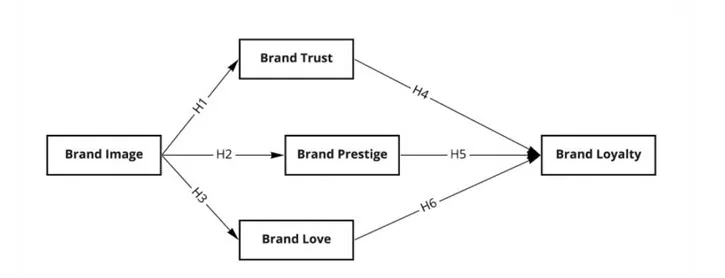
A study of Victoria's Secret showed that an updated brand image increased trust, prestige, and emotional connection. These improvements supported loyalty even if some relationship paths were mixed.
Now that this is clear, let’s move into the pillars that shape an effective refresh.
A strong refresh needs structure, guardrails, and clear decision points. So here are the pillars that help you turn identity updates into operational change across markets and teams.
Staying relevant starts with responding to shifts in behavior, expectations, and market trends. As audience signals change, your tone and messaging, visuals, and framing need room to evolve without breaking what still works. A refresh helps you adjust these elements so your brand story matches how people now evaluate products and experiences.
And because perception shapes outcomes, updated identity work can influence engagement. One study showed that redesigned visuals lifted perceived modernity, engagement, purchase intent, and recall, with recall improvements reported near 90%.
This matters when you face new competitors or need to regain momentum in key markets. It also helps you tighten the link between how you present your brand and how audiences judge credibility and intent.
Modernizing your visual style helps you correct dated elements without replacing the foundation. Updating font types, layout rules, and your color palette brings coherence to channels that didn’t exist when the original system was built.
And because today’s interactions happen across fast-moving digital surfaces, simpler structures usually perform better. Cleaner patterns reduce friction for local teams that need to apply assets at speed, and they help you remove outdated design decisions that slow production.
Mastercard offers a good example because it modernized its visual system by simplifying its iconic red-and-yellow circles for the digital era. They even removed the wordmark entirely after confirming that over 80% of consumers recognized the symbol on its own.
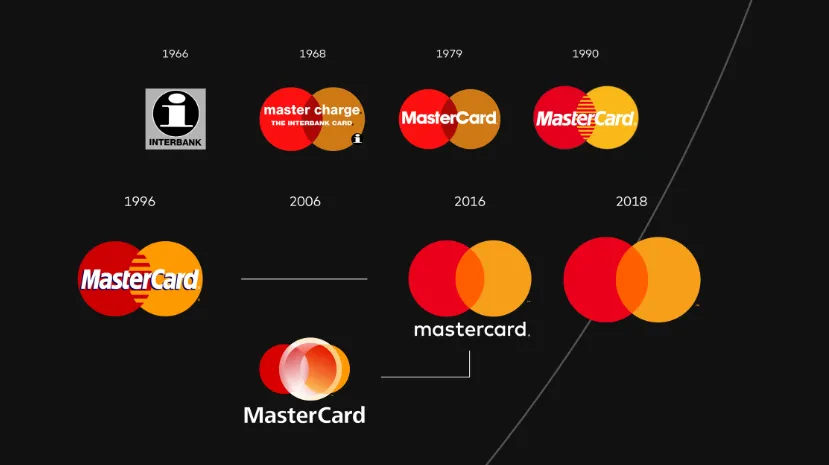
The refresh expanded into a full multisensory brand system, including a new sonic identity designed for consistent use across physical, digital, and voice touchpoints.
A more structured visual brand experience like this also reduces the risk of mixed styling across regions. We’ve seen this perform well especially when teams work with different vendors or legacy templates. So this pillar sets the groundwork for efficiency and consistency across full-scale global branding programs.
A refresh only works when it lands consistently. Slow or uneven rollouts create fragmented signals, especially when teams across regions work with different timelines, asset libraries, or interpretations of the new system.
This is where coordination matters. Fieldtrip’s work with NielsenIQ across 19 countries shows what this looks like in practice. Our team supported local creators, formats, and cultural nuances while keeping the core identity stable.
The approach balanced global structure with local variation so content still felt aligned, even in high-volume programs. We even helped NielsenIQ cut CPA by 37% through performance creative creators.
With a setup like this, your markets can adapt to local expectations without weakening the identity system you’re trying to strengthen. And because global audiences move across channels, consistent framing protects both relevance and recognition.
Inside your company, a refresh creates a second layer of work where teams must shift habits, tools, and decisions. Without guidance, they default to older brand standards or previous templates, which can create a long tail of inconsistency.
So giving people context and direction early is important. And there is evidence that leadership communication shapes adoption. Research shows that when leaders explain the purpose behind the shift, employees are more willing to support and apply the new system.
With this in mind, we recommend clear brand guidelines, a structured playbook, and accessible portals to reduce confusion and help teams update workflows with less friction. This becomes even more important for global teams that manage large brand portfolios or heavy volumes of marketing materials.
Updating your identity system improves digital output by removing outdated elements that slow teams down. Modern files, simplified patterns, and refined brand assets allow faster production because they reduce decision points and rework.
And when your refresh includes stronger logic for hierarchy, color, or spacing, your digital experience becomes clearer across platforms. This has a direct operational impact where teams ship campaigns faster, agencies produce fewer revisions, and creative audits become easier.
We also know first-hand that a refined system can improve compliance significantly because fewer edge cases slip through reviews. In high-volume environments, these savings add up quickly.
With a defined structure, your teams spend less time guessing how assets should look or how messages should be framed. This is where real efficiency gains appear. Fieldtrip’s integrated model (strategy, creative, media, and measurement) gives you a continuous loop for testing and adjusting identity elements in the market.
For example, Fieldtrip’s work with Hurom used live testing across social media platforms to adjust creative signals across formats. This reduced CPA by 60% because performance data shaped iteration cycles.
So a refreshed identity becomes a system you can validate, refine, and scale across regions.
Every identity change brings legal considerations. Updated names, structures, packaging, and image types require review across all active markets. If this process runs without clear sequencing or shared tools, you risk delays, trademark conflicts, or forced rework. A strong refresh program sets a legal pathway early so your rebrand rollout plan stays on track.
We recommend clear workflows and defined responsibilities to avoid missteps and reduce exposure, especially in markets with strict advertising or product-label regulations. So legal planning becomes a core structural pillar.
All of this leads us to our next point.
A brand refresh supports global expansion by giving you a system that stays consistent across regions while still giving markets room to adapt. Clear brand standards, structured identity guidance, and scalable design rules help you adjust elements like colour schemes or framing without drifting from the core.
And because expansion brings cultural nuance and multilingual needs, a strong refresh sets boundaries that protect recognition. Meanwhile, it lets local teams respond to real customer attitudes.
Take it from us: this balance matters more as your footprint grows.
Research on cross-cultural marketing shows the impact of this approach. Brands that localize well tend to see stronger engagement, higher loyalty, and deeper market penetration. That type of lift comes from alignment and not decoration.
Now that the global lens is clear, let’s look at the signals that tell you a refresh is due.
As your markets grow and your channels expand, certain pressure points start to surface. These signals help you judge whether the system that once served you well is now slowing progress.
We advise our clients to check for the signs below to see if a refresh is due:
But you can take care of all of this by following our roadmap, so let's cover that next.
A refresh only works when you treat it as a system rather than a set of design updates. So here are the core steps that help you move from intention to repeatable execution across markets.
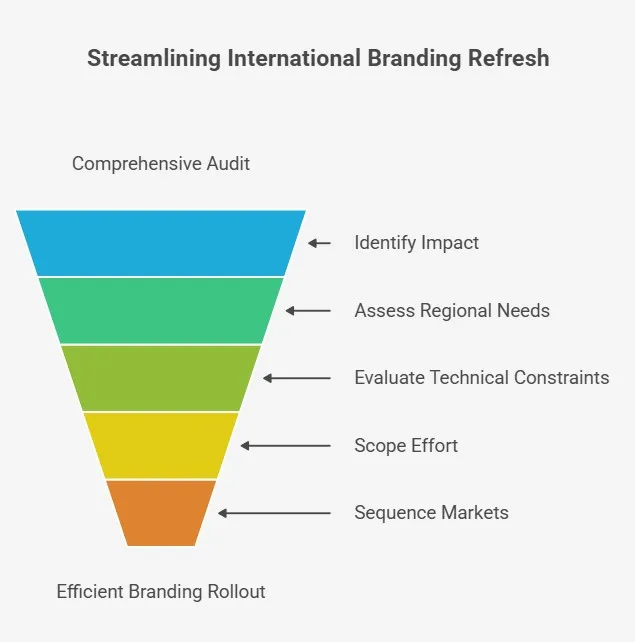
A full audit gives you a clear view of what the refresh will impact. This means reviewing every physical and digital touchpoint across your international branding ecosystem. This includes packaging lines, templates, website modules, regional campaigns, in-store formats, and internal decks.
Even small shifts in typography or layout cascade through these assets and force downstream decisions for teams. And because each market tends to hold its own backlog of materials, the audit helps you see which regions will face the largest lift.
It also shows technical constraints such as outdated files, vendor-created elements, old toolkits, or gaps in your digital asset management (DAM system). With this level of clarity, you can scope the real effort, sequence markets, and judge whether your current tools can support the rollout.
A refresh must anchor to a clear strategic center. Otherwise, execution becomes inconsistent. So this stage focuses on sharpening your brand management strategy.
We advise you to focus on what you promise, who you serve, how you differ, and where you plan to grow.
When you refine your positioning, values, and audience logic, you give your markets a stable “why” behind the change. And because global teams interpret strategy differently, you need simple language that explains the direction without creating ambiguity. This also sets the base for downstream decisions such as tone, hierarchy, and structure.
As a result, creative, legal, and market teams align on the same intent instead of applying their own interpretation.
Trust us; you’ll appreciate this framework because it becomes the backbone of your system and informs the decisions that follow.
Once your strategic core is clear, you can shape the structure that supports it. This covers typography, colour schemes, spacing, motion, iconography, and templates (built around how your teams actually work). So the system must scale across high-volume markets, new channels, and varied formats.
Also, modern identity systems narrow choices and reduce exceptions, which cuts inconsistency and speeds production. After all, many global brands now favor simpler geometry, streamlined logo design, and flexible grids because these elements perform better across digital surfaces.
With this clarity in place, your markets can apply the system without creating drift.
A strong system is only effective when teams know how to use it. So this stage focuses on creating accessible playbooks, guidance, and real examples.
Having a brand refresh playbook becomes the source of truth for decision-making across markets because:
And because global teams usually work through vendors or agency partners, you need simple, direct instructions that minimize interpretation risk.
Pro tip: We advise you to pair playbooks with brand portals, where teams can access templates, guidance, and tutorials in one place. This reduces rework and protects the system as more regions adopt it.
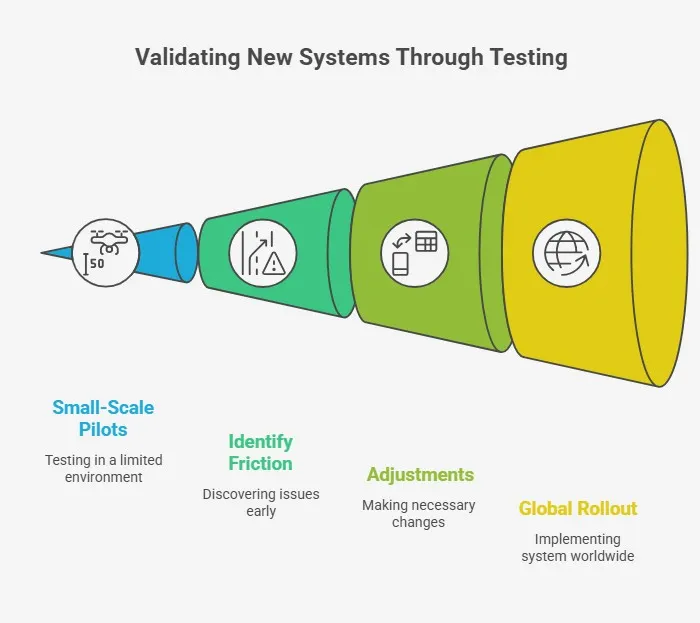
Before you fully release the new system, you need to validate your decisions. This is where small-scale pilots help. You can test identity elements across one market, channel, or format to see how the system performs.
These tests reveal friction early, such as confusing hierarchy, unclear color logic, image styles that don’t scale, or templates that slow production. And because markets vary, pilots show which adjustments are needed before the global rollout.
We do this for our clients at Fieldtrip to reduce risk and strengthen alignment across regions.
With a testing cycle in place, you avoid launching a system that creates new operational problems or fails to support real workflows.
A global refresh cannot launch everywhere at once. So the rollout must happen in waves:
A phased approach also reduces operational strain because teams have time to adapt workflows and tools. And when markets see the system in action, confidence grows.
We recommend this staged model to any international company with varied infrastructure, vendor networks, or approval processes. With clear sequencing, regions follow the same roadmap rather than building their own.
Once the system is in use, measurement helps you understand where it performs well and where adjustments are needed. This includes tracking outcomes such as:
Measurement also helps you spot drift early so you can intervene before inconsistencies spread across regions. And by tying creative signals to media impressions or market response, you refine the system through real evidence instead of subjective opinions.
This step is ongoing because your markets, channels, and audiences change over time. With a strong measurement loop, your refresh remains active.
We’ve created this brand refresh playbook so you can track your progress easily.
A global refresh stretches every part of your system, so friction is normal. These are the challenges that tend to surface first in our experience:
But all of this doesn't need to happen. Here's how we shifted the positioning of Dockers.
Fieldtrip’s work with Dockers shows how momentum builds when storytelling and execution shift together. Once we moved from product-first to creator-led framing, the program delivered over 15M views and strong recall gains through targeted amplification. This proves how a refreshed narrative can scale when supported by real distribution.
Now, let’s look at what strong execution actually looks like.
A strong refresh proves its value through clarity, adoption, and how well it supports growth. So here are examples that show how small, well-judged shifts can reset performance without disrupting equity.
Google shows how small adjustments can tighten global consistency. The brand refined shapes, proportions, and motion rules while keeping the core identity stable.
These changes made the system easier to apply across surfaces and improved clarity at small sizes. And because the updates were built on what people already recognized, the refresh strengthened customer loyalty without forcing a full identity reset.
Mailchimp’s shift shows the benefit of refreshing rather than rebuilding. The team introduced bolder colors, expressive illustration, and a more unified voice, but kept its tone and mascot.
This allowed Mailchimp to grow from an email tool into a broad marketing platform without losing familiarity. The system scaled with new products and created a clearer link between personality and capability.
Burger King modernized its look by bringing back a simplified logo by redesigning flagship stores and packaging, and refining color and typography rules. The update honored heritage while giving the brand a digital-ready structure.
As a result, the identity worked better across menus, apps, and campaigns, which helped the business reach both existing and new audiences.
Fieldtrip helps you move from a refreshed identity to a system that works across every market. Our team combines strategy, creative, media, and measurement so your decisions connect directly to execution.
This starts with research that clarifies what needs to change and how those changes will affect your channels, markets, and teams. From there, Fieldtrip builds identity systems that scale across formats and workflows.
And because global programs depend on real performance data, Fieldtrip tests creative signals in live environments and feeds the results back into the system. Our multi-country work for brands shows how identity choices hold up under volume, localization pressure, and platform variation.
With this structure, you gain a refresh that is easier to apply, easier to measure, and easier to evolve as your markets grow.
Doing a marketing transformation with a brand refresh becomes meaningful when it strengthens how your markets operate rather than just how your assets look.
The value comes from clearer systems, faster production, stronger alignment, and identity choices that hold up under scale and pressure. And as your business expands, this structure helps you adapt without losing coherence.
So if you want a refresh that works across every region and proves its impact, you can move forward with a partner built for that level of complexity. Contact Fieldtrip today to learn how we can help with your brand refresh for your global marketing strategy.