






















For Fortune 500 organizations, agency partnerships are far more than vendor relationships. Agencies are strategic collaborators in the pursuit of measurable performance, sustainable growth, and long-term innovation.
In 2025, the marketing agency industry stands at $182 billion in the U.S. market, and will cross $238 billion in 2030. That means more companies and brands are turning to agencies for marketing, advertising, PR, strategy, recruitment, and more.
But agency partnerships for large enterprises like the Fortune 500 aren’t the same as those for other enterprises. As a large client, you’re typically working with higher budgets, complex communication chains, multi-channel campaigns, multi-brand projects, and big data. That obviously calls for a partner that can live up to the scale and standards you bring.
If you’re an executive at a Fortune 500 company deciding to work with agencies (or are already doing that), you’re on the right page.
We created this guide using our in-house experience, so you can consider it your blueprint to achieve measurable outcomes from those partnerships.
Let’s dive in.
What to read next: Check out the Best Digital Marketing Agencies for Large Companies.
Fortune 500 companies work with a matrix of specialized agencies to scale global campaigns, drive innovation, or tap into expertise they might not have.
In large enterprise settings, agencies are typically used for specific vertices, brands, or products.
For instance, inBeat, the Creator Marketing agency under our Fieldtrip umbrella, has worked with Nestlé, a Fortune 500 client, on creator discovery for Nuun nutritional drinks. We sourced relevant micro-influencers that matched the brand’s brief and delivered a successful enterprise influencer marketing campaign.
Here’s one example:
As a side note, these 50+ creator activations led to a 60%+ TOFU budget capture and 30%+ lift in engagement metrics.
Of course, large agencies like Fieldtrip can also serve as the de facto partners for all things marketing or advertising.
Then, there’s the geographic consideration.
Many Fortune 500 companies operate across different regions and may have regional agency partners or take the global route with a large agency that collaborates with teams in different areas.
Large enterprise partnerships with agencies can be quite layered.
These partnerships typically fall into six categories:
The retainer model is the go-to for large enterprises, where an agency provides continuous services (whatever they’re hired for). However, it’s not uncommon for these companies to partner for one-off projects or specific campaigns.
In fact, in our experience, such projects are the litmus test of an agency's compatibility before committing long-term.
While agency partnerships are essential for Fortune 500 companies striving to innovate performance, they also introduce complex organizational challenges. As enterprise brands manage big budgets, global teams, and extensive media investments, common pain points arise that can impede the value of these collaborations.
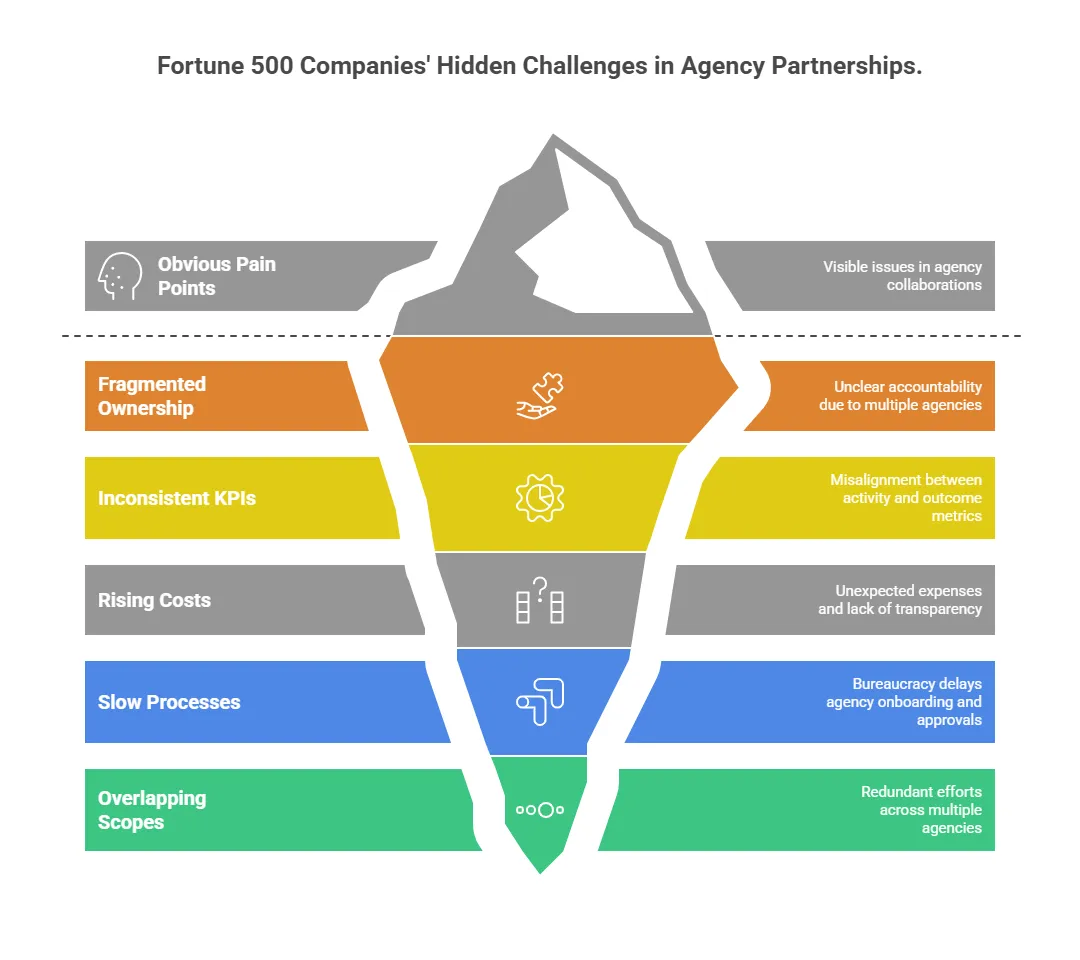
Fortune 500 companies may choose to work with multiple specialized agencies (creative, digital, social, analytics, and SEO) instead of a single full‑service partner. Although this model has its benefits, it can make ownership and accountability difficult.
For example, when one agency handles SEO, and another oversees paid media (Google Ads, paid social), gaps can emerge in how data flows across reporting dashboards, such as Google Analytics or BigQuery.
Besides, the SEO team may not have access to timely data from the paid media team, for example, regarding specific trends. And that means they can miss many keyword opportunities.
That’s a problem we don’t have at Fieldtrip, since our project managers always exchange relevant info to streamline communication between teams.
58% of agency reports are delivered monthly, but frequency alone doesn’t guarantee strategic insight.
For example, many agencies still default to activity‑based KPIs (impressions, clicks, post likes) rather than outcome‑based KPIs (conversion rate, customer retention, ROI estimate). This misalignment frustrates enterprise clients who need clarity on how marketing activities impact business objectives.
By comparison, here’s how our reports look at Fieldtrip:
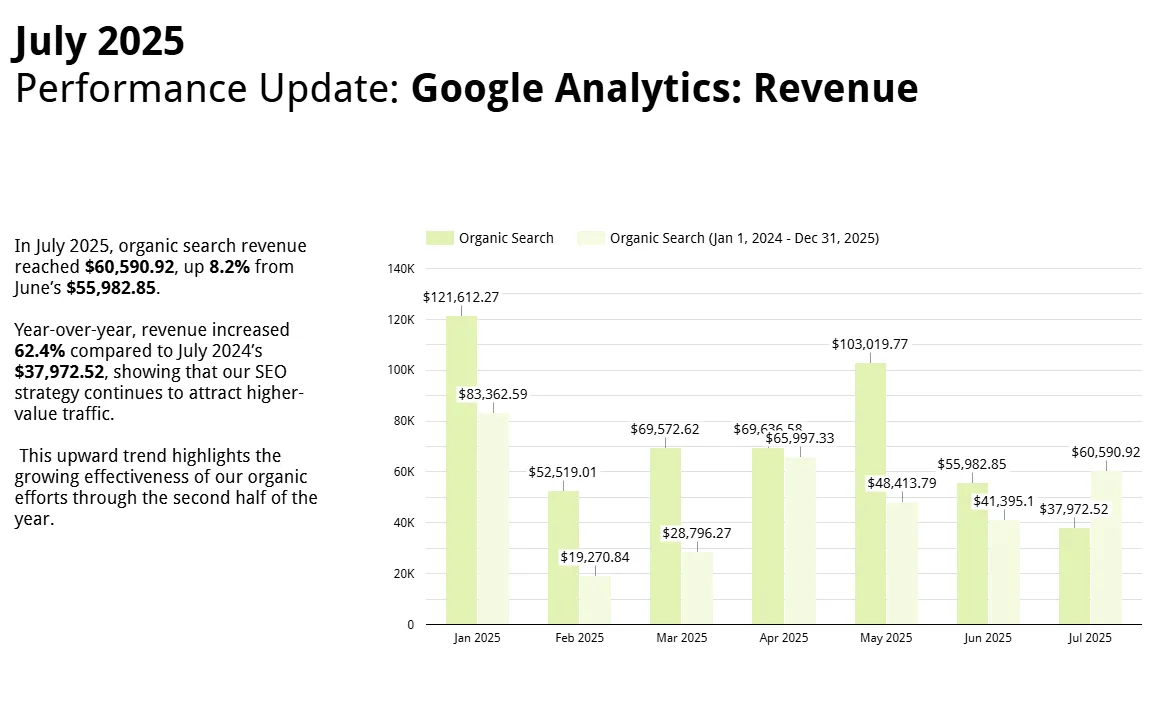
Besides, agencies that lack consistent dashboards and frameworks make it harder for FP500 clients to compare performance across customer-journey touchpoints. They can’t conduct category analyses that matter to strategic decision-makers.
That’s why we encourage our teams to use templates for reporting.
Fortune 500 corporations manage vast organization-wide budgets across global markets. That said, they have limited tolerance for surprises.
In some cases, costs can add up unnecessarily, and clients may (deliberately or inadvertently) be overcharged. That obviously is a deal breaker for any business, let alone a large enterprise with stakeholders to answer to and regulations to uphold.
In one case from the UK, an agency was found to have overcharged its client over GBP 500,000 in third-party services.
Without transparent cost models tied to measurable ROI, even seasoned procurement teams can struggle to justify ongoing spend.
At Fieldtrip, every dollar is accounted for. Transparency is the top priority. We keep costs in check on our end and provide detailed reports to clients that break down service costs in a granular manner.
Large enterprises also contend with bureaucratic processes and compliance requirements that lengthen agency onboarding, contract renewals, and creative approvals.
For example, Fortune 500 clients may require detailed due diligence, market research, and legal reviews before finalizing engagements. These steps, while necessary, slow down responsiveness and reduce agility.
That’s why it becomes important to partner with an agency that has experience with such standardized processes and the patience and cash flow to navigate the long onboarding period.
Multiple partners can introduce redundant efforts. A global campaign might engage one digital agency for SEO and eCommerce, another for content marketing and influencer engagements, and a third for paid social and creative support.
This can dilute accountability and inflate costs without delivering proportionate value unless carefully coordinated through clear swim lanes and shared KPIs.
Choosing an agency that can tackle these rather overlapping marketing/ advertising avenues while still maintaining its specialty is the key.
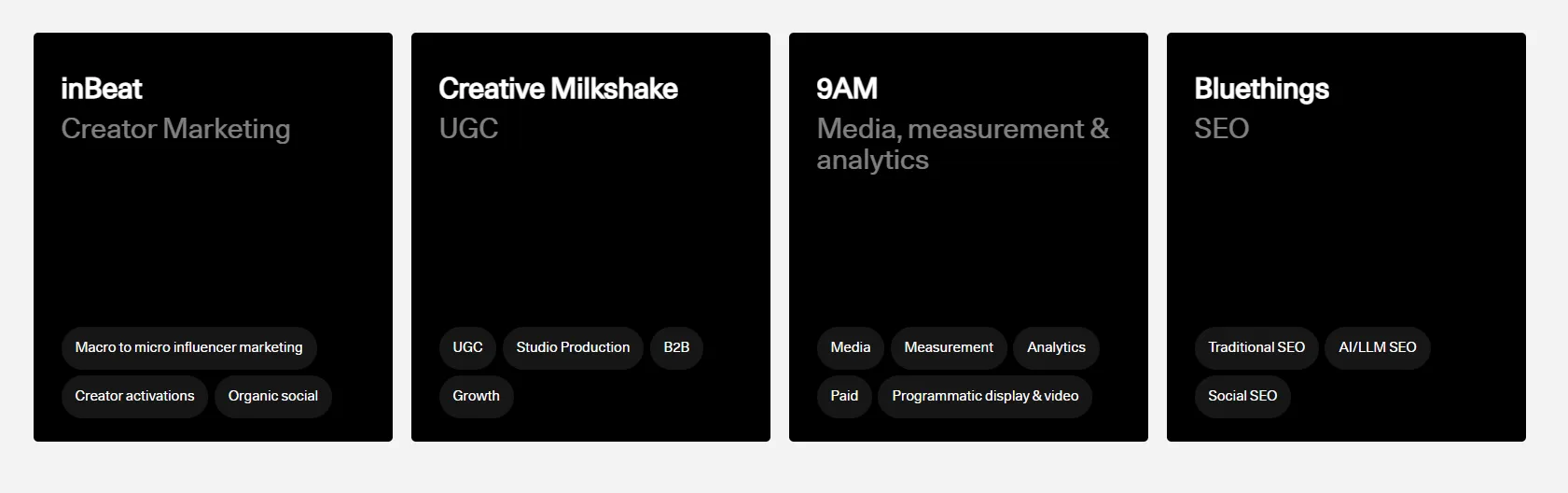
In our experience, maintaining separate units for key services such as paid media, creative strategy, influencer marketing, and SEO eliminates overlaps and budget bleeds. After all, marketing and ad efforts are interlinked. This approach allows us to maintain focus and specialization in individual areas, while also sharing data on progress and providing clients with a single point of contact.
As a reference, the Fieldtrip ecosystem includes:
As a Fortune 500 company, you have several agency partnership models at your disposal. Each model has its pros and cons, but some are clearly better suited to the scale of your traditional and digital media investments.
Let’s look at each closely:
In this model, one agency serves as the primary partner (lead agency), responsible for overall strategy, brand coherence, and coordination across sub‑vendors. This, of course, is typically a large agency with the resources and capabilities to take on a high volume of work that large enterprises require.
A multi‑agency roster breaks work into specialty areas (e.g., performance, creative, PR) with each partner owning distinct parts of the customer journey or linked to different business goals.
How do we solve the multi-agency challenge? Fieldtrip runs an ecosystem of specialty agencies that are their own independent units but also interlinked. That helps us address redundancies, data fragmentation, and communication that typically arise when working with multiple specialty agencies.
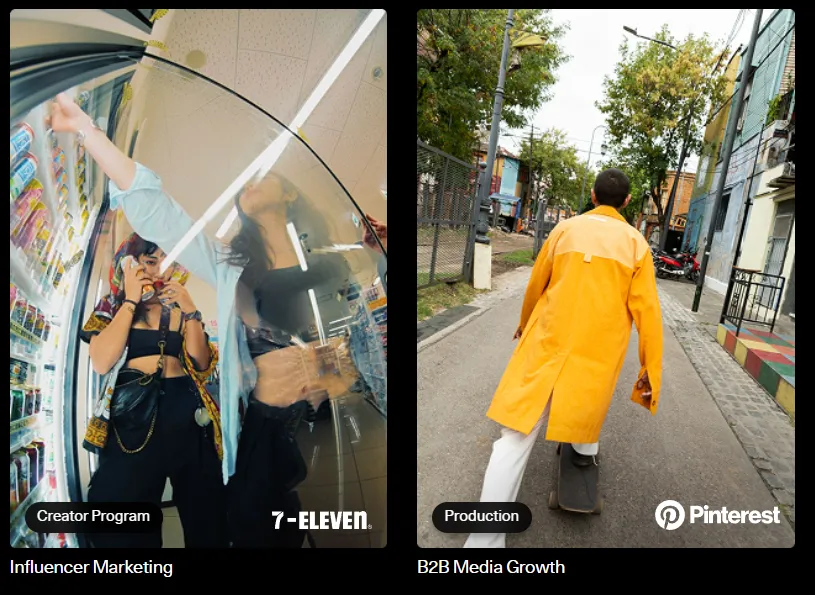
That’s how we can help large clients like Pinterest, 7-Eleven, YouTube, Nestle, and more.
This is a variation on the roster approach, in which agencies are engaged for specific functions (e.g., influencer engagement, PR, creative, analytics, MMM, or syndicated studies) on a project- or campaign-based basis.
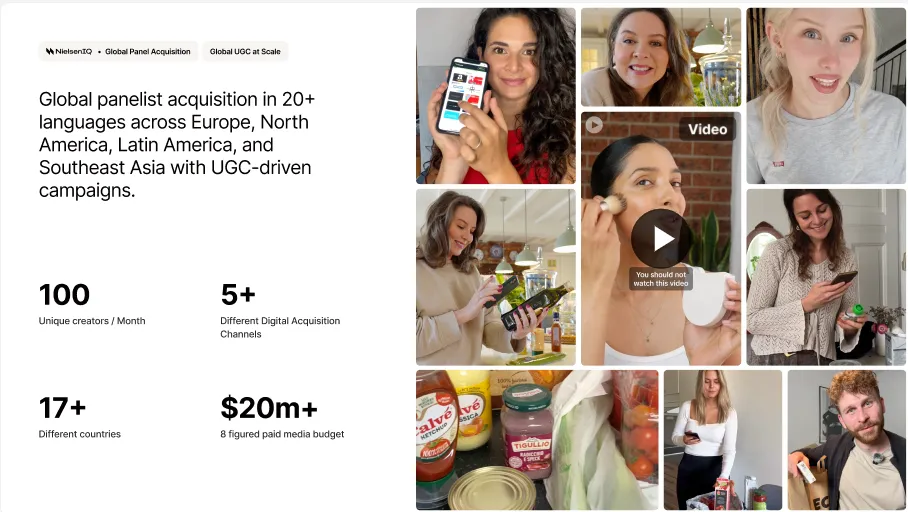
This is the approach some of our clients take. They turn to inBeat Agency for influencer and creator marketing services to tap into our extensive network of creators and take advantage of our expertise in this niche. See our influencer marketing work for brands like New Balance, Hurom, Native, 7-Eleven, and Nielsen IQ.
This blended approach embeds external agencies as extensions of internal marketing teams. The in‑house team maintains control over brand guardrails and strategy, while agencies bring execution horsepower, innovation, and specialized tools.
Hybrid is increasingly becoming the mainstream direction for large corporations because it blends strengths and mitigates drawbacks of purely in‑house or purely external models.
Pros
Cons
When Fortune 500 companies evaluate potential agency partnerships, the stakes are high. After all, you’re making strategic investments that can influence global customer perception, ROI, and long‑term performance.
We advise savvy enterprise buyers to assess potential partners through multiple lenses: services, structure, capabilities, and the ability to deliver on outcomes that align with corporate strategy.
Here’s what to prioritize when selecting or renewing an agency relationship.
First, ensure the agency’s offerings directly support your business strategy and strategic priorities. The agency should have expertise in what it offers.
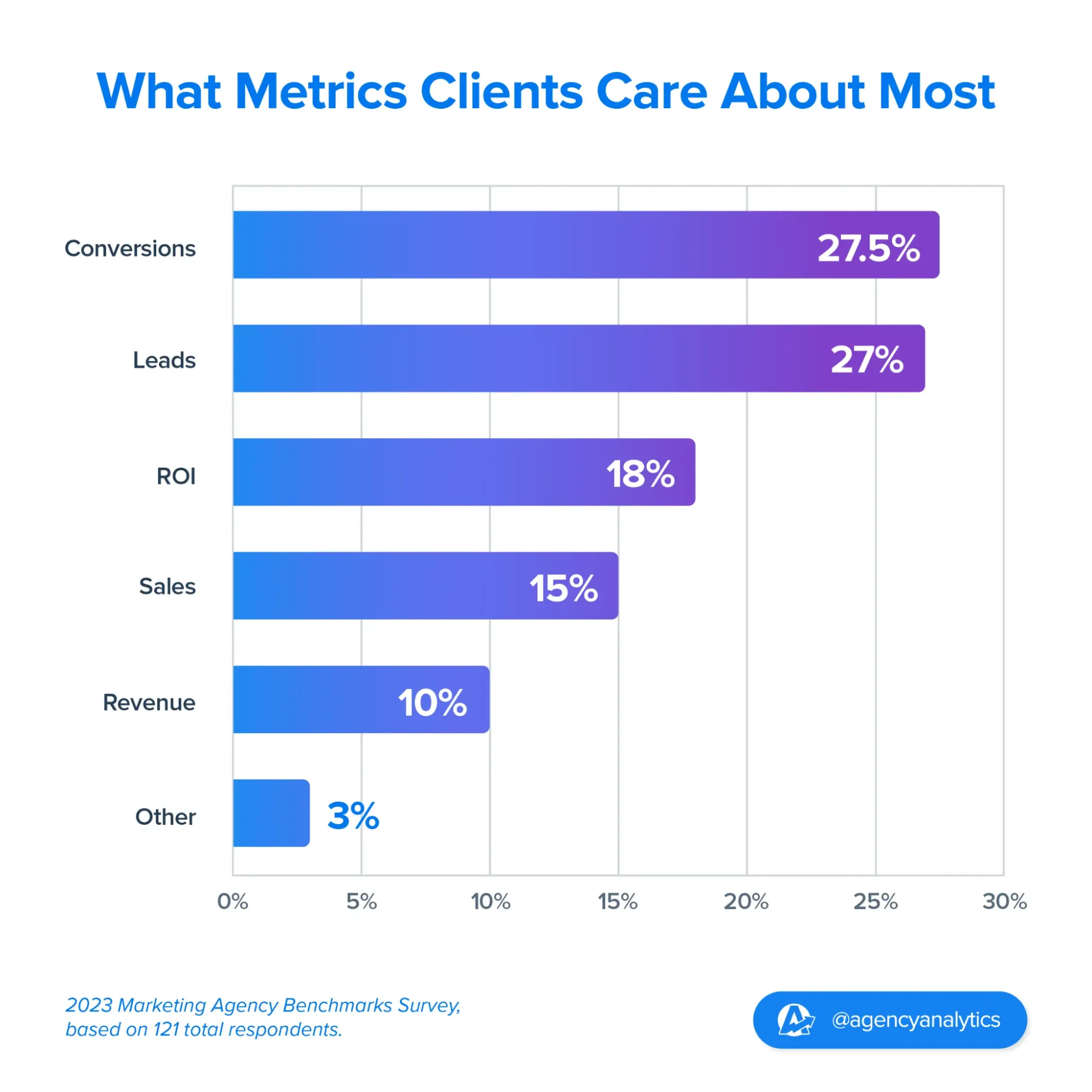
Look for partners that can articulate how they will impact KPIs like conversion rate, lead generation, and customer retention with clear measurement frameworks. Firms that only focus on vanity metrics may fall short of enterprise expectations.
This should become clear with case studies.
Fortune 500 organizations operate across regions, product lines, and business units. The ideal agency partner should mirror that geographic reach and structural maturity.
Similarly, operational maturity separates agencies that execute from those that drive outcomes with strategic moves. That’s an absolute must when partnering with a creative agency for enterprises.
Look for disciplined processes around project governance, timelines, and communication. Agencies should be able to integrate with your internal systems, whether Salesforce, Google Analytics, or other enterprise reporting tools. With those tools and platforms, they should facilitate seamless data flows and eliminate manual bottlenecks.
Regular performance reviews using unified dashboards help maintain accountability and ensure that priorities like analytics and reporting cadence are transparent and effective.
Handling marketing, ads, or PR for a company on the Fortune 500 list calls for a sophisticated tech stack. And your partner’s technical capabilities must match your ambition for digital transformation.
Agencies should show proficiency with advanced analytics platforms, AI‑enabled tools, and big data environments to support a data‑driven strategy.
You need a company with a strong technical foundation to benefit from real‑time optimization and deeper insights across complex data sets.
Plus, this basis makes it easier for your agency to adopt automation and AI in the future. That way, they can accelerate time-consuming aspects of marketing, like research, content production, testing, and distribution.
Fortune 500 companies need transparency in pricing, deliverables, and performance. We’ve already discussed that costs can inflate quickly when working with the wrong partner.
Ask prospective partners how they structure their fees (whether retainers, hourly models, or outcome‑based contracts). And, of course, we advise you to insist on a clear link to performance metrics.
We like outcome‑based contracts because they align incentives between clients and agencies by tying compensation to results.
Transparency also means delivering regular, comprehensive reporting that maps directly to your KPIs and corporate scorecards. Partners who give you only siloed reports by channel miss the bigger picture of enterprise performance.
Don’t accept generic metrics. Define a blend of outcome‑based KPIs (e.g., ROI estimates, funnel conversion rates, customer LTV) and activity‑based KPIs (e.g., creative asset utilization, speed‑to‑market) that tie back to your organizational goals.
Include KPIs that reflect cross‑channel performance, such as how investments in paid media influence organic growth or branded search lift.
A strong partner will co‑develop a dashboard that aggregates these metrics and supports regular performance reviews. That makes your job as an executive at the enterprise easy, too, when you have to report to the C-suite.
In 2024, 40% of companies reported planning to change their agency, according to a survey cited by Search Engine Journal. The reality is that although there’s no shortage of agency partners (especially in advertising and marketing), not all agencies can deliver. And that becomes pretty obvious when it’s a large company.
Knowing when to switch agency partners is just as important as choosing the right one.
Even trusted partnerships can plateau or underperform. We noticed these red flags usually give you early warnings that your current agency may no longer be the right fit:
Now that you understand the complexities and nuances of agency partnerships for a Fortune 500 company, you’re in a position to make the right decisions.
If you need an agency partner that fits the bill when it comes to enterprise-scale projects in paid media, creator marketing, SEO, and growth strategy, Fieldtrip is the answer.
We have the capacity and expertise to integrate well with enterprises across industries and verticals. Even though we offer a wide range of services, we’re the farthest thing from a ‘generalist.’
How? We’ve pioneered the ‘divide and conquer’ agency model with multiple sub-agencies with agile teams that activate unparalleled expertise and seamless collaboration. And that’s what works for corporations.
And our past work with names like Nestle, Meta, Marvel (Disney), and YouTube proves we have what it takes.
So, let’s get in touch and talk strategy because we really do mean business!
It’s best to partner with agencies when internal teams can’t scale campaigns, drive innovation, or handle data complexity. It’s especially useful for large media investments, digital transformation, and advanced analytics work.
Yes. Global agencies provide local expertise, scalable marketing strategies, and unified reporting across regions that are key to international campaigns.
Monthly retainers may start at $10,000+, depending on services like SEO, paid social, content marketing, and market research. Expect more for strategy or custom work.
Use directories like Clutch.co, ask peer companies, or consult firms like Forrester or the American Marketing Association. Look for real ROI in their case studies.
Fieldtrip builds creative systems for the growth of both small and large-scale enterprises. We specialize in creative strategy, influencer marketing, user-generated content, SEO, podcast production, and analytics for performance marketing.
At Fieldtrip, we cater to a wide range of industries, including but not limited to retail, SaaS, automotive, sports industry, travel, consumer goods, and healthcare.
Fieldtrip, particularly its creative marketing division, inBeat Agency, has worked with Fortune 500 companies like Nestle, Meta, Disney, YouTube (Alphabet), and Seven & I Holdings Co. (parent company of 7-Eleven).