






















Marketing shared services work when the central team owns repeatable operations and business units keep decisions that require local judgment.
This balance matters when budgets are tight: Gartner’s 2026 CMO Spend Survey found that 56% of CMOs lack the budget to deliver their strategy.
Centralize media operations, production workflows, data taxonomy, and reporting where shared processes improve efficiency. Keep positioning, campaign ideas, audience strategy, and budget timing with the teams accountable for each market’s results.
Funding should reflect that split: cover core platforms through overhead and charge variable work at agreed rates.
Friction starts when the central team makes decisions without understanding the market, or business units request work without seeing its cost.
In this guide, we’ll explain how to divide responsibilities, compare three funding models, measure performance, and decide when to bring in an external specialist.
A shared services model in marketing is an arrangement in which a central team provides defined services to multiple brands, regions, or divisions. These business units act as internal clients, requesting work through agreed processes while retaining responsibility for their market priorities and business results.
The central team handles repeatable work, such as campaign setup, asset production and reporting. Clear service agreements establish what it delivers, how teams request support and who approves the output.
Three elements hold the model together:
Consider a multi-brand company where each brand uses separate reporting templates and negotiates with the same production vendors. A shared services team can consolidate reporting and vendor management while each brand retains control over its messaging.
Examples include creative production studios, media operations teams and shared measurement functions:
Many companies already have internal capabilities they could organize this way. The ANA’s 2023 in-house agency study found that 82% of surveyed members had an in-house agency, compared with 42%. However, an in-house team becomes a shared service through defined processes and service agreements for multiple business units.
Shared services define how internal teams receive support, centralization defines where capabilities and decision-making authority sit, and outsourcing defines who performs the work.
A company can combine all three in one marketing operating model.
| Model | Marketing example |
|---|---|
| Shared services | A production studio serves several brands through agreed briefs, deadlines and quality standards. |
| Centralization | One central media team controls campaign budgets and channel allocation across regions. |
| Outsourcing | An external agency manages paid search for the company. |
When designing the model, specify who sets priorities, approves briefs, controls budgets, and accepts completed work.
Marketing shared services must accommodate differences in audience response, brand positioning and competitive conditions. HR, finance and IT also require local adaptations, but standardizing a marketing process does not mean the same campaign will work across markets.
A central studio can use one production workflow across regions, while local teams adjust the offer, messaging and imagery. Service agreements should define where those adaptations enter the process and who approves them.
Sort each marketing function with two tests.
High standardization and low judgment belongs in the shared service. Low standardization and high judgment stays in the business unit. Everything in between needs a written shared decision or an SLA.
| Marketing function | Centralize in shared service | Business unit owns | Shared decision or SLA needed | Main risk if misplaced |
|---|---|---|---|---|
| Media buying and ad operations | Platform access, account structure, negotiated rates, brand-safety controls, trafficking | Audience strategy, budget level and phasing, channel priorities for its market | Budget change lead times, approval thresholds, weekly optimization handoff | Decentralized buying duplicates contracts and loses rate advantage; centralized strategy misses market timing |
| Creative production | Asset adaptation, versioning, templates, design systems, production vendors | Positioning, campaign ideas, local insight, final creative approval | Shared quality standards, brand guardrails, turnaround per asset type | Centralized judgment produces generic work; decentralized production multiplies cost and inconsistency |
| Measurement and reporting | Data pipelines, taxonomy, attribution models, dashboards, tool contracts | The questions asked, the decisions taken on the answers | Naming conventions, data access, request intake for new analyses | Business units build shadow reporting; central team reports numbers nobody acts on |
The table reflects the standardization and judgment tests described above; the assignments are our recommended defaults, not measured industry norms.
Media is the clearest case for centralization because the mechanics are the same across brands. One account structure, one set of negotiated rates, one approach to brand safety and one trafficking process remove the most visible duplication. What should stay with the business unit is anything tied to its P&L: which audiences matter this quarter, how much to spend, when to spend it.
Central teams are still building this capability: the same ANA study found that 54% of in-house agencies handle some media planning or buying, and marketers who had not brought media in-house described it as too complex.
Take a hypothetical regional setup: a central team builds the paid search account structure and negotiates rates, while each regional brand sets its own budget and seasonal priorities, with a weekly handoff documented in the SLA. Fieldtrip's media team plans and buys side by side with the strategy and creative teams that direct the work.
Creative is where centralization mostly goes wrong, because leaders centralize the wrong half. Production, adaptation, templates, and the design system scale well and benefit from one standard. Positioning, campaign ideas and local insight do not, because their quality is judged by an audience the central team may never meet.
Keep those in the unit, and give both sides a shared quality bar that central production is measured against. Fieldtrip separates brand creative from design systems and identity for the same reason: the idea and the system that carries it are different kinds of work.
Measurement follows the same pattern. Pipelines, taxonomy, attribution models and dashboards should be built once, because competing definitions of a conversion make every cross-brand conversation an argument about data that stalls the decision.
The business unit owns the questions and the decisions that follow. A central team that decides what to ask on the unit's behalf drifts toward reporting that is technically correct and commercially irrelevant.
Fill this table for your own organization and mark every row where both sides claim ownership. Those rows are the SLAs to write first.
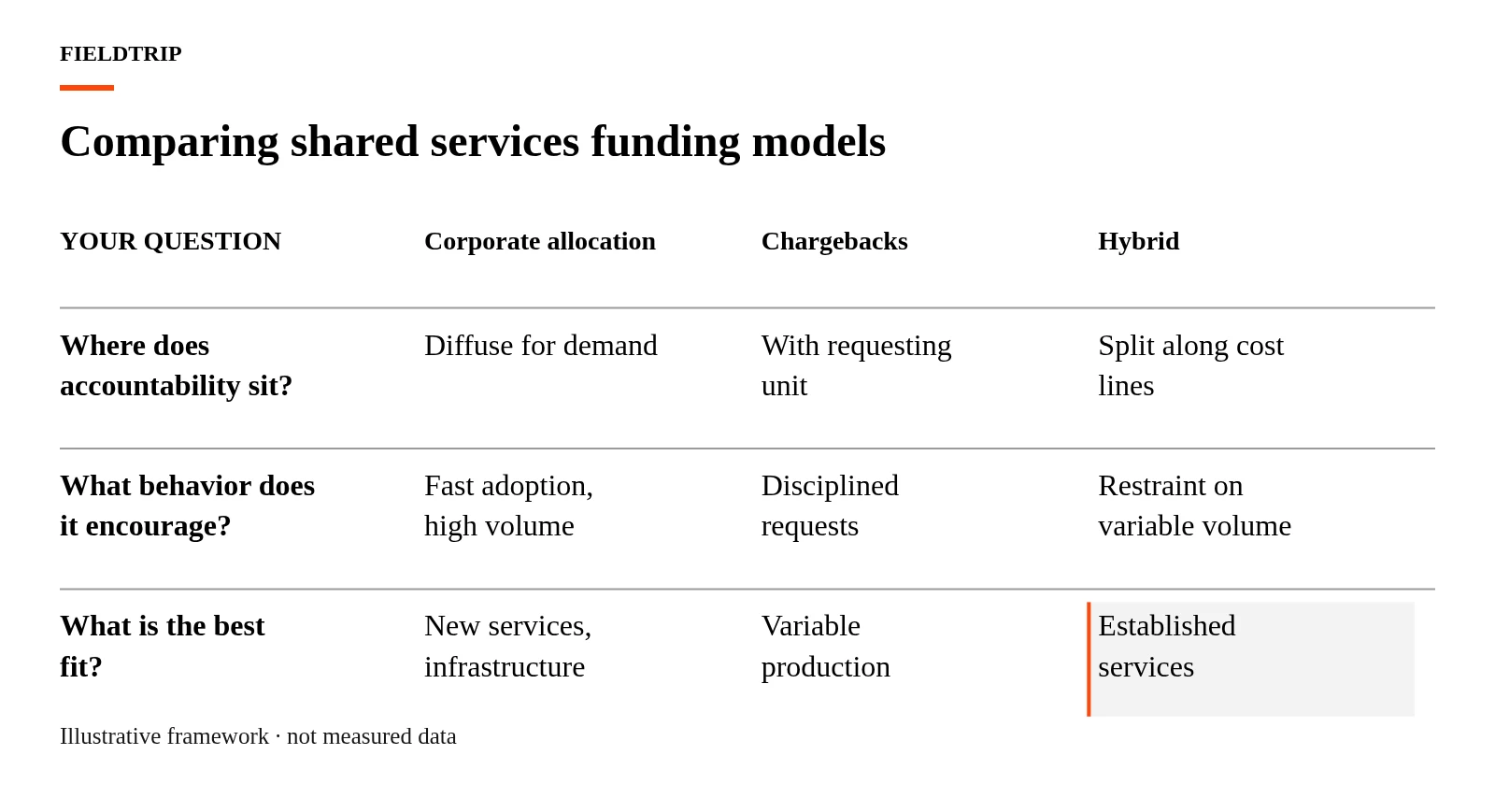
Fund marketing shared services with corporate allocation, chargebacks, or a hybrid of the two; most mature setups pay for core platforms centrally and charge back variable work.
The funding question is about accountability: who feels the cost of a request, and who answers for the cost of delivering it.
| Funding model | How it works | Where accountability sits | Behavior it encourages | Best fit |
|---|---|---|---|---|
| Corporate allocation | Central budget pays for the team; cost is spread across units by a formula or absorbed as overhead | With the central team's leader for cost; diffuse for demand | Fast adoption, high request volume, little prioritization by units | New shared services, infrastructure and standards, organizations with few units |
| Chargebacks and internal pricing | Units pay an internal rate per deliverable, hour or campaign | With the requesting unit for demand; with the central team for rate and delivery | Disciplined requests, comparison against external options, some friction | Variable production and media management across many units |
| Hybrid | Core platforms, data and standards funded centrally; variable work charged back by volume | Split along the cost line, written into the SLA | Adoption of shared infrastructure plus restraint on volume | Most multi-unit organizations once the service is established |
The comparison describes operating logic and typical behavior; it carries no cost or savings figures, which vary by organization.
Allocation is the simplest model to run and the fastest route to adoption, because the service feels free to the people using it. That is also its weakness. Demand grows without discipline, the central team queues work it cannot prioritize, and the business units blame it for slowness while adding requests.
In-house agencies show the pattern: in the ANA study, 88% said their workload grew over the past year, and their top challenges were managing workflow, scaling resources and prioritizing projects.
Allocation suits the parts of the service you want everyone to use without hesitation: platforms, data infrastructure, and the standards that make cross-brand comparison possible.
A chargeback model prices the service, typically per deliverable, per hour, or per campaign. It creates accountability on the demand side because a unit that orders forty variants sees the cost of forty variants. It also lets units compare the central team against external providers, which keeps the central team honest about quality and speed.
Running it has a cost of its own. Someone has to maintain a rate card, issue internal invoices and handle disputes, and finance teams in different units may argue over allocations for months. In our judgment, a chargeback system rarely pays for its own administration below several business units or a few million in annual marketing spend.
A hybrid model funds shared capabilities centrally and charges units for defined variable services. It works best when teams can clearly distinguish baseline support from additional work.
For example, central funding could cover measurement infrastructure and dashboard maintenance. Business units could then pay agreed rates for campaign asset adaptations beyond a baseline allowance.
That boundary needs to be explicit. Otherwise, units may challenge additional charges while the central team struggles to recover delivery costs.
Whatever the funding mix, agree on three governance rules:
Map each cost category to a funding method. Record what business units receive, what triggers an additional charge, and who approves changes.

Measure the ROI of centralizing marketing operations by comparing verified financial benefits with the full cost of implementation and delivery. Establish a baseline before launch, then track total costs, delivery performance, and business outcomes. Faster production and better reporting support the business case, but they do not automatically represent financial returns.
For a defined period, calculate:
ROI (%) = [(Financial benefits − Total costs) ÷ Total costs] × 100
Financial benefits can include verified avoided costs and attributable incremental profit. Total costs should include setup, transition, and ongoing delivery. Use the same period for both sides of the calculation and avoid counting the same benefit twice.
Before launch, inventory platform contracts, tools, vendor fees, and staff time across the business units. Identify genuine duplication, such as equivalent subscriptions or reports rebuilt separately.
After launch, compare the cost of delivering equivalent work at comparable volume and quality. Include:
A lower central budget does not establish a saving if business units take on additional work. Likewise, time released creates capacity; it becomes a cash saving only when spending actually falls.
Track delivery performance by request type so simple adaptations do not distort comparisons with complex campaigns.
Measure:
Track changes in scope separately from avoidable corrections. If delivery slows, investigate request volume, staffing, approval delays, and brief quality before attributing the problem to the funding model.
Record how shared services support budget reallocations, creative changes and channel decisions. For each example, document the evidence provided, the decision owner, the action taken, and the resulting outcome.
For instance, a shared reporting team might identify an underperforming channel and support a budget reallocation. Record the subsequent performance change, while accounting for other factors that could explain it.
Include business outcomes in financial ROI only when their contribution can be reasonably established. Report other improvements, such as stronger data consistency or faster decisions, separately.
Set the baseline before launch and review results quarterly. Assess financial return alongside delivery performance and business impact to see where the model creates value and where it needs adjustment.
Yes. Business process outsourcing (BPO) means contracting an external provider to perform a business process. Shared services means organizing services for multiple internal business units.
The two can overlap: a shared services team may outsource parts of its delivery while retaining responsibility for service standards and internal relationships.
Managed services typically involve ongoing responsibility for a defined operation.
A specialist agency provides expertise or creative work within an agreed scope. These arrangements can support the same central marketing team.
| Arrangement | How delivery works | Marketing example | What to clarify |
|---|---|---|---|
| Shared services | A central function coordinates services for multiple internal units | Shared media operations, production and reporting | Service scope, priorities and decision rights |
| BPO | An external provider performs a contracted process | High-volume asset versioning or campaign trafficking | Quality controls, exceptions and retained responsibilities |
| Managed services | A provider manages an ongoing operation against agreed service levels | Platform administration or analytics operations | Performance targets, access and continuity |
| Specialist agency | An agency supplies expertise for defined projects or ongoing work | Campaign concepts, brand creative or specialist channel support | Deliverables, approvals and integration with internal teams |
Choose according to the work’s requirements. Repeatable tasks with clear specifications may suit external process delivery. Activities requiring frequent business decisions need close internal involvement, even when a provider performs the work.
An external specialist can address a capability gap or temporary capacity shortage while the central team continues to coordinate delivery.
For example, central media operations could manage platform access, tracking and reporting while a creative agency develops campaign concepts. Define who briefs the agency, approves its work, and adapts the concepts into final assets.
Start with a specific problem and measurable expectations. Expand the scope when the results justify it.
Compare equivalent scope, quality, and turnaround times using the total cost of delivery. An internal chargeback rate provides a starting point, but check which costs it includes before comparing it with an agency quote.
Assess both options against the same criteria:
Set these criteria before reviewing proposals or renewing contracts. The decision should show where external support improves delivery and what responsibility remains with your team.
Set up marketing shared services in four steps, in this order:
Fieldtrip is built to sit inside that structure. Small specialist teams for strategy, creative, media and measurement work under shared strategy and common quality standards, and an engagement can begin with one defined problem alongside an existing internal team or agency roster.
A brand with a central production studio might use an external specialist for campaign ideas while keeping measurement standards central.
The next experiment is small. Choose the single function where central and unit ownership is most contested, pilot an SLA there for one quarter, and review the cycle time and the decisions it influenced before extending the model anywhere else. If you want a specialist team on that pilot, talk to Fieldtrip.
There is no reliable threshold, and we would distrust any precise one. The model pays when duplication is visible: several units holding the same platform contracts or rebuilding the same reports. Two or three brands can share infrastructure through allocation.
Detailed enough to settle the rows in the function table where both sides claimed ownership, and no more. Cover intake, turnaround by request type, quality checks, approval rights, escalation owners and review dates. A document that fits on a page gets used; one that needs a lawyer to interpret gets ignored.
Yes, within rules. A central team that cannot decline becomes a queue under allocation funding. Give it the right to refuse work outside the standardized-service definition or to route it to an external specialist, with the decision logged and an escalation path to the operating committee so a unit can challenge the refusal.
Keep the idea in the unit and the system in the center. Production works from each brand's positioning and approved campaign direction. Review a sample of outputs across brands each quarter and ask whether a customer could tell them apart.