




















Too many brands invest heavily in media without knowing what their campaigns are doing for their long-term brand health. Are those campaigns actually increasing brand awareness? And beyond campaigns, does your offering leave a good impression on consumers?
Brand tracking helps answer these questions by revealing whether your media spending is making an impact.
It helps you understand how audiences see your brand before, during, and after media activity. It also shows whether paid search, social, video, retail media, and connected TV are actually moving the metrics that matter beyond immediate performance.
Remember, a campaign can generate clicks but also weaken brand equity, or it could deliver short-term conversions without improving future demand. In addition to measuring campaign performance and overall media spend, you should also consider brand tracking to understand the big picture.
Side note: Brand tracking heavily relies on data and a clear measurement system. Fieldtrip’s measurement services help you build a system to track your brand's performance and media impact among your consumers.
Brand tracking is a structured research process that continuously measures how your brand performs in your target audience's minds
But that’s just the technical definition. For media teams, it should do more than monitor consumer perception. Good brand tracking turns audience insight into practical inputs for marketing strategy, channel planning, creative decisions, and media buying.
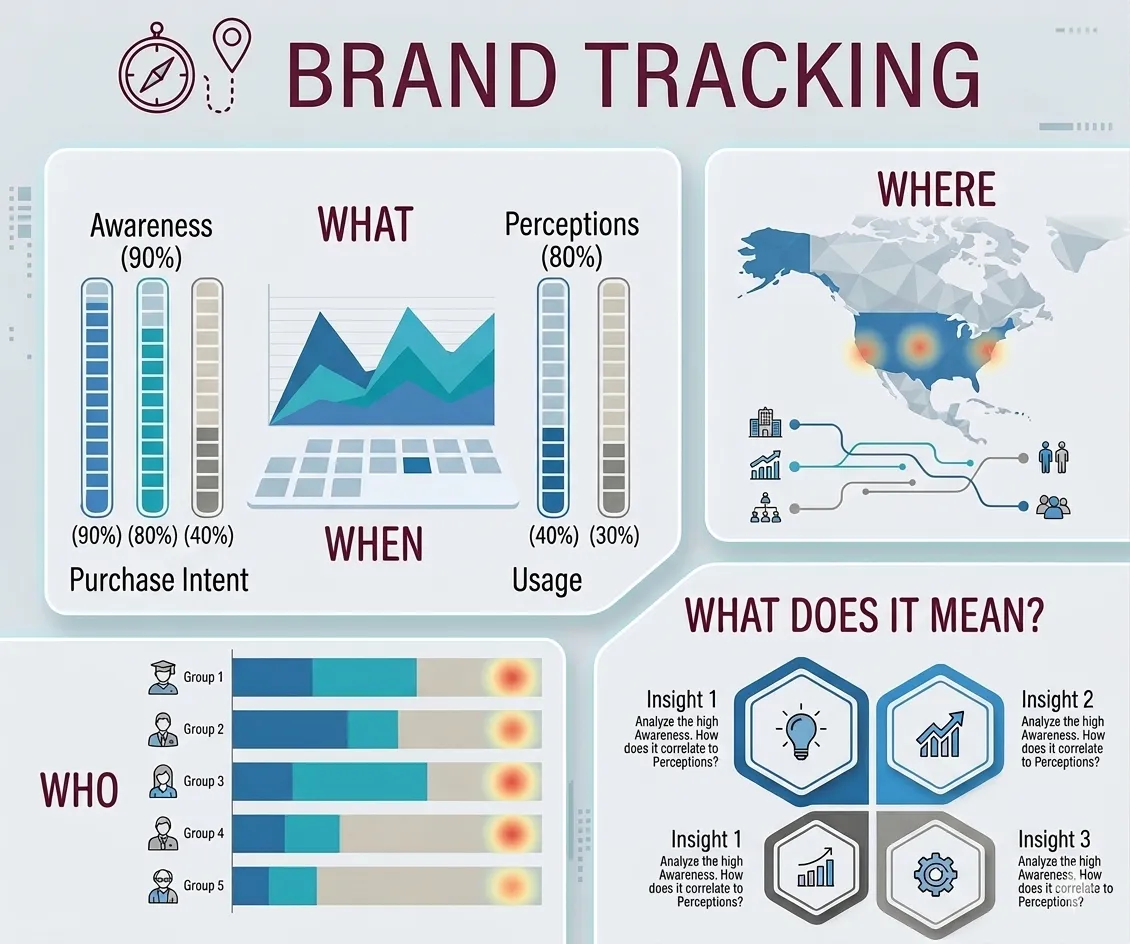
Traditionally, brand tracking research follows periodic surveys that measure awareness and recall. But this approach is too slow for today’s media cycles.
High-performing teams now combine survey data with behavioral signals, like search trends, social engagement, and conversion data, to create a real-time view of consumer behavior and brand perception.
And at the heart of it all is constant monitoring and measurement that gives you the data to understand where your brand stands at any given moment. For this purpose, several methods and platforms are available for collecting and analyzing data.
For example, platforms like Quantilope enable automated brand tracking through methods such as implicit testing and MaxDiff analysis, which can help you uncover subconscious drivers of brand choice. Meanwhile, social listening tools such as Brandwatch analyze millions of conversations to detect shifts in sentiment and reputation in near real time.
Brand tracking should measure the indicators that show how people recognize, remember, perceive, and choose your brand. These usually include brand awareness, recall, perception, consideration, preference, purchase intent, and customer behavior.
While marketing plays a big role in brand tracking, the key metrics you measure may also be affected by other factors, such as customer experience, product/service quality, and even social impact. For example, in one survey, 13% of consumers said they’d pay 50% more for brands with a positive impact on the world.
Let’s cover the main KPIs and metrics that you need to keep an eye on for accurate brand tracking:
Brand awareness is basically your entry point to brand tracking. It determines whether your brand is known enough to enter the consumer’s consideration set. But tracking it properly requires more nuance than simply asking, “Have you heard of us?”
You should measure:
Your paid media campaigns, like search, programmatic display, TV/connected TV, and social media (those with awareness-focused creatives), should give you enough data to understand brand reach. You could also look at branded search volume on Google and Bing, and compare pre- and post-marketing states.
However, media data alone does not confirm brand awareness. For a clearer view, combine platform data with surveys, brand lift studies, focus groups, and search behavior analysis (we’ll discuss them in more detail later).
Awareness gets you noticed, but brand perception determines whether you’re chosen. This is where emotion and trust shape your competitive advantage. It’s also a good measure for understanding where your brand stands in terms of its service, customer support, and even visual identity.
Key metrics include:
Strong customer loyalty reduces acquisition costs and increases lifetime value (LTV). And 82% of brands agree with that. In fact, it’s one of the most important (and underused) signals in media planning.
You should track loyalty using metrics such as repeat purchase rate, customer churn, referrals, and LTV.
Loyalty is shaped by the actual product or service experience, but marketing can increase it through retention campaigns, email nurturing, loyalty offers, personalized messaging, and post-purchase communication.
You can easily connect survey-based loyalty data with customer relationship management (CRM) solutions and sales systems to identify high-value segments.
Ultimately, brand strength must translate into action. Purchase intent and actual brand usage help connect brand metrics to real revenue outcomes.
For this, measure:
According to McKinsey Consumer Decision Journey Research, brands that effectively influence multiple touchpoints in the customer journey are significantly more likely to win at the point of purchase.
You can use intent data (e.g., via Google Analytics) and retail sales data to create a full-funnel view of performance. This is particularly good for FMCG categories, where frequent purchases and low switching costs make real-time insight essential.
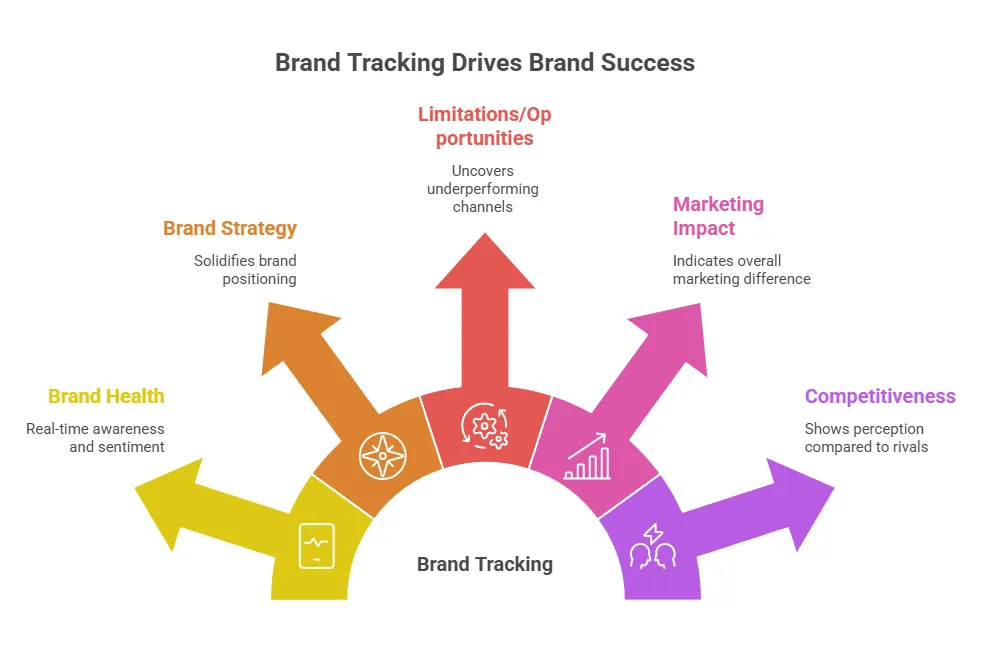
Brand tracking helps measure brand health, identify areas of improvement, uncover new audience segments, validate marketing strategies, and monitor competitors. For media teams, it also acts as a decision engine for budget allocation, campaign planning, messaging, and customer experience.
Let’s talk specifics of each of those benefits:
The marketing data itself is a great source for brand tracking, but there are also special, dedicated methods that give you direct access to your very audience.
At a practical level, reliable brand tracking needs a mix of structured market research and always-on performance data.
Some of the most commonly used methods are:
Surveys are the backbone of brand tracking research because they give you direct access to customer perceptions, including on critical factors like consideration and purchase intent. These can also be great for researching specific elements for brand tracking, like overall user experience.
But your survey should be strong enough to extract all that data.
Use a survey design with clear research questions and relevant demographic questions. The sample should be big enough to extrapolate findings about the brand from its larger audience.
You can easily create surveys with Google Forms or more sophisticated tools like SurveyMonkey. And if you’re investing in platforms for brand tracking (like Quantilope), survey deployment and analysis are built into them.
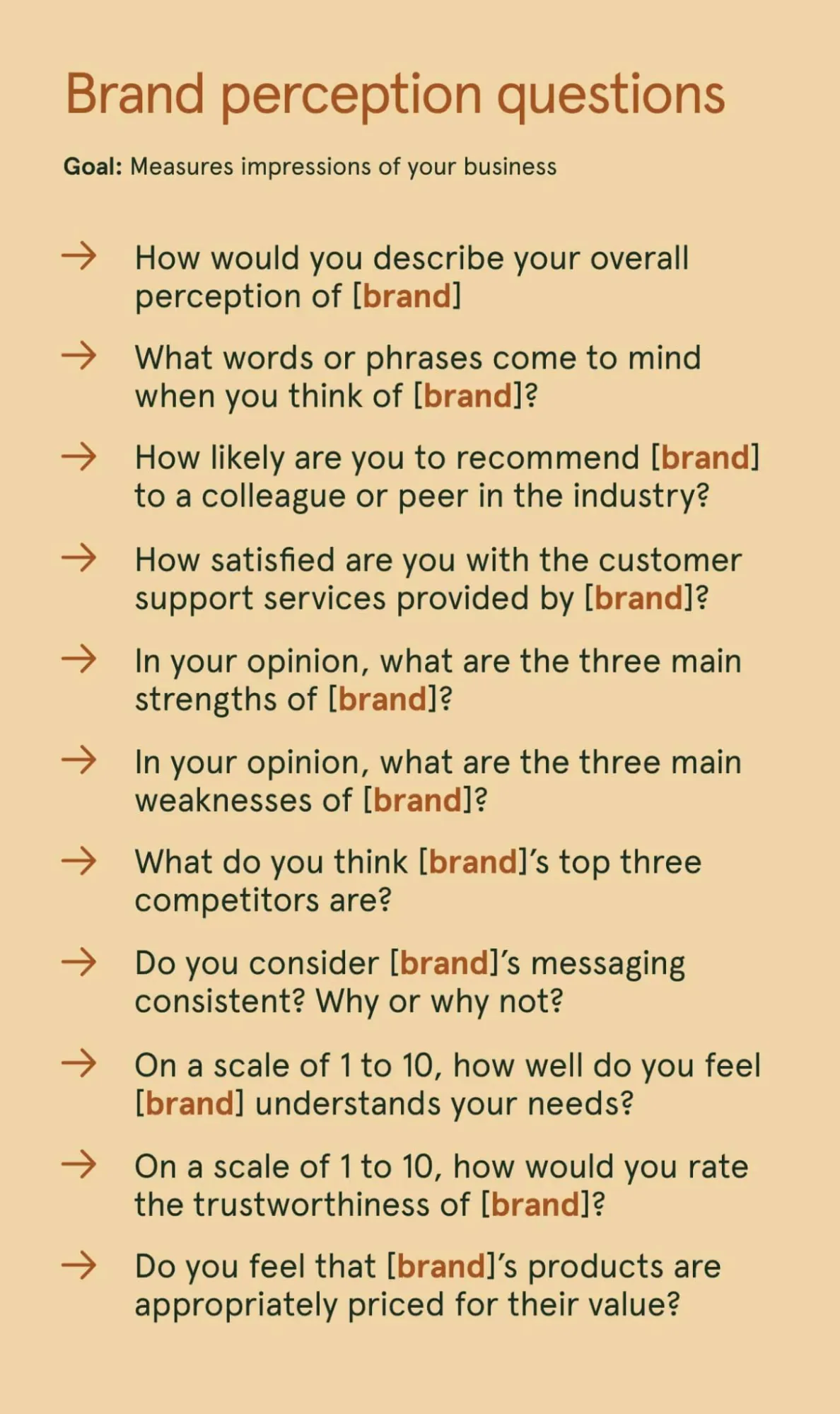
Here are some survey question examples about brand perception:
Focus groups provide the qualitative layer that surveys might miss. They can be an extension of internal data and surveys. Surveys can tell you what is changing, but focus groups help explain why those shifts are happening.
They are useful for:
While not statistically representative, these sessions may reveal patterns that can later be validated through surveys.
If your brand is active on social media platforms like Facebook, Instagram, TikTok, X, or LinkedIn, you have a massive opportunity to track your brand. In fact, social media provides real-time insight into changing audience sentiments about what your brand is doing and producing.
Unfortunately, there aren’t any sentiment analysis tools built into the marketing or business side of social media. Social listening tools like Pulsar and YouScan can be great for tracking brand perception. These platforms use AI to analyze millions of social posts to track perception shifts during campaigns.
Customer feedback from online reviews and testimonials is one of the most direct indicators of customer experience and brand reputation. It’s particularly easier to use for brand tracking on a smaller scale.
Just look at the percentage of positive reviews (say four stars or above) and compare it to the percentage of negative reviews (two stars or below). This will immediately give you an idea of brand standing, at least for a particular product or service.
Pro tip: You can set up Google Alerts to track new mentions on the web and keep track of what people are saying about your brand.
Brand tracking provides actionable insights for media planning and buying. Once you know how consumers see your company, how they’re engaging with your online presence, and how marketing is impacting the brand name, you have plenty of information to put into your media strategy.
Use brand health metrics to decide what role each channel should play in your media mix. Not every channel needs to drive immediate conversions.
How to apply this:
From what we have seen, this is where many teams get media planning wrong. They scale spend based on short-term conversion signals while ignoring weakening brand perception or poor recall.
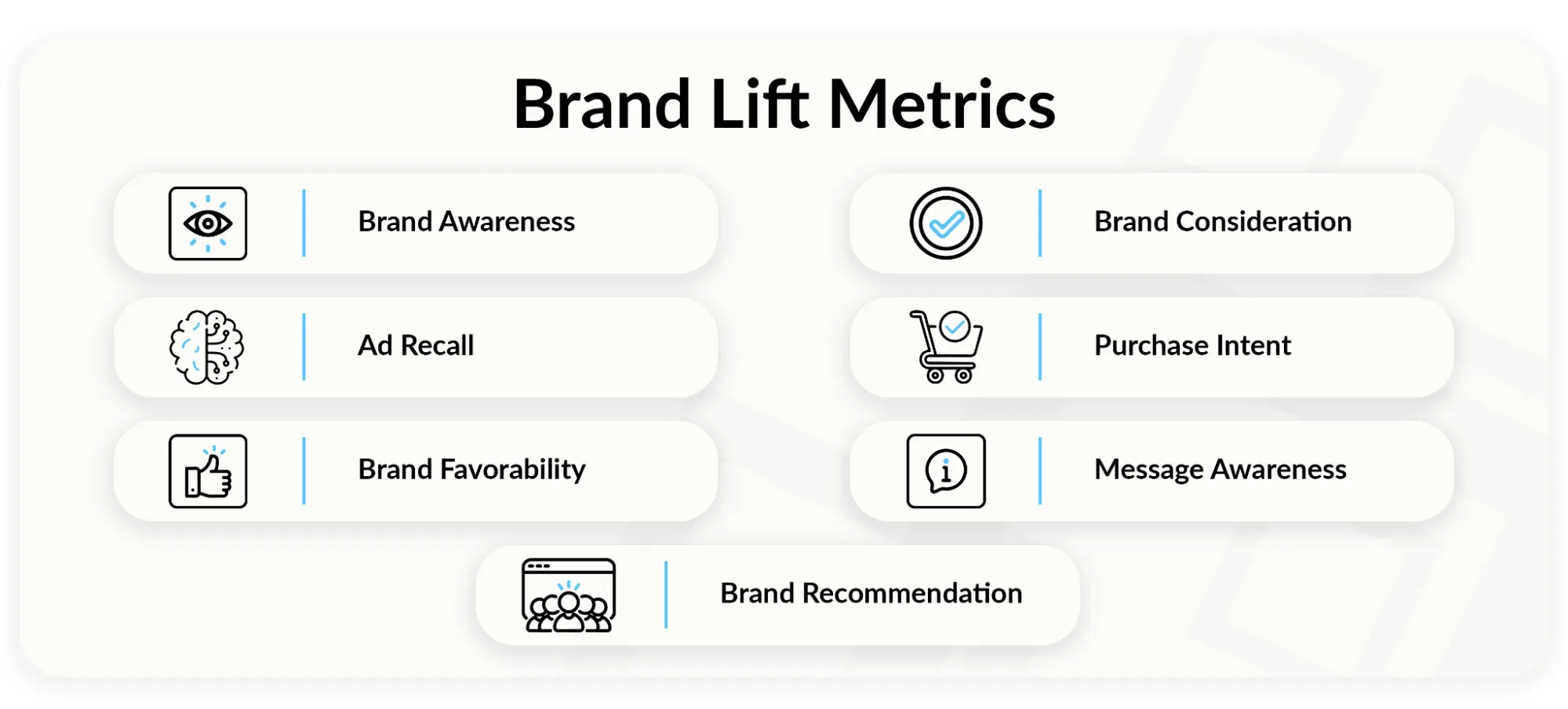
To avoid that, run brand lift studies to compare how each platform affects awareness, recall, and purchase intent. For example, if YouTube drives +8% ad recall but paid social only +2%, you have a clear signal to rebalance spend toward video for top-funnel growth.
Insider tip: We align each channel to a specific KPI (e.g., YouTube = awareness, search = conversion, TikTok = discovery + conversions via different creatives). This prevents channels from being judged against the wrong KPIs, which is a common source of wasted spend.
Your marketing investment should follow incremental impact. Don’t fall for volume metrics like impressions or clicks. This is where brand tracking gives media teams a clearer read on what is actually working.
Depending on the number of channels and campaign size, you can detect statistically significant changes in awareness and intent within days. This helps you optimize spend mid-campaign instead of waiting for a post-campaign review.
And always pair brand metrics with cost data. A channel delivering +5% lift at half the cost may just be more valuable than one delivering +8% lift at 3x the cost.
Your target audience should be defined by behavior and brand relationship. Demographics are important, but they’re not everything. Based on your brand tracking findings, you can easily segment audiences and target them with specific channels and campaigns.
For example, if your analysis shows a tanking customer sentiment, you can target previous customers with messaging that inspires them to give you a second chance (like offers or testimonials).
CRM data will be incredibly valuable for this, as well as any findings from research methods like surveys or focus groups. You can apply what you learn through the right creatives targeted at the right audience to affect brand image.
Insider tip: We build “brand-state audiences” (e.g., aware/non-buyer, loyal customer, churn risk). This aligns customer segmentation directly with media actions, which makes targeting far more efficient.
Creative is one of the biggest drivers of brand impact, yet many teams still measure it mostly through CTR, CPC, or short-term conversions.
Brand tracking helps you look beyond performance metrics. Track ad recall, message clarity, and emotional response through surveys and brand lift.
Test multiple creative routes and compare how each one affects awareness, consideration, purchase intent, and specific brand attributes such as trust, innovation, value, or premium perception.
Use these findings to guide the next creative cycle. At Fieldtrip, we evaluate creative on ‘memory impact.’ If people don’t remember your ad, it won’t build brand equity, no matter how efficient it looks in the short term.
When and how long you run campaigns should be guided by how quickly brand metrics move. There shouldn’t be a fixed calendar.
For example, if brand perception is at risk, you may need a campaign focused on rebuilding trust before pushing harder for reach or conversions. If awareness, recall, or sentiment is rising, increase spend to capture momentum. If metrics plateau, refresh the creative, adjust the message, or change the channel mix.
For instance, if awareness spikes early but purchase intent does not follow, your next flight should shift toward stronger proof points, conversion messaging, reviews, testimonials, or offers.
You can create a brand tracking system by integrating data from different sources, applying research methods, investing in appropriate analytical tools, and training the team to understand brand metrics.
Let’s get into the details:
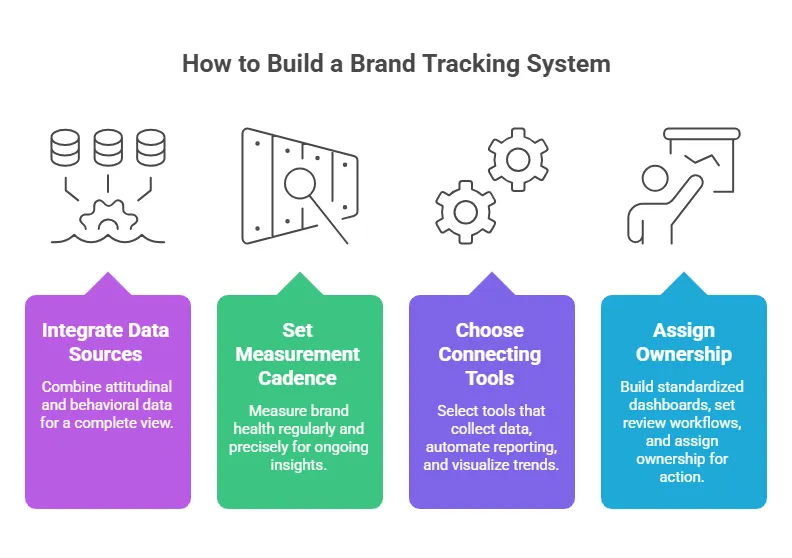
A strong system combines attitudinal and behavioral data to create a complete view of consumer behavior and brand perception.
Key data sources that you should connect are:
The value of brand health tracking depends heavily on how often and how precisely you measure it. Ideally, it should be an ongoing process where you can see brand health at any given time.
We have noticed that most teams either measure too late or too broadly. By the time they review brand health, the campaign has already ended, or the insight is too general to guide the next media decision.
For more detailed interventions, such as surveys or brand lift studies, you should consider creating an annual brand health report.
The good thing is that with a dedicated platform for brand tracking, you don’t need to see it as an occasional endeavor. It goes alongside other brand management and marketing operations.
As for granularity, the more detailed insights (by channel, audience, and campaign) you have for measuring brand health and perception, the more empowered you are in your creative and media decisions.
Your tech stack should help you collect data, automate reporting, visualize trends, and turn brand tracking insights into media decisions. We’ve already mentioned some of the best tools for this. But here’s a list for individual categories:
Almost all such tools can be easily integrated with your broader marketing stack and, most importantly, your CRM.
Brand tracking is not always part of an internal marketing team’s core responsibilities, but it can become a useful decision-making system with the right ownership, training, and process.
Build standardized dashboards with clear chart headlines, key takeaways, and recommended next steps. You can use a dedicated brand tracking platform or build a custom dashboard if your team has the capacity.
Set a regular cadence for reviewing brand tracking insights and making decisions. This could be weekly, biweekly, or monthly, depending on campaign activity and reporting needs.
Most importantly, assign ownership for brand tracking to someone higher up the ladder, so they can take action when brand sentiment goes into the negative territory.
If your team does not have the time or resources to manage this internally, a media planning and buying agency can help build the system, interpret the data, and turn insights into action.
As Steve Forbes once said, “Your brand is the single most important investment you can make in your business.”
But like any major investment, your brand needs measurement. Brand tracking shows how people perceive your brand and how media activity shapes that perception over time.
Most importantly, it helps you move beyond chasing conversions alone. It gives you the evidence to invest media spend where it can build both short-term performance and long-term brand value.
The advantage compounds over time. As your system matures, you gain a clearer understanding of your market position, how your brand compares with competitors, and where future growth will come from.
Looking for a sophisticated agency partner to track brand health and inform media strategy? Get in touch with Fieldtrip today to unlock data-driven media decisions.
Brand tracking involves various elements, including measuring brand awareness, assessing consumer perception, and analyzing sentiment (why your audience feels the way they do). In addition, brand tracking can also validate marketing spend.
Brand tracking should inform decisions continuously, instead of quarterly or post-campaign. Core metrics like awareness and perception are typically tracked weekly or monthly, while digital signals (search, social, traffic) can be monitored daily through automated reporting.
Balancing brand and performance requires aligning spend with both short-term results and long-term brand equity. Performance channels drive immediate conversions, while brand-building activities improve market share (and reduce future acquisition costs).
It depends on the metric. Ad recall, branded search lift, sentiment shifts, and engagement patterns may appear within days or weeks. Deeper changes like preference, loyalty, and market perception usually take longer because they build through repeated exposure and customer experience over time.