






















The shift from traditional broadcast to digital streaming has officially moved past the experimental phase. Connected TV (CTV) is the cornerstone of modern media planning.
For enterprise-level organizations, this transition re-engineers how high-stakes brand stories are told. It combines the cinematic impact of the living room with the surgical precision of digital data.
CTV allows global brands to maintain a massive presence while minimizing the "waste" historically associated with linear TV's broad-brush approach.
According to current market projections, U.S. CTV ad spending is expected to reach approximately $38 billion in 2026. In 2029, that number will be $59 billion.
Clearly, CTV advertising is on an upward trajectory. And it should be a major component of future-proof enterprise-level campaigns if it isn’t already.
With that in mind, let’s dig deeper into what this future looks like and what you can do to ace it.
P.S. Struggling to scale Connected TV campaigns without wasting budget or losing targeting precision? Fieldtrip helps enterprise brands build data-driven CTV strategies that maximize reach, control costs, and deliver measurable results. Book a free strategy call now.
For enterprise marketers, the question isn’t whether Connected TV belongs in their media mix. In fact, the real question is how quickly it can scale.
The rapid shift from linear TV to streaming and internet-connected devices has fundamentally changed how large brands approach digital advertising, audience targeting, and campaign performance.
And that’s evident from where CTV advertising currently stands. Here’s what that looks like:
The most important driver behind the growth of CTV advertising is the transformation of consumer viewing behavior.
According to Nielsen, streaming accounted for 43.8% of all TV viewing time in March 2025, growing by 10 percentage points in just two years.
In fact, streaming has already surpassed the combined share of broadcast and cable viewing, which together accounted for about 44% of TV time.
This shift means traditional broadcast and cable buys alone no longer deliver the reach required for modern brand awareness campaigns. Consumers (particularly Millennials and Gen Z) increasingly watch content through smart TVs, streaming sticks, gaming consoles, and other internet-connected devices.
From our experience working with enterprise marketing teams, this shift changes how reach planning works. Linear TV once carried the bulk of mass awareness. Streaming environments now play a much larger role.
.webp)
Where enterprise marketers once used CTV primarily for experimental video ads, it has now become a serious performance and branding channel within the broader digital marketing ecosystem.
Several data points show this shift. In the U.S., CTV advertising spend reached roughly $33 billion in 2025, with projections suggesting continued double-digit growth.
In many programmatic video campaigns, CTV accounted for over 53% of video impressions in 2023. This proves how quickly the channel has become dominant in premium video delivery.
On the enterprise marketing front, this is a structural shift rather than a short-term trend. As viewing migrates toward on-demand viewing environments and ad-supported video-on-demand services, the opportunity to reach large audiences through CTV has grown immensely.
Another defining characteristic of the current CTV space is the rise of the programmatic ecosystem, where brands buy ad inventory across multiple platforms using automated technology.
Enterprise advertisers use Demand-Side Platforms (DSPs) and modern ad tech stacks to manage programmatic buying across streaming environments. Platforms like AdRoll, Amazon DSP, and The Trade Desk allow marketers to manage Connected TV advertising, track impressions, and integrate campaign data.
With the programmatic route, enterprise teams can integrate CTV advertising directly into their digital marketing workflows instead of managing it as a separate channel.
Statistics already show that CTV marketing is gaining significant momentum. But this is only the beginning, as it’s clearly projected to become an even more important channel for brand recognition.
In short, it’s going to be a central part of the modern omnichannel ecosystem.
Several key developments are likely to shape the future of Connected TV advertising, particularly for enterprise-level campaigns.
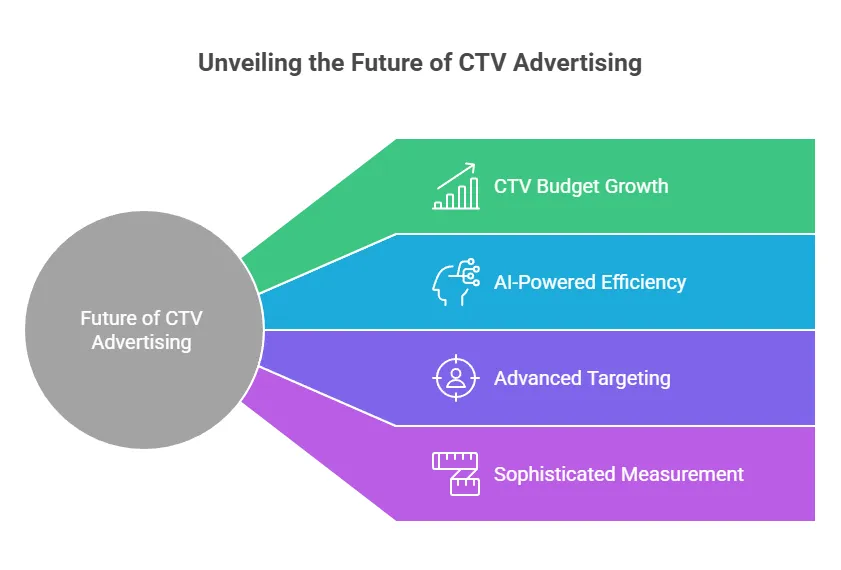
Industry forecasts suggest that enterprise adoption of CTV advertising will accelerate over the next several years.
According to WARC Media, CTV will account for 40% of global ad spending by 2030. Emarketers says the growth rate will go from 14% in 2026 to 11% in 2029, which indicates the channel will have matured by then.
It’s clear that the channel is moving from experimental budgets to long-term strategic investment. Large brands will increasingly build media plans where Connected TV advertising works alongside paid social, search, and display as a measurable full-funnel channel.
Research from MNTN found that a whopping 70% of advertisers plan to increase spending on streaming TV. And CTV ranks at the top for planned spend growth.
One of the most important forces shaping the future of CTV is the progress in AI-powered advertising technology. These systems now influence nearly every major digital channel, and Connected TV is no exception.
Enterprise marketers are already using AI-powered platforms (both native to ad platforms and separate) to improve campaign performance. These systems analyze consumer behavior, past behavior, and contextual signals to improve targeting and optimize delivery.
AI-driven optimizations allow you to:
For example, The Trade Desk uses AI-based algorithms to analyze millions of bid requests across CTV inventory. Its technology brands automatically allocate budget toward higher-performing audience segments. And it claims AI brings the cost of acquisition down by 27%.
Greater efficiency matters for a channel like CTV. CPM rates can be higher than traditional linear TV and many social media placements. Intelligent optimization helps you make better use of those budgets while maintaining strong reach and campaign performance.
Historically, television advertising has relied on broad demographic assumptions. In contrast, Connected TV is built around advanced targeting and highly personalized experiences.
Because CTV operates within the broader digital marketing infrastructure, brands can combine multiple signals for audience targeting.
Personalization can be based on
Traditional television advertising offered limited control. Most decisions revolved around selecting a network and a time slot. Connected TV provides much greater precision over who sees an ad and when it appears.
This also opens the door for more sophisticated messaging strategies. You can run different creative variations for different audience segments and tailor campaigns more effectively.
Stefanie Beach, CEO & Founder at the Marketing Group, said it well in the AI + CTV 2026 Report:
“You’re not just buying a network anymore—you’re buying a behavior, a mood, and a household.”
Another defining characteristic of the future CTV ecosystem will be the continued improvement of campaign measurement and attribution technologies.
Enterprise marketers increasingly expect digital-style measurement capabilities across television campaigns. And that’s what CTV is increasingly looking like.
Again, technologies like AI now allow real-time ad tracking across devices, measure attention metrics (how long viewers actually watch ads), and conversion lift tied to specific campaigns.
For example, Nielsen ONE, a cross-media measurement solution, is designed to unify metrics for CTV advertising, digital video, and traditional television into a single reporting framework.
These advancements are helping enterprise teams understand the full customer journey, from initial exposure to post-view conversion. Attribution and measurement make CTV marketing more accountable than traditional TV ever was.
For enterprise brands in industries like retail, CPG, health/wellness, travel, and finance, CTV campaigns have become a core part of the advertising strategy.
But what makes it even more crucial and certainly beneficial is how well it works with other digital channels, unlike, of course, linear TV.
One of the most immediate benefits of connected TV advertising is the incremental reach it provides beyond linear TV. Many younger audiences now consume most video content through streaming services and on-demand viewing.
For enterprise advertisers, this makes CTV ads a valuable tool for extending campaign reach while maintaining the storytelling impact of premium video ads.
More importantly, CTV also enhances performance across other digital marketing channels. Because campaigns run within the programmatic ecosystem, marketers can coordinate ad placements across TV, web, and mobile devices using DSPs.
Even if programmatic is taken out of the equation, CTV still serves as a key element to a cohesive, full-funnel digital marketing strategy.
It brings a similar kind of control, customization, and measurement as search and paid social (see how CTV compares with social). This is one of the reasons it has grown so fast: it integrates well and is measurable.
Matt Freedman of Tegna sums it up well:
“CTV often introduces the story, and other channels pick up the thread as people search, click, and eventually buy.”
When channels work together this way, campaigns maintain consistent messaging across touchpoints. This coordination improves brand recall, increases engagement, and supports performance throughout the customer journey.
There’s so much happening in the CTV advertising world. Some forces are particularly strong and paving the way for the future projections we just shared.
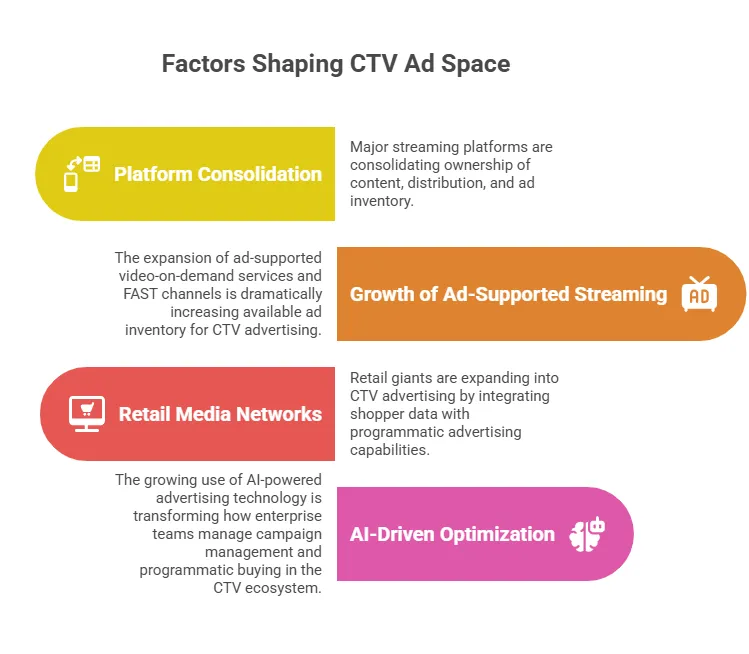
Major streaming platforms are increasingly consolidating ownership of content, distribution, and ad inventory. This shift is reshaping how advertisers access Connected TV advertising opportunities.
Companies like Amazon, Disney, and Netflix now control both content libraries and advertising platforms. This enables direct media delivery through their ecosystems while limiting open-market programmatic buying.
For advertisers, this means some inventory sits inside closed ecosystems. Access often requires working directly with platform-specific buying tools and partnerships.
The expansion of ad-supported video-on-demand services and FAST (Free Ad-Supported Streaming TV) channels is dramatically increasing available ad inventory for CTV advertising.
Platforms like Roku Channel, Tubi, and Pluto TV allow you to deliver video ads to audiences watching on-demand viewing content across Smart TVs and other internet-connected devices.
Industry projections suggest that the AVOD market could reach approximately $72.9 billion by 2031. As more platforms introduce ad-supported tiers, advertisers gain additional opportunities to reach viewers in streaming environments.

Retail giants are expanding into CTV advertising by integrating shopper data with programmatic advertising capabilities. Companies like Walmart Connect now allow you to target high-value audiences using purchase data and first-party data.
This shift is turning CTV into a powerful digital marketing channel if you are seeking both brand awareness and measurable commerce outcomes.
As we already covered, the growing use of AI-powered advertising technology is transforming how enterprise teams manage campaign management and programmatic buying in the CTV ecosystem.
These tools and technologies can analyze consumer behavior, contextual signals, and past behavior to optimize campaigns in real time.
Automation also simplifies campaign management across complex streaming environments. Enterprise marketing teams can evaluate performance signals faster and adjust media allocation while campaigns are still running.
It’s evident that the future of Connected TV campaigns is strong. They’re going to be the next big thing in advertising. As an enterprise marketer or CMO, you might be more interested in learning how to leverage these campaigns to your advantage.
As advertisers who have witnessed the flourishing of CTV ads and participated in the revolution, here is our take on how enterprises can succeed in this space:
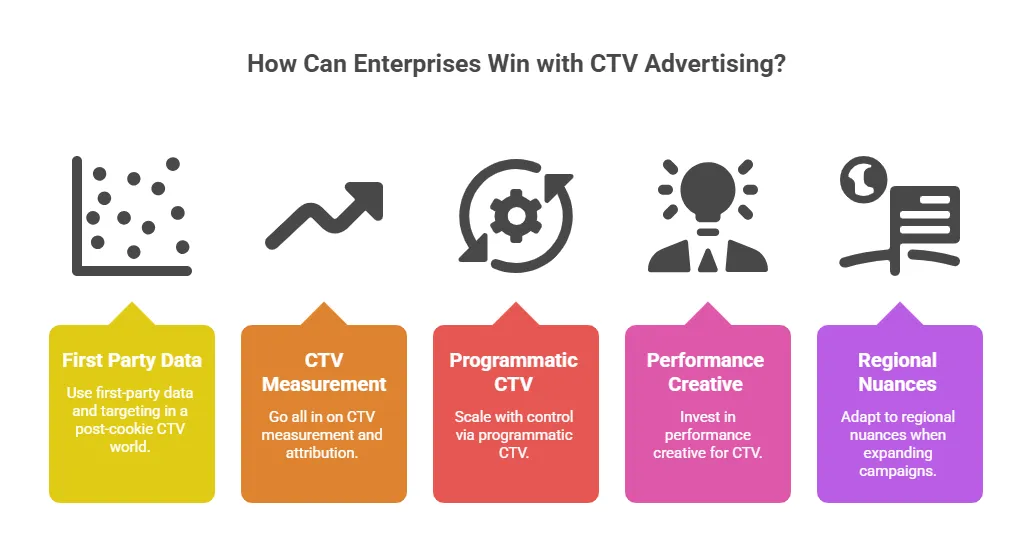
As third-party cookies disappear, you’ll need to rely more heavily on first-party data to power audience targeting in CTV advertising. This is where your customer relationship management (CRM) tools and retail media come into play, creating a closed-loop system for better targeting.
First-party data is already super important, but it will be even more consequential if and when third-party cookies are completely phased out.
With that data, you can use demographics, location, and behavioral and interest-based targeting. You can reach audiences whose past behavior signals strong purchase intent.
Platforms like AdRoll and other major DSPs allow you to securely onboard customer data to activate campaigns across Connected TV environments.
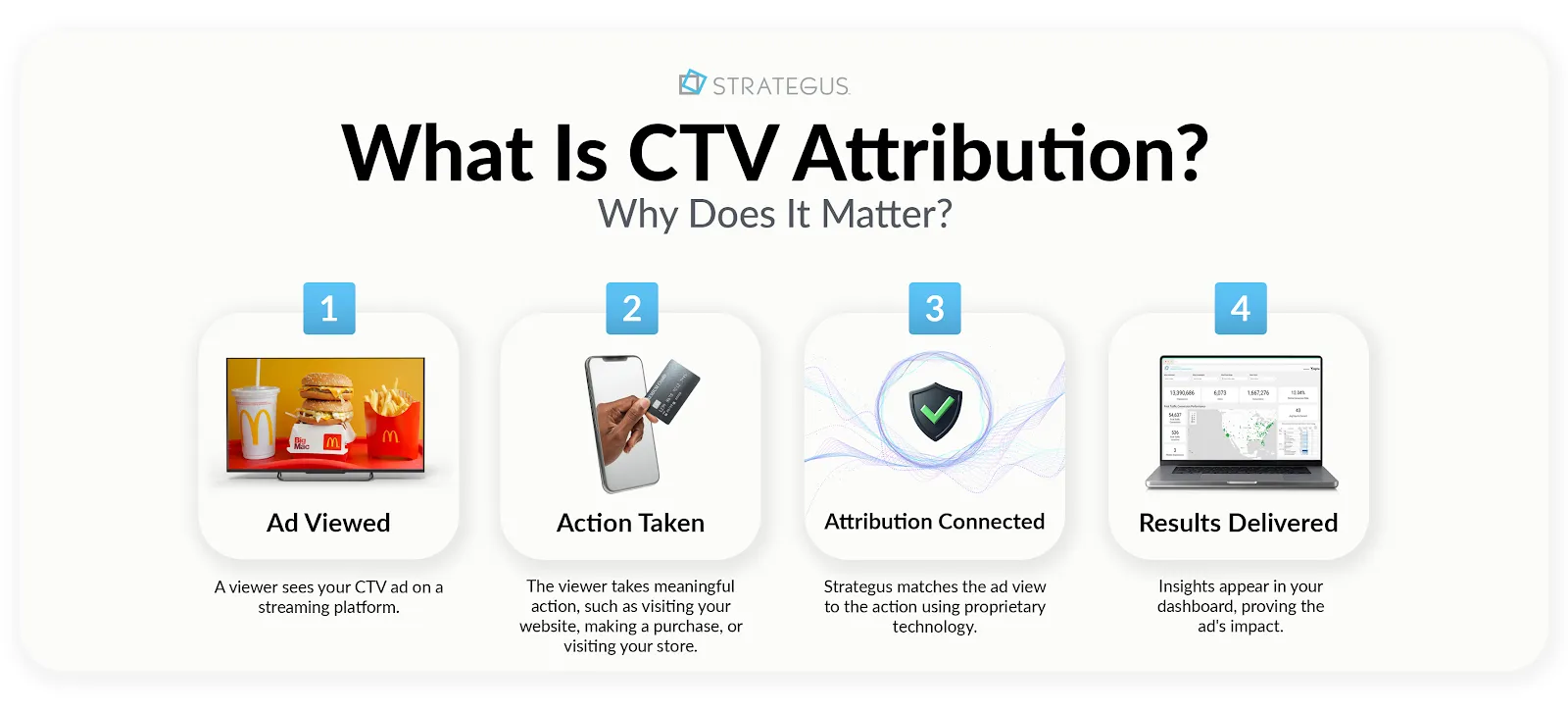
Enterprise success with CTV advertising depends heavily on strong campaign measurement, reliable performance metrics, and modern attribution models.
Measurement providers such as Nielsen and VideoAmp are developing cross-platform attribution technologies that link CTV impressions to downstream conversions and user engagement.
These solutions also incorporate data analytics to help you understand whether ads are working as they should and are driving the impact you need.
This is where many teams run into problems. In our experience, strong measurement usually determines whether CTV becomes a scalable channel or remains an experimental one.
Connected TV campaigns can generate strong returns. Connected TV ROI is 4.5X higher than linear TV. But that ROI can only be realized if you’re pivoting efforts based on performance measurements.
Scaling campaigns efficiently can be done via programmatic advertising and automated programmatic buying. Enterprise marketers turn to DSPs to manage ad placements, access premium ad inventory, and coordinate cross-channel campaigns across internet-connected devices.
For 6 and 7-figure-budget video campaigns intended to run across different channels, programmatic is simply the best way to go. It removes silos and centralizes management, while also measuring the total impact.
In many ways, the growth of Connected TV is accelerating the broader adoption of programmatic media buying.
From what we have observed, enterprise teams that integrate CTV into their programmatic stack gain far better control over budget allocation, targeting, and measurement.
Creative quality plays a major role in campaign success because video ads remain the primary ad format used in Connected television. Unlike other video formats, this channel also offers interactive ads, which opens the door for even more creativity. Your viewers can engage directly with branded experiences through their TV interface.
Strong performance creative helps capture attention and guide viewers toward the next step, whether that means visiting a website, scanning a QR code, or taking another action.
In our experience, this is another point where many campaigns struggle. Teams invest heavily in media placement but underestimate how much creative quality influences results. High-performing CTV campaigns often rely on multiple creative variations designed for different audience segments and viewing contexts.
![Case study showing Nissan’s interactive CTV ad campaign with true[X], allowing viewers to choose ad language and improving brand awareness and purchase intent.](https://cdn.prod.website-files.com/68866783256fadfdd68e0713/69c53e51377361d9c22fde1c_Nissan%20Interactive%20CTV%20Ad%20Case%20Study%20with%20true%5BX%5D%20Choice-Based%20Format.webp)
Global enterprise campaigns must adapt advertising strategies to local consumer behavior, viewing interests, popular streaming genres, and cultural nuances.
Regional differences in platform adoption, content preferences, and media delivery infrastructure mean that CTV strategies that work in one market may require adjustments elsewhere.
You can turn to data for localized campaign management. That way, you can reach high-value audiences while maintaining brand safety and relevance in each region.
As you scale connected TV campaigns, you must also look out for the potential pitfalls, like:
Managing CTV advertising at enterprise scale requires specialized expertise across ad tech, programmatic advertising, and cross-platform campaign management. A dedicated CTV agency helps large enterprises navigate fragmented platforms, access premium ad inventory, and coordinate programmatic buying across multiple DSPs.
Agency expertise ensures campaigns reach the target audience while maintaining efficiency across complex cross-channel campaigns.
Agencies also provide advanced strategic support across creative strategy, media planning, and campaign measurement.
With data and technology, agencies help brands:
Finally, a CTV-focused agency helps enterprises scale campaigns globally while maintaining control over targeting and media buying.
They can help incorporate advanced targeting capabilities, so campaigns remain aligned with broader digital marketing and advertising strategies. This, in turn, delivers measurable outcomes across the entire full-funnel channel.
Further Reading: Learn how to navigate agency partnerships as a Fortune 500 enterprise.
Fieldtrip is a full-service marketing agency with a specialty in Connected TV. We provide the perfect mix of media buying, creative optimization, and measurement for enterprise CTV campaigns, rooted in business goals.
Our media team, which leads CTV buying, works alongside creative and strategy to plan and execute large budget campaigns. We leverage the unique strengths of CTV, such as interactive experiences and persona-based targeting. And we’re obsessed with cost-effectiveness to ensure your CTV ads' CAC is lower than the industry average.
This is why companies like Nestle, Nordstrom, Meta, and Abbott have chosen services from our marketing ecosystem.
Connected TV is replacing linear TV for many enterprise advertisers because streaming platforms deliver on-demand viewing, household-level targeting, and digital measurement. Enterprises are shifting budgets from traditional broadcast toward streaming environments that provide measurable reach and data-driven audience targeting.
CTV measurement will improve for enterprise-level campaigns through cross-platform identity graphs, unified reach and frequency tracking, and conversion-attributed attribution models. Advanced measurement platforms combine first-party data, device graphs, and clean rooms to link ad exposure to outcomes such as website visits, in-store traffic, and purchases
CTV can drive performance outcomes by combining television-scale reach with digital targeting and measurable attribution. Brands use QR codes, sequential messaging, and retargeting across mobile and desktop to convert viewers into customers. Studies show CTV campaigns increase site visits, app installs, and purchases when paired with programmatic optimization.
Enterprises manage frequency across CTV and other channels by using identity graphs, cross-channel demand-side platforms, and unified campaign management systems. These tools track exposure across devices and households, then cap impressions to prevent over-delivery. Unified frequency control improves user experience while increasing incremental reach.
Retail media networks will play a major role in CTV by linking shopper purchase data with streaming ad inventory. Retailers such as Amazon, Walmart, and Target allow brands to target audiences based on real purchase behavior. This integration enables closed-loop measurement that connects CTV impressions directly to product sales.
Enterprises can start by allocating 20-40% of total video advertising spend to streaming environments. Media plans are increasingly shifting budgets from linear TV to CTV as streaming viewership continues to grow while traditional broadcast audiences decline.
Fieldtrip can plan and execute enterprise CTV campaigns by managing audience targeting, programmatic buying, creative distribution, and performance measurement across major streaming platforms. Enterprise CTV campaigns require coordinated media planning, data integration, and cross-channel optimization–all of which Fieldtrip and its experts can support for enterprise clients.