





















Creative teams feel pressure to stand out while paid media costs rise and data signals shift. As third-party cookies fade and privacy rules tighten, you lose simple targeting shortcuts and face harder decisions.
Recent research shows that 61% of high-growth companies are moving to first-party data for personalization strategies. So creative teams now need to know how to turn first-party data into ideas that feel relevant and still perform.
And we can help you learn how to do that, sharing our in-house experience.
In this article, you’ll see how to link signals to execution and how to shape concepts with audience insights. This is the right place for you if you want to integrate first-party data into your creative campaigns.
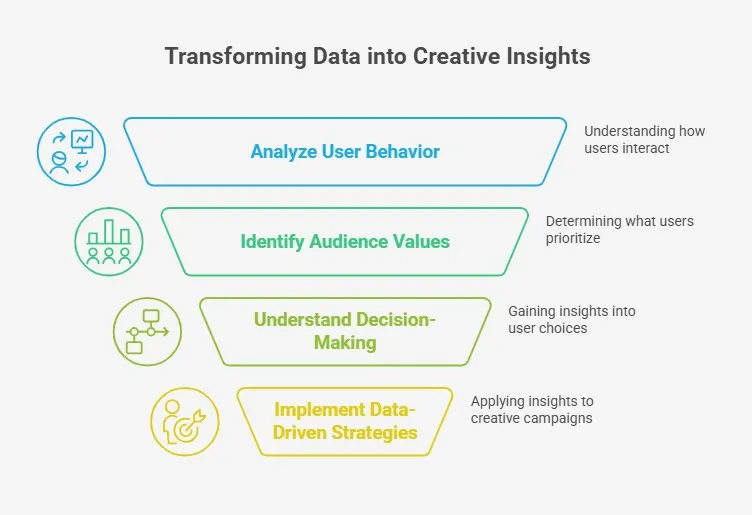
First-party data for creative campaigns is the information you collect directly through your own channels, such as your site, app, emails, or social platforms. It includes browsing behavior, past conversions, email activity, loyalty programs, and app events.
These are basically signals people create through real actions, so we frankly prefer them over assumptions drawn from third-party data. They can give you a clearer view of what your audience values and how they decide to take action.
However, you need to get serious about implementing it.
Recent findings show that 88% of marketers see this data as more important than ever. That raises the bar for your team because your competitors can become more successful if you neglect it. And we're sure you do not want that.
Next, let’s look at why its importance keeps growing.
First-party data matters more now because it gives you clearer audience insight when cookies fade, and targeting gets harder.
Let's be honest for a second. All of us marketers have probably felt that creative decisions are harder to make as signals shrink and noise grows across channels. So it helps to ground the pressure you feel in the shifts shaping today’s environment.
Here are the forces pulling teams toward first-party data:
As these changes stack up, many teams are rethinking where their signals come from and how they support creative decisions.
Research from Epsilon shows that 69% of advertisers expect third-party cookie shifts to hit harder than past regulatory changes. 70% expect digital advertising to take a step backward under weaker signals.
As a result, creative work now needs to start with first-party data.
But you can watch this short video that breaks down how these market shifts are changing the marketer’s role when using first-party data:
To keep work moving, first-party data gives you:
Okay, but how does this data shape creative that actually performs? We’ll share our in-house findings below:
Creative work moves faster and hits harder when it starts with what your audience actually does instead of what teams assume. So, from experience, we know that first-party data drives creative that performs in real conditions.
Let's see the core reasons why.
Ideas land better when they're shaped by behavior instead of estimates or intuitions. Signals from real actions, such as repeat visits, saved carts, behavioral segments, or clicks on specific themes, show you what your audience values and which ideas earn their attention.
And it’ll pay off.
In fact, a recent report from EMARKETER found that taking a behavioral approach to first-party data improved performance marketing for 56% of marketers. This gives you a cleaner path from observation to story angle.
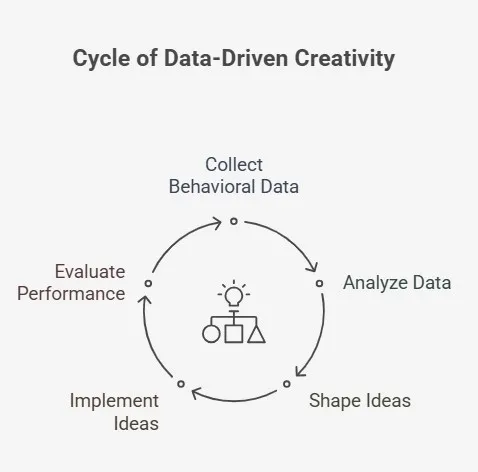
Testing becomes more structured when you anchor it in real patterns. It becomes easier to validate hooks early, stress-test formats, and read platform feedback without overreacting to noise.
So instead of running scattered experiments, you run focused cycles that answer clear questions about which messages earn attention and which formats drive stronger campaign performance. This helps you avoid wasted time and budget.
Clear signals shorten the distance between concept and result. They help you shape assets with higher relevance, which leads to better click-through rate,lower cost per acquisition, and faster learning loops across channels.
And this is how we work at Fieldtrip.
We make, launch, learn, and repeat, while using real platform signals to sharpen ideas before scaling them. This rhythm keeps output tied to real performance signals.
Creative decisions get stronger when they pull from clear, observable signals. So it helps to group the data you collect into a few practical categories that shape story angles and message choices.
Here are the ones that matter most for daily execution:
And to make this easier to apply, here’s a simple table showing how common signals guide creative decisions:
These inputs give you a clearer view of patterns across customer profiles and help you shape ideas with more precision across the customer journey.
Next, let’s learn how your team can turn these signals into a working creative system.
Creative teams move faster when data flows cleanly from insight to action. And because data privacy rules keep tightening, having a clear workflow helps you avoid rework and protect your customer experience.
Now, here are the steps you can follow to build a first-party data workflow.
A clean data foundation makes every creative decision faster and more grounded. So the first step is mapping what sits across your systems and deciding what should flow into your creative process.
You can start by listing the sources you already rely on, such as CRM, website, app, POS, email, and loyalty data. Each one captures different signals, from website visits to purchase behavior, that shape segments and message choices. And this mapping helps you see where gaps or overlaps slow your team down.
Next, focus on data quality. Freshness, duplicates, and broken tags typically create friction, especially when multiple teams pull from the same customer data platform or CRM systems.
Research shows that about 45% of marketing data used for decision-making is inaccurate, incomplete, or out of date. This can push your team toward the wrong concepts or delay testing cycles.
This step is about creating a stable ground before you start shaping creative ideas. A simple marketing audit helps to fix outdated entries, align naming across tools, and confirm tracking fires correctly across key touchpoints.
Segmentation turns raw signals into directions your creative team can use. To make that work, you group people based on what they do and what they need rather than broad demographic labels. Clear segments help you:
So, we believe that you should start with segments that reflect real intent. Examples include “first-time buyers,” “high-value customers,” and “people who viewed but didn’t buy.”
Each group gives you a different lens for message framing and a clearer path to tailored content marketing workflows. And these segments map neatly across channels, from Google Analytics signals to email marketing platform activity.
Next, add behavioral and context cues. Patterns such as repeat visits, deep scroll sessions, saved items, or high social media engagement reveal where someone is in their decision process.
Once these segments are in place, you can translate them into creative tasks. Each group should guide a specific angle, format, or message test. For example, lapsed buyers may need a value reminder, while high-engagement non-purchasers typically respond to deeper product context or social proof.
At Fieldtrip, we already did this for Dockers. Our team moved away from direct product talk and changed the message to creator-led storytelling. The focus became “worldbuilding” instead of selling pants. Creators placed Dockers inside their real lives, with the product playing a background role.
This shift changed how people reacted. The campaign reached over 15.8M views, drove strong engagement, and later improved brand recall once paid media focused on more engaged audiences.
Here's an example of our work:
Segmentation only helps if it moves your creative work forward. Here, the focus shifts to turning each group into a clear direction your team can shape, test, and scale These directions guide formats, message angles, and the level of context each audience needs.
To make this practical, here are the formats that work well when built from segment-level signals:
Each format matches a different behavior pattern. For example:
Behavioral context also helps you decide where each asset should run. Someone with strong intent may be ready for a direct push inside search or Google Ads. On the other hand, those still exploring tend to respond better to narrative formats on social.
This is where Fieldtrip leans in.
We run segmented creative testing at speed, and we pull signals from each group to shape hooks, formats, and pacing. For NielsenIQ, we applied this approach across 19 countries and cut CPA by 37% by aligning each concept with the segment most likely to act.
Here's what we did:
Early tests help you validate ideas before committing resources, and they keep your creative work tied to real signals. This step focuses on small, focused experiments that show what earns attention and what needs to be reworked.
Start with A/B creative testing that stress-tests the basics.
Hooks, pacing, visuals, and length all shape how people respond. Small changes can shift conversion rate or early engagement in meaningful ways.
Side note: Many teams already rely on these experiments. In fact, around 77% of firms worldwide run A/B testing on their websites. This reflects how widely this method supports decision-making.
Once the variants are live, move to feedback loops. Platform signals, especially early results inside social, help you read what is picking up traction.
Pro tip: At Fieldtrip, our team treats social as a sensor, which means we look at fast signals as guidance for what to refine next rather than as final answers. This keeps testing cycles short and gives your team direction without slowing production.
Here is a simple testing framework that keeps this process easy to repeat:
This rhythm gives you fast reads on what works and what needs a new angle. It sets you up to scale the tests across more channels and concepts.
A repeatable system helps you move from one-off wins to consistent output. That’s why this part focuses on automating what should run in the background.
So, start with automation. CDPs, data routing, and creative tagging help you keep signals fresh without manual effort.
Recent data shows how central these tools are.
According to CDP research, 59% of teams use CDPs for campaign personalization, and 56% use them for audience segmentation and targeting. This gives you a direct line from first-party signals into segmentation and message choices across digital marketing channels.
Next, connect insights back to your creative briefs. We found that this simple structure can keep your team aligned, so we always recommend it to our clients:
From there, focus on cross-team workflow. Creative, media, and measurement should move together, especially when you run fast testing cycles.
Pro tip: At Fieldtrip, our small autonomous teams work as one unit across strategy, creative, media, and measurement, which helps us adjust quickly without losing context.
All of this leads us to our next part.
Certain formats gain extra power when they’re shaped by real behavior (even though all creatives benefit from this). But because first-party signals show what people are actually doing across channels, these formats become easier to target, refine, and scale.
In our experience, these are the ones where that impact shows up the fastest.
Performance assets respond well to first-party signals because they let you match hooks and angles to real intent.
We discovered that tailored openings, sharper value framing, and segment-specific pacing typically lift early engagement and support stronger customer lifetime value over time.
When these signals guide what you test, the feedback loop tightens, and your team moves faster from idea to result.
We see this play out consistently at Fieldtrip.
In our work with Hurom, performance-tested variations built from segment behavior helped triple ROAS and cut CPA by 60%. This came from running fast tests, reading early signals with precision, and adjusting creative based on what each audience group responded to.
Here's an example of our work with Hurom:
Influencer-created content works even better when you match creators to segments instead of broad audiences. It allows you to personalize storylines and speak to real concerns without overexplaining.
This approach supported strong results for our client Greenpark.
Fieldtrip worked with micro-creators across specific sports niches instead of one broad creator pool. Each creator spoke to a clear fan group and use case, such as live game chats, avatars, or betting features.
That made the stories feel natural and easy to follow. It even led to a 70% drop in CPI, 6x more daily installs, and the ability to scale spend by 300%. Here's an example of our work:
User-generated content scales well when you feed it with real behavior patterns. Segment-level cues help you brief creators with more clarity, shape formats for each intent group, and remove guesswork from what you launch.
This is how we approached Genomelink.
A continuous UGC system reduced CAC by 73% through ongoing tests that drew directly from first-party signals inside the data ecosystem. Here's what we did:
With that in mind, there are also challenges that usually slow teams down.
Even with strong signals, teams run into structural issues that slow creative work down. So here are the most common obstacles with first-party data and how to address them:
We’ve seen many teams pulling signals from disconnected tools, which causes misreads and slows decision-making.
It’s not just our personal read on things. Research from Treasure Data shows that 54% of companies list fragmented or siloed data as their biggest barrier to using information effectively.
Our solution: Unify your CDP and shared dashboards so that creative, media, and measurement read from the same source.
Consent signals must stay clear as privacy laws tighten. A recent survey found that 73% of respondents view consent and preference management as one of the most important areas in data and marketing.
Our solution: Use transparent opt-ins, clean preference centers, and simple user flows.
Data loses value when it stays in dashboards instead of shaping concepts. When teams cannot translate signals into ideas, creative work slows down, and decisions rely more on instinct than insight.
Our solution: Run cross-team creative sprints. At Fieldtrip, our modular system pulls insights into creative early. This helps us build ideas aligned with segment behavior and refine them through fast tests.
A clear loop helps you move from raw data to working creative without slowing your team down. Here’s the framework your workflow should follow:
You can download our detailed framework to learn more and track how things are going. Framework on Integrating First-Party Data.
When you want creative decisions shaped by real signals, you need a partner built to work the same way your team works. Fieldtrip connects strategy, creative, media, and measurement inside one system.
This gives you a direct line from insight to production without handoff delays. And our small autonomous teams stay close to the data so they can adjust quickly and turn early patterns into concepts your channels can use right away.
This setup helps you remove the gap between data and creative because every idea starts with what your audience is actually doing across touchpoints. And as feedback comes in, the same team refines and scales the work.
In a market where relevance moves fast, having a partner who blends creativity with continuous data signals keeps your system improving with each cycle.
First-party data gives you a clear creative advantage because it lets you base decisions on real audience signals.
When you understand your data, build segments, shape stronger ideas, test early, and scale what works, your creative system becomes faster and more predictable. Brands that adopt this rhythm now gain an edge as the privacy-first world continues to expand.
If you want a partner who turns signals into systems, Fieldtrip can support your full lead generation process and help your team move with confidence. Contact us today.