




















Measuring media impact becomes much harder at enterprise scale. You’re spending millions on display, paid social, and connected TV to build awareness and a specific brand image.
Impressions and clicks can tell you how widely a campaign traveled or how people interacted with it. They cannot answer some of the questions that matter most:
Brand lift studies answer these questions by measuring changes in how exposed audiences think about, remember, or respond to your brand.
Bain's recent research shows that finance and marketing already agree that a brand takes a year-plus to pay off. What finance wants is credible proof along the way. A brand lift study is exactly that.
This guide explains how brand lift studies work, what they can reliably measure, where platform-based approaches differ from independent research, and how to connect upper-funnel movement to decisions about creative, investment, and long-term growth.
Need a partner for enterprise marketing? Check out agencies powering late-stage and enterprise growth.
A brand lift study is an experimental approach to measuring lift that estimates whether advertising caused a measurable change in brand perception.
Instead of relying on clicks or conversions, it compares consumer attitudes between people eligible to see advertising and a comparable unexposed group.
The basic logic is straightforward: randomize part of your target audience, expose one group to advertising, use polling to question both groups, and measure the difference in key performance indicators.
The survey questions then determine what attitude you are testing. While brand awareness is a common theme in such tests, you can also measure other vital metrics like ad recall, brand consideration, and purchase intent.
Enterprise marketers can benefit from brand lift studies in several ways. They can get proof of upper-funnel activity, learn things about their audience, pivot creative direction, and optimize media spend.
Brand lift studies, whether conducted within advertising environments like Meta or Amazon DSP or orchestrated independently, are essentially part of the broader enterprise marketing measurement framework.
Like conversion lift studies or incremental testing, brand lift studies, when done right, power important marketing objectives like:
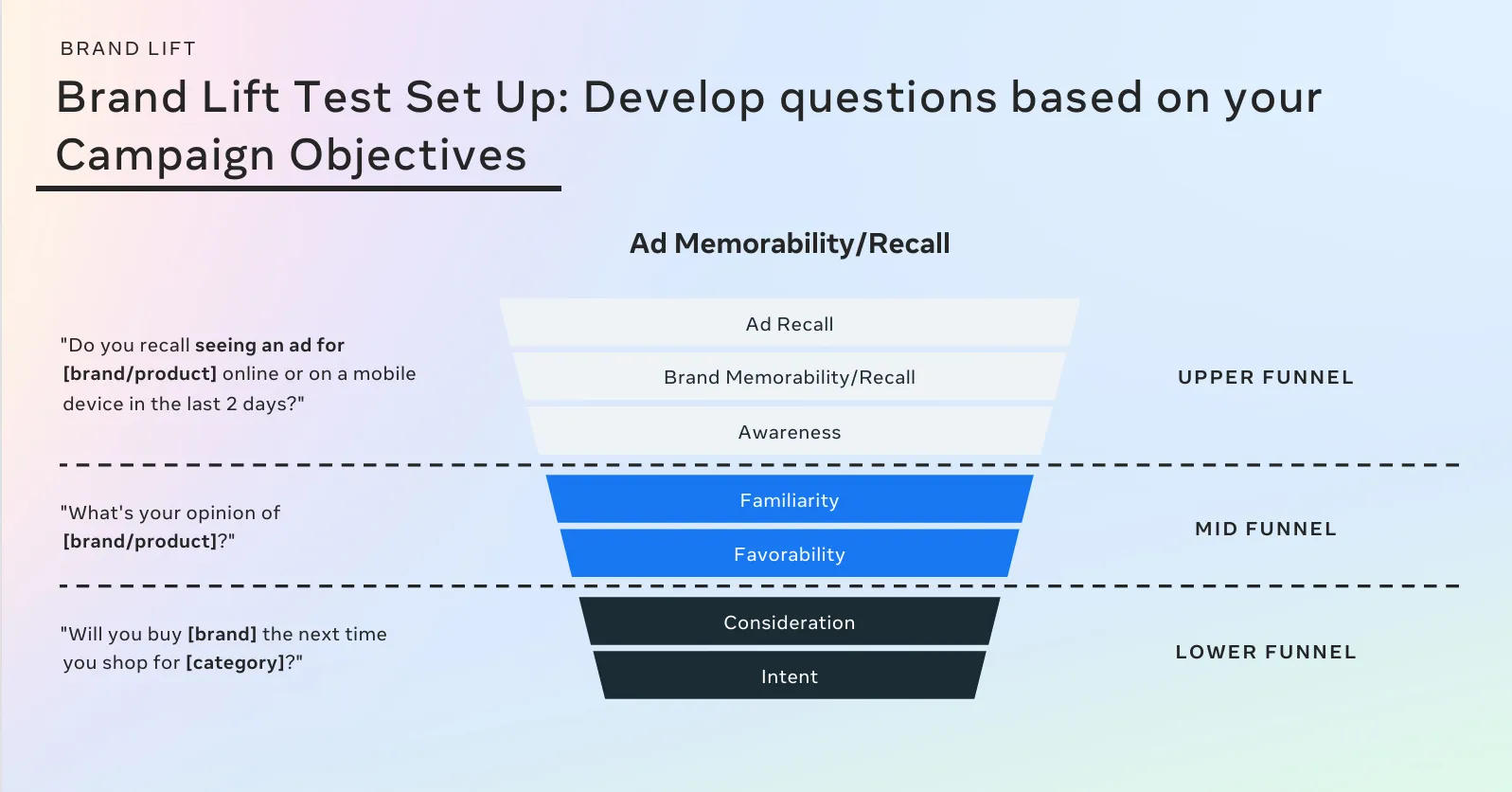
Brand lift studies can show whether advertising changed how people perceive or remember your brand. This makes them particularly useful for campaigns focused on awareness, message recall, brand preference, or consideration, where direct conversions may take longer to appear.
But brand lift study objectives and learnings aren’t limited to upper-funnel activity. These tests can also answer mid- and lower-funnel questions. For instance, Meta allows advertisers to select brand survey questions that align with different campaign goals and stages of the customer journey.
Brand lift findings can show which creative executions are actually changing awareness, recall, differentiation, or other brand metrics. This gives you stronger evidence for decisions about creative direction and media allocation.
HP, for example, reported a 22% increase in brand differentiation in research conducted with Kantar and LinkedIn. 5 of 6 custom creatives outperformed HP’s standard ad unit on differentiation. 82% of respondents found the custom creative memorable.
These findings help marketing leaders and creative teams with the insights needed to understand what’s working to shift audience perception and opinion of the brand. Creative teams can refine the strongest elements, while media buyers can allocate more budget toward campaigns that produce stronger brand recall or perception.
Enterprise studies can reveal where lift is concentrated rather than hide differences within a single aggregate number.
For instance, Amazon’s brand lift measurement tool lets advertisers break down findings by audience segments, including age, household income, gender identity, ad frequency, device, and ad type.
These findings can inform future campaigns for even sharper targeting and better creatives that cater to the audience most likely to respond to the brand and its offering.
Lift data gives leadership another layer of evidence when allocating budget to upper-funnel activity.
In an Amazon Ads case study, Indian skincare company Dot & Key delivered more than 84 million video impressions over eight months. With Amazon’s tool and a third-party Lucid lift study, the brand discovered:
The example shows why simply reporting 84 million impressions would have left executives with an incomplete picture. Exposure tells you how much media was delivered, while lift testing asks whether that exposure changed consumer thinking.
For enterprise marketers, that evidence can make budget conversations more concrete. You can show leadership what upper-funnel investment is changing and use those findings to support future allocation decisions.
Brand lift studies quantify changes in brand perception across upper- and mid-funnel outcomes. This includes brand awareness, ad recall, brand favorability, brand consideration, message association, and purchase intent.
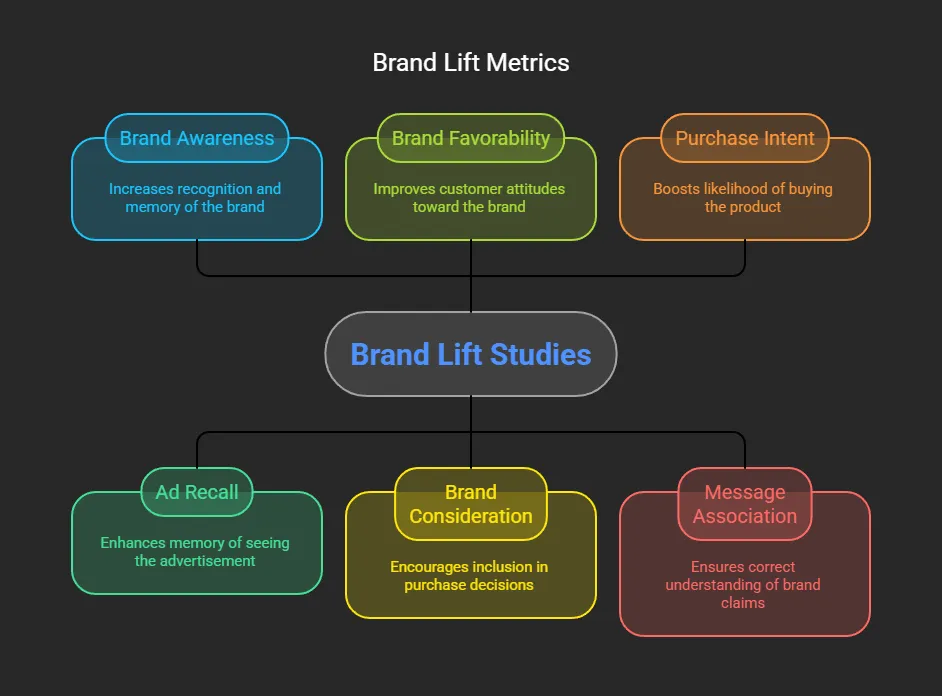
Brand awareness measures whether more people recognize or remember your company after exposure to advertising. For enterprise teams, this metric is useful for launches or awareness campaigns where immediate conversions are not the primary objective.
Ad recall measures whether people remember seeing your advertising. Google’s Brand Lift survey setup, for example, includes questions asking respondents which brands they have recently seen advertised in online video. It helps distinguish memorable creative from advertising that actually makes the brand more salient.
Brand favorability measures whether exposure improved how people feel about your brand. It is useful when the campaign aims to change perception, strengthen preference, or improve sentiment among audiences that may already know your company.
Brand consideration measures whether consumers are more likely to include your company in their shortlist when making a decision. This key performance indicator (KPI) can reveal whether greater visibility is actually moving consumers deeper into the funnel.
Purchase intent measures whether exposed consumers say they are more likely to buy a product or brand. Most brand lift study tools on platforms like Google and Amazon focus on purchase intent. This KPI is more middle- or even bottom-of-the-funnel and can be consequential in understanding the impact advertising is creating on sales.
Message association indicates whether survey respondents correctly associate a specific claim, positioning, or message with your brand. This matters when the goal is not simply recognition but communicating a particular value proposition.
Insider tip: We recommend tracking several of these brand metrics together. Strong recall paired with weak consideration, for example, may indicate that people noticed the advertising but found the proposition unpersuasive. This gives your team a clearer direction for creative or messaging changes than a single lift percentage.
Note on search and behavioral lift studies: Brand lift studies can complement other survey techniques, such as search lift or conversion lift studies, which examine metrics like branded search, website visits, and sales. They serve a different purpose but can provide additional context for understanding branding impact.
Brand lift studies typically use surveys with two groups: one exposed to the ads and one that’s not- that is, the control group.
But good brand lift studies take a systematic approach to survey questions, target audience, and ad creatives. Let’s see what that looks like in practice:
Start with one decision you need the study to inform:
These are just some examples. Your survey setup should follow the question you want to answer. For instance, Meta lets marketers adjust questions based on business needs, ad format, and the action the audience is supposed to take.
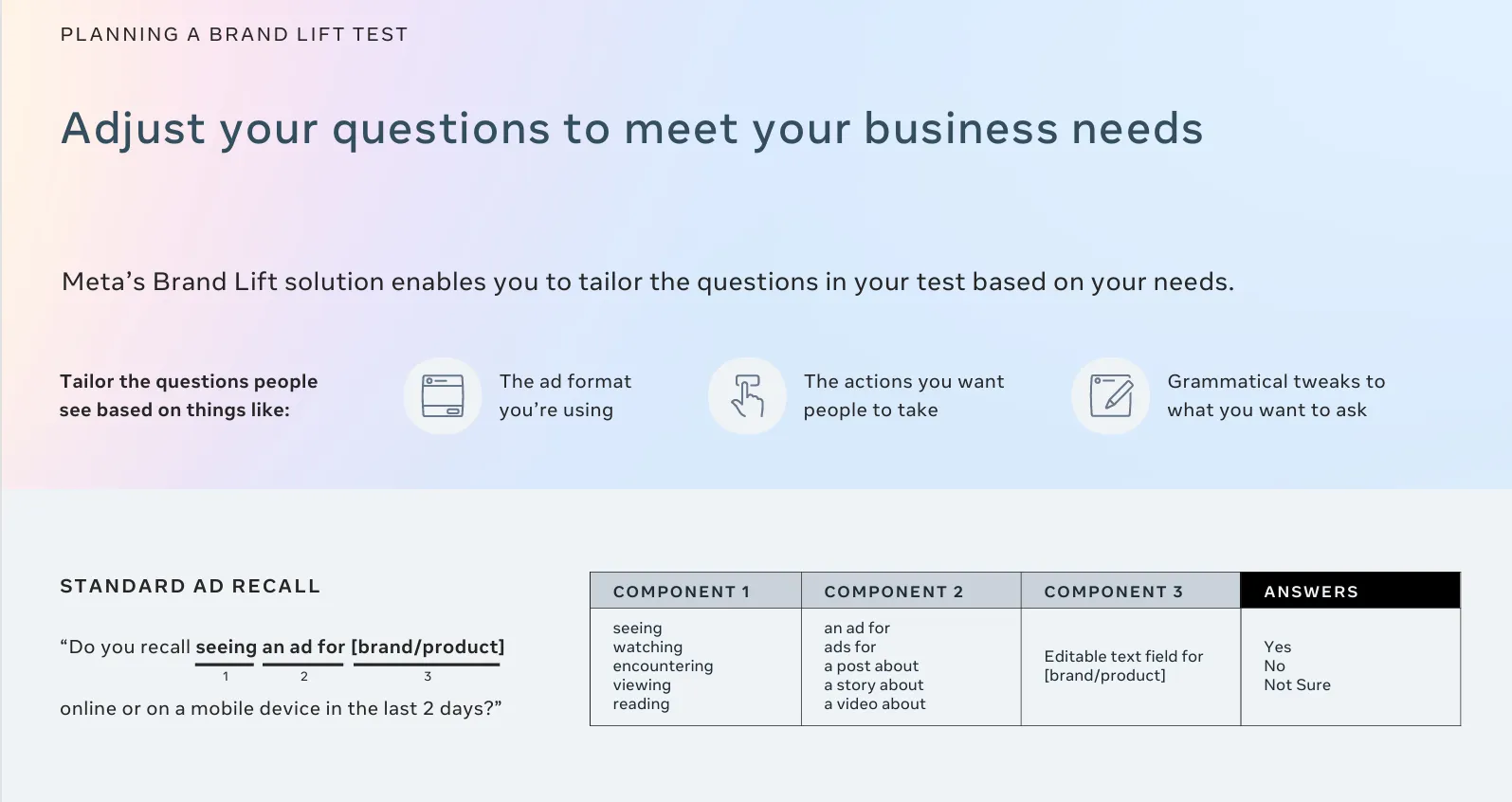
Create comparable randomized groups before interpreting lift. One test group is eligible for advertising while the other is withheld, creating controlled exposure.
TikTok, for example, randomizes part of the campaign audience into exposed and control groups. It also recommends supplying campaign IDs from recent campaigns so people who previously saw sponsored content do not contaminate the control population.
This is critical because poor holdout design can make ordinary audience differences look like advertising impact.
Define the exposure and survey periods before the campaign begins.
Amazon Brand Lift measures impressions daily and surveys panelists who were exposed during the previous two days. Selected panelists then have seven days to complete the survey.
For enterprise teams running overlapping media, we recommend documenting these windows in the media plan. This helps you identify overlapping activity that could influence the same audience and make the lift harder to attribute to one campaign.
Here’s a tutorial for running a brand lift study with Google Ads:
Both groups should receive equivalent questions and answer choices. Changing the wording across populations introduces another variable beyond advertising.
Pay particular attention to each respondent's experience: questions should be short, neutral, and closely tied to the original business hypothesis.
If you’re running self-serve tests on platforms like Meta and Amazon, you’ll get pre-populated question templates, which makes things easier.
Compare positive survey responses between exposed and unexposed audiences to determine the difference between them:
For example, if 38% of exposed consumers respond positively compared with 33% of the control group, the absolute lift is 5 percentage points.
Amazon uses this calculation in its brand lift reporting. It typically surveys at least 1,000 panelists in both the exposed and control groups and notes that smaller true lifts require more responses to establish statistical confidence.
Platforms may then translate the measured lift into additional reporting metrics. Meta, for example, can show the estimated number of people lifted, the cost per person lifted, and the percentage lift alongside the survey findings.
Here’s an example of how Meta presents and interprets brand lift results:
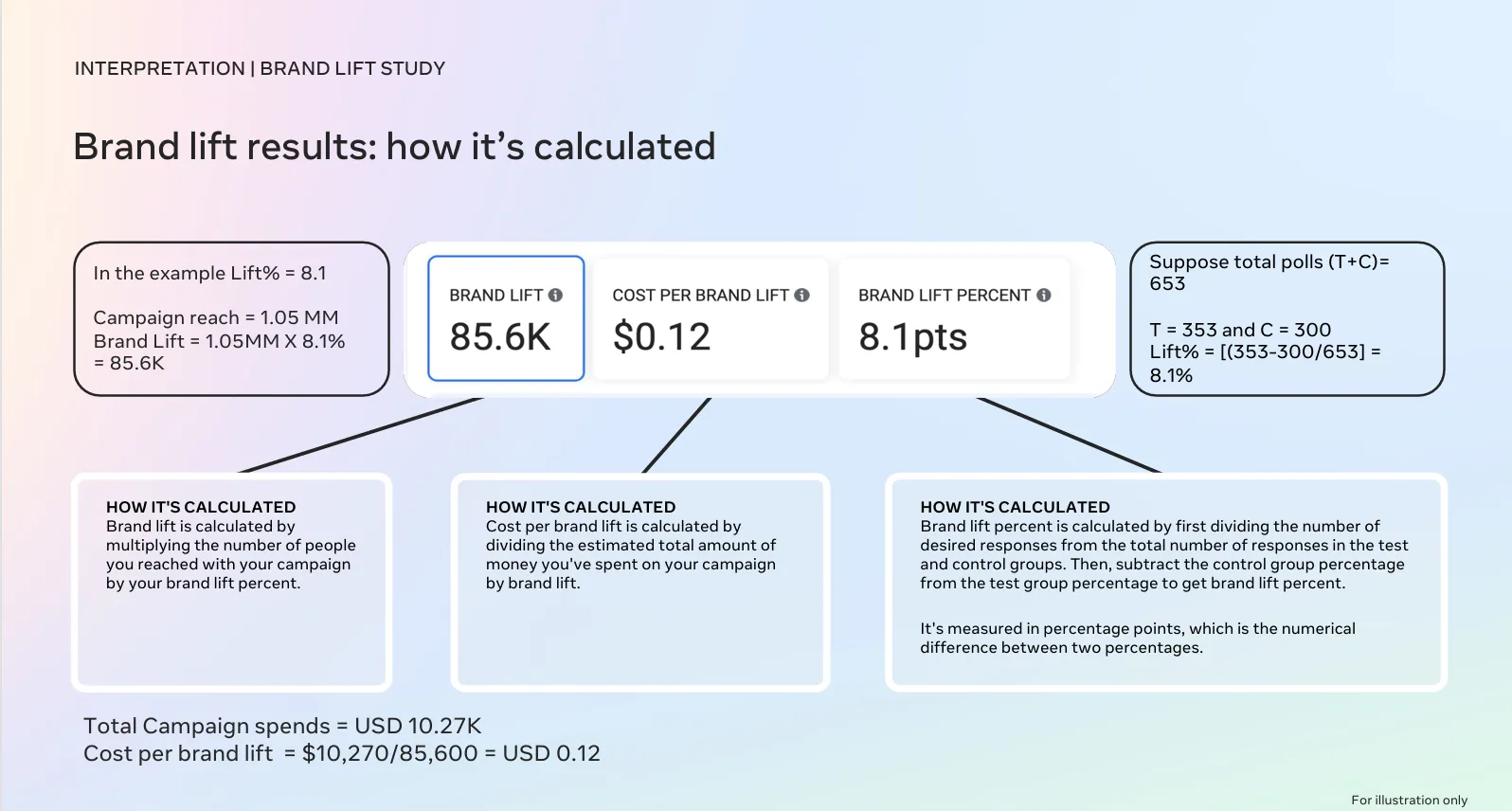
Finally, look beyond the headline number. Break lift down by demographics, frequency, device, or other meaningful audience characteristics where sample sizes support the comparison and such information is available.
For instance, Amazon allows you to analyze aggregated results across age range, household income, gender identity, ad frequency, ad type, and device. This can reveal that a campaign with modest overall lift is highly effective within a strategically important audience.
Insider tip: At Fieldtrip, we segment results only after the overall study design is established. We also avoid drawing firm conclusions from very small subgroups. This keeps the analysis focused on meaningful differences instead of statistically fragile cuts.
Run a lift study when the decision you need to make depends on proving incremental brand impact. These are the moments we believe are best for brand lift studies:
In short, invest in a lift study when its findings can change a real decision, like media allocation, launch strategy, messaging, or future campaign settings.
The right method depends on whether you need fast platform-specific feedback, independent market research, cross-channel measurement, or continuous tracking.
Virtually all major digital advertising platforms offer built-in brand lift study capabilities. These are easier to run, but they run in a closed ecosystem, so the findings are limited to that platform and its audience.
Platform studies may be self-serve or managed. With self-serve studies, your team handles the setup directly. Managed studies rely more on the platform or account team for configuration and analysis.
Question flexibility can also vary. Some platforms offer predefined survey questions, while others allow more customization. Google and TikTok, for example, place tighter limits on custom survey design than some independent research providers.
Here’s a look at the different platforms and their brand lift study features:
Independent studies are better when you need neutral measurement across publishers or media channels.
Providers like Nielsen and Kantar can measure campaign exposure against brand outcomes without relying solely on a platform's own reporting.
Nielsen’s Brand Lift solution measures campaign effects across media, while Kantar's Brand Lift Insights uses an exposed/control survey design. Kantar also reported that its Brand Lift Insights database contained more than 25,000 digital campaigns when it expanded independent YouTube measurement.
We generally favor this approach when an enterprise's media plans span social, video, audio, display, and Connected TV, because a common methodology makes channel comparisons easier.
GeoLift studies divide comparable geographic markets into treatment and control regions. Advertising investment differs across the treatment regions, while the control regions provide a baseline for comparison.
These studies are useful when user-level randomization is impractical or when you want to connect media exposure with regional sales and other business outcomes.
A Word on Brand Tracking: For continuous findings on your brand’s perception and impact, opt for brand tracking. It differs from a one-off lift test because measurement continues over time. Instead of asking only, “Did this campaign cause lift?”, you monitor whether consumer awareness, consideration, and perceptions are rising or falling across months or quarters.
An enterprise brand lift study, whether platform-specific or multi-channel, should follow the following practical tips:
Advertising influence develops across several stages. People may first notice a campaign, remember the message, form an opinion, consider the brand, and eventually take an action that contributes to revenue.
Brand lift studies are strongest in the earlier parts of that journey. They can show changes in awareness, recall, perception, consideration, and purchase intent, but those metrics alone cannot explain the full commercial impact of a campaign.
This is why enterprise teams need a wider measurement approach. Brand lift can sit alongside conversion lift, incrementality testing, attribution, and other methods that show what happens further down the funnel.
When these signals are assessed together, your team gets a clearer view of how media influences both perception and behavior. That makes it easier to evaluate campaign performance, refine creative, and make stronger investment decisions.
That same principle shapes Fieldtrip’s measurement services. We connect measurement across channels, platforms, and audience segments so teams can compare signals, validate performance, and understand where marketing is creating meaningful impact.
Speak with a measurement and testing expert at Fieldtrip to strengthen your enterprise measurement strategy.
Brand lift can be calculated by comparing the positive response rate of an exposed group with an unexposed control group. Absolute lift equals the exposed response rate minus the control response rate. Relative lift expresses that increase as a percentage of the control rate. Statistical significance determines whether the measured difference is reliable.
You can conduct a brand lift study on Google Ads by creating an eligible Brand Lift study, selecting the campaigns or products to measure, and choosing survey questions. Google separates users into exposed and control groups, serves surveys to both groups, and compares their responses to calculate lift attributable to advertising.
A brand lift study asks survey questions that measure how advertising changes consumer perceptions. It can measure metrics like ad recall, awareness, consideration, favorability, and purchase intent. Respondents typically identify or evaluate the advertised brand through their answers.
The main difference between a brand lift study and a conversion lift study is what they measure. Brand lift measures changes in consumer perception, including awareness, consideration, and purchase intent. Conversion lift measures incremental actions, such as purchases, sign-ups, or other conversions, caused by advertising compared with a control group.
Brand lift studies can’t directly measure incremental sales. They primarily measure changes in consumer attitudes and perceptions. To measure sales lift, use a conversion lift study or a sales-based experiment to determine whether advertising drove additional purchases.
The minimum spend required for a brand lift study varies by platform and even country. They can also vary by campaign configuration, study duration, and the number of lift metrics measured or questions in the survey.
Fieldtrip uses brand lift studies as part of its testing and measurement services. We recommend brand lift studies to test new messaging or for executive reporting. We can run brand studies on Google, Meta, and TikTok.