

























Enterprise marketing teams are being sold a compelling vision of generative AI marketing: more ad creatives, more personalization, faster campaign launches, and an almost unlimited content supply chain.
The pressure behind that vision is real. Adobe’s 2025 research involving more than 1,600 marketers found that 96% had experienced at least a twofold increase in demand for content during the previous two years, while 62% said demand had grown fivefold or more.
Generative AI appears to offer exactly what marketing leaders need. Tools such as ChatGPT, DALL-E, Midjourney, and Gemini can produce campaign concepts, social copy, ad variations, localized messaging, images, and video assets within minutes.
For teams trying to serve multiple channels, markets, and audience segments, that level of production speed is hard to ignore. You can create more assets without increasing headcount, production costs, and campaign timelines at the same rate.
And major enterprises are already testing that promise in public.
Coca-Cola launched its “Create Real Magic” platform early on in 2023 using OpenAI’s GPT-4 and DALL-E. The idea was to let digital artists generate work using some of the company’s most recognizable brand assets. It later expanded its experimentation with AI-generated content into major advertising productions, including its holiday campaigns.
These examples show the speed and production capabilities of generative AI. What they don’t necessarily prove is that AI can provide the strategy behind the work.
This distinction matters.
Generative AI-powered marketing still needs data backing, tested ideas, and expert oversight. It can scale a distinctive brand voice, a strong customer insight, or a well-defined creative hypothesis. But it can just as easily multiply generic positioning, weak audience assumptions, inconsistent messaging, and ad creatives built around the wrong goals.
The same risk applies whether your enterprise manages creative internally or works with an external creative agency. Faster production has little value when the strategy guiding it is flawed.
The first thing enterprise marketers should understand about generative artificial intelligence, particularly for ad creatives and copy, is that it relies entirely on direction. Its output reflects the quality of the brief, customer information, audience data, and assumptions supplied by the marketing team.
That essentially creates three distinct limitations:
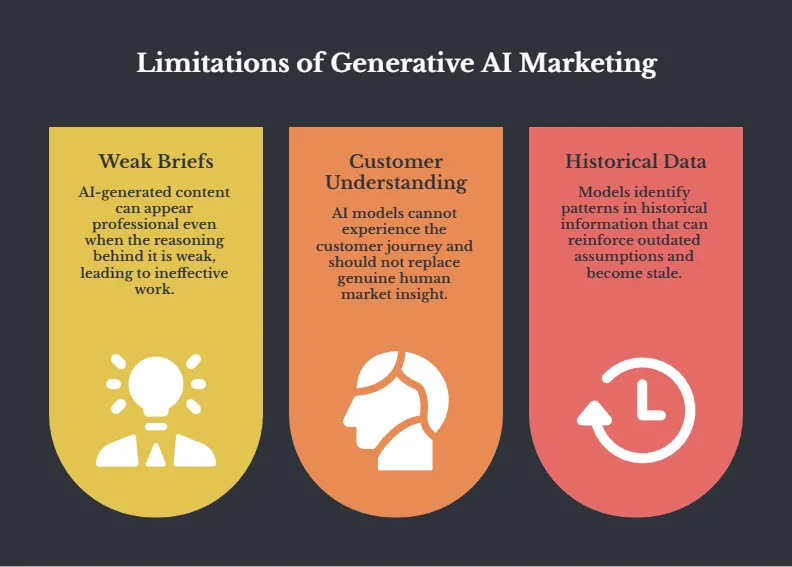
AI-generated content can appear professional even when the reasoning behind it is weak.
In a 2023 Harvard Business School study of 758 Boston Consulting Group employees, consultants using GPT-4 performed some suitable tasks 25% faster and produced work rated 40% higher in quality.
However, on a more complex task that fell outside the model’s capabilities, AI users were 19 percentage points less likely to reach the correct answer. The output could still sound persuasive, making the underlying error harder to detect.
The AI models have improved significantly since then. But the problem still applies to ad creatives. A vague prompt or poorly constructed brief may generate polished headlines, images, social media captions, and video concepts, but it may not perform well in the real world.
And that’s typically because of factors like unclear positioning, an irrelevant offer, or the wrong campaign goals.
Prompt engineering can improve execution, but it can't replace a clear creative hypothesis explaining who the customer is, what they need, and why they should respond.
Generative AI models can summarize customer data or simulate buyer personas, but simulated customer responses should not be treated as genuine market insight.
A 2026 Marketing Science study found meaningful differences between LLM-generated and human research data. Simply replacing real respondents with AI-generated responses could increase bias, while the researchers concluded that synthetic data worked better as a complement to human research than as a direct substitute.
Keep in mind ChatGPT, Gemini, and other AI tools don’t experience the customer journey, use the product, negotiate an enterprise buying committee, or explain why a message feels untrustworthy.
Marketing leaders still need interviews, sales feedback, behavioral research, and first-party customer data to understand the real problem, particularly when advertising isn’t having the desired effect.
AI can organize those details and support marketing segmentation, but it should not invent the insight the campaign depends on.
Machine learning models identify patterns in historical information, but customer behavior, market conditions, language, and expectations change.
Google’s machine learning guidance warns that statically trained models can become stale as data patterns shift. This causes predictions to deteriorate unless organizations continually monitor and update their inputs.
In the context of paid media creative generation, past performance can become a strategic trap. A content creation system trained on yesterday’s highest-performing ads may repeatedly reproduce familiar messages, formats, and audience stereotypes instead of identifying new needs.
Historical data is still very important for creative A/B testing and campaign planning. But human oversight is needed to question whether yesterday’s winning pattern still reflects today’s customer, brand voice, competitive environment, and growth goals.
The internal business case for AI creative usually focuses on faster image and video production, lower costs, more variations, and easier personalization. Those benefits are valid.
Your audience, however, does not evaluate an ad based on how efficiently your team produced it. Customers care about whether the creative feels credible, relevant, emotionally engaging, and consistent with the brand. They may also react to the fact that the ad was generated with AI.
Research so far shows that consumer opinion remains mixed.
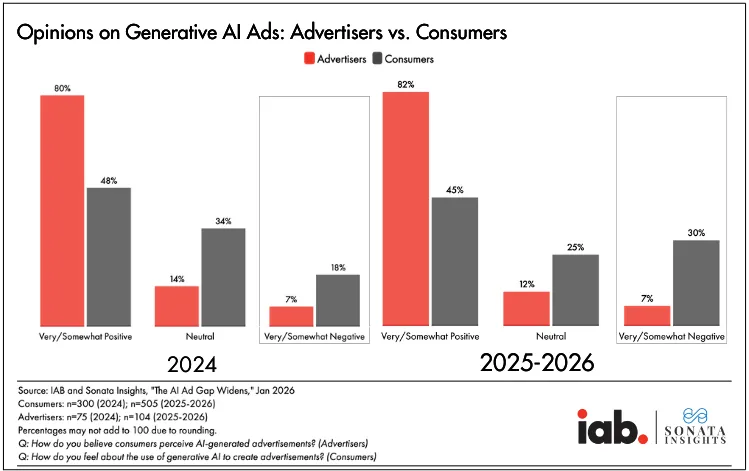
The 2026 IAB research with Sonata Insights found a significant gap between how advertisers believe audiences feel and how audiences actually respond.
While 82% of advertising executives believed Gen Z and Millennial audiences viewed AI-generated ads positively, only 45% of consumers shared that opinion.
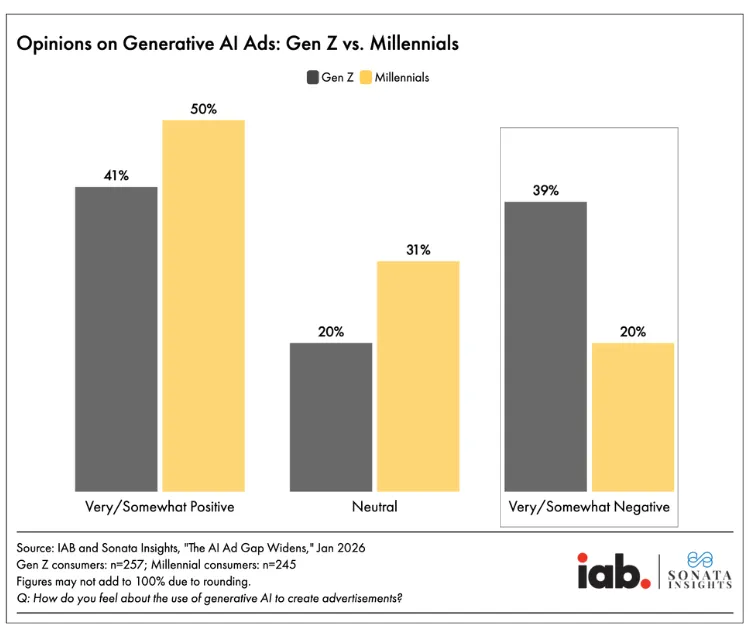
The divide was more pronounced among Gen Z respondents, 39% of whom felt negatively about AI ads, compared with 20% of Millennials. Consumers were also twice as likely as advertising executives to describe brands using AI creative as “manipulative.”
This doesn’t mean disclosure always harms performance. In the same IAB study, 73% of Gen Z and Millennial consumers said knowing an ad was created with AI would either increase their likelihood of purchasing or make no difference.
Clear disclosure was also one of the stronger drivers of attention. These findings suggest that transparency can reduce suspicion for some audiences.
However, research from the Nuremberg Institute for Market Decisions shows why enterprises can’t assume disclosure automatically creates trust.
NIM surveyed 1,000 people in each of the US, UK, and Germany. Only 20% said they trusted AI itself, while 21% trusted AI companies and their claims.
The researchers also ran controlled experiments using identical advertisements. Participants rated the ads less favorably when they were labeled as AI-generated. They considered them less natural and less useful and showed less interest in researching or purchasing the products.
The response also depended on the product. Participants were more accepting of AI-generated ads for innovative and technology-focused products. Resistance was stronger for traditional products.
These studies may appear contradictory, but that tension reveals the real issue. There is no single audience response to AI creative.
Reactions can change based on:
You cannot treat AI disclosure as a universal trust signal or a guaranteed performance risk. You need to test how your specific audience responds within the context of your brand, product, and campaign.
The truth is that generative AI has created real value for marketing. This is particularly true at the enterprise level, where creative production challenges include churning out hundreds of creatives for dozens of campaigns across different markets.
The speed and efficiency are undeniable. But to reap those benefits without compromising on performance, consumer trust, and brand image, marketers need to take a more strategic approach to AI creative production.
A strategy-first approach doesn’t reject generative AI. It gives AI a defined role within the marketing process. The technology is used to accelerate execution, expand testing, and reduce repetitive work only after the business problem, customer insight, and creative direction are clear.
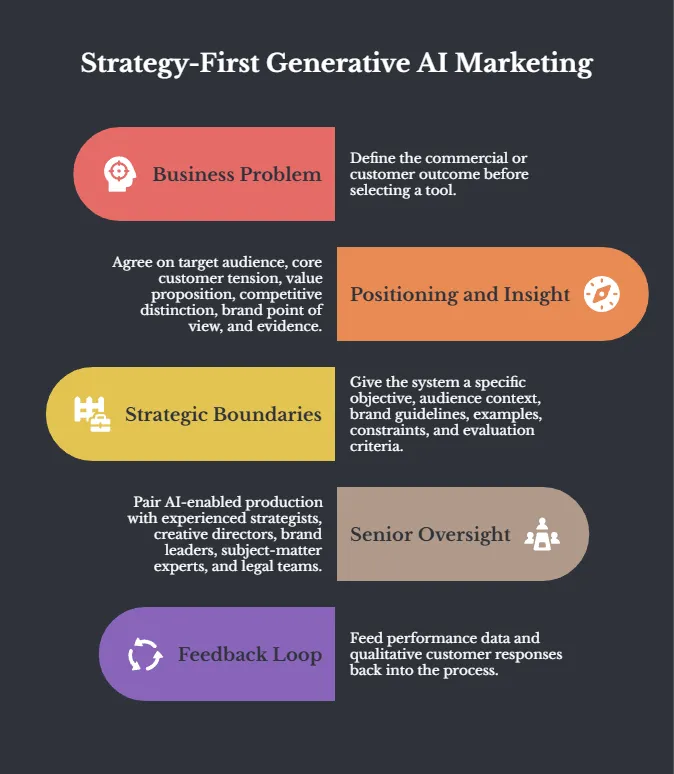
The process should begin with the outcome the marketing organization needs to influence. This problem might be declining customer acquisition efficiency, weak brand awareness in a priority market, low conversion among a specific buyer persona, or poor retention at a particular stage of the customer lifecycle.
Once the problem is defined, you can decide whether generative AI is genuinely useful. It may help create more ad variations for A/B testing or adapt content across audience segments.
But if the actual problem is a weak offer, unclear positioning, poor customer data, or an ineffective media strategy, automated content creation will not solve it.
Before prompting your preferred content generation tool, you should know:
Most importantly, buyer personas and marketing segmentation should be based on real customer research, sales insights, customer support conversations, performance data, and competitive analysis
The strongest prompts are downstream of strategy.
They translate an established point of view into specific copy and creative instructions, including the brand's tone, message hierarchy, visual boundaries, objections to address, and campaign goals.
AI can generate multiple expressions of that idea, but it should not invent the strategic foundation behind it.
Enterprises should define where generative AI may operate independently, where approval is required, and where its use is inappropriate.
These boundaries should be documented through governance frameworks covering privacy, customer data, copyright issues, security, disclosure, approved AI models, and legal and regulatory policies. That way, your own team or an agency partner has clarity on what kind of asset can be generated with AI.
A controlled test environment can also help teams assess new tools before they are connected to the wider MarTech stack or content supply chain.
Don’t remove experienced strategists and creative leaders from the process. Senior oversight is needed to determine whether the AI-generated work reflects the brand voice, supports long-term positioning, and makes an intentional strategic choice.
Marketing leaders must also judge risks that AI can’t fully evaluate. A concept may meet the brief but still feel inappropriate for the cultural moment, create tension with another campaign, or conflict with what senior leadership will approve.
Human accountability should remain clear, particularly when AI-generated content affects reputation, customer experience, ethical safeguards, or regulated claims.
Strategy-first AI marketing treats every output as a hypothesis. AI-generated content should be tested against human-developed alternatives using meaningful measures like incremental conversions, qualified leads, brand lift, customer sentiment, retention, and revenue.
The results should then improve both the creative strategy and the AI inputs.
Winning messages, customer responses, rejected ideas, compliance concerns, and channel-specific lessons can be documented and fed back into future content creation workflows.
Over time, this creates a more useful system in which generative AI supports institutional learning instead of repeatedly generating disconnected batches of content.
The cost and speed benefit is attractive, but AI-generated creatives may not work for every company, market, or situation. And besides, generative AI content in marketing isn’t free.
At the enterprise level, you’ve invested in software licenses and dedicated team members to use those tools. So, before allocating creative budget to this mechanism (however small), ask yourself:
Generative AI creates the most value when it supports well-defined marketing processes. The strongest use cases usually involve organizing information, expanding approved ideas, and reducing repetitive work across the content supply chain.
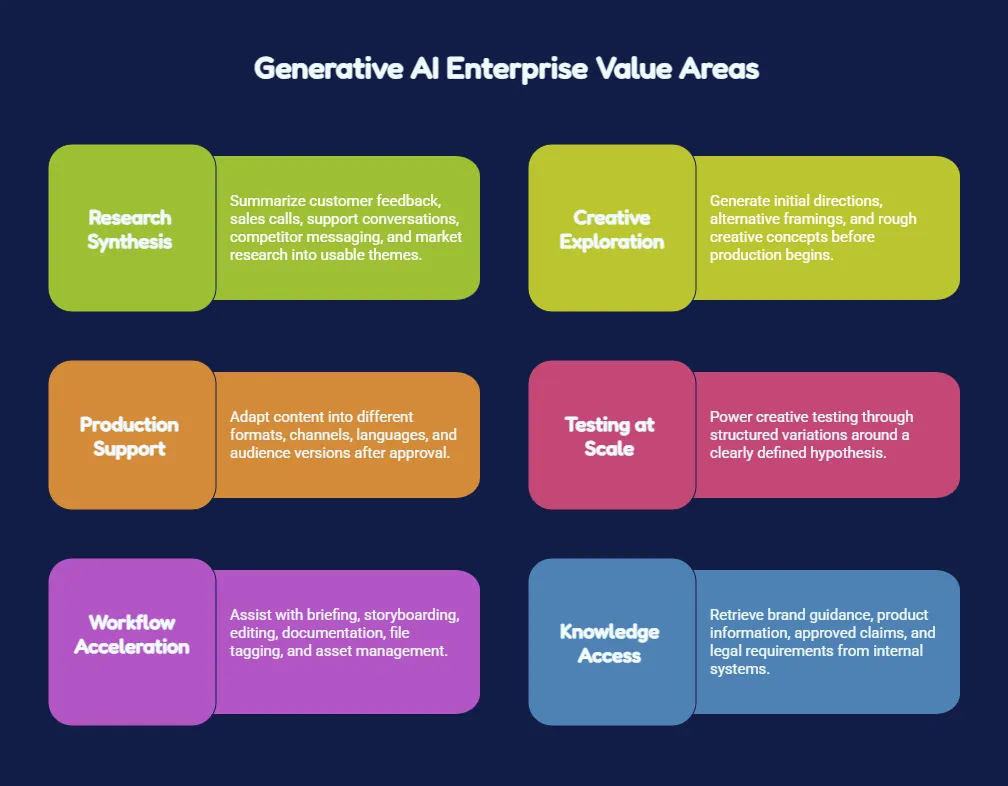
Generative AI can summarize customer feedback, sales calls, support conversations, competitor messaging, and market research into usable themes. This helps teams process large volumes of information faster and identify recurring objections, needs, and language patterns.
And that learning can inform the next campaign’s creative decision, whether or not they end up getting made with AI.
AI tools can help marketing teams generate initial directions, alternative framings, and rough creative concepts before production begins. This can widen the range of ideas considered and help teams move beyond the first obvious solution.
It can let non-creative team members pitch ideas, too, or create campaign assets, based on detailed guidelines, of course.
In the 2026 Adobe AI and Digital Trends Report, 70% of respondents said gen AI improved the ability of non-creatives to generate content. This means more hands on board when the team is stretched thin.
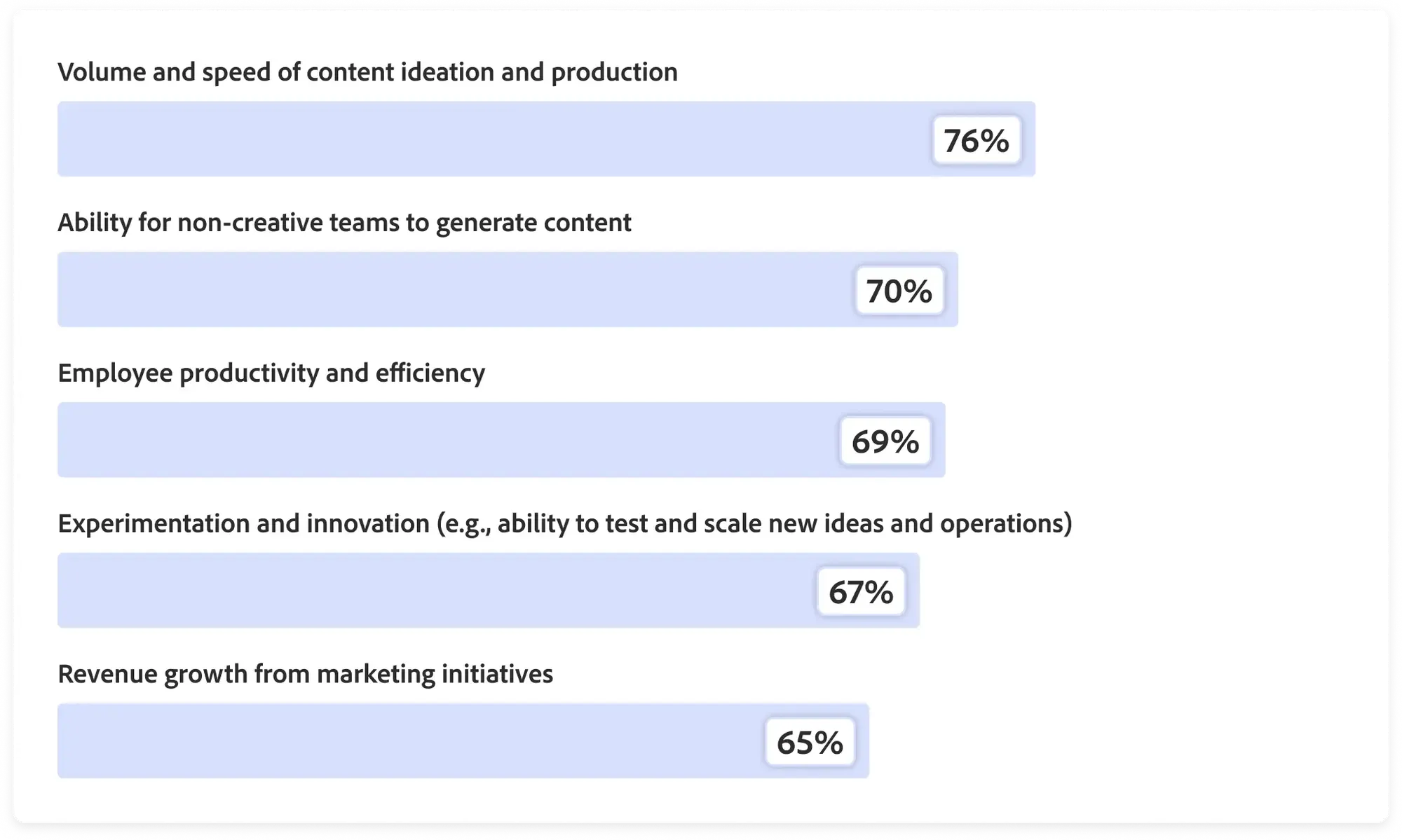
76% of marketers in the Adobe survey also said that generative AI improved ideation and production
Once an idea, brand voice, and message hierarchy have been approved, generative AI can adapt content into different formats, channels, languages, and audience versions. It can support all kinds of instances in marketing where speed matters, like social media reaction posts, display ads, email campaigns, and images/videos for the website.
This improves cost-effectiveness while keeping the core concept consistent across markets and platforms.
Generative AI can power creative testing for large brands through structured creative variations around a clearly defined hypothesis. For example, you can test different benefits, emotional angles, calls to action, or audience pain points.
This makes A/B testing faster and gives teams more evidence about which elements influence performance. The variations should remain controlled, so the team can understand what actually caused the result.
Even if the creative to be used in the advertising campaign isn’t AI-generated, AI can still be instrumental in getting it done right through workflow support.
Briefing, storyboarding, editing, documentation, file tagging, and asset management across content creation workflows can be done with the help of generative AI models. And many marketers are already using AI in many different ways.
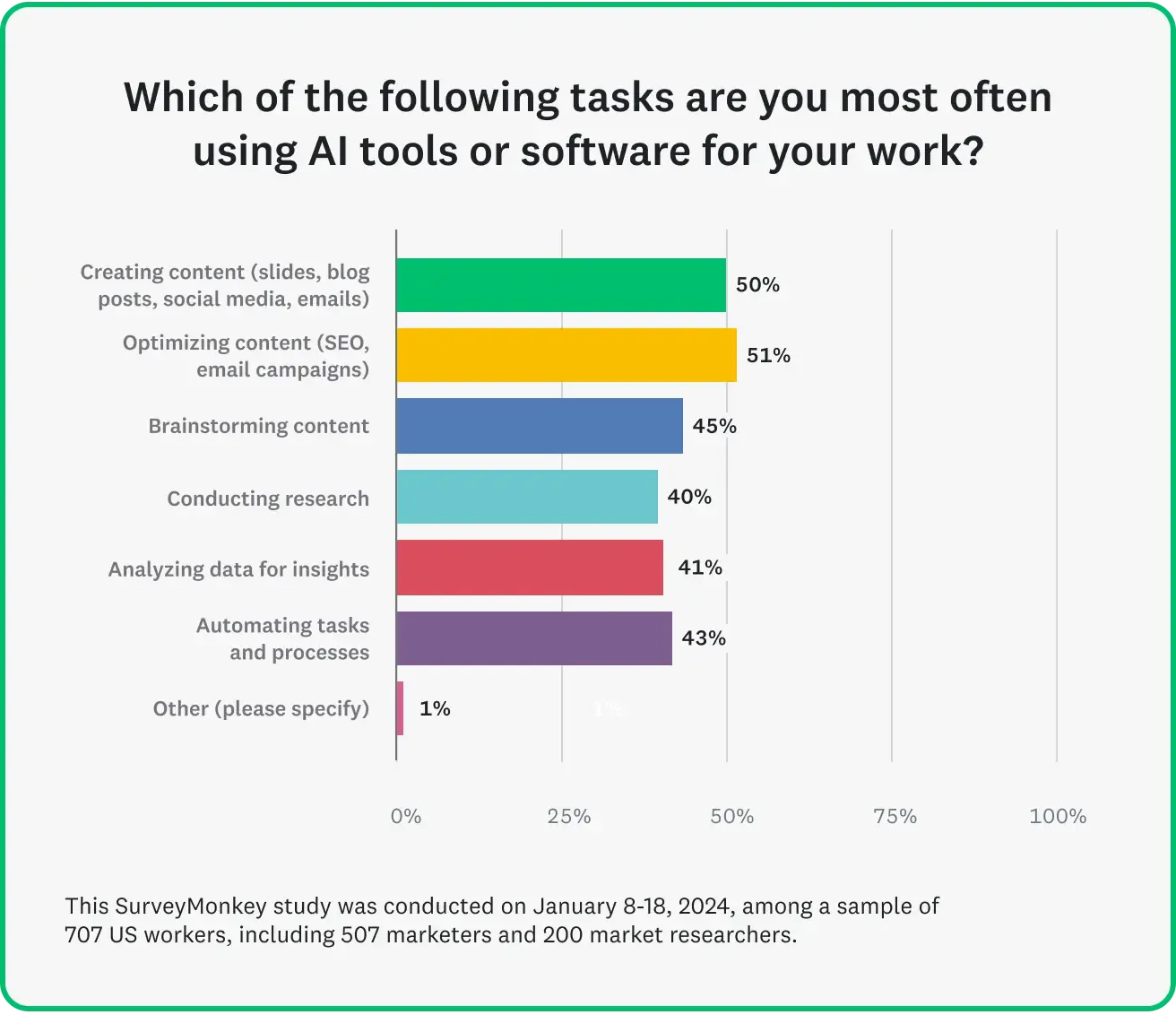
These applications reduce administrative work and help employees spend more time on strategy, review, and decision-making. Agentic AI may eventually automate more of these handoffs, but clear approval points and governance frameworks are still necessary.
Generative AI can help teams retrieve brand guidance, product information, approved claims, legal requirements, and past campaign learnings from internal systems.
With assistants like Claude Cowork, chatbots can be integrated into the work ecosystem, which makes information gathering faster.
This gives employees quick access to the details they need and reduces the risk of inconsistent messaging. The system is only reliable, however, when its knowledge sources are current, accurate, secure, and properly governed.
Generative AI can help enterprise marketing teams research faster, test more ideas, and produce content at unprecedented scale, but it can’t decide which customer problem a brand should own, what position it should take, or why an audience should care.
These choices still depend on customer understanding, organizational context, creative judgment, and accountable leadership.
At the end of the day, success isn’t a numbers game (generating the most AI content), but smart use of quick AI generation with reliable insights and strong governance.
When the strategy is strong, AI multiplies its impact. And when the strategy is weak, it simply forces the business to make the wrong decisions faster.
The creative services offered by Fieldtrip balance the efficiencies of AI models with human expertise to plan, produce, and optimize creatives for the diverse paid media space most enterprises operate in.
Book a free strategy call with us to discuss your brand’s creative direction in the age of Gen AI.
One example is a retailer using generative AI to create several versions of the same campaign for different customer groups. The tool can adjust the headline, product image, offer, and social copy for new customers, repeat buyers, or high-value shoppers. However, the marketing team still sets the audience insight, message, brand rules, and campaign goal before AI produces the variations.
AI creatives can work in paid media campaigns when marketers use them to produce and test multiple ad variations. AI-generated images, videos, headlines, and calls to action can improve testing speed and reduce production costs. Performance still depends on audience targeting, brand consistency, platform policies, offer quality, and human review.
Although not a universally accepted technical standard, in marketing, the 30% rule of AI describes using AI to complete or accelerate about 30% of a workflow while humans control strategy, judgment, brand standards, and final approval (the 70%).
Generative AI can help performance marketing by accelerating creative production, personalization, testing, and campaign analysis. Marketers can use it to generate ad variations, landing-page copy, audience-specific messages, and testing ideas.
