






















For large-scale brands running 6-figure campaigns across multiple channels, creative production can quickly become a hurdle when it should really be the way to win with marketing. As a performance creative agency, we know firsthand how impactful ad assets can be in achieving desired outcomes.
A lot of it comes down to the sheer amount of resources required to make creatives. In fact, 61% of marketing teams cite limited time, budget, or staff as barriers to creative progress.
On top of that, enterprise marketers also face the challenge of consistent branding across different markets. That’s because many brands, particularly FMCG, have a global presence.
Well, we’ve created the ultimate guide for your team to tackle creative production challenges head-on with tactics we use daily to turn out stellar, ROI-boosting assets.
P.S. Struggling to scale creative without losing speed, control, or performance? Fieldtrip can help you build integrated growth systems that unify creative, media, and measurement into one streamlined engine. Contact us to build infrastructure that moves as fast as your ambition.
The stakes of creative production at the enterprise level stretch far beyond simply creating compelling content. In fact, they extend into operational complexity where challenges multiply quickly as creative output scales.
Unlike smaller teams, enterprise marketers contend with intertwined pressures that affect workflow efficiency, brand alignment, and time and resource constraints.
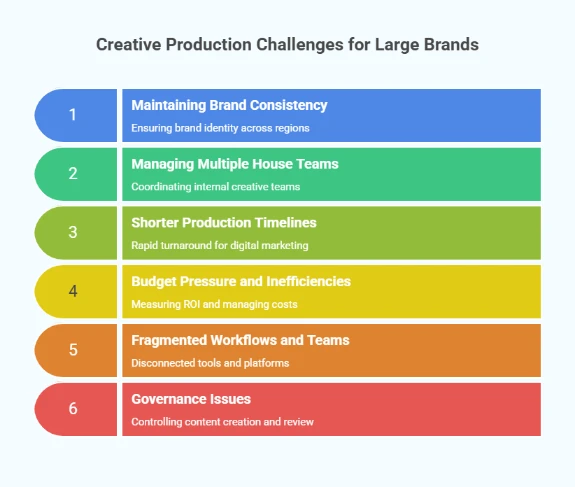
Below are the key dynamics that make creative production uniquely demanding at scale:
This approval friction is not theoretical. It is an operational reality inside many enterprise organizations. As one enterprise social media marketer explains:
“Every post I create needs approval at multiple levels. Usually, I coordinate closely with product teams, and sometimes even SBU heads provide feedback. Once they approve, I need the CMO’s green light, and then finally approval from the VP of Sales and Marketing.”
Besides all that, creative work can be a challenge in its own. Brainstorming and conceptualizing ideas, especially for conversion, can be a tall order. The video below explains why:
The factors that make creative production different for enterprises are, in themselves, challenges. However, there’s even more. And if you’re a marketer or a leader overseeing marketing for a Fortune 500 company, you’d recognize these hurdles easily, especially if you focus on digital marketing channels.
One of the toughest challenges for large organizations is ensuring that every piece of creative content resonates with local audiences without eroding the core brand identity.
In distributed enterprises, misaligned messaging and off-brand visuals can damage credibility and tank customer trust.
Consumers increasingly expect unified experiences. For instance, 60% of US millennials say consistent brand interactions matter in their purchasing decisions.
Centralized digital asset management (DAM) and brand templates help, but without governance, teams still risk creating dozens of variants that feel disconnected from the brand.
Large brands operate with multiple internal creative teams, from in-house studios to regional designers and even external agencies. Without shared systems, these teams end up replicating work and creating redundant creative assets.
Another issue is that teams sometimes use different tools that don’t sync. When creative, media, and brand teams operate in disconnected environments, alignment breaks down.
In our experience, the real issue is not talent, but coordination. Without shared dashboards, feedback loops, and centralized asset visibility, execution drifts away from strategy.
Modern digital marketing calls for a rapid turnaround. You need to produce and refresh ads weekly or even daily across channels like TikTok, Meta, and programmatic platforms to combat ad fatigue and remain competitive.
One trend report notes that marketers use an average of 10 channels. This means there can be a variety of content and creative production needs.
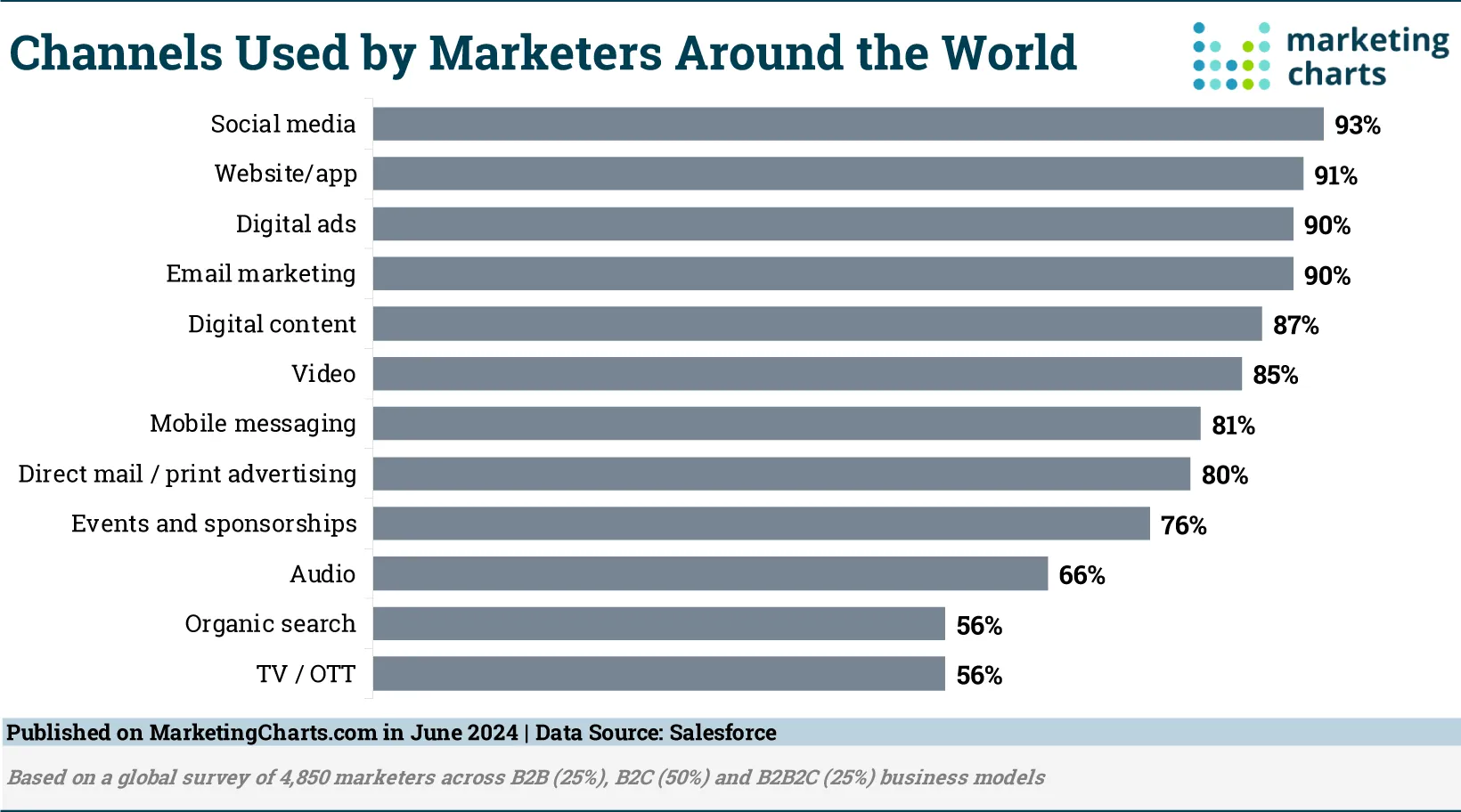
While some assets overlap, most platforms demand native formatting, unique hooks, and tailored messaging. And all that work needs to be done fast, as brands need to stay engaged constantly and fight creative fatigue for paid ads.
In our daily practice supporting paid social teams, we have learned that speed without structure leads to burnout.
Managing who can change what, where, and how becomes complex at enterprise scale. Governance challenges are uniquely a pain point for enterprises. When teams create unauthorized or “rogue” content that hasn’t undergone centralized review, brand reputation is at risk.
Without clear governance, creative processes degrade into fragmented practices that undermine quality. But in the worst-case scenario, it can let problematic creatives through and spark backlash (the last thing any brand wants).
There are examples of such blunders all over. H&M, the Swedish apparel brand, posted an offensive product image that its creative team failed to flag, likely due to a lack of cultural understanding or guardrails against racial tropes.

Despite producing vastly more content, many enterprise teams still struggle to measure the ROI of creative projects. According to industry benchmarks, only about 27% of brands actively track the ROI of their content investments.
Without clear attribution frameworks, creative budgets face increased scrutiny, and teams must justify every production expense. Meanwhile, expectations for high-volume, high-quality content continue to escalate across channels.
At the same time, the cost of production tools, creative software, asset management systems, and visualization platforms increases overhead. From what we have seen across enterprise accounts, inefficiency compounds quietly until costs outpace measurable impact.
Workflows across different creative production stages (ideation, drafting, review, revision, and distribution) are sometimes spread across disconnected tools and platforms. This fragmentation creates data silos, inconsistent asset versions, and duplicated effort, particularly when teams use different project management or creative platforms that are not integrated.
Remember that organizations without synchronized systems produce inconsistent work more slowly. And this leads to burnout and missed deadlines.
Further reading: The Role of Brand Refresh in Global Marketing Strategy
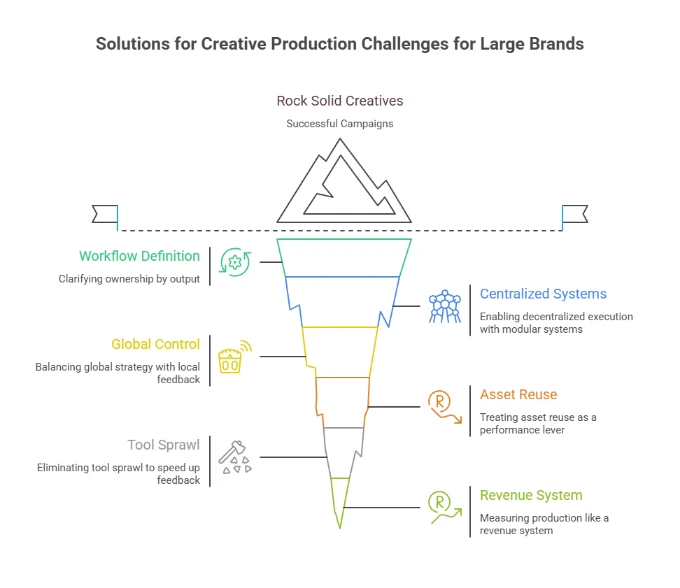
The challenges are many, but they’re not impossible to tackle. In fact, with the right processes, policies, workflows, and tools, a team producing content at scale can prevent issues that slow production.
These are the very strategies we use when handling performance creative production for large-scale brands.
Many enterprise teams organize creative processes around internal hierarchy rather than actual workflow, which creates inefficiency and delays.
We recommend mapping workflows by throughput (the flow of work from ideation to post-production). This way, each step, from briefing to final asset, is optimized for speed and quality.
For example, we use centralized project management tools to route creative tasks dynamically among creators, reviewers, and approvers based on capacity and deadlines. This allows teams to automate repetitive assignments, gather feedback early, and reduce cycle time by up to 40%.
Design workflow based on work stages (concept, draft, review, finalize, distribute) rather than administrative silos. Most project management tools allow some flexibility in terms of tags and fields, so you can easily adjust stages and handovers for a particular type of task.
Expanding on the first point, large enterprise marketing teams must centralize creative content and governance while enabling regional teams to act with agility and autonomy.
In addition to a fully integrated project management platform, it can be beneficial to invest in a digital asset management (DAM) system that integrates with creative production tools. It basically becomes the hub for storing approved creative assets, dynamic templates, and brand guidelines.
This can also make it easier for different teams or members to access creatives from others. For example, at Fieldtrip, our teams sometimes share assets in a centralized repository when working on different channels for the same brand (like SEO + paid social).
Centralizing assets ensures global standards are maintained, while decentralized execution empowers local marketers and in-house teams to adapt and distribute content that resonates with specific audiences and markets.
Large brands win when they stop forcing a one-way, top-down creative process and instead design systems that align global brand control with local, data-driven performance inputs.
In simpler terms, maintain a higher level of control through guidelines and policies, but give local teams creative control. That’s also important from a localization and personalization perspective.
Since they’re in the market and understand the audience better, they can design creatives that hit the mark just right. Remember, every market is different, and that should be reflected in the creative for both digital and offline advertising.
Also, this means using platforms that connect performance data directly to creative decisions. For example, when local markets can flag that a specific ad format or message is driving higher engagement or lower churn, those insights can inform global templates and future campaign iterations.
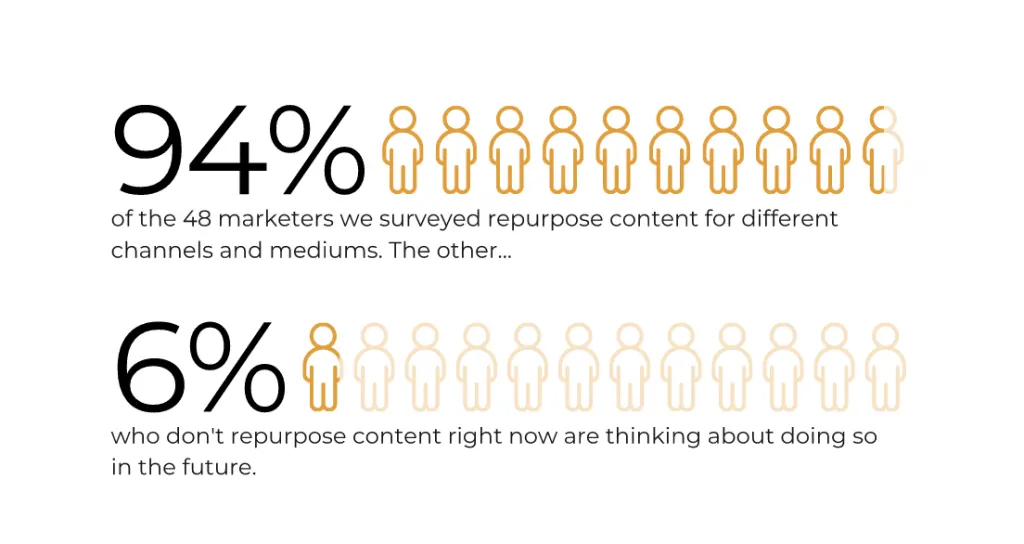
One of the best ways to tackle time and resource constraints with creative production is asset reuse. And yes, it’s also a cost-saving tactic.
When teams intentionally design creative assets for reuse, adaptation, and refresh, they reduce rework, accelerate timelines, and increase productivity across the entire production process.
Of course, this shouldn’t come at the expense of quality or performance. Reusing the same asset for paid media is a recipe for ad fatigue.
We suggest starting with modular thinking: breaking campaigns into reusable components (headlines, CTAs, visuals, motion elements) that can be recombined across ad formats, channels, and markets using approved templates.
Again, brands that centralize these assets in a shared platform and pair them with automation software (like Google Performance Max or Facebook Dynamic Creative) can quickly and efficiently refresh content to combat ad fatigue.
Also, measure reuse as a metric and track how often assets are repurposed, how reuse impacts speed to market, and how refreshed creative influences engagement and ROI.
As creative production scales, tool sprawl becomes one of the most damaging and least visible creative challenges for large brands.
When ideation lives in one system, production in another, review and approval in email or chat, and performance data in another system entirely, teams lose speed, context, and alignment. This disconnect slows feedback loops, increases rework, and makes it harder to ensure high-quality output under tight deadlines.
What you need instead is a handful of tools, or ideally a single system where creative workflows live. This becomes easier with integrations.
For instance, at Fieldtrip, we use a project management platform like ClickUp that integrates seamlessly with the tools our creative teams use. That way, creative assets are shared easily and go through edits and approvals quickly.
We find that with integrated platforms, teams can collaborate more openly, act on feedback faster, and make decisions based on shared, data-driven insights rather than fragmented inputs.
To truly scale creative production, large brands must stop treating it as a cost center and start managing it like a revenue system with clear, measurable outcomes.
That means defining and tracking the right metrics across the entire creative workflow. This also includes operational signals such as cycle time, asset reuse rate, cost per asset, and volume produced per creative team.
Remember, missed timelines, excessive rework, approval delays, and underutilized assets can all directly lead to lost ROI. So, it’s better to treat creative production as a revenue system and govern it with the right benchmarks. Given the volume of work enterprises produce, it should be easier to gather enough data on creative production. Use those insights to bring about improvements.
One way large enterprises can tackle creative limitations and challenges in marketing is by turning to professional creative agencies. When agencies take over creative production, or better yet, designing and executing marketing campaigns, the enterprise itself is free to focus on the big picture stuff.
Here’s how agencies improve creative production for both organic and paid marketing projects:
One of the biggest advantages agencies offer is elastic capacity. Large brands experience fluctuating demand (such as during product launches, seasonal campaigns, and market expansions) that can overwhelm even well-run in-house creative teams.
Agencies allow you to scale creative production up or down without permanently increasing headcount, infrastructure, or overhead. This flexibility is partcularly valuable for high-volume campaigns that require rapid asset creation across multiple ad formats, where internal teams would otherwise face burnout, missed deadlines, or compromises in quality.
Agencies that specialize in data-driven and digital marketing workflows, by design, move faster than enterprise organizations. As a result, they can easily adopt shorter timelines, produce more variations, and iterate quickly to reduce ad fatigue.
At Fieldtrip, we combine automation tools, structured templates, and performance feedback loops to experiment and learn from different creatives. That, in turn, helps us fine-tune campaigns even further.
Well-integrated agencies act as operational hubs. They help brands centralize creative assets, documentation, and feedback across stakeholders.
Instead of fragmented email chains and disconnected systems, agencies often enforce disciplined workflow management, clearer version control, and structured review and approval processes. This reduces disconnect, minimizes rework, and improves collaboration among brand, media, legal, and production teams.
In our daily practice managing multi-market campaigns, we have built systems that coordinate production across time zones seamlessly. With teams distributed across regions, we maintain continuous momentum, accelerate review cycles, and consistently deliver ahead of deadlines.
Good agencies bridge the gap between performance data and creative ideas. They look at campaign results, engagement signals, and metrics tied to business goals to adjust messaging, formats, or personalization logic.
This ability to translate real-time, data-driven insights into actionable creative direction helps brands align creativity with ROI.
We always follow this approach. From the minute a campaign goes live on any platform, our analysts monitor performance and work with strategists and designers to further refine creatives.
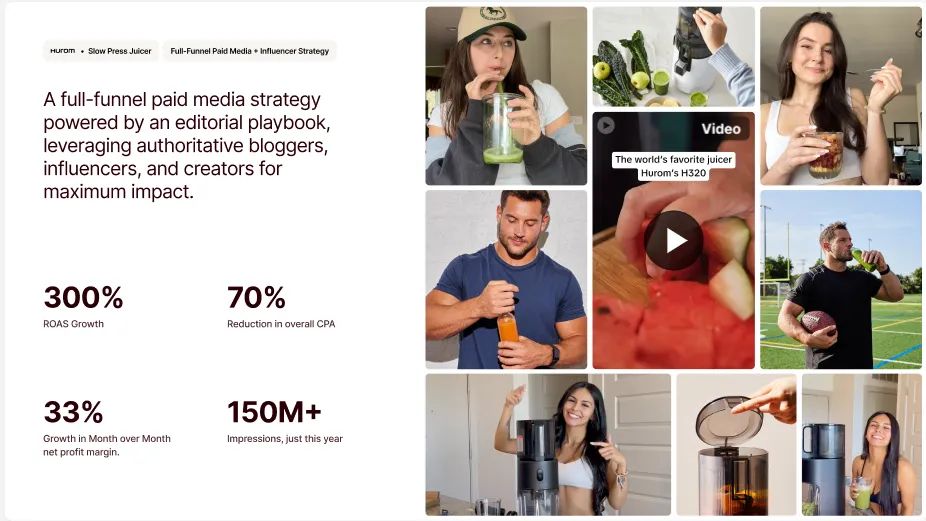
That’s how we delivered high-converting campaigns (3X ROAS) for brands like Hurom across search and paid platforms.
Read Next: Learn How to Choose an Advertising Agency for a Global Brand.
Marketing and advertising heavily rely on creative production–whether that’s a simple branded image or a long-form video. If that production is slow in any way, its effects will trickle down to ROI one way or another.
With well-defined workflows, brand guidelines, and the use of tools and agencies, your marketing division can take on even the most complex and long-running campaigns like pros.
Fieldtrip can be your partner for tackling any creative production challenges. Our flexible, highly collaborative teams, empowered by tools, make asset production efficient and cost-effective.
That’s why dozens of brands have used Fieldtrip and its sub-agencies to execute performance creatives (UGC, video, influencer content, and more) across various paid media channels.
Learn more about our creative services!
Creative production covers the end-to-end production process of turning ideas into finished creative assets that can be distributed across channels. This includes ideation, briefing, design, copywriting, versioning, localization, review and approval, post-production, and distribution.
Large brands face different creative challenges due to scale. Multiple markets, products, stakeholders, and approval layers introduce complexity that smaller teams simply don’t encounter. Add growing demands for personalization, faster timelines driven by digital marketing, and rising consumer expectations, and even well-resourced teams can experience bottlenecks, rework, and churn.
To scale creative production without sacrificing quality, brands should standardize templates, centralize assets, automate repetitive tasks, and align global standards with local execution. Creative automation and data-driven workflows help teams refresh content, fight ad fatigue, and produce content at scale.
Reducing costs starts with eliminating inefficiencies. Brands can lower spend by increasing asset reuse, minimizing rework, shortening approval cycles, and consolidating management tools.
Yes. Fieldtrip helps large brands modernize creative production by combining strategic thinking, leveraging technology, and scalable execution models. We align creative workflows with business goals, empower in-house production teams, and provide the best tools to improve speed and quality when producing images and videos.