






















The best marketing agencies for private equity portfolio companies tie every campaign to the value creation plan, report in pipeline and EBITDA terms, and start moving within weeks of close. That bar is higher now than it was five years ago.
Bain's Global Private Equity Report 2026 counts 32,000 unsold companies worth $3.8 trillion, with holding periods at exit hovering around seven years. With multiple expansion fading, Bain expects returns to depend on strong EBITDA growth, and marketing is one of the few growth levers a portco controls directly.
This list covers agencies that market the portfolio company itself: its pipeline, its customers and its story at exit. We compared each one on PE operating fit, published proof, measurement and speed, so an operating partner or portco CMO can build a shortlist in one read.
| Agency | Best for | Strongest hold-period stage | HQ |
|---|---|---|---|
| Power Digital | Diligence-to-exit programs for consumer and healthcare portcos | Diligence, exit readiness | San Diego, CA |
| WebFX | Portfolio-wide SEO, paid media and revenue tracking | Mid-hold | Harrisburg, PA |
| Fieldtrip | Consumer portcos that need creative, media and measurement in one team | First 100 days, mid-hold | New York, NY |
| Chief Outsiders | Fractional CMOs and CSOs when a portco has no marketing head | Post-close, pre-exit | Houston, TX |
| Grey Matter | B2B portcos that need pipeline inside 90 days | First 100 days | Cincinnati, OH |
| MonogramGroup | Brand integration across add-on acquisitions | Mid-hold, exit | Chicago, IL |
| SmartBug Media | HubSpot-based RevOps across a portfolio | Post-close | Newport Beach, CA |
| Bluetext | Carve-outs, roll-ups and renames in B2B tech and GovCon | Post-close | Washington, DC |
| Percepture | Search and PR that shape the exit narrative | Pre-exit | New York, NY |
| Chameleon Collective | Interim leaders, recruiting and execution under one contract | Post-close | Distributed |
| Valve+Meter | PE-backed home services platforms | Mid-hold | Indianapolis, IN |
| Fratzke | Sponsor-level digital maturity scoring across a portfolio | Diligence, portfolio review | Fullerton, CA |
We scored each agency against five criteria, using only what we could check on its own site or in public sources this month:
| Criterion | What we looked for |
|---|---|
| PE operating fit | A defined offer for diligence, the value creation plan, add-on integration or exit readiness |
| Verifiable proof | Named portcos, named sponsors or published case results |
| Measurement and reporting | Reporting in pipeline, CAC, revenue or EBITDA terms an operating partner can use |
| Execution breadth and speed | How many channels one team covers, and how fast work starts after close |
| Portfolio scalability | Ability to repeat a playbook across several portcos |
Disclaimer: Fieldtrip publishes this list and is included in it. We scored ourselves on the same criteria as every other agency here, and we'd encourage you to weigh that placement the way you'd weigh any other.
A portfolio company needs a growth agency that markets the business itself, while a PE firm raising capital needs a fund marketing agency. Both show up when you search "private equity marketing agency", but they work for different clients.
Fund marketing agencies build LP materials, firm websites and deal-sourcing content for the PE firm. Portfolio company agencies grow the businesses the fund owns: their pipeline, their customers and the growth story buyers see at exit.
If one sponsor needs both, some agencies handle fund and portco work under one relationship. Every agency on this list does portfolio company work.
Each agency listed below covers who the agency suits, its credentials and HQ, and published proof from PE-backed work.
Power Digital runs a dedicated private equity practice built around four stages: diligence, thesis validation, value creation and exit readiness. Its proprietary platform, nova, analyzes a target's marketing channels with first- and third-party data to flag growth levers before a deal closes, and the same team can run paid, SEO and commerce work afterward.
In January 2026, Power Digital acquired Cardinal, a healthcare agency for multi-location provider groups, which extends the practice into PE-backed veterinary and dental roll-ups. Few firms here cover both diligence and daily execution.
WebFX limits its private equity offer to portfolio-company growth and leaves fund-level investor marketing to others. The pitch to sponsors is one team across the whole portfolio: 750+ specialists who carry a working playbook from one portco to the next, plus RevenueCloudFX, a platform that reports cost per lead, pipeline and revenue by company and by channel.
Work can start before close with a digital due diligence review of a target's traffic, rankings, paid performance and martech stack. WebFX is PE-backed itself, after a strategic investment from Trilantic North America.
Fieldtrip runs strategy, creative, media and measurement as one operating model, with specialist companies from its ecosystem added as a portco needs them: inBeat for creator and UGC production, Content Allies for B2B podcasts, and Alpha Apex Group for executive search and fractional leaders.
For a PE-backed consumer brand, that means one partner can fill a leadership gap, rebuild attribution and ship weekly creative without three vendor onboardings. Most engagements move into audit and planning within 10 to 15 business days, and the measurement team reviews tracking and attribution frameworks weekly.
Chief Outsiders places fractional and interim CMOs and chief sales officers inside portfolio companies, which fits a common post-close problem: a growing company with no senior marketing owner. The firm says its executives have worked with 300+ PE firms and 500+ portfolio companies across diligence, early post-acquisition, mid-investment and pre-exit work.
Its GrowthGears framework, now run through an AI-supported operating system, structures the first engagement around gaps in market, company, offering, marketing and sales. When a portco also lacks hands to execute, a "Team Outsiders" bench can be added within days.
Grey Matter is a B2B growth agency that structures every portfolio-company engagement around 90-day sprints mapped to the value creation plan. It reviews the VCP in week one, delivers a diagnostic of positioning, competitors and buyer behavior in month one, and writes sprint summaries in the metrics operating partners already read: pipeline, attributed revenue, CAC and pipeline velocity.
Its Intelligent Acquisition framework pairs demand generation with sales enablement and stays consistent across portcos, so a sponsor can benchmark results company to company. Grey Matter also runs fund-side marketing for PE firms.
MonogramGroup is a Chicago brand consultancy that has focused on private equity since 1996 and says it has worked with 270+ PE firms and portfolio companies. Its Commercial Impact & Value Creation Playbook runs in four stages (position, build, operationalize, scale) and targets the problems buy-and-build creates: mixed messaging after add-ons, slow sales integration and a brand that undersells the platform at exit.
Work ranges from brand architecture and integration playbooks to web, SEO and AEO, plus mgREV, an AI-supported brand hub that keeps sales teams consistent across acquired companies.
SmartBug Media calls itself the largest and most decorated Elite HubSpot partner, and its PE and VC practice uses that depth to standardize marketing, sales and service operations across portfolio companies. The offer starts before close with a pre-LOI evaluation of a target's digital maturity, then moves into a post-acquisition roadmap covering demand generation, sales enablement, customer engagement and RevOps.
For a fund running several portcos on HubSpot, reporting definitions and CRM hygiene can be set once and repeated. SmartBug says it has supported 215+ companies across funding stages.
Bluetext is a Washington, DC agency whose PE work is organized around four corporate events: carve-outs, roll-ups, renamings and mergers. Each one carries a predictable brand risk. A carve-out needs an identity that stands apart from its former parent, a roll-up needs one story across acquired names, and a rename has to keep search traffic and customer trust intact.
Bluetext handles naming, messaging, identity, websites and launch campaigns for these moments, with most of its client list in B2B technology, cybersecurity and defense contracting, where buyers scrutinize credibility closely.
Percepture is a New York agency, operating since 2004, that frames portfolio marketing around five P&L levers: price realization, retention, CAC payback, channel de-risking and exit narrative.
Its senior-only team, each member with 10+ years of experience, combines SEO, generative engine optimization (GEO), digital PR and paid search, and reports against a board-pack KPI set that includes net revenue retention, CAC payback and pipeline coverage.
Its view of search and press as surface area buyers check before the data room makes it a practical pick in the run-up to a sale.
Chameleon Collective is a network of senior operators, including former CMOs, heads of eCommerce and VPs of digital, that PE firms engage once under a master services agreement and then deploy across portfolio companies.
It combines three motions most firms split: interim leadership while a search is open, full-cycle recruiting for the permanent hire, and execution teams for the first 90 days. Engagements usually start with a diligence or 100-day-plan conversation, and an interim operator can be in place within two to four weeks, with no account-management layer between sponsor and operator.
Valve+Meter is a performance marketing agency that has worked with home services companies since 2017, and its PE program targets platforms built through HVAC, plumbing and electrical acquisitions. Its ThinkFirst diagnostic and Math Before Marketing method look at branch capacity, call handling, close rates and service mix before recommending channels, so spend follows what technicians can fulfill.
Reporting goes down to cost per booked job and revenue by location, the view an operating partner needs when acquired branches arrive with different vendors and CRMs. The agency says it has tracked 144,000+ client invoices.
Fratzke is a strategy and digital agency for mid-market and enterprise brands, and its most relevant PE work happens at the sponsor level.
For a fund whose portcos sit at very different stages of digital maturity, Fratzke builds a repeatable assessment framework: benchmark each company's capabilities and competitive position, find the gaps, separate quick wins from long-term initiatives, and turn the findings into value creation roadmaps the deal team can revisit.
That makes it a useful first call for an operating partner deciding where marketing dollars should go across the portfolio before choosing execution agencies.
A marketing agency should deliver a marketing read on the target before close, a measurement baseline in the first 100 days, repeatable acquisition mid-hold and a growth story that survives buyer diligence before exit.
That sequence is the outline of a private equity marketing plan. Longer holds make the middle years matter more: the Bain report cited earlier found that almost 40% of PE-owned companies are held for more than five years, up from 29% in 2019.
You can use the table below to see what to expect at each stage.
| Stage | What the agency should deliver |
|---|---|
| Diligence (pre-close) | Channel health, tracking quality, hidden growth levers and marketing risks in the thesis |
| First 100 days | A measurement baseline, VCP-mapped priorities, leadership gaps filled and quick-win channels live |
| Mid-hold | Repeatable acquisition across channels, add-on brand integration, CAC and payback reporting |
| Pre-exit | Clean attribution, search and AI visibility, and a brand story that holds up in buyer diligence |
If tracking is the weak point, fix it before you rationalize vendors. A strategic marketing audit can help identify gaps in measurement, channel performance, and attribution before they affect the value creation plan.

Choose the agency that has moved the same value creation lever you need, inside a comparable hold period, and can report it in board terms. This is what sets a PE-ready digital marketing firm for private equity apart from a generalist: it plans around an exit date, reports on pipeline and CAC payback, and absorbs add-on acquisitions without rebuilding the program each time.
To compare finalists on the same terms, run a structured marketing RFP with these questions built in.
Walk away from any agency that shows these red flags:
Paid search can generate early lead and pipeline data within weeks, provided tracking and conversion paths are already working. SEO and digital PR typically require several months to build momentum, while retention programs depend on existing customer data and purchase cycles.
For PE-backed companies, the first 100 days should focus on measurable acquisition improvements while longer-term growth initiatives develop. Track qualified pipeline, customer acquisition costs, and revenue impact against agreed baselines throughout the hold period.
Published PE marketing programs run $15,000 to $35,000 a month for a 6 to 10 week campaign that proves one lever, and $35,000 to $75,000+ a month for a 90 to 180 day program that builds the full growth system. Those figures are agency fees before media spend, and most PE marketing agencies quote case by case.
Digital due diligence is usually priced per deal, by size and scope. Fractional CMOs and CSOs are priced per engagement and exclude media. Budget for working media separately: one HR software portco's pipeline result ran on $25,000 a month in ad spend, on top of agency fees.
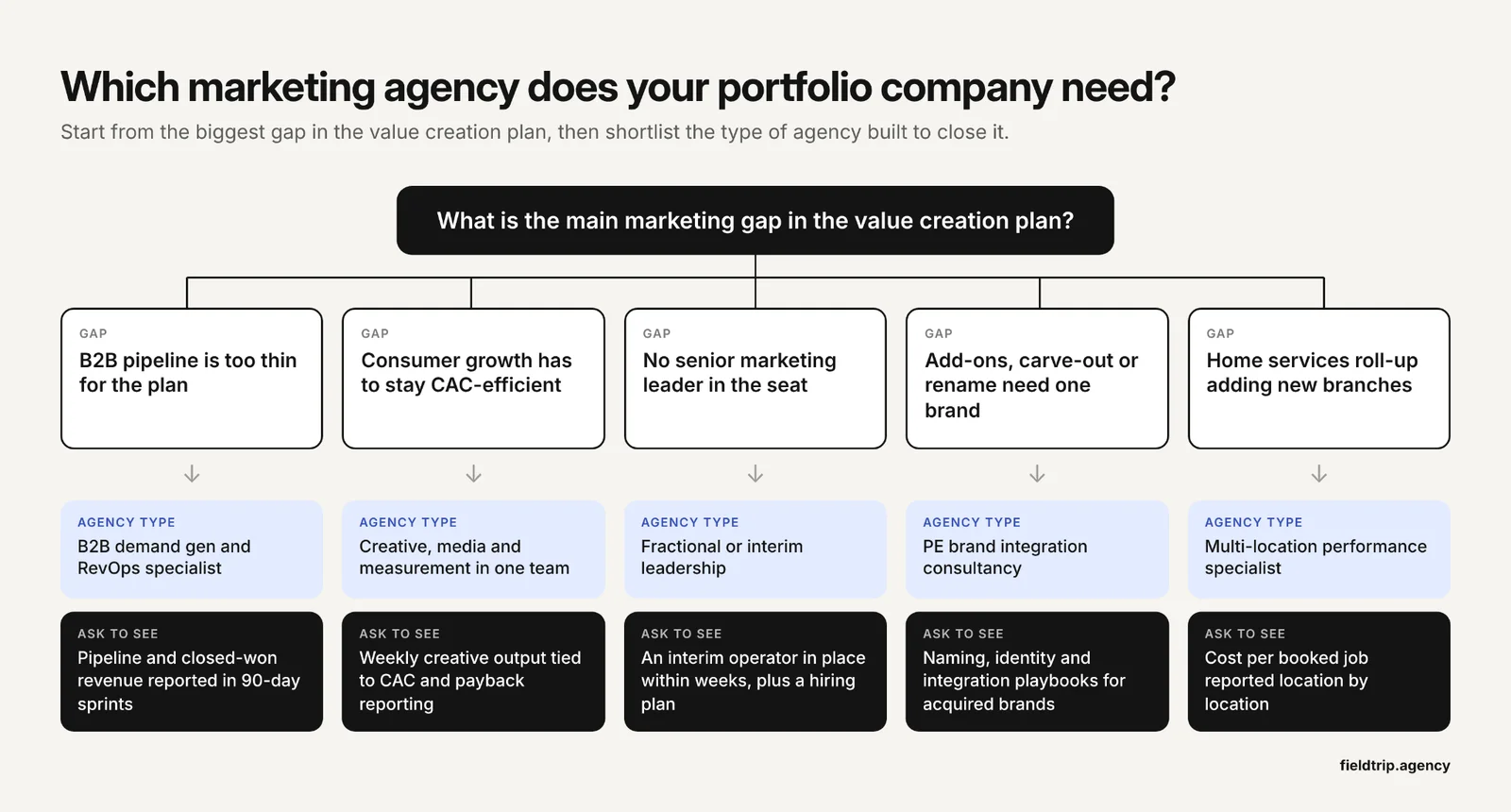
The right marketing agency for a portfolio company is the one built for the gap in its value creation plan. Start with the business model and the stage of the hold, then shortlist partners whose proof matches both.
A B2B company chasing pipeline, a multi-location platform absorbing add-ons and a portco without a marketing leader each need a different kind of partner.
For PE-backed consumer brands, the gap is usually growth that has to stay CAC-efficient through the hold, which takes creative, media and measurement working from the same numbers.
That's the work Fieldtrip is built for. If you're an operating partner or portco CMO, book a strategy call with us to discuss where your value creation plan is stalling and how we can help address the gaps.
A marketing agency for a private equity portfolio company grows the revenue and enterprise value of a business a PE fund owns. Typical work includes a marketing review before the deal closes, a marketing plan tied to the fund's value creation plan, paid media, SEO and AI search, brand integration after add-on acquisitions, and board reporting on pipeline, customer acquisition cost (CAC) and revenue.
A PE firm should bring in a marketing agency during due diligence where possible, so marketing risks and growth opportunities shape the investment thesis. Otherwise, the agency should start within the first 100 days after close, when the measurement baseline and the value creation plan are set. Most specialist agencies can begin an audit within a few weeks of signing.
A PE firm should use one marketing agency across the portfolio only when its portfolio companies share a similar go-to-market model. One agency simplifies reporting and lets a proven playbook move from company to company. A diverse portfolio usually does better with one shared scorecard for every company and different specialist agencies inside each.
PE firms measure marketing ROI at portfolio companies with metrics that connect to EBITDA: customer acquisition cost (CAC), CAC payback period, pipeline coverage, marketing-sourced revenue, win rate and customer retention. Service businesses add cost per booked job. Impressions and website traffic rarely make it into a board report.
A fractional CMO is better when a PE-backed company has no senior marketing leader, and a marketing agency is better when the strategy is set but the team lacks execution capacity. A fractional CMO sets strategy and owns the function part-time, while an agency runs channels at volume. Many portfolio companies use both in sequence: a fractional leader first, then an agency to execute the plan.
Marketing can affect a portfolio company's exit valuation by making growth easier for buyers to verify. Buyers research a company online before they open the data room, so search visibility, press coverage and attribution that proves where revenue comes from all shape how they value its growth.