






















Enterprise marketing has become too complex to run on disconnected tools, scattered requests, and manual effort. Your team is expected to launch campaigns across more channels, personalize customer journeys, prove pipeline impact, and keep pace with AI-driven change while working with tighter budgets.
This pressure is why marketing operations, or MarOps, have become central to modern enterprise growth. Strong MOps turns strategy into repeatable workflows, cleaner data, better campaign governance, smarter technology adoption, and clearer revenue reporting.
McKinsey’s 2024 research on marketing operating models also points to this shift. CMOs are being asked to drive growth while improving efficiency, governance, and agility across complex organizations.
In this guide, we’ll break down how marketing operations support campaign execution, automation, lead management, sales alignment, RevOps coordination, and executive reporting.
Looking for a marketing partner who can handle the complexities and scale of an enterprise brand? Check out the leading advertising partners for enterprise giants.
Marketing operations, also called MarOps, MOps, or MarketingOps, is the function that designs, manages, and improves the systems behind enterprise marketing.
It brings together the marketing people, processes, technology, data, governance, and measurement so your organization can execute campaigns consistently, use its technology effectively, and show how marketing contributes to pipeline and revenue.
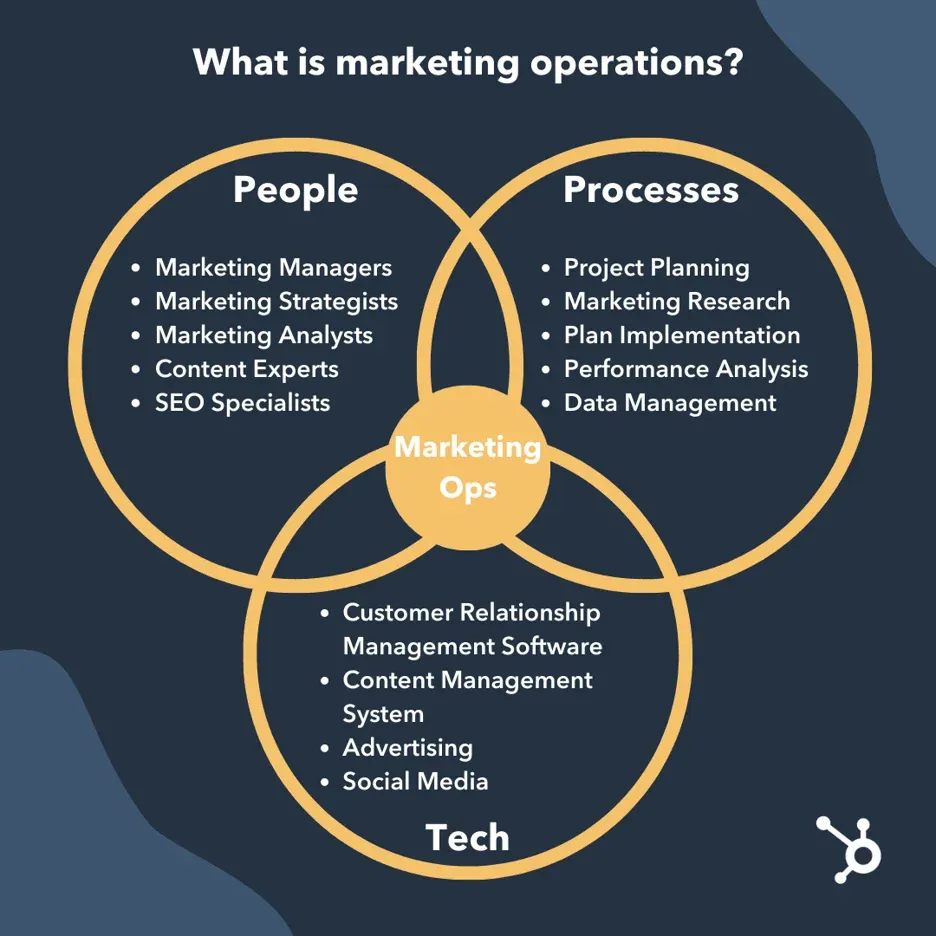
MOPs turn marketing strategy into a repeatable operating model. It also streamlines the workflows powering those campaigns. It defines how campaign requests are submitted, how briefs move through approval, how audiences are built, how leads are scored and routed, how marketing automation runs, how campaign data is captured, and how performance is reported back to leaders and stakeholders.
A useful way to think about MarOps is this: it is not the team that “just sends emails” or “fixes Salesforce fields.” It is the operating layer that helps a modern marketing department scale.
When your team launches an integrated campaign, MarOps makes sure the audience list is accurate, consent rules are respected, UTM structures are consistent, lead qualification logic is working, campaign members sync to CRM, and executives can trust the final campaign analysis.
We’ve seen this distinction matter most in large organizations where multiple regions, product lines, agencies, and sales teams all depend on the same marketing infrastructure. A strong MarOps function gives those groups one shared way of working, so that marketing output performs well for the goals.
In an enterprise environment, marketing operations are essentially a cluster of responsibilities that keep the marketing team moving in a coordinated, measurable, and scalable way. The function usually sits at the intersection of management, process, workflows, data, technology, campaign execution, and revenue alignment.
The exact roles for the personnel (and the number of personnel) in MarOps may vary, but for the most part, most MarOps teams inside enterprises take on the following roles:
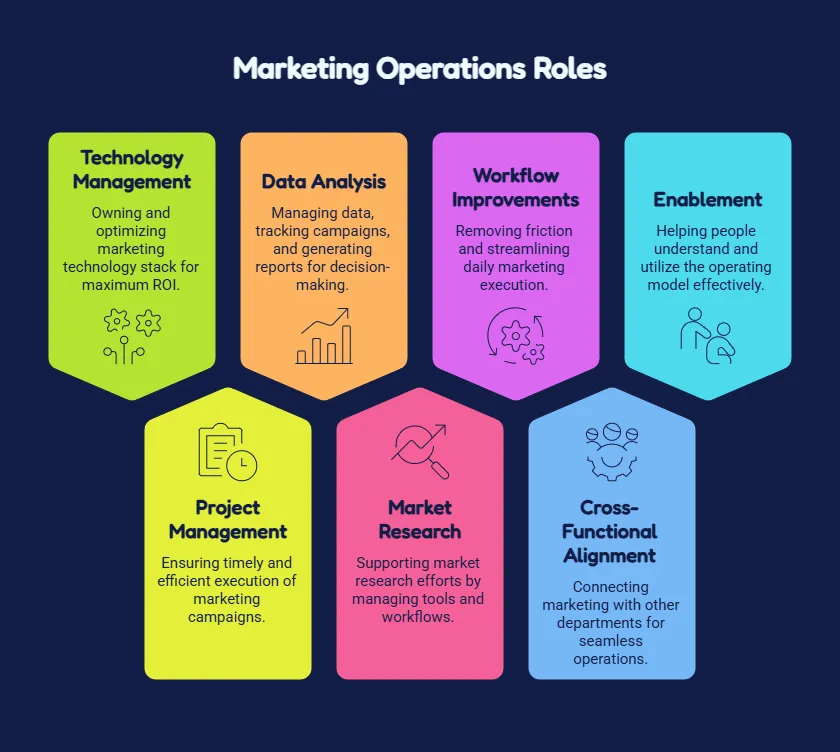
Technology management is one of the most visible MarOps responsibilities because enterprise marketing depends on a large and expensive MarTech stack.
The marketing operations team may own or co-own platforms that power marketing and sales (like Salesforce, HubSpot, Adobe Marketo Engage, Oracle Eloqua, 6sense, Demandbase, Segment, Tealium, Snowflake, Tableau, Power BI, Workfront, Bynder, or Aprimo).
This particular role isn’t limited to administration. It’s actually more about ensuring the tech is used to its maximum potential and efficiently. It includes vendor evaluation, user permissions, integrations, field mapping, system documentation, data sync rules, platform governance, and adoption.
Gartner’s 2025 Marketing Technology Survey found that martech utilization had dropped to 49%, which means many organizations are using only about half of the capabilities they already pay for.
This makes MarOps critical to improving ROI from existing marketing software before the business buys more tools.
Enterprise campaigns usually involve creative, demand generation, product marketing, field marketing, legal, sales, web, analytics, and external agencies. Without strong project management, launch timelines slip, approvals become unclear, and teams waste time chasing updates.
Marketing operations builds the intake system, campaign calendar, approval paths, SLAs, and status reporting needed to keep projects moving. They use tools like Asana, Jira, Monday.com, Adobe Workfront, Smartsheet, and Airtable to manage campaign requests, asset production, dependencies, and stakeholder visibility.
Data operations are a big and important part of MarOps. And it’s what makes it indispensable to enterprise decision-making. This role covers data management, campaign tracking, attribution rules, dashboard governance, audience segmentation, CRM hygiene, consent data, and performance reporting.
For instance, a MarOps analyst may define UTM standards, build campaign hierarchy rules in Salesforce, track source and medium values, monitor lead routing accuracy, and reconcile data between CRM and Customer Data Platforms.
Salesforce’s ninth State of Marketing report, based on insights from nearly 5,000 marketers worldwide, found that the top priorities for marketers include AI use and improving marketing ROI/attribution. These priorities require strong operational ownership because changes can only work when your data is trustworthy.
Marketing operations might not own market research, but it can certainly support it. After all, it manages tools, data sources, research workflows, and reporting infrastructure, all of which are important for solid enterprise-level market research.
In enterprise teams, market research may involve customer surveys, win-loss analysis, competitive intelligence, search trend analysis, intent data, analyst reports, and campaign performance benchmarks.
All these endeavors require the right MarTech (like SurveyMonkey for surveys or Semrush for competitor Share of Search). They also need proper workflows for the research to be done in a timely manner and for the outcome data to be useful. Again, MarOps can make all of that smooth.
Workflow improvement is where MarOps removes friction from daily execution. This includes intake forms, approval chains, campaign build checklists, QA steps, routing rules, naming conventions, documentation, and handoffs between teams.
In our opinion, this is where MarOps makes the biggest impact.
For instance, 58% of enterprise marketers say that reporting takes too much of their time. That’s because the reporting workflows sometimes have bottlenecks and dependencies. The MOps team actively works to remove those hurdles and streamline regular processes.
This is also where process improvement methods such as Lean can be useful. Instead of adding more approval steps, MarOps looks for waste: duplicate data entry, unclear ownership, unnecessary handoffs, manual list uploads, avoidable campaign rebuilds, and recurring reporting fixes.
Marketing operations sits between marketing, sales, RevOps, finance, customer success, IT, legal, and executive leadership. That makes cross-functional alignment one of its most important roles.
This work includes defining important things like:
For MarOps, alignment might show up in very practical ways. If a demo request comes in from a target account, the operations layer determines whether the lead becomes an MQL, which sales rep gets it, how quickly sales must follow up, which campaign receives credit, and how the outcome appears in funnel reporting.
Enablement is the role that helps people actually use the operating model. MarOps may create playbooks, training sessions, office hours, campaign templates, QA checklists, dashboard guides, and onboarding materials for marketers, sales teams, agencies, and regional users.
This is important when a company introduces new tools, new workflows, or AI capabilities.
PMI’s 2024 report found that 64% of senior leaders say their teams need new technical skills, which reflects the pressure teams face as project work becomes more technology-enabled.
Good enablement also protects the business. When marketers understand how to use approved templates, naming conventions, data fields, and consent rules, the organization reduces operational risk and improves campaign speed.
Similarly, when sales understands the routing logic and SLA expectations, marketing-generated demand is more likely to become a real pipeline.
Enterprise marketing operations teams need operating frameworks that help them prioritize work, reduce friction, create consistent workflows, and improve delivery without slowing the business down.
Remember: the best framework is the one that fits your team’s campaign volume, compliance requirements, stakeholder complexity, and need for process improvement.
For most enterprise teams, the strongest MarOps operating model borrows from several agile frameworks rather than following one method rigidly. Let’s talk about three such frameworks commonly used by enterprise MOps as well as the hybrid approach.
Lean is useful for marketing operations because it forces the team to ask a simple question: which parts of this process create value, and which parts create delay, rework, or confusion?
The Lean Enterprise Institute defines value-stream mapping as diagramming every step in the material and information flows needed to bring a product from order to delivery, and describes it as a core continuous improvement tool for identifying and eliminating waste.
In a MarOps context, the “product” might be a campaign, webinar, nurture program, paid media launch, or technology adoption.
For example, if your campaign request process takes 10 business days, Lean thinking helps you map the full path from intake to launch. It will ask the important questions to find waste, like:
Removal of waste shouldn’t be removal of control. Enterprise teams need governance around consent, brand, legal review, data access, and security.
Pro tip: Watch out for the one downside of Lean, where it becomes too process-heavy and the team treats every task like a formal improvement project. For MarOps, Lean should be applied where repeatability makes sense.
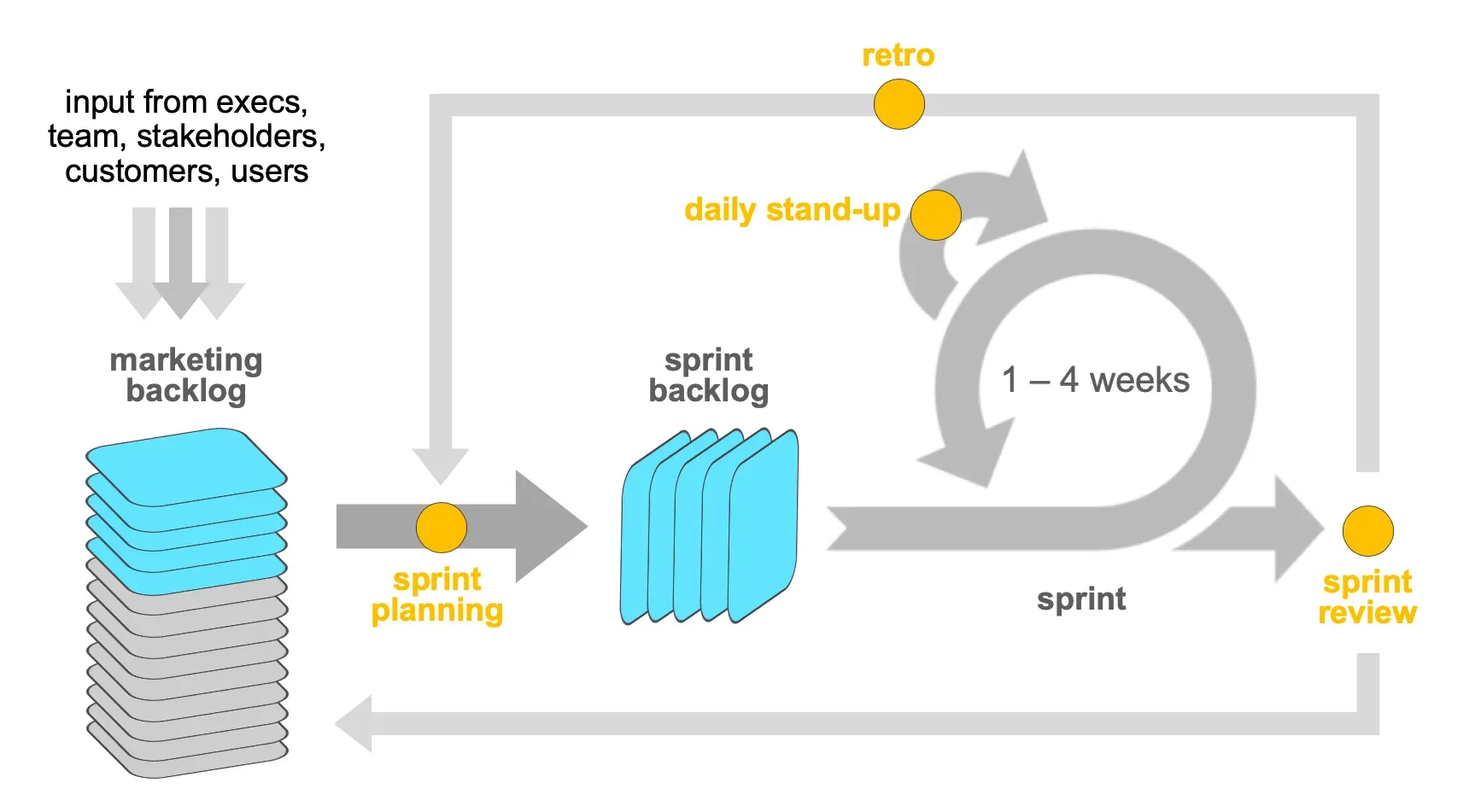
Scrum is helpful when the marketing operations team needs focused execution in short cycles. It works best for work that can be planned, prioritized, reviewed, and improved iteratively, for example, building a new attribution dashboard, cleaning lifecycle-stage logic, or rolling out a new marketing automation workflow.
The 17th State of Agile Report found that Scrum remains the most widely used team-level Agile methodology, with 63% of Agile users reporting Scrum usage at the team level.
For enterprise MarOps leaders, that matters because Scrum gives teams a common language for planning and delivery: backlog, sprint, owner, review, and retrospectives.
Here’s an example of a practical MarOps Scrum:
Scrum is not ideal for every MarOps workload. It can feel too rigid for teams that handle a high volume of interrupt-driven work, such as urgent campaign fixes, event list uploads, executive reporting requests, and last-minute stakeholder changes.
It also requires discipline. Without a clear backlog owner and realistic sprint commitments, Scrum can become a calendar ritual rather than a delivery system.
Kanban is perhaps the most practical framework for day-to-day marketing operations because it makes work visible. Instead of forcing every task into a sprint, Kanban lets the team manage continuous flow across stages such as intake, triage, build, QA, approval, scheduled, launched, and reported.
It’s an Agile framework that helps teams track tasks, identify bottlenecks, and optimize delivery cycles using boards, cards, WIP limits, standardized workflows, and metrics such as cycle time and cumulative flow diagrams.
Atlassian notes that WIP limits help teams highlight bottlenecks, reduce multitasking, and improve workflow efficiency by limiting the number of tasks in each workflow stage.
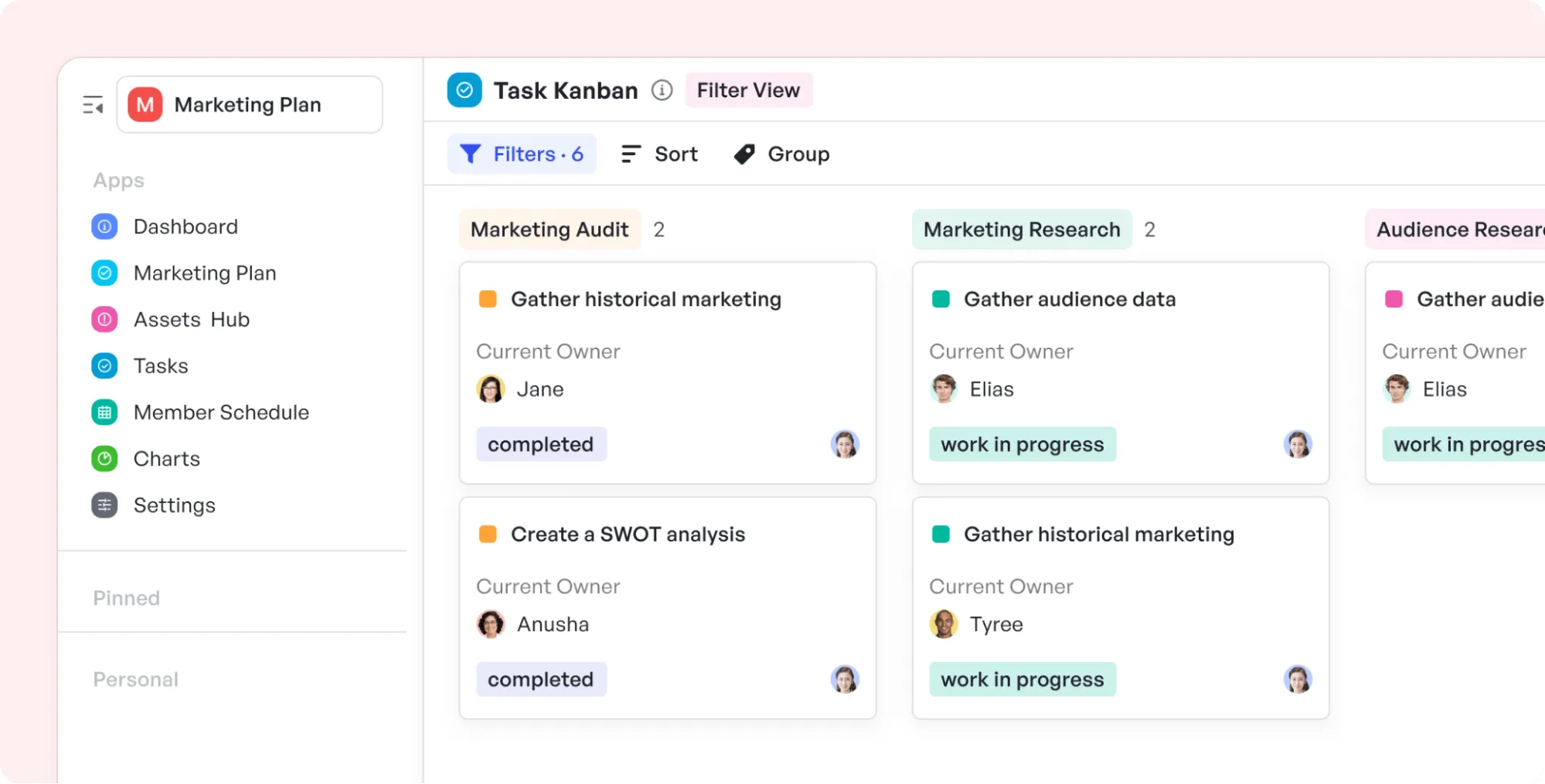
Kanban can be great for request management. A campaign operations board might show that there are 34 open requests, but 19 are stuck in “Awaiting Stakeholder Approval.” That insight changes the conversation. The issue is no longer “MarOps is slow.” The issue is that the workflow is overloaded at a specific approval point.
Kanban works well in tools like Trello, Jira, Asana, Workfront, Airtable, and Monday.com. A mature MarOps team can use it to track request completion time, campaign production time, SLA adherence, workflow bottlenecks, and automation usage.
Kanban can become a dumping ground if intake rules are weak. A board with 200 cards and no prioritization logic does not create operational clarity.
To make Kanban work, define request types, required fields, owners, priority levels, and service expectations before scaling it across the marketing team.
Most enterprise MarOps teams eventually need a hybrid model because marketing is not a single type of work.
PMI’s 2024 Pulse of the Profession that we have mentioned above found a 57% increase in the use of hybrid approaches. This reflects how organizations are blending predictive, Agile, and hybrid methods to improve delivery.
A hybrid MarOps model might use:
For example, an enterprise SaaS company launching a new product line might use a structured project plan in Workfront for executive milestones, a Jira Scrum board for CRM/CDP integration tasks, and a Kanban board in Asana for campaign asset requests. The operating model is hybrid because the work is hybrid.
A hybrid approach does come with a management challenge.
If every team uses a different system without shared definitions, you end up with fragmented reporting and confused stakeholders. To avoid that, MarOps should define common rules across tools: what counts as a request, what counts as complete, which SLA applies, which fields are mandatory, and where leadership can see status.
Read Next: Navigating Agency Partnerships as a Fortune 500 Company
MarOps can be its own dedicated team of professionals overseeing the different roles. But essentially, it’s part of the enterprise marketing department and reports to the Chief Marketing Officer (CMO).
In most organizations, it’s headed by a MarOps manager, who leads the team and reports to the executive board.
There’s also debate in the industry about whether MarOps professionals are even marketers themselves. Considering the fact that most of the members in these teams have marketing titles and come from marketing backgrounds, it’s fair to say that they are, in fact, marketers.
But MOps shouldn’t strictly be confined to the marketing department. Remember, one of its core functions is alignment.
In most enterprise structures, MarOps can fit in one of three ways.
Marketing operations are beneficial for enterprise marketing because they bring structure, clarity, and efficiency to the whole marketing machine, which is super complex for large, global companies.
It acts as a layer that oversees the many levers that make up marketing (and even other departments like sales and data).
Without a strong marketing operations function, even a talented marketing team can become slow, fragmented, and difficult to measure.
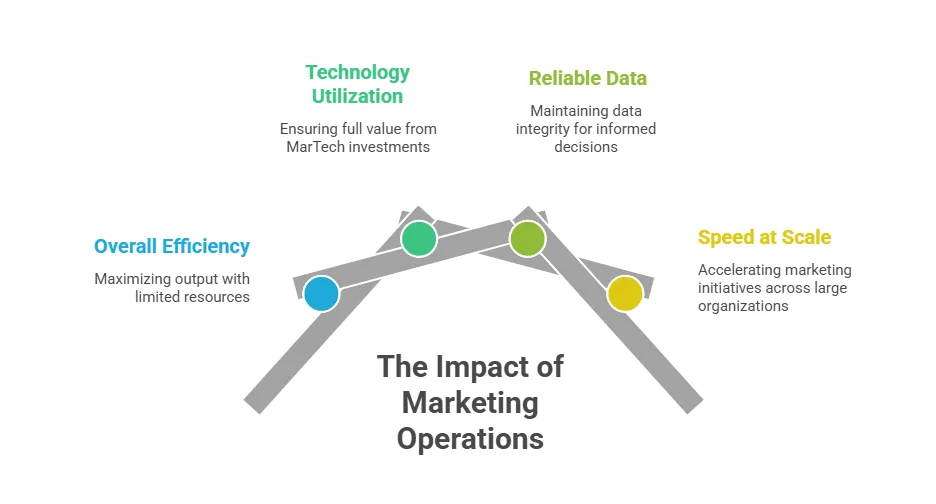
Illustration showing the impact of marketing operations across four key areas: overall efficiency, technology utilization, reliable data, and speed at scale, highlighting how marketing operations improve productivity, data integrity, MarTech value, and organizational performance.
Investing in MarOps makes sense for four reasons:
The first reason is efficiency. Enterprise marketing leaders are being asked to do more with less.
Gartner’s 2025 CMO Spend Survey found that marketing budgets remained flat at 7.7% of company revenue, and 59% of CMOs said they did not have enough budget to execute their strategy.
Of course, if headcount and budget are constrained, the team needs cleaner workflows, better prioritization, stronger automation, and fewer manual handoffs. And that’s exactly the job for MOps.
The price tag for enterprise-level MarTech digital tools is in the tens of millions. But as mentioned, Gartner found that utilization was only about half of what it could be. That’s a clear indication that technology is being underused, which isn’t just a waste of money; it’s a setback.
MarOps becomes the difference between owning a stack and operating one. A company may pay for sophisticated software, but without governance, permissions, integrations, workflows, and reporting, the MarTech stack becomes expensive complexity rather than a scalable engine.
The third reason is data trust. Modern enterprise marketing depends on customer data for segmentation, personalization, attribution, lead routing, and executive reporting.
Salesforce’s State of Marketing report says engaging with customers in real time and improving their trust are among the top five priorities in enterprise marketing. These priorities are hard to achieve when duplicate records, incomplete fields, invalid email addresses, broken consent statuses, and inconsistent campaign tracking pollute the system.
MarOps protects decision quality by creating standards for data management, CRM/CDP governance, lifecycle stages, and source values.
The fourth reason is speed at scale. A small team can sometimes survive with informal Slack requests, spreadsheet trackers, and tribal knowledge. An enterprise team cannot.
When you have multiple regions, product lines, agencies, field teams, legal reviewers, and sales segments, every unclear workflow adds delay.
MarketingOps reduces that friction by standardizing intake, approvals, QA, email operations, campaign build steps, audience creation, digital asset management, and post-launch reporting.
We have noticed that mature enterprise marketing teams rarely treat MarOps as basic administrative support. They see it as an operating layer that helps the organization prioritize work, connect systems, standardize processes, choose the right metrics, and identify the next area for improvement.
The right marketing operations KPIs help enterprise leaders see whether the marketing engine is fast, reliable, measurable, and connected to revenue.
In MarOps, the KPIs and metrics that define success are quite diverse because the scope of the work overlaps various marketing functions.
For simplicity, we’ve categorized metrics by function/purpose.
The future of marketing operations is more strategic, more technical, and more AI-assisted.
Enterprise marketing teams will still need strong management, clean workflows, reliable data, and clear governance, but the work will increasingly involve connecting systems, evaluating AI outputs, and designing better human-machine processes.
One major shift is the rise of AI-enabled operations. McKinsey estimated that generative AI could increase marketing productivity by 5% to 15% of total marketing spending, especially across activities such as content creation, personalization, customer analytics, and campaign execution.
For MarOps, this means the next wave of efficiency will not come only from traditional automation. It will also come from AI-powered agents, language models, AI APIs, and better evaluation frameworks that help teams test whether AI is accurate, secure, and useful.
Data architecture will also become more important. Unified data strategy, personalization at scale, account-based engagement, and AI implementation are core marketing priorities. That points to a bigger role for MarTech tools that MarOps will need to realize.
As for career options within MOps, employment opportunities will expand for those who can combine technical skills with business judgment. The most valuable operators will understand workflow design, data quality, marketing automation platforms, analytics, security, stakeholder alignment, and AI.
Fieldtrip’s network of specialist agencies can help enterprise marketing teams close capability gaps across strategy, creative, media, technology, and cross-border execution. Our teams and tools support global brands that need sharper coordination at scale. Fill out the contact form and let’s talk.
Marketing operations designs and manages the systems, workflows, data, and reporting that help the marketing team execute efficiently. In enterprise teams, MarOps owns campaign intake, marketing automation, CRM/CDP processes, lead routing, campaign tracking, and performance dashboards. Its job is to make marketing scalable, measurable, and aligned with revenue goals.
Marketing operations is the function that makes the MarTech stack useful. It manages and governs tools for sales, paid media, design, content production, projects, measurement, communication, and collaboration.
MarOps supports revenue growth by improving lead qualification, SLAs, campaign attribution, lead rotation, funnel reporting, and sales handoffs. It also strengthens alignment between marketing, sales, customer success, and finance.
Start by defining the most urgent operational gaps, such as data quality, marketing automation, campaign production, reporting, or CRM/CDP governance. Then hire or assign people with skills in process design, MarTech administration, data management, project management, analytics, and stakeholder alignment. As the function matures, add more specialized roles.
Not every company needs a large MarOps department, but every growing company needs some level of marketing operations discipline. Small teams can manage basic workflows, automation, and reporting within their marketing teams or with external agencies. Enterprise organizations usually need dedicated MOps specialists.
Fieldtrip supports MarOps teams with strategy, measurement, media, creative, and technology expertise. Its measurement services help improve attribution, reporting, and workflow clarity, so marketing teams can connect campaign activity more directly to ROI.