






















Enterprise marketers operate in a measurement environment that finance teams struggle to understand. The issue isn’t a lack of attribution tools or campaign data. It is that most marketing measurement systems still struggle to connect media spend to defensible financial outcomes that Chief Finance Officers (CFOs) actually want to see.
The reality is that Chief Marketing Officers (CMOs) and, by extension, marketing departments are under pressure to justify every dollar they spend. And according to BCG, they’re having to do this amidst shifting consumer confidence, media inflation, and proliferation of channels.
If you’re in a similar situation, you might want to turn to media mix modeling (MMM), a measurement and analysis technique that CFOs can understand when done right.
Why? And exactly how? Because it speaks their language. It uses sophisticated statistical methods to quantify the impact of marketing on business outcomes like growth and revenue.
In this guide, we’ll walk you through the basics of MMM and provide the architecture of a finance-centric framework, so your next meeting with the CFO is a roaring success.
Side note: Looking for support with marketing measurement? Fieldtrip’s marketing analytics measurement services can help you with media mix modeling, performance tracking, and cross-channel measurement.
First, let’s address the elephant in the boardroom. Many finance teams remain skeptical of marketing performance data.
According to a Gartner report, only 48% of CFOs believe marketing is important for corporate performance.
Clearly, the relationship between enterprise marketing teams and finance departments has changed dramatically over the years. And the reasoning is pretty simple.
CFOs aren’t satisfied with dashboards that report clicks, impressions, or platform-attributed conversions. They want evidence that marketing investment drives measurable business performance, protects margins, and contributes to long-term enterprise growth.
Fragmented data, vanity metrics, and marketing jargon aren’t helping your case.
While those nitty-gritty measurements and attribution are valuable for marketers to optimize media spend, it’s not what CFOs are interested in. They want to see the big picture and whether marketing spend is delivering impact for profits.
Here’s what finance actually wants to learn from marketing reporting:
Media mix modeling can help answer these questions, backed by experimentation frameworks such as incrementality testing and geo-based lift studies.
Gartner’s 2024 survey also found that CFOs ranked “metrics, analytics, and reporting” as their top priority for 2025. That makes the measurement divide harder to ignore. Enterprise marketing teams need reporting that CFOs can trust, understand, and confidently use in budget decisions.
Media mix modeling is a measurement framework that uses aggregated historical data to estimate how media investments influence business outcomes such as revenue, profit, market share, and ROI over time.
It evaluates channels such as paid search, paid social, connected TV, programmatic display, and retail media.
Most explanations of MMM are written for analysts, data scientists, or advertising teams. CFOs, however, do not evaluate marketing measurement systems based on statistical sophistication alone. They evaluate whether the framework improves capital allocation decisions.
Instead of tracking individual users across fragmented touchpoints, MMM analyzes aggregated historical data to understand the incremental contribution of different media channels while controlling for external variables such as seasonality, pricing fluctuations, competitor activity, and broader economic conditions.
This makes MMM different from multi-touch attribution, which attempts to map the customer journey at the individual user level.
MMM uses statistical regression models and increasingly advanced Bayesian modeling techniques to support forecasting, scenario planning, and budget allocation decisions.
Enterprise-grade MMM succeeds or fails based on architecture. In our experience, this is where most teams get MMM wrong: they treat it as a modeling exercise instead of a decision-making system.
The real challenge is structural alignment between marketing measurement and financial decision-making.
A CFO-ready framework requires five integrated layers:
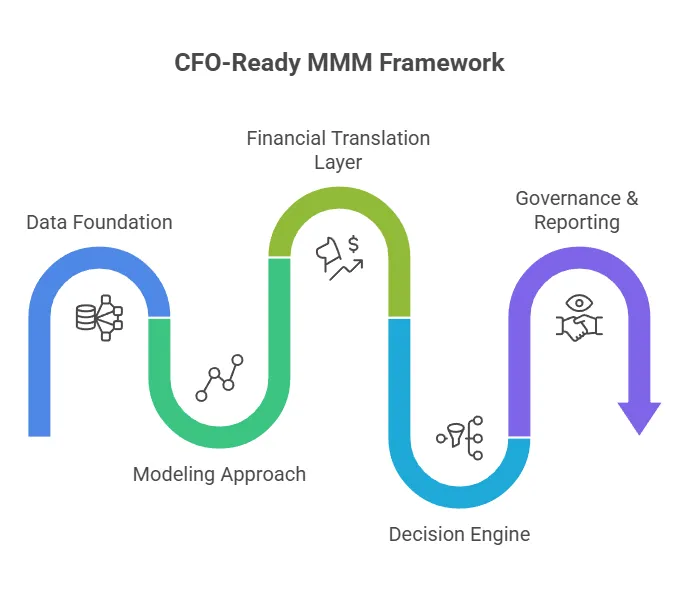
Together, these layers transform MMM from an analytics project into a scalable enterprise measurement engine that supports cross-functional planning, investment prioritization, and executive accountability.
Let’s discuss each in more detail.
Strong MMM outputs depend entirely on data quality. If your marketing spend data is inconsistent, unreconciled, or disconnected from finance systems, even sophisticated models will produce misleading recommendations.
We have noticed that this is where enterprise MMM initiatives start to break down. Teams invest heavily in modeling, but the underlying data is still fragmented across media platforms, CRM systems, finance reports, and internal BI tools.
Enterprise organizations typically need a centralized measurement framework that integrates fragmented media inputs across paid, owned, and earned channels.
The first requirement is consolidating granular channel-level investment data across all major marketing channels and distribution channels, like:
At a minimum, you should standardize:
This usually requires integrating APIs from platforms like Google Ads, Meta Ads, Amazon Ads, DV360, Salesforce, and internal BI systems into automated pipelines.
A CFO-ready model must optimize toward enterprise value creation. This means connecting media mix performance directly to measurable business outcomes, such as:
One of the most common enterprise mistakes is optimizing MMM exclusively around conversions or ROAS. Those metrics don’t necessarily tell actual profitability.
One reason CFOs distrust simplistic attribution systems is that they ignore external business conditions. MMM addresses this by incorporating external variables directly into statistical models.
Common control variables include:
For example, a retail sales increase in Q4 may have less to do with media activation and more with seasonal demand spikes. Without controlling for seasonality, your model might over-credit advertising. Similarly, price discounts may temporarily increase conversion efficiency while simultaneously damaging long-term contribution margin.
Governance is the most overlooked component of enterprise marketing measurement.
Many MMM initiatives fail because different departments use conflicting definitions for revenue, conversions, attribution windows, or customer acquisition metrics. What finance typically requires is standardized KPI definitions, audit-ready documentation, version-controlled data pipelines, and consistent reporting cadence.
Without governance, MMM outputs quickly lose executive credibility.
Once the data foundation is stable, the next step is selecting the right modeling structure. This layer decides how effectively your organization can estimate incrementality, forecast outcomes, and support future budget decisions.
Most MMM frameworks rely on regression analysis to estimate the relationship between media spend and business outcomes like revenue or customer acquisition.
The most common approach is multilinear regression, in which the model assesses how changes across media channels influence performance over time.
Simple regression models are:
However, some enterprise environments may need more flexibility because marketing systems involve uncertainty, lag effects, and overlapping channel interactions.
This is where Bayesian modeling can be more useful.
Bayesian models allow analysts to incorporate prior assumptions, update estimates continuously, and better handle sparse or noisy datasets. They also improve forecasting stability when historical performance patterns shift.
One of the biggest weaknesses in basic attribution systems is that they assume advertising impact happens instantly and linearly. In reality, media influence decays over time and eventually reaches saturation.
This is where adstock modeling becomes important. (Adstock is the prolonged memory effect of ads.)
Adstock estimates how long advertising effects persist after exposure. For example:
Similarly, the MMM framework must also account for saturation effects and diminishing returns. This matters because media performance rarely scales infinitely. After a certain point, increasing ad spend generates smaller incremental gains.
We have observed this frequently in enterprise paid social campaigns. Early spend increases may produce strong incremental lift, while later budget increases generate significantly weaker returns.
For example, increasing paid social investment from $100K to $200K may yield a strong incremental lift, whereas increasing it from $2M to $2.5M may yield minimal additional impact.
Enterprise buying cycles are rarely immediate. Your marketing efforts may influence consumer behavior gradually across multiple touchpoints and extended sales cycles. This is particularly true in B2B, automotive, telecom, financial services, and enterprise SaaS industries.
MMM handles these delayed effects by modeling time-based carryover impact.
For example:
This approach is much more realistic than relying exclusively on click-based attribution modeling.
An MMM model is only valuable if it reliably predicts future outcomes. This is why enterprise MMM programs require rigorous validation processes. The two most common approaches are: backtesting and holdout validation.
You can also validate MMM outputs against external experiments, such as geo lift tests, incrementality tests, and platform calibration studies.
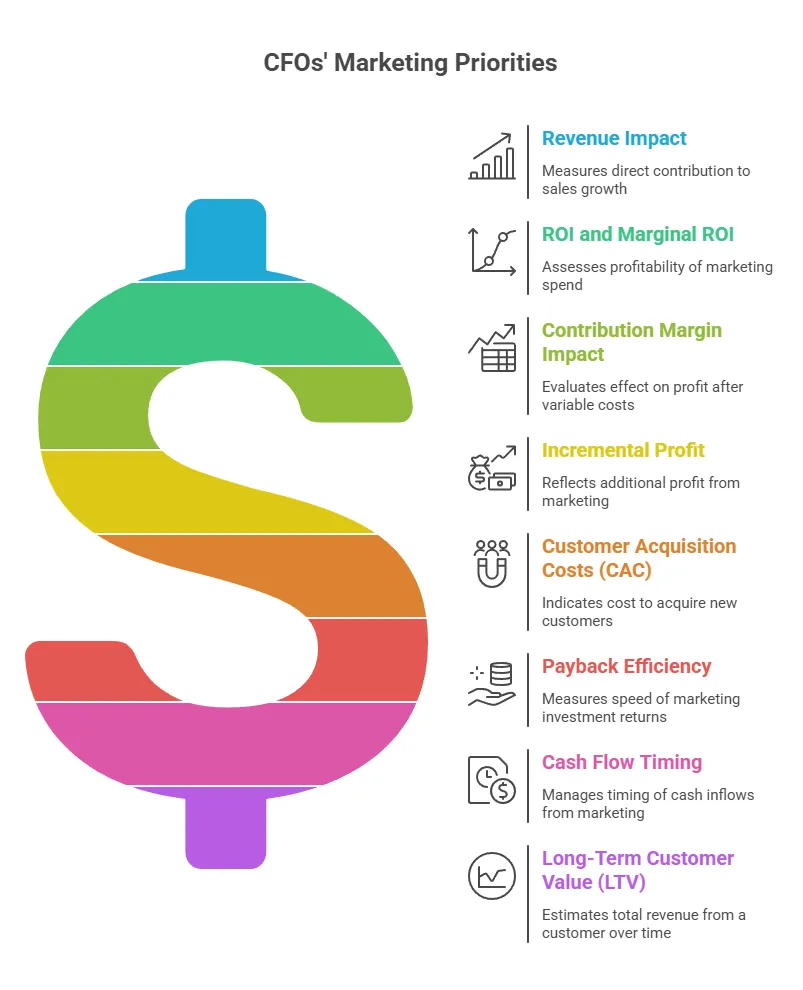
This is the layer that determines whether MMM becomes a finance-approved operating system or remains a marketing analytics exercise. Most models can estimate channel contribution. But your goal is to translate those outputs into metrics a CFO uses for investment decisions.
Based on our experience, this is where MMM either earns executive trust or loses it. A model that shows “channel lift” may impress marketers, but finance needs to understand what that lift means for revenue, margin, cash flow, and future budget allocation.
The purpose of the financial translation layer is to convert statistical findings into measurable business value.
The purpose of the financial translation layer is to convert statistical findings into measurable business value.
A CFO-ready MMM framework should be able to connect marketing activities directly to:
For example, if the model estimates that paid social drove $4M in incremental revenue, finance leaders will immediately ask:
This is why mature MMM systems integrate ERP data, CRM platforms, and finance reporting systems rather than relying only on ad platform dashboards.
Once MMM outputs are translated into financial metrics, the next step is operational decision-making. This is where enterprise organizations move beyond passive reporting and use MMM as an active planning system for optimizing investment across media channels.
This layer is for both marketing and finance. For marketing, it decides media spend and activity. For finance, it creates the justification for budget release.
The decision engine layer helps marketers and finance teams answer one core question:
“How should we allocate future spend to maximize business performance while managing risk?”
After all, the primary purpose of MMM is to improve future budget allocation decisions.
Instead of distributing spend based on historical habits or platform recommendations, marketers can use modeled insights to identify where incremental investment creates the strongest returns.
For example, the model may reveal that paid search has reached saturation or that connected TV is underfunded. This allows teams to reallocate spend based on modeled contribution instead of surface-level ROAS metrics.
Another important element of this layer (at least for finance teams) is scenario modeling.
Organizations can simulate questions like:
These simulations allow marketing leaders to prepare best-case, expected-case, and worst-case forecasts before spending decisions are finalized.
Not all marketing investments carry the same level of risk. Some channels deliver stable returns with predictable forecasting behavior. Others are highly volatile due to auction pressure, competitive activity, or shifting consumer demand.
A CFO-ready framework should evaluate both return potential and planning risk.
Your MMM model should help quantify uncertainty by evaluating how sensitive performance is to changes in spend, pricing, seasonality, and external market conditions.
Again, Bayesian models are particularly useful here because they estimate probability ranges rather than single fixed outcomes. Finance gets a more disciplined marketing investment planning across the enterprise.
Governance and reporting standards ensure the framework remains trusted, repeatable, and operational across the enterprise.
This layer is what turns MMM into a long-term executive decision system rather than a one-time analytics project.
We usually recommend treating governance as part of the model, instead of an afterthought. Even accurate MMM outputs can lose credibility if teams cannot explain where the data came from, how assumptions were made, or why the model changed between reporting cycles.
Marketing and finance teams consume performance data differently. The latter is obviously interested in revenue and growth-linked KPIs. A CFO-ready MMM framework should standardize reporting across both groups but tailor outputs to their priorities.
Also, finance teams require transparency.
Every assumption, transformation, and modeling decision should be documented clearly enough for internal review, external audits, or leadership scrutiny.
This includes documenting:
Without documentation, MMM outputs become difficult to defend during budgeting cycles or executive reviews. This is even more important if you’re using automated machine learning models, in which the logic can be difficult for non-technical stakeholders to interpret.
MMM can produce many useful marketing metrics, but CFOs care most about the ones tied to financial performance, investment efficiency, and future budget decisions.
Below, we have mentioned the core MMM metrics that matter most in finance-led marketing conversations.
Return on investment is the primary metric finance teams use to evaluate the efficiency of marketing efforts.
And that is exactly why 45% of CMOs in PwC’s Pulse survey said that showing ROI is one of their top three priorities.
We have observed that CFOs typically prioritize incremental ROI rather than platform-reported ROAS. This is because they want to understand how much true business value marketing generates after accounting for baseline demand and external influences.
A mature MMM framework measures ROI across all major media channels, including offline and upper-funnel activities, while accounting for factors such as seasonality, pricing, and saturation. This creates a more realistic view of profitability than isolated ad platform reporting.
Enterprise organizations evaluate customer acquisition through a profitability lens rather than pure lead volume. MMM helps marketers understand which marketing channels drive the most efficient acquisition at scale while accounting for delayed conversion behavior, repeat purchases, and contribution margin.
For example, paid search may initially produce lower acquisition costs, while connected TV or influencer marketing may improve long-term retention and customer quality. So, this one metric alone can help marketers justify certain media spend choices.
Pro tip: We suggest integrating CRM systems and first-party data to measure acquisition efficiency beyond surface-level conversions.
CFOs also care about whether marketing investment creates incremental growth beyond short-term transactional performance. MMM helps quantify both direct sales impact and broader brand lift effects across an omnichannel approach.
This is particularly important for upper-funnel investments such as video formats, connected TV, audio, and public relations, where attribution models can easily under-credit performance.
Behind the scenes, you may also need to conduct brand lift studies and implement consistent brand tracking to report specific findings that campaign data alone won’t provide.
Now that you have a core architecture for your MMM and some key metrics to focus on, here’s the actual implementation guideline to bring all of it into action.
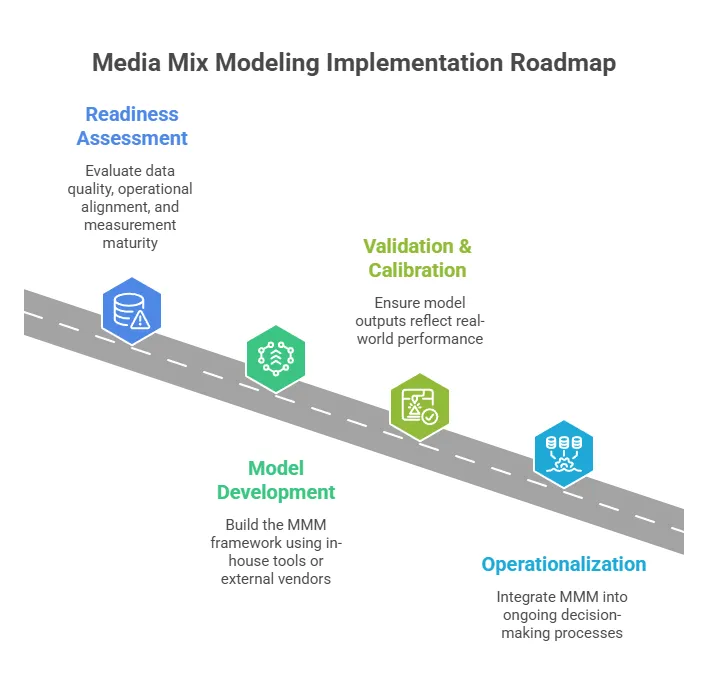
Before building any MMM framework, you should conduct a readiness assessment focused on data quality, operational alignment, and measurement maturity.
This phase typically begins with a full data audit covering marketing spend data, CRM systems, ERP records, attribution platforms, and campaign reporting pipelines to identify inconsistencies across channels.
Also, evaluate whether you have reliable historical data, standardized KPI definitions, and access to finance-approved revenue metrics.
Stakeholder alignment is equally important because MMM initiatives can fail when marketing, finance, analytics, and engineering teams operate with conflicting objectives or reporting structures.
Once the organization is operationally prepared, the next step is developing the MMM framework itself.
One of the first decisions is whether to build in-house or use external vendors.
Large enterprises with mature data science teams may prefer internal development using open-source tools such as Robyn or Google LightweightMMM, as they offer greater customization and transparency.
But organizations that lack such expertise can choose vendors such as Nielsen or Analytic Partners.
For a more cost-effective approach, you can partner with a marketing measurement expert agency like Fieldtrip to conduct MMM.
During this phase, teams structure regression models, integrate external variables, and calibrate media inputs across all major marketing channels. Cloud infrastructure and automated data feeds also become critical, as enterprise-scale MMM requires scalable processing environments capable of handling large, multi-channel datasets.
After the initial model is built, organizations must validate whether outputs reflect real-world business performance. This phase focuses on cross-checking model estimates against historical outcomes, experimentation frameworks, and operational benchmarks.
To do that, you can compare MMM projections against prior campaign performance, financial reporting, and known sales patterns to evaluate predictive accuracy.
Calibration becomes critical because attribution systems, ad platforms, and MMM frameworks often produce different estimates.
In our daily practice, we rarely recommend relying on one measurement method alone. A triangulated approach that combines experimentation, attribution modeling, and MMM gives teams more confidence in investment decisions and reduces the risk of over-trusting any single source of truth.
The final phase focuses on embedding MMM into ongoing enterprise decision-making.
In addition to reporting the findings to the finance board, integrate MMM outputs into quarterly planning, forecasting, and media allocation workflows.
You may even connect models directly to business intelligence environments, so finance and marketing stakeholders can consistently monitor performance.
We have seen MMM create the most value when it becomes part of the operating rhythm. The strongest organizations use it continuously to guide strategic planning, tactical optimization, and long-term investment governance.
A CFO-ready MMM framework only works when measurement is trusted, consistent, and usable across teams. Start by auditing your current reporting ecosystem across paid media, CRM systems, finance platforms, and attribution tools to identify where platform-reported performance differs from real business outcomes.
Enterprise teams should also avoid treating MMM as a one-time analytics initiative. The strongest programs operate as continuous decision systems that integrate media mix modeling, experimentation, and forecasting into a single process.
And remember, MMM is a highly sophisticated and challenging undertaking. Even with a large marketing division and excellent teams, gaps can appear across data quality, technology, modeling expertise, and financial translation.
For teams that need support, Fieldtrip can help connect media mix modeling, performance tracking, and cross-channel measurement into a more finance-ready system.
Get in touch with us to discuss your measurement goals.
Media mix modeling measures the incremental impact of aggregated media channels on business outcomes using historical data, statistical modeling, and external variables such as seasonality, pricing, and market conditions. Attribution models focus on tracking individual user interactions across the customer journey to assign credit to specific touchpoints.
Implementation timelines are based on data maturity, tooling, and organizational complexity. Enterprise organizations typically require 3 to 6 months for initial deployment, including data integration, model development, validation, and reporting setup. More advanced frameworks with automated data feeds and scenario-planning tools may take even longer.
MMM accuracy depends heavily on data quality, model design, and validation processes. Strong models are usually calibrated against historical performance, incrementality tests, and lift experiments to improve predictive accuracy.
Yes, but model reliability improves significantly with larger and cleaner datasets. If you have limited historical data, you may still build directional models using aggregated campaign performance, first-party data, and external benchmarks.
Generally, yes. Unlike attribution systems that rely heavily on cookies, pixels, and user-level tracking, MMM primarily uses aggregated data instead of personally identifiable information.
It’s recommended to refresh MMM models quarterly or semi-annually, depending on media spend volume, market volatility, and campaign frequency.