






















Agency models are far less settled than they used to be. In WFA’s 2025 research, two-thirds of global brands said they had changed their agency model within the previous four years, with many running more than one model at the same time.
That makes the agency of record (AOR) less of a default arrangement and more of a deliberate choice: when does putting one agency formally in charge actually make sense?
This guide covers what an AOR does, how the relationship is structured and paid for, and how it compares with project-based agencies, agency rosters, and in-house teams.
Let’s dive in.
An agency of record (AOR) is the agency a brand formally appoints, under contract, as its primary partner for a defined set of marketing disciplines.
The narrower, older definition is an agency authorized to purchase advertising on behalf of the company that holds the agency contract, as the Wikipedia entry, which cites Barron's Dictionary of Marketing Terms, puts it.
The two meanings overlap. An appointed AOR is often also the party authorized to buy on the brand's behalf, which is where the AOR letter, covered later, comes in.
The phrase also appears outside marketing. In HR and staffing, an agency of record manages a company's contingent and contract workforce vendors. That is a different job and this guide does not cover it.
The term comes from media buying. Media publishers sold advertising space to agencies, and agencies bought it for their clients and earned a commission on the spend. Naming one agency of record told a publisher which agency could commit a given brand's budget.
Over time the appointment grew into a broader arrangement. Axelerant describes the classic AOR as one agency responsible for brand strategy, creative, and media placement, with a single point of contact for the client.
An AOR describes a formal appointment: the brand gives one agency standing responsibility for a defined scope. A lead agency describes a coordination role: one agency aligns the work of other specialist partners around a shared strategy.
The same agency can be both. For example, a brand may appoint a creative AOR and also ask it to coordinate media, PR, or production partners. In other setups, the lead agency coordinates the roster without holding AOR status for every discipline.
Scope depends on the contract. A full-service agency of record covers strategy, brand creative, media, and measurement, and narrower AORs own a subset of those layers, as the next section explains.
The table shows what a full-service appointment usually contains.
| Layer | What the AOR owns | Typical outputs |
|---|---|---|
| Strategy | Market segmentation, positioning, competitive read, media and communications planning | Audience definitions, positioning, annual plan |
| Creative | Concepting, copy, and production | Campaign concepts, ad variants, brand assets |
| Media | Planning, buying, and ad account management | Media plan, platform buys, budget pacing |
| Measurement | Reporting and attribution | Dashboards, quarterly business review |
Smaller organizations get the same bundle in a lighter form. Hemisphere Design describes brand strategy, content marketing, digital advertising, social media, email, and website work, scoped to the client.
Loyalty programs and CRM mechanics, on-site events, web development, and specialist PR or crisis work can sit inside or outside an AOR contract. What matters is writing it down. Everything-PR warns that a scope line like "PR support" is too vague and advises naming each service.
Ask which of these are in scope before you sign. The agreement section later in this guide covers the wording.
The four main types of agency of record are media, creative, digital or full-service, and PR, each named for the discipline the agency owns.
A media agency of record plans and buys media for the brand and negotiates with content platforms and publishers. Our list of top media buying agencies for the biggest brands compares agencies that run this work. Because it spends the brand's budget, its contract needs the most care around transparency, which the agreement section covers.
A creative agency of record owns brand creative, including graphic production, and the system that keeps assets consistent across channels. Media usually sits with a different agency, so the two teams need a shared brief and shared reporting to work from the same plan.
A digital or full-service agency of record runs advertising campaigns across several layers under one contract. Yotpo separates full-service agencies, which cover several disciplines, from specialized agencies, which focus on one.
A PR agency of record handles ongoing media relations and executive visibility. Everything-PR describes it as the default communications partner, with specialist firms brought in for crisis or transaction work.
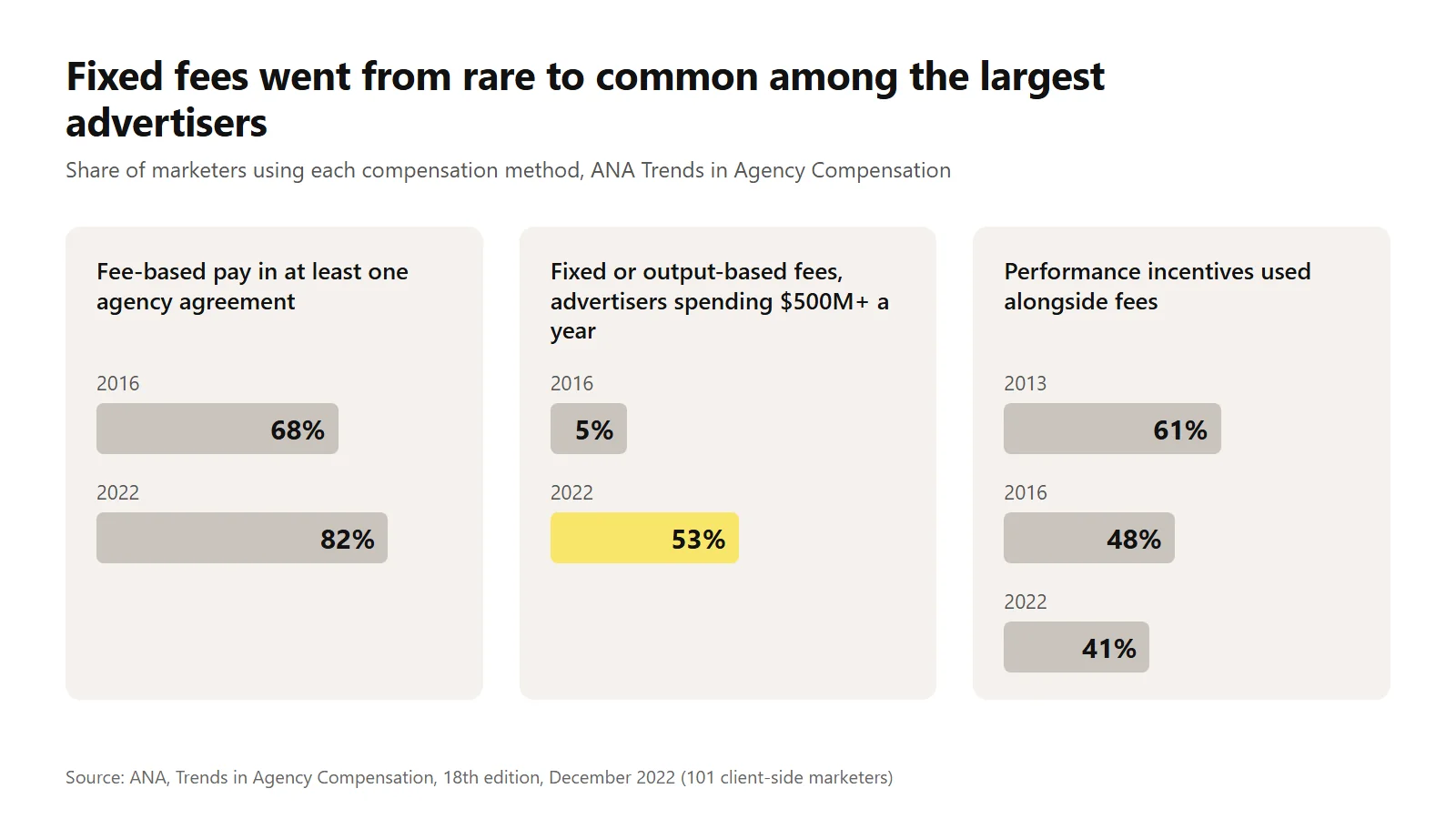
Across the market, agency pay has moved from commission to fees. In ANA's 2022 Trends in Agency Compensation survey, 82% of marketers used a fee-based method in at least one agency agreement, up from 68% in 2016. The survey covers all agency agreements, and AORs are priced in the same market.
Under commission pay, the agency earns a percentage of media spend. A 4A's and ANA guide to compensation models gives the standard arithmetic: at a 15% commission and $100,000 of media placements, the agency receives $15,000.
The model ties pay to how much the brand spends, so the agency earns more when spend rises whether or not the work improved. Commission has not disappeared everywhere. Web Tonic's 2026 pricing roundup notes that media buying at scale still runs commission structures in some contracts.
A labor-based fee multiplies agency hours by agreed rates. A fixed or output-based fee prices a defined set of deliverables regardless of the time spent.
ANA found the fixed model spreading among the largest advertisers: 53% of marketers spending $500 million or more a year used fixed or output-based fees in 2022, up from 5% in 2016. The report names administrative efficiency as one likely reason, because output-based fees remove the haggling over agency labor time.
Most AORs bill as a monthly retainer, which wraps a labor-based or fixed fee into one predictable payment. Hemisphere Design says the structure replaces unpredictable project-by-project costs and the repeated onboarding that comes with them.
Incentives sit on top of the fee. ANA found that 41% of marketers used performance incentives in 2022, down from 48% in 2016 and 61% in 2013. Its 2025 report puts the figure at 15%, the lowest since 1994. In the 2022 survey, most marketers said they did not know whether the incentives improved agency performance.
An agency of record retainer runs from about $1,500 a month for a small business to $250,000 a month or more for an enterprise PR account. Published numbers are scarce and tied to specific disciplines, and they come from two sources: Hemisphere Design, an agency listing its own packages, and Everything-PR, an editorial guide to hiring PR firms.
| Brand type | Reported monthly range | Source |
|---|---|---|
| Small business, design plus digital advertising | From $1,500 | Hemisphere Design |
| Small business, adding video, web, and several channels | From about $4,500 | Hemisphere Design |
| Mid-market PR AOR | $10,000 to $75,000+ | Everything-PR, June 2026 |
| Enterprise PR AOR | $50,000 to $250,000+; top-tier Fortune 500 accounts can exceed $500,000 | Everything-PR, June 2026 |
They show how wide the range is, and they are not a benchmark. Your fee depends on the disciplines in scope, the seniority of the team, and the volume of work. We do not publish our own fees, because a scoping conversation produces a number for your brand that a table cannot.
An agency of record gives a brand one accountable partner and accumulated knowledge of the brand, while a retainer structure can also make agency costs more predictable. The sources agree on four benefits:
The trade-offs, such as monthly minimums and less price competition, are in the comparison table below.
An agency of record gives you continuity and one accountable owner. Project and roster models give you specialist depth and price competition between agencies.
| Structure | How work is assigned | Strength | Trade-off |
|---|---|---|---|
| AOR | One agency holds an agreed scope for a set term | Institutional knowledge builds, one party is accountable, and the agency can mobilize fast | Monthly minimum commitments, less price competition, and no single agency is best at every discipline |
| Project agency | An agency is hired for a defined, time-bound deliverable | Specialist match and competitive pressure on every brief | Context is rebuilt each engagement, and no one owns the overall brand outcome |
| Roster of specialists | Several agencies each own one discipline, such as digital media or creative | Best craft in each discipline | The brand coordinates the agencies, and the plan can fragment |
| In-house team with agency surge | The internal team does steady work and agencies take the peaks | Control and institutional knowledge stay inside | Needs internal headcount and management time |
Everything-PR lays out the advantages of both the AOR and project models in detail. Axelerant, writing in 2017, traced the shift toward project work to digital channels adding more specializations than any one agency could handle, and warned that projectization leads to fragmentation.
An AOR can also take the lead-agency role over specialist shops. In this setup, the primary agency owns the shared strategy and brand guardrails, while specialist partners handle areas such as PR, production, or market-specific work.
The specialist shops own their craft and report into the lead plan.
The setup works when the lead agency sees every specialist's plan before it runs. Without that, the brand has a roster with a coordinator in name only.
Our guide to boutique and enterprise agency partners covers which roles suit which kind of agency.
Appoint an agency of record when recurring work within a defined scope benefits from one standing owner, consistent planning, and accumulated knowledge of the brand. That scope can cover one discipline, such as media, or several that need to work from the same plan.
An AOR still makes less sense for an episodic need such as a single launch, while a brand with a strong internal team may only need agency capacity for peaks.
The table maps common situations to a structure. Treat it as a starting point for the discussion, because budgets and internal capacity change the answer.
| Brand situation | Suggested structure | Why | Watch-out |
|---|---|---|---|
| Early-stage brand with one channel | Project agency or freelancers | The work is too small for a retainer minimum | Revisit when the scope becomes large and recurring enough to need a standing owner. |
| DTC brand scaling creative and paid across digital media | AOR, potentially acting as lead agency over specialists | Test results from paid should feed the next creative brief | Check that fees flex when creative volume swings |
| Enterprise with several divisions | One AOR per division, or an AOR that leads specialist agencies across divisions | Divisions serve different markets, and Fortune 500 agency partnerships often combine more than one structure | Define which divisions share an agency |
| Brand with a strong in-house team | Roster plus agency surge | The internal team carries continuity | Brief agencies on internal standards |
| Brand running a one-time launch with event registrations | Project agency | Scope and deliverables are fixed and time-bound | Plan the handover for work after launch |
| Brand with five vendors on separate contracts | Lead agency, or consolidation to fewer partners | Five briefs and five reporting formats make a shared plan hard to hold | Map contract end dates before you move |
Answer these five before you write a brief.
If your answers point toward an appointment, our guide to choosing an advertising agency for a global brand goes deeper on evaluation criteria.
The agency of record model has evolved because one agency can no longer cover every digital specialization well, as the comparison above explains. The original promise of one point of contact and clear ownership still matters, and Axelerant (2017) lists effective strategy, ownership, efficiency, and trust as the classic advantages.
The usual answers are a roster, which leaves coordination to the brand, or a lead agency over specialists, covered above. A third answer keeps the specialists inside one operating model. Fieldtrip's ecosystem is built that way: small autonomous teams, each strong in one discipline, connected by a shared strategy.
You can start with one team, such as SEO, creator marketing, media, or analytics, and add others as priorities change. When several teams work on a brand, we stay accountable for the overall outcome and define each team's responsibilities from the start, so the brand has one party to call. The model can sit alongside your in-house team or your existing agencies.
The decision table above applies to this model too.
An agency of record agreement should name each service the agency owns as a deliverable, then set the term, notice period, staffing, conflicts, reporting, principal media, and account ownership. A high-performing agency-client relationship depends on those terms being clear on day one.
| Clause | What to specify | Why it matters |
|---|---|---|
| Scope and contract disciplines | Each service and deliverable by name | A vague scope line invites disputes |
| Term | 12 to 24 months for an initial term; Everything-PR calls anything over 36 months unusual and says it should carry strong review and exit clauses. Hemisphere Design cites 12 months as standard for small businesses | Strategic work needs time to show results |
| Termination | 60 to 90 days' notice is standard; Everything-PR advises negotiating 180+ days down | A long exit window locks in a weak fit |
| Staffing | Named senior people, committed hours by role, and who works the account | The team that pitches should be the team that works |
| Conflicts | Which competitors the agency may also serve during the term | Protects the brand's data and strategy |
| Reporting and approvals | Weekly status, monthly strategic reviews, quarterly business reviews, and who signs off work before it ships | Gives both sides a fixed rhythm |
| Principal media | Disclosure and approval before any principal transaction | See below |
| Account and data ownership | The brand owns ad accounts and data | Mechanics are in the next section |
Principal media needs its own clause. ANA defines it as agencies purchasing media inventory themselves and reselling it to clients, where an agent buys on the client's behalf. In ANA's March 2026 report, 58% of marketers said their company used principal media in the past year, up from 47% in ANA's 2024 study.
Governance lags that adoption. Only 57% of marketers have internal guidelines, 63% say their agency contracts address principal media, and 90% cite uncertainty about whether recommended principal media is in their best interest. ANA recommends addressing it explicitly in the agreement and setting approval and transparency requirements before such transactions occur.
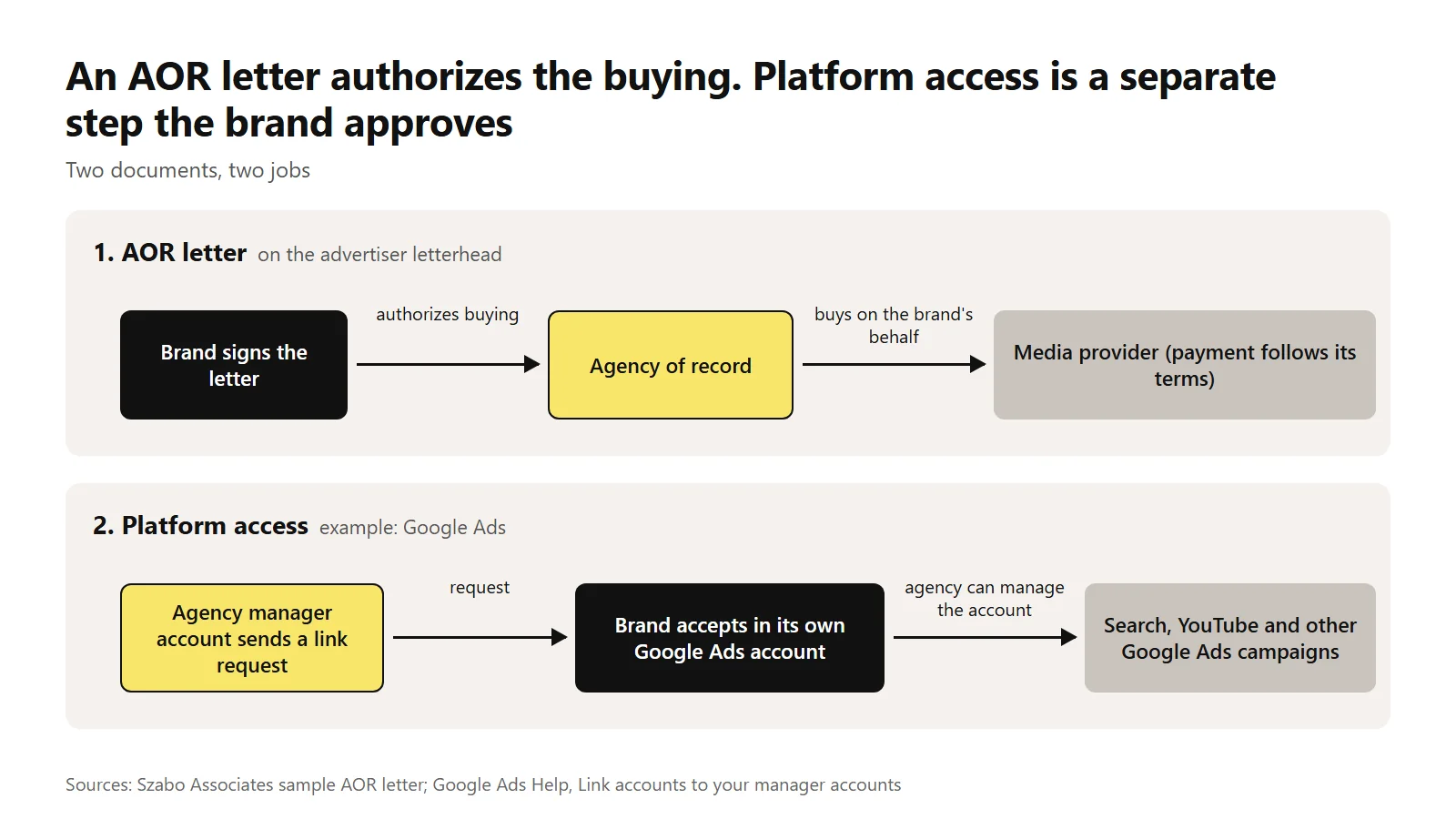
An AOR letter is a short document on the advertiser's letterhead telling a media provider that the agency is authorized to purchase advertising and related services on the brand's behalf. Szabo's sample letter says exactly that, and adds that payment follows the media provider's terms.
Platform access works separately. In Google Ads, a brand can keep its existing account and link the agency's manager account. The agency sends a link request, the brand accepts it, and the agency gains management access without automatically taking administrative ownership of the account.
That is also the route for YouTube campaigns, which run through Google Ads. Because several manager accounts can be linked to the same client account, platform access alone does not establish AOR status or exclusivity. Write into the contract who retains administrative control, which agencies receive access, and how access, data, and learnings are handled when the relationship ends.
To appoint an agency of record, define the scope, run a pitch, compare responses on one sheet, run a pilot, and sign with review points, in that order.
Whether you appoint one agency, a lead agency, or a roster, the structure works when strategy, creative, media, and measurement share one plan. Fieldtrip's strategy and ecosystem teams can help you scope the disciplines, pick a starting team, and set up reporting so one party answers for the result.
Book a conversation about the disciplines in scope and which team should start.
Yes. Everything-PR notes that multi-division companies often assign different AORs to consumer products, corporate communications, and specific business units. Set one lead for brand guardrails and shared reporting so divisions do not build separate versions of the brand.
When an agency buys as an agent, it purchases inventory on your behalf and the transaction is yours. In principal media, the agency buys the inventory itself and resells it to you, so the price you pay can differ from what the agency paid. Ask for written approval of each principal deal and for the right to see the agency's cost.
It can. Require disclosure of which shops work on your account, write each shop's role into the scope, and keep the AOR accountable for the outcome.
It can, with two additions. Set a volume band, such as a range of assets per month, and agree a change-request rate for work above it. Get the rate in writing, because that clause decides whether a fixed price stays fixed.
Review it at least annually against agreed metrics, on top of the reporting rhythm in the contract. A re-pitch is worth considering when targets are missed across two consecutive reviews or when the brand's needs outgrow the agency's disciplines.
No. A retainer describes how an agency is paid, while AOR status describes the agency's formal role. Many AOR relationships use monthly retainers, but compensation can also be fixed, labor-based, commission-based, or a hybrid. What makes an agency the AOR is its formal appointment and standing responsibility for a defined scope.