






















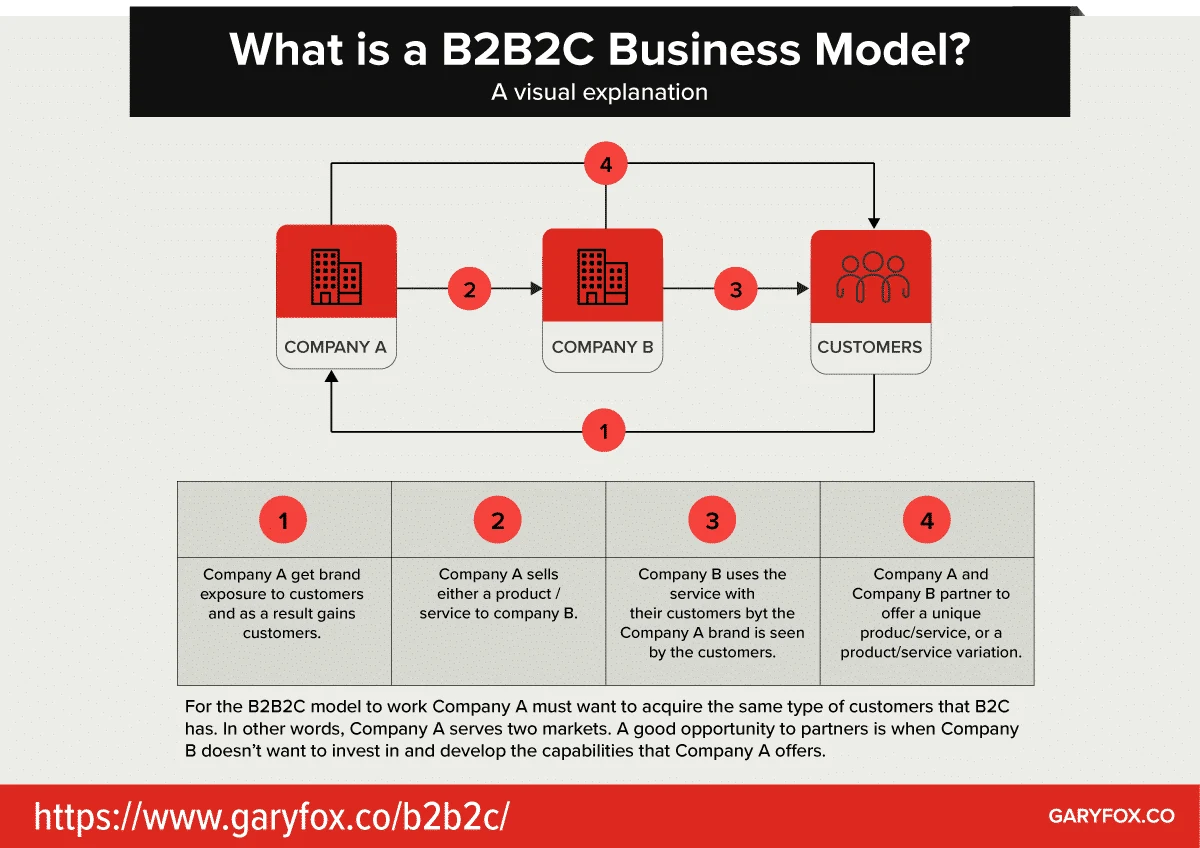
B2B2C (business-to-business-to-consumer) marketing helps a brand reach consumers through a business partner, such as a retailer, marketplace, or platform. The brand stays visible to the end customer, while its marketing supports two connected goals: giving partners a reason to promote the product and consumers a reason to choose it.
This connection depends on how partners present your product. In Syndigo’s State of Product Experience 2026 report, 80% of consumers said inaccurate product information negatively affects their perception of a brand.
Your campaigns may create interest, but the information shoppers encounter on a partner’s product page can undermine their confidence.
Effective B2B2C marketing connects consumer demand with partner execution. Partners need confidence in your product’s margins and sales potential. And consumers need a clear proposition that holds up across listings, promotions, and the buying experience.
Your strategy has to connect those priorities through coordinated campaigns, useful sales materials, and shared measures of success, even when access to customer data is limited.
In this guide, we’ll share how to coordinate partner campaigns, build consumer demand, and measure B2B2C marketing results when customer data is limited.
B2B sells to businesses, while B2C sells to consumers. B2B2C connects two businesses that jointly serve consumers, with both brands visible in the experience. In a white-label arrangement, the supplier’s product appears under another company’s brand. The distinctions involve who buys, whose brand appears, and how each business participates in the customer relationship.
These categories can overlap. A manufacturer’s sale to a retailer is B2B, while the retailer’s sale to a shopper is B2C. A B2B2C strategy connects the businesses’ roles in reaching and serving that shopper.
In B2B2C, consumers encounter both businesses as visible participants in the experience. White-label products carry the selling company’s branding. B2B and B2C describe the buyer rather than prescribing which brands appear, so visibility alone cannot classify every arrangement.
| Model | Buyer | Brand visibility | Customer relationship | Main marketing challenge |
|---|---|---|---|---|
| B2B | A business | Depends on how the product is used or resold | Between the supplier and business buyer | Addressing business needs and multiple decision-makers |
| B2C | A consumer | May include retailer and product brands | Between the consumer and selling business | Turning consumer interest into purchases and repeat business |
| White-label partnership | A business that sells under its own brand | The selling company’s brand; the supplier usually stays behind the scenes | Usually led by the selling company | Building demand without consumer recognition for the supplier |
| B2B2C | A business partner and the end consumer have connected roles | Both participating brands | Both businesses participate; responsibilities and data access vary | Connecting partner adoption with consumer demand |
A visible logo on a retailer’s shelf does not, by itself, establish an integrated B2B2C partnership. Look at how the businesses coordinate discovery, delivery, service, and customer engagement.
Both businesses can have a relationship with the consumer, but their access to customer and transaction data depends on the partnership. One may manage checkout while the other provides the product, service, or ongoing support. Shared participation does not automatically mean equal access to information.
Before launching campaigns, establish which sales reports, customer insights, and attribution data each side can access. Also agree on who handles support, follow-up communication, and repeat purchases. These responsibilities affect what your marketing can deliver and measure.
B2B2C can expand your reach, add useful capabilities, and help you earn consumer trust through an established partner. The trade-offs include partner fees, coordination costs, and less control over parts of the customer experience. The value depends on whether additional profitable sales justify those costs.
The main advantages include:
The main disadvantages include:
B2B2C is a strong option when a partner helps you reach or serve consumers more effectively, your brand retains a meaningful customer role, and the economics support both businesses. You also need enough coordination and performance visibility to manage the relationship.
Assess the partnership against four questions:
A partner selling competing products does not automatically rule out the model. What matters is whether your offering can remain discoverable, differentiated, and profitable within that environment.

The most common B2B2C examples are marketplaces and grocery delivery apps such as Amazon and Instacart, app stores such as the Apple App Store, and embedded financing at checkout such as Katapult.
In each, the intermediary runs the transaction and the brand stays visible to the shopper. Each example below shows who holds the consumer relationship and what the manufacturer can usually see.
Amazon and Instacart are the standard retail cases. The scale is hard to ignore: more than 60% of sales in Amazon's store come from independent sellers, according to Amazon's 2025 small business report.
A grocery brand on Instacart stays visible on the product page while Instacart runs the order, the delivery, and the shopper account, so both parties are known to the consumer.
The brand gains reach into households it could not serve directly, and typically sees aggregate sell-through, placement performance, and whatever retail-media reporting it pays for. It rarely sees the individual shopper.
The Apple App Store carries developers to users while Apple controls discovery, billing and the account. It facilitated over $1.4 trillion in developer billings and sales in 2025, according to Apple.
The developer's brand is visible, but the platform owns the transaction and shares limited customer information. This is the architecture that gives the manufacturer the least data and the most dependence on the partner's merchandising rules.
Financing providers such as Katapult appear at a retailer's checkout, and brokerages route investors to products built by other firms. Here the intermediary is the one visible at the moment of decision, which is why embedded financial brands invest in recognition well before the checkout screen.
| Industry | Example | Intermediary role | What the manufacturer typically sees |
|---|---|---|---|
| Retail and grocery | Amazon, Instacart | Runs order, delivery, and shopper account | Aggregate sell-through, paid placement reporting |
| Digital platforms | Apple App Store | Controls discovery, billing, and account | Download and revenue summaries, little customer detail |
| Financial services | Katapult, brokerages | Appears at checkout or advises on product | Volume by partner, limited end-customer view |
The risk pattern to watch is a brand that lets the partner own every communication.
Retailers' own labels are growing fast: US store-brand sales hit a record $282.8 billion in 2025, and store brands' dollar share rose from 19.1% to 21.3% between 2021 and 2025, according to PLMA and Circana data.
Consider a hypothetical kitchenware brand that stops its own consumer marketing once a marketplace listing performs well. Within a few seasons, the marketplace's private label appears in the same search results, the brand's page is now one of many, and shoppers who once searched for the brand by name search the category instead. Nothing in the contract changed; salience leaked because the partner was the only voice.
Write one operating agreement that covers segmentation, incentives, brand guardrails and data flow before launch. Coordination done after launch is a negotiation from weakness, because the partner already has your product and your shoppers.
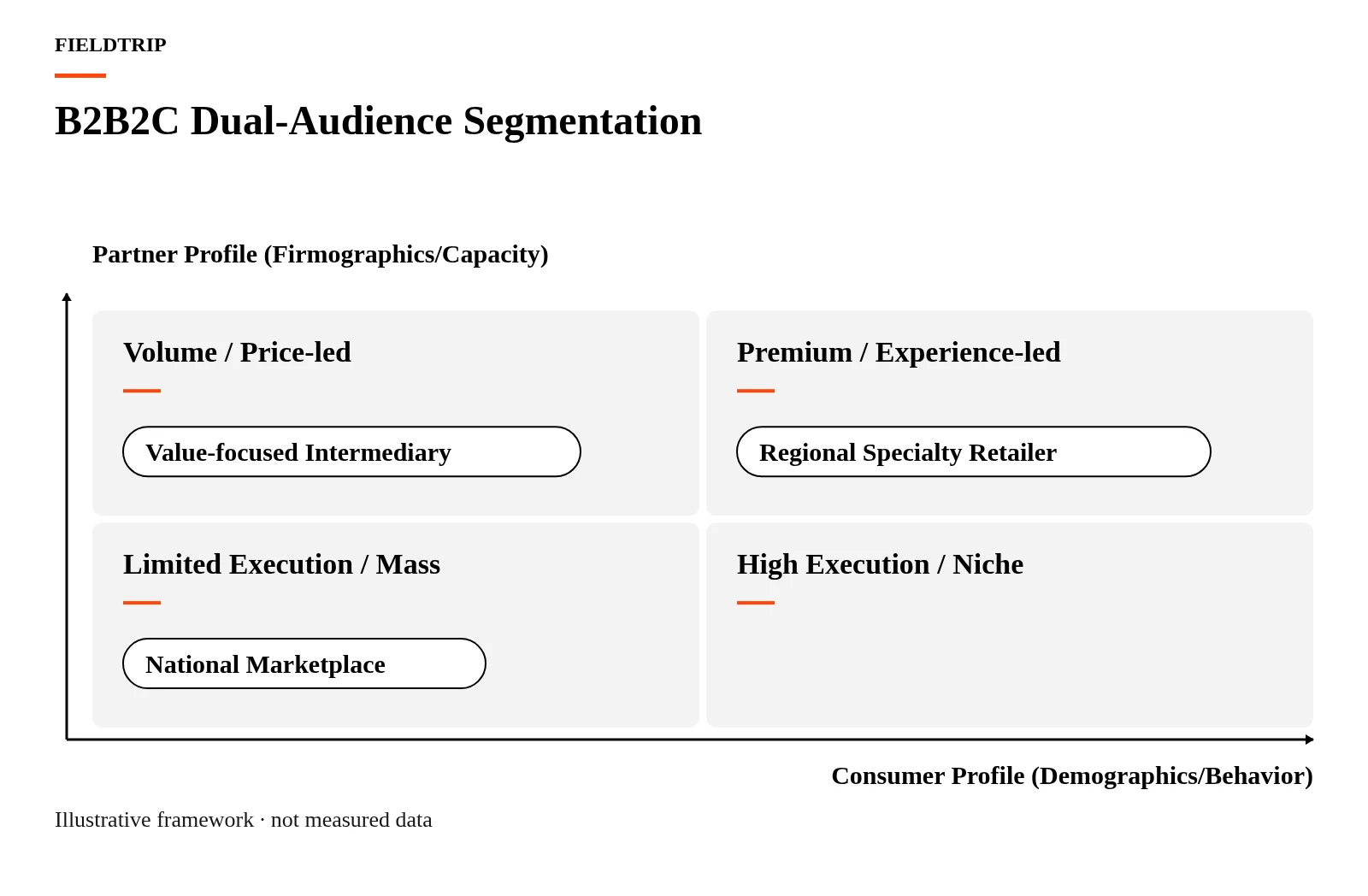
Plan both audiences on a single grid. Segment partners by firmographic and technographic data such as industry, company size, growth capacity, and technology adoption, and segment consumers by demographics, psychographics, and behavior. Put partner segments on one axis and consumer segments on the other.
Each cell tells you which consumer story a given partner needs to carry and whether that partner has the capacity to carry it. A regional retailer with strong in-store execution and an older customer base sits in a different cell from a national marketplace reaching younger, price-led shoppers, and the two should not receive the same assets or the same incentive terms.
The partner side of the matrix deserves real research. Business purchase decisions run through buying groups with several people and jobs to complete, so the category manager is rarely the only person you need to convince. Interviews with category managers and channel leads usually reveal more about what a partner needs to say yes than any volume of survey data.
Build one message architecture with two expressions. The partner story rests on margin, velocity, support, and risk reduction; the consumer story rests on your proposition. Both descend from the same positioning, so the claims never contradict each other when a partner's buyer and a shopper compare notes.
The incentive conversation then becomes concrete. Co-branded promotions, revenue sharing, and placement commitments are the usual instruments.
Tie each to a behavior you can observe: a promotion earns funding when it appears in the agreed slot, a rebate tier triggers on reorder cadence, a placement commitment is checked against the live page or planogram. If an incentive rewards something only the partner can see, you have paid for a promise.
Identity needs the same discipline. Decide in advance which brand elements are non-negotiable inside the partner's ecosystem, typically the mark, a core color, and the lead claim, and which adapt to the partner's templates, such as layout, image ratio, and secondary copy.
This is craft work, because an identity that only holds in your own channels is not doing its job; Fieldtrip's brand design practice treats the partner template as a brief, and the guardrails belong in the agreement itself, where the partner will read them.
Name the fields, the cadence, and the permitted uses before launch:
Access to consumer data in B2B2C depends on the contract far more than on goodwill, and a partner that is also selling your competitors has no reason to volunteer it later. Put the schedule in writing while the partner still wants the listing.
Build consumer demand by giving people a clear reason to choose your product and making it easy to buy through your partners. Support that demand with accurate listings, useful sales materials, and coordinated campaigns. Evidence of consumer interest strengthens your case for distribution, better placement, and continued partner investment.
Partners need confidence that your product can attract buyers and generate profitable sales. Consumer recognition can strengthen that confidence, alongside your pricing, margins, product quality, and ability to deliver reliably.
Trust matters to shoppers. In its July 2026 analysis of private-label growth, Circana reports that 80% of shoppers say buying a trusted brand is important. The same analysis shows that private labels can earn this trust, so an established name alone does not guarantee preference.
Give consumers a specific reason to choose you. Show how your product solves a problem, demonstrate its benefits, and make those benefits consistent across your campaigns and partner listings.
Then bring relevant evidence to partner discussions: customer requests, regional search interest, reviews, repeat purchases, or results from comparable channels. Explain what each signal suggests and where sales evidence is still limited.
Allocate spending according to what prevents consumers from finding, choosing, or buying your product. Partner support and consumer marketing need to work together throughout the relationship.
Use three steps:
Share campaign schedules early so partners can coordinate stock, placement, and promotions. Supply adaptable creative that keeps your proposition consistent while including the partner’s branding and purchase instructions where appropriate.
For example, an electronics accessory brand could concentrate advertising in three regions where its retail partner has strong coverage. It could share the campaign schedule in advance, confirm stock availability, and provide in-store displays naming the retailer. That gives the partner a clearer commercial case for additional placement.
Agree on the evidence both businesses will review and who will provide it. When checkout data is limited, combine consumer-interest indicators with partner reports rather than treating either as a complete picture.
Useful measures include:
These signals answer different questions. More searches suggest interest; stronger sales show purchases; reorders indicate the partner needs additional stock. Looking at them together helps you decide what to improve.
Set review dates that reflect the buying cycle and campaign objectives. Agree on early indicators, commercial targets, and reporting responsibilities before launch, then use the findings to adjust campaigns, partner support, and distribution.
Watch: B2B2C business model and B2B vs B2C marketing strategies
Classify each partner by the data you can actually get, then pick the measurement method that works at that level. Trying to run marketplace attribution as if you owned the checkout produces confident dashboards and wrong decisions.
The attribution gap in B2B2C is structural. The intermediary owns the transaction and the shopper account, so your dashboards see spend, reach, traffic, and partner-site visits but not the sale, while the partner sees the sale but not your media.
Neither side can close the loop alone. Map, for each partner, what arrives under the data-sharing schedule, what you collect yourself, and what nobody has.
| Data access level | What you can measure | Method | What it cannot prove |
|---|---|---|---|
| Partner shares aggregate sell-through | Sales by SKU, region and week against media flights | Marketing mix or regression on partner feeds | Which shopper responded; cross-channel cannibalization |
| Partner shares retail-media reporting only | Attributed conversions inside the partner's ecosystem | Partner platform reporting with holdout checks | Incrementality; the platform grades its own work |
| Manufacturer first-party data only | Registrations, warranty, loyalty and direct traffic | Cohort analysis by region and campaign exposure | Total sales; registrants are a biased sample |
| No shared data | Reorders, placement changes, branded search | Matched-market or time-based holdouts | Precise return; small partners add noise |
A weekly sell-through feed by region, written into the data schedule above, is enough to run a serious test and feed a media mix model; without it you are left with proxies.
Safari and Firefox block third-party cookies by default, and Apple requires apps to ask permission before tracking users across other companies' apps, so a measurement plan that depends on following a shopper from your ad to the partner's checkout will keep breaking.
Prioritize the first-party signals you control:
These channels also recover part of the relationship the model gives away.
The payoff is measurable: brands using first-party data for key marketing functions achieved up to a 2.9x revenue lift and 1.5x cost savings in a BCG and Google study. Treat registrant data as a directional read of the wider customer base.
A retail-media or marketplace platform reporting its own return has every incentive to credit itself. Run a holdout. In a hypothetical case, a brand with no partner sell-through data pauses consumer media in a matched set of regions and compares partner reorder volumes between test and control over two ordering cycles.
That tells leadership whether consumer spend moves partner demand, which is the decision that matters, even though it cannot price each incremental sale.
Fieldtrip's measurement work starts from that question: which test, with the data this partner will share, changes the next budget decision. State what each method can and cannot establish on the same slide, so leadership does not mistake a platform-reported return for proof.
Your B2B2C strategy needs to give partners a commercial reason to support your product and consumers a clear reason to choose it. Connecting those priorities takes coordinated messaging, campaigns, and measurement across the businesses involved.
At Fieldtrip, we bring strategy, creative, media, and measurement together through specialist teams working from a shared strategy. Our work connects audience insights and positioning with campaign development, channel planning, and performance evaluation.
For your B2B2C business, that means starting with the challenge limiting growth: reaching the right consumers, strengthening your proposition, supporting partner campaigns, or understanding which activity drives results. We can help define the priorities and build a plan around your audiences, commercial goals, and measurement options.
Contact our team to build a B2B2C marketing strategy that connects partner priorities with consumer demand.
Yes. A brand can sell through partners while operating its own direct-to-consumer channel. To reduce channel conflict, clarify each channel’s role, coordinate promotions, and consider differentiated bundles or services. Give consumers a reason to use each channel while preserving a worthwhile commercial opportunity for your partners.
Review how the competing product affects your positioning, visibility, and profitability. Strengthen meaningful differences through product benefits, innovation, service, or customer experience. Discuss promotional opportunities with the partner, and assess your margins and customer response before deciding whether to compete on price.
Choose a partner whose audience, sales channels, and service standards fit your product. Assess commercial terms, reporting access, operational requirements, and promotional support. A smaller partner with a relevant audience and a clear launch plan may offer a better starting point than a larger partner offering limited support.
A limited pilot can help you assess demand, profitability, and how well the businesses work together before expanding. Start with selected products, locations, or customer segments. Agree on responsibilities, spending, the review period, and the results that would justify expanding, adjusting, or ending the pilot.
Assign responsibility according to the issue and the partnership agreement. The partner may handle payments and delivery, while your brand handles product guidance or warranty support. Establish clear contact points, response times, and escalation routes so customers can resolve problems without repeatedly moving between teams.