


























First-party data has become a critical asset for enterprise advertisers as privacy regulation, platform restrictions, and signal loss continue to reshape digital advertising.
And this isn’t something new. In fact, it’s been in motion ever since the ‘demise of the cookie’ fear struck marketers. In 2024, IAB’s State of Data report found that 71% of brands, agencies, and publishers were growing or planning to grow their first-party data sets.
But the need for first-party data isn’t just a product of changing tracking dynamics. It also offers real business benefits, especially for enterprise advertisers looking to improve return on investment (ROI) in paid media.
Clearly, a well-thought-out, documented first-party data strategy is the need of the hour. And that’s what this guide will cover, including data collection, platform activation, and privacy compliance.
First-party data is information a company collects directly from its customers, prospects, and audiences through its own channels and systems.
Unlike data purchased from outside providers, it comes from interactions the business owns or manages, like website visits, app activity, purchases, account registrations, email engagement, customer service conversations, loyalty programs, and customer relationship management (CRM) platform records.
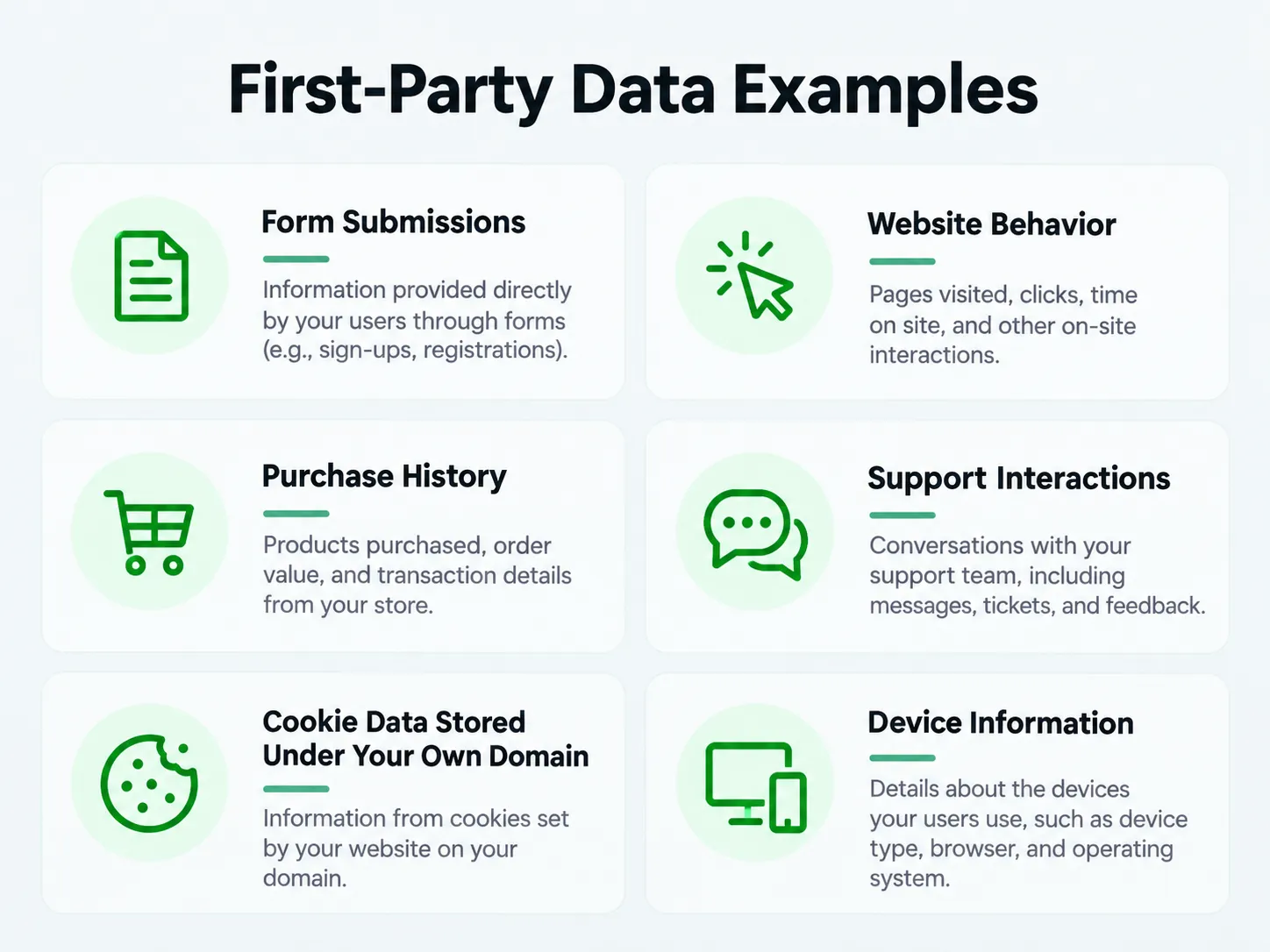
For advertisers, first-party data can include:
Enterprise brands can use this data to build audience segments, personalize campaigns, suppress existing customers from acquisition campaigns, improve retargeting, create lookalike or modeled audiences, and measure advertising performance more accurately.
First-, second-, and third-party data mainly differ based on where the data comes from (which can affect data quality and usefulness).
There’s a fourth type, too. Zero-party data is information that customers intentionally and proactively share with a brand, like preferences, interests, purchase intentions, survey responses, or product choices. Because customers provide it directly, it can drive personalization, segmentation, and better customer experiences.
The story around third-party cookies has become more complicated than the simple idea that they are disappearing. While they haven’t left the chat yet, the conversation has changed for the most part.
Some browsers already block third-party cookies by default. Safari does this through ITP (WebKit documentation), but Google hasn't yet followed suit. Google originally planned to phase them out completely in Chrome, but changed direction in 2025. Instead, Google now lets users manage third-party cookies through existing privacy settings.
That doesn’t mean advertisers can return to business as usual. Third-party cookies had already been heavily restricted elsewhere. Safari blocks third-party cookies by default through Intelligent Tracking Prevention, while platforms, browsers, devices, and operating systems increasingly limit the identifiers and cross-site signals advertisers once relied on.
Data privacy regulation is adding to the need for first-party data. Europe’s GDPR, the EU Digital Markets Act, state-level U.S. privacy laws, and other regulations have placed greater emphasis on consent, transparency, data minimization, and how personal information can be combined for advertising.
The main issue with reliance on external parties for data is signal loss, with fewer user-level identifiers available for targeting, attribution, and performance measurement.
In other words, 2026 is less about waiting for a single cookieless future deadline and more about adapting to a gradual, fragmented decline in reliable third-party signals.
Signal quality is becoming as important as signal availability. Advertisers are operating across walled gardens, retail media networks, connected TV, social platforms, search, websites, apps, CRM systems, and offline channels, each producing different identifiers and measurement methodologies.
Having large amounts of data doesn’t solve that problem if the information is duplicated, outdated, poorly matched, or disconnected from actual customers.
AI has created another reason to improve first-party data.
Advertising platforms increasingly use machine learning to decide who sees an ad, what creative they see, and how budgets are allocated.
At the enterprise level, brands are also building AI systems for personalization, audience modeling, customer analysis, creative development, and decision-making.
And AI models need quality data. Proprietary customer, transaction, product, and campaign data can make these systems more relevant to the individual business, while poor-quality or fragmented data can limit their usefulness.
First-party data gives enterprise advertisers a more direct and reliable view of their customers. Because it comes from owned interactions and systems, it can support better targeting, stronger analysis, and more efficient media investment across the customer journey. When collected and used lawfully, with appropriate consent or another applicable legal basis, first-party data can support these outcomes without bypassing privacy requirements.
First-party data lets you build audiences around real customer behavior. No broad assumptions or generic demographic profiles.
You can segment users based on purchase history, product interest, website behavior, lifecycle stage, account status, engagement, or other signals that reflect actual intent.
This creates more useful personalization across paid media. For example, an enterprise advertiser could show different messaging to a new prospect, a high-value customer, a dormant buyer, and someone who recently viewed a specific product or service.
First-party data can also improve suppression strategies. Instead of spending acquisition budget on customers who have already converted, you can target them with upsell pitches. Behavioral messages can increase the likelihood of purchase from both potential and existing customers.
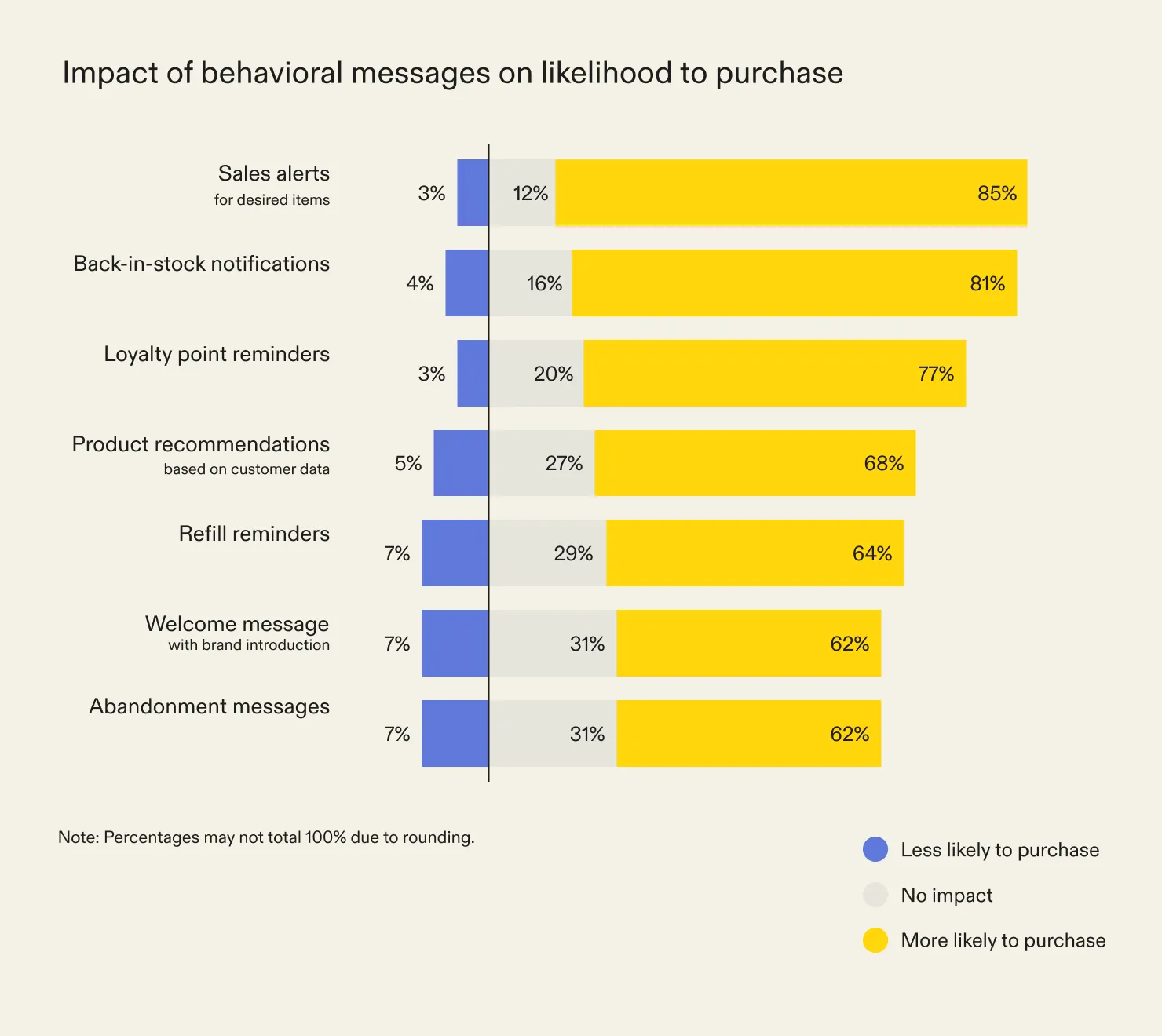
First-party data is valuable beyond campaign targeting. When data from CRM systems, transactions, websites, apps, customer service, and marketing platforms are connected, it can reveal a lot more:
These insights can influence broader business decisions, including product development, pricing, market expansion, customer experience, and sales strategy.
Enterprise teams can also use first-party data to develop more accurate customer profiles and identify differences between audiences across markets, business units, or product categories.
Better data helps advertisers allocate budget to audiences, channels, and campaigns more likely to produce meaningful business outcomes.
CMOs have already been under pressure for years now to achieve more with their budget and show ROI, according to Deloitte. First-party data can help with that significantly.
Instead of optimizing primarily around clicks or platform-reported conversions, enterprises can feed richer signals such as qualified leads, purchases, revenue, customer lifetime value, or offline conversions back into advertising platforms.
This can improve bidding and optimization while giving marketers a clearer picture of which media investments actually contribute to growth.
Your first-party data strategy starts with understanding what data you already have, where it lives, and how useful it is. Then, you create pathways to collect even more data. The crux of the strategy is consolidating and cleaning the data so ad platforms can use it effectively for AI-driven decision-making.
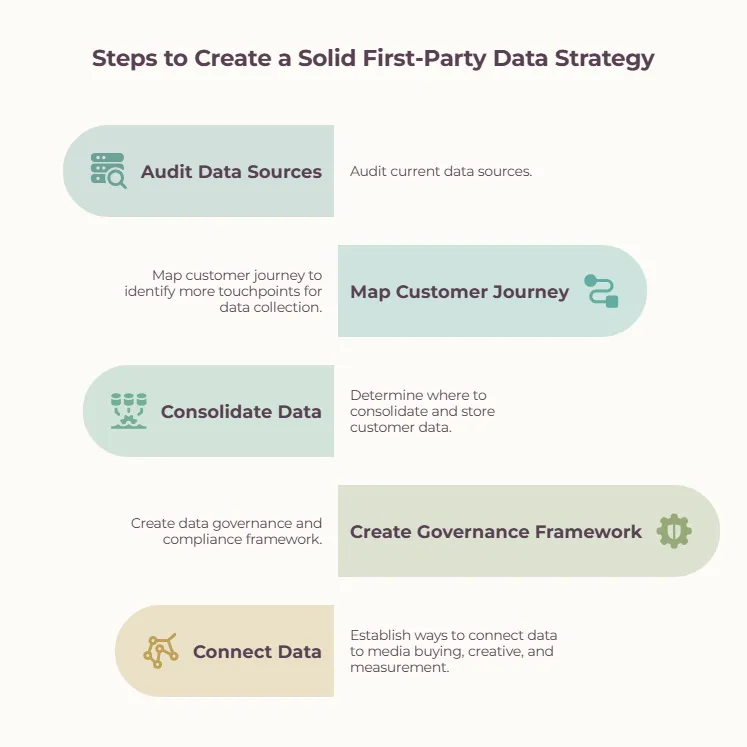
Let’s discuss the details:
Map every first-party data source across the organization. This may include CRM platforms, websites, mobile apps, ecommerce systems, loyalty programs, email platforms, customer service systems, point-of-sale data, offline sales records, event registrations, and product usage data.
For each source, document what data is being collected, which team owns it, how frequently it is updated, and whether it can be connected to other systems.
Enterprise organizations should pay particular attention to data silos, as customer information is sometimes spread across different regions, brands, business units, and technology platforms.
The audit should also assess data quality. Look for duplicate records, missing fields, inconsistent naming conventions, outdated customer information, and incomplete consent data.
Finally, identify which sources provide the strongest signals for advertising.
The result should be a clear inventory of the data you already have, the gaps to address, and which sources to prioritize for integration and activation.
Your data team can conduct the audit with marketing, media, and any external agencies you partner with.
Once you understand your existing data sources, map the customer journey from initial awareness through consideration, purchase, retention, and advocacy.
This is to identify where customers interact with the brand and where those interactions could generate useful first-party data.
Your audit findings plus this customer journey map should highlight any opportunities to collect more customer data. For example, a B2B organization may also capture valuable signals through sales conversations, account-based marketing programs, and actual product usage (through customer feedback surveys).
However, avoid collecting information simply because you can. Each data point should have a clear purpose and offer value to the customer.
We usually prefer touchpoints that generate usable signals for segmentation, personalization, advertising optimization, measurement, or improving the customer experience, with explicit consent and privacy controls, of course.
After identifying your data sources and collection opportunities, decide where to consolidate and manage customer information.
Enterprise organizations typically use one or more of customer relationship management (CRM) systems, customer data platforms (CDPs), and marketing cloud platforms.
The right architecture depends on data volume and variety, the existing technology stack, activation needs, and whether the organization needs a unified customer profile across multiple channels.
Establish a clear architecture that defines which system owns each type of data, how records are synchronized, and which platform provides the visitors and signals used for advertising.
First-party data has to be collected and used responsibly.
That requires a governance framework that defines what data can be collected, the legal basis or consent required, how long it can be retained, who can access it, and which marketing platforms, analytics setups, and AI systems may use it.
The framework should also standardize data definitions and ownership across markets and business units. Pay special attention to the regulations in the different jurisdictions you operate in. Ensure your assets comply with regulations and implement consent management properly.
Document consent status, data lineage, retention rules, access permissions, and procedures for handling deletion or access requests.
Privacy, legal, security, marketing, and data teams should all have clearly defined responsibilities.
The next step is turning customer data into signals that advertising teams can actually use.
Connect relevant CRM, CDP, ecommerce, and conversion data with advertising platforms through approved integrations, APIs, server-side connections, clean rooms, or other privacy-conscious activation methods.
For enterprise media buying, first-party audiences can support customer matching, exclusions, remarketing, modeled audience creation, bidding, and optimization toward higher-value outcomes.
You can feed approved, purpose-compatible behavioral data into analytics tools, subject to consent, access, retention, and platform-use requirements. The goal is to uncover insights into messaging, offers, and perceptions. You can then turn those findings into a clear report for the creative teams.
In other words, maximize the potential of the data you’re collecting, whether that’s simply providing better real-time signals to advertising platforms or understanding consumer expectations.
Once advertisers organize and govern first-party data, they can activate it across major advertising platforms for audience targeting, exclusions, optimization, personalization, and measurement.
The exact options vary by platform, region, consent status, and the identifiers available, so enterprise advertisers should build activation around approved integrations. Here’s a high-level overview of first-party data integration with the most widely used ad platforms:
Google's Customer Match allows advertisers to use customer information such as email addresses and phone numbers to match first-party audiences with Google users. You can then use these audiences across properties like Search, Shopping, Gmail, YouTube, and Display, subject to Google's eligibility and policy requirements.
Enterprise advertisers can also connect CRM and other customer data through Google Ads Data Manager, then use it for Customer Match, offline conversion imports, and related measurement workflows.
Social platforms generally allow advertisers to activate first-party customer lists, website and app usage, lead information, and conversion data. The strongest enterprise implementations combine audience activation with server-side conversion signals so the platforms have better information for both targeting and optimization.
On Meta, advertisers can create Custom Audiences from customer information like email addresses and phone numbers, provided they have the necessary rights and lawful basis to use that data. Meta hashes customer-list data as part of its audience-matching process.
The Meta Pixel can collect website events, while Conversions API can establish a server-side connection between Meta and data held in a company’s website platform, app, server, or CRM. Depending on the implementation, these signals can support retargeting, exclusions, optimization, audience expansion, and measurement across Facebook and Instagram.
TikTok also offers Custom Audiences. You can create them from customer files, website activity, app activity, lead generation, and engagement with TikTok properties.
And they’re used pretty much the same way as they are on Google and Meta, for retargeting, exclusions, and optimizations.
TikTok also supports both the Pixel and Events API for sending conversion signals. TikTok recommends using both together, where appropriate, to create a more reliable data connection for measurement, audience creation, and ad delivery.
For B2B advertisers, LinkedIn's Matched Audiences are particularly useful because companies can upload contact or company lists and combine them with LinkedIn's professional and firmographic data.
Advertisers can also retarget people based on website visits, video views, Lead Gen Form interactions, Company Page engagement, and other activity.
Plus, LinkedIn's Conversions API can connect online and offline conversion data directly from enterprise systems to LinkedIn. This is useful for businesses that want to optimize and measure deeper-funnel outcomes.
First-party data can also work for you on demand-side platforms (DSPs) for programmatic display, online video, audio, and connected TV (CTV).
Depending on the platform and market, you may onboard customer identifiers, create first-party audience segments, connect CDPs or identity partners, or use clean-room environments to match and analyze audiences without freely exchanging raw customer-level data.
For programmatic and CTV in particular, enterprises should avoid assuming that one audience can be activated identically everywhere. Match rates, publisher identity systems, device identifiers, consent requirements, and DSP capabilities differ considerably.
The better approach is to define the audience centrally, then determine the most privacy-conscious and technically reliable way to activate and measure it within each media environment.
First-party data isn’t a future-proofing tactic anymore because it’s very much the present. It’s becoming central to how enterprise advertisers target audiences, optimize campaigns, personalize creative, and measure outcomes.
First-party data can also support governed internal AI use cases where the organization has established an appropriate purpose, legal basis, security controls, and data-use policy.
But the winners will be those who focus on data hygiene, consent, integration, and practical activation, not just collecting more information.
A well-structured first-party data strategy gives you a more durable foundation for making media decisions as privacy rules, platforms, and technology continue to change.
Liked this article? Next read: Creative Testing and Measurement for Large Brands
Not directly. Third-party cookies are only one type of advertising signal, while first-party data is a broader source of customer information collected through owned channels. As cross-site tracking becomes less reliable, first-party data has become a better alternative.
First-party data includes information a business collects directly through its own interactions and systems, such as purchases, website or app activity, account information, CRM records, and customer-service interactions. Zero-party data is information customers intentionally provide, such as preferences, interests, survey answers, and purchase intentions.
Clean rooms aren’t a requirement. They’re usually needed when enterprises have to match or analyze their first-party data alongside publisher, retailer, or platform data without directly sharing raw customer-level information. They can improve activation and measurement, but you can build a strong first-party strategy without one.
Most enterprise stacks include a CRM, CDP or customer data layer, consent management platform, analytics tools, data warehouse, tag or server-side event infrastructure, and advertising platform integrations. The exact mix depends on whether the priority is identity resolution, personalization, media activation, measurement, or all of the above.
B2B advertisers can use CRM data to build customer and prospect audiences, suppress existing customers, create account-based segments, and send qualified lead or revenue signals back to advertising platforms.
First-party data is not automatically compliant simply because a company collected it directly. Under GDPR, businesses still need an appropriate lawful basis, transparency, purpose limitation, data minimization, security, and mechanisms for exercising data-subject rights. Other jurisdictions impose their own requirements as well.
Ownership of first-party data marketing is usually cross-functional. Marketing may lead activation, but data, IT, privacy, legal, security, analytics, sales, and customer-experience teams typically need to share responsibility for collection, governance, architecture, and usage.
A focused audit may take several weeks, while implementation can take several months or longer depending on system complexity, data quality, regional requirements, and integration scope. Besides, first-party data collection is an ongoing effort.
A common enterprise model is usually centralized governance with decentralized execution. Enterprise standards for consent, identity, data quality, technology, and measurement should remain consistent, while individual business units can adapt audience strategy, activation, and use cases to their own markets and customers.