






















Brand dilution can start with growth opportunities that make perfect sense on paper:
Each decision may look commercially attractive. The risk emerges when companies assess immediate returns without examining how those decisions could affect the parent brand.
A 2025 study published in the Journal of Brand Management analyzed purchasing data from more than 30,000 German households. Researchers found that a higher level of line extension was associated with lower brand revenue, even though adding product variants could help satisfy demand for variety.
For CMOs, this raises an important question: how much growth can a brand pursue before expansion begins to undermine the value customers associate with it?
This article explains how to evaluate growth opportunities against five criteria: audience fit, association risk, product credibility, distribution context, and reversibility. It also covers how to detect early signs of brand dilution and decide when an initiative needs to change or stop.
Brand dilution occurs when a company's products, partnerships, or marketing decisions weaken the associations customers hold with its brand. Over time, this can reduce brand distinctiveness, perceived quality, and overall brand equity.
A product launch can fail without damaging the parent brand. Similarly, a new offering can achieve its sales targets while weakening customer perceptions of the brand behind it. These outcomes require different measures of success.
A brand extension uses an established brand name to introduce a new product or enter another product category. A line extension adds variations within an existing category, such as a new flavor, size, or formulation.
Companies pursue extensions because existing brand recognition and customer trust can make new offerings easier to introduce. However, customers also evaluate the parent brand through their experience with the extension. Poor quality or an inconsistent positioning can affect perceptions of the original brand.
Brand equity depends partly on the associations customers connect with a brand, including its quality, credibility, and distinctiveness.
Dilution occurs when new offerings weaken or confuse those associations. For example, a premium brand that repeatedly introduces poorly differentiated, lower-priced products may make customers question what justifies its premium positioning.
The effects may not appear in the new product's sales figures. A successful launch can still create longer-term concerns about customer perceptions, pricing power, or brand preference.
Brand cannibalization occurs when a new product takes sales from existing products within the same company's portfolio, rather than generating entirely new demand.
A 2024 study in the Journal of Marketing Analytics examined line extensions across three consumer packaged-goods categories. Researchers found that similarity in product features was a stronger driver of cannibalization than similarity in brand names.
The distinction matters when evaluating growth opportunities. A new flavor that takes sales from an existing product creates cannibalization. If that same extension weakens customers' perceptions of the parent brand, it may also cause dilution.
Both outcomes can occur together, but they require different assessments.
| Term | What it describes | What gets damaged | Typical warning sign |
|---|---|---|---|
| Brand extension | The tactic of placing an existing brand on a new product, channel or partnership | Nothing by definition; it is the action, not the outcome | A proposal that relies mainly on the parent name to justify its forecast |
| Brand dilution | Weakening or muddling of what customers believe the brand stands for | Brand equity, pricing power and distinctiveness | Existing customers describe the brand less consistently than before |
| Brand cannibalization | New offer wins sales that would have gone to the existing range | Revenue and margin of current products | Flagship volume falls as the extension grows, with little category share gain |
The table reflects standard marketing usage; the extension economics described in the opening come from the 2003 MIT Sloan Management Review article linked there.
Lawyers use the word differently. In United States federal law, dilution by blurring means an association arising from similarity to a famous mark that impairs that mark's distinctiveness, a standard examined in the University of Chicago Law Review.
That is a question about third parties and legal proof.
The rest of this article addresses the commercial question only: how a brand's own growth decisions change what its customers believe. A useful first step is to write down which of the three outcomes above your current opportunity most plausibly risks.
Most brand dilution traces back to four causes: a failed extension close to the core product, an extension into a category where the brand has no credibility, inconsistent quality or messaging, and channel or partner choices that clash with the brand.
Each maps to a criterion the scorecard later tests. Match your opportunity to the mechanism it most resembles, because that tells you where to apply the hardest scrutiny.
The intuitive assumption is that distant extensions are the dangerous ones.
The evidence points the other way: when an extension close to the flagship fails, customers start to question the company's expertise in its main category, a conclusion HubSpot draws from Dartmouth and UCLA research and illustrates with Pillsbury's microwave popcorn.
The underlying mechanism was tested in the lab by Loken and John in a 1993 experimental study.
Dilution of beliefs about the family brand occurred when extension attributes were inconsistent with those beliefs, and was less likely when consumers saw the extension as atypical of the brand.
This is foundational consumer research rather than market tracking. It shows the conditions under which beliefs move in controlled settings, not how much revenue or equity a given brand lost, so treat it as a model of risk rather than a forecast.
The second mechanism is a category where customers have no reason to believe the brand can perform.
Cheetos lip balm is the usual example: a snack brand known for a crunchy, savory experience moved into personal care, and a SmashBrand retrospective attributes the failure to the dissonance between product and consumer perception, a reading made after the fact rather than from launch-period consumer data.

That analysis is written after the fact and does not draw on consumer data from the launch period. It supports the mechanism, a confused customer, without quantifying what the parent brand lost.
The distinction from the first mechanism matters. A distant, atypical stretch may embarrass and be withdrawn with limited harm, while a close one that disappoints lands directly on the beliefs that make the brand valuable.
No new product is required for dilution. Lowering quality standards on any part of the range weakens the overall reputation, because customers do not file experiences by SKU; they file them under the brand.
Messaging works the same way. When different teams, channels or agencies describe the brand differently, customers lose a clear picture of what it stands for and what is being offered, and the associations blur even though nothing was launched.
This mechanism is the hardest to see from the inside. Each team's work can pass its own review while the sum of the work says something nobody chose.
Where a brand is sold, and with whom, carries meaning in the same way a product does.
A discount retail exclusive, a licensing deal or a co-branded partner can clash with the brand's established image.
The numbers can be stark. When Vlasic began offering pickles in gallon-size jars in the late 1990s, Wal-Mart sold them for $2.99 and soon made up 30% of Vlasic's business.
The jar cannibalized Vlasic's other channels and shrank its margins by 25%, and by 2001 Vlasic had filed for bankruptcy, as Leonard Lodish and Carl Mela recount in Harvard Business Review.
A channel or partner decision deserves the same assessment as a product launch, because customers experience it as a statement about who the brand is for and what it is worth.

To avoid brand dilution, score every growth opportunity (product, channel, partnership or promotion) on five criteria before you decide to pursue, reshape or decline it.
Use a 1 to 5 scale on each, where 5 means the opportunity strengthens the brand and 1 means it contradicts the brand, and treat any single score of 1 or 2 as a redesign requirement, whatever the other scores say.
The framework's value is that it forces the people who own product, media and measurement to state their assumptions in the same room and to record what would make them stop.
Ask who the opportunity serves: existing customers, a new group whose expectations are compatible with theirs, or a new group whose expectations conflict.
A conflict is the first sign the brand will come to mean different things to different people, which is the definition of a muddled association.
A new audience is not a low score in itself. The question is whether serving it requires the brand to say something to them that it would not say to its current customers.
Write down the two or three beliefs that define the brand in customers' minds, in customers' own words. If your brand strategy framework already names them, start there. Then test each attribute of the opportunity against those beliefs and ask whether any attribute contradicts one of them.
Contradiction is the condition under which the Loken and John experiments found belief dilution. A distant opportunity that customers see as atypical scores higher here than a close one that undercuts a core belief.
Ask whether customers would believe this brand can make this thing well. Credibility is about perceived expertise, so a brand can have the manufacturing capability and still fail this test.
Closeness to the core raises the stakes rather than lowering them, as the Pillsbury case suggests. If a near-core extension disappoints on quality, customers doubt the flagship; if a distant one disappoints, they mostly doubt the extension.
Ask where the offer will appear, next to what, at what price, and under whose service standards. A discount channel, a licensee with different quality control or a partner whose brand carries its own associations all transmit meaning back to yours.
Score the context as customers will experience it. A partner's pledge to maintain standards is a hope until their operations show it.
Ask how hard it would be to withdraw, who owns the decision to stop, and which tracking signal would trigger that call.
An opportunity you can exit in a quarter at known cost tolerates more uncertainty on the other four criteria than one locked into a multi-year licensing term.
The decision owner should be named before launch. If nobody can say who is allowed to pull the offer, reversibility scores low regardless of the contract.
| Criterion | Question to answer | Low-risk signal | High-risk signal | Evidence to gather |
|---|---|---|---|---|
| Audience fit | Who does this serve, and do their expectations fit current customers' expectations? | Same or compatible audience, same core need | New audience whose expectations conflict with current buyers | Segment research, current-customer interviews, purchase data |
| Association risk | Does any attribute contradict the two or three beliefs that define the brand? | Attributes consistent with core beliefs, or clearly atypical of the brand | A close extension that undercuts a core belief such as quality or expertise | Tracker belief statements, concept tests against stated beliefs |
| Product credibility | Would customers believe we can make this well? | Category adjacent to recognized expertise | Category where customers see no reason to trust the brand | Concept credibility ratings, qualitative reactions to the brand name on the offer |
| Distribution context | Where will it appear, beside what, under whose standards? | Owned or aligned channels with controlled presentation | Discount placement, licensee or partner with weaker standards | Channel audit, partner quality controls, shelf and site context review |
| Reversibility | How hard is withdrawal, who decides, what triggers it? | Exit within a quarter at known cost, named owner, agreed trigger | Multi-year terms, no owner, no tracking trigger | Contract terms, exit cost estimate, pre-agreed tracker thresholds |
The association-risk and product-credibility rows rest on the research covered in the examples section; the other rows are Fieldtrip's working criteria.
Run the scoring as a single meeting with the owners of product, creative, media and measurement, and record each score with a one-line reason. Then apply three rules.
A hypothetical walkthrough: a premium kitchenware brand weighs an exclusive range for a discount retailer.
It scores 5 on product credibility because the category is its own, 4 on audience fit, 3 on association risk because the price point strains a quality belief, 2 on distribution context and 2 on reversibility because of a three-year exclusivity term.
Under the rules above, the two low scores force a redesign. A separate sub-brand with a one-year pilot term might lift context and reversibility to 3, at which point the brand can proceed with its eyes open rather than refuse growth outright.
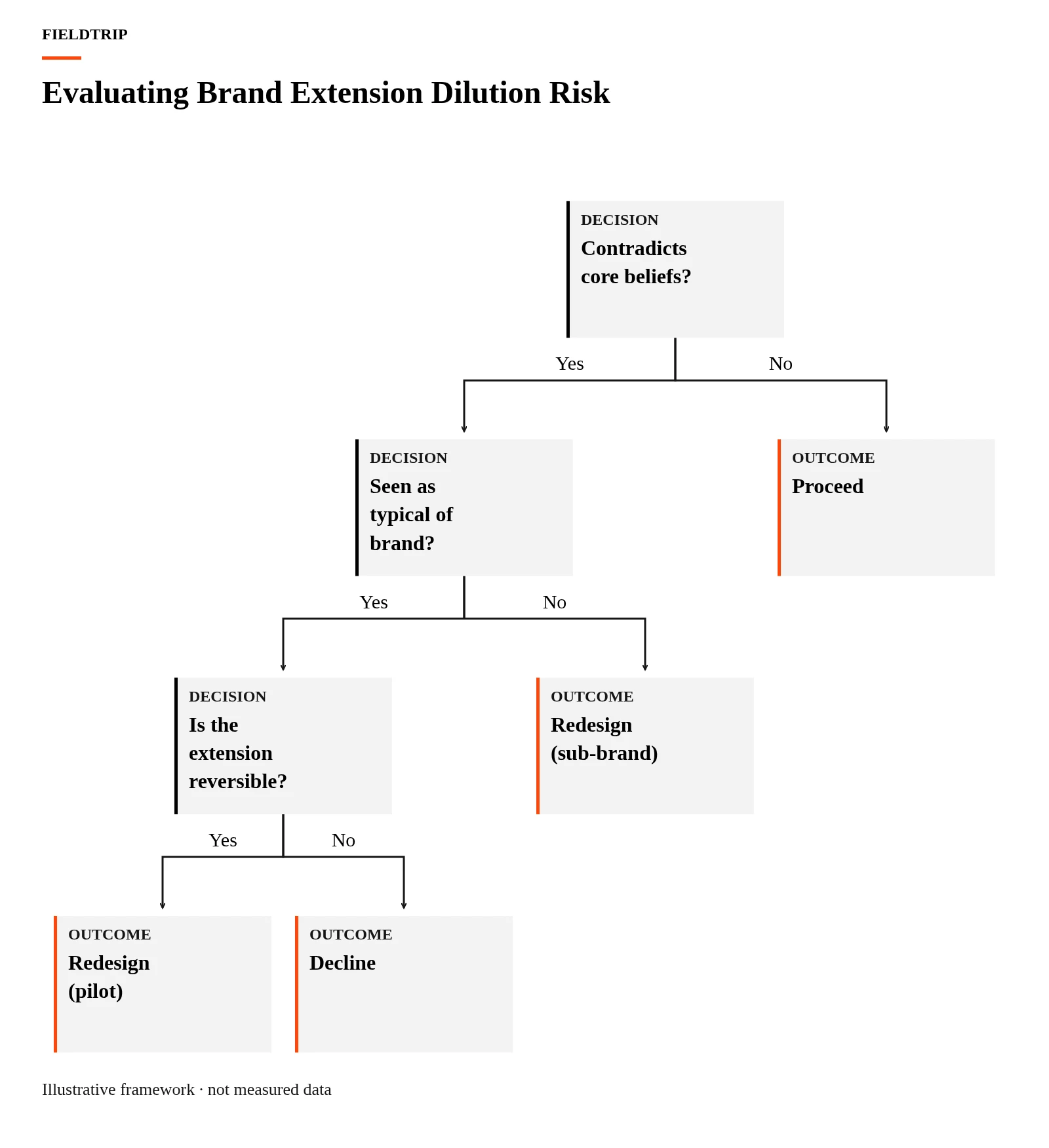
Add two or three belief questions and a segment split to your brand tracker before launch, because you cannot detect dilution without knowing what customers believed beforehand.
Awareness and consideration will not do it; dilution is a change in meaning, and a brand can grow more recognized while standing for less.
Record the beliefs identified in the scorecard as agreement statements in the tracker, worded the way customers talk. Run at least one wave before anything launches so the comparison is against the brand as it was before launch.

If you have no tracker, a modest survey of existing customers on those few statements is a workable baseline. The measurement design matters more than the sample size at this stage.
After launch, read movement separately for existing buyers and for the new audience the opportunity targets. The same offer can strengthen one group's view while weakening the other's, and a blended number hides both effects.
Existing buyers are the group to watch most closely. They hold the beliefs the brand's value rests on, and they are the ones the Loken and John mechanism puts at risk when an extension contradicts those beliefs.
Price is a lagging but concrete signal. If quality inconsistency weakens overall reputation, it eventually shows up as more discounting needed to hold volume, a narrowing gap to cheaper alternatives, or weaker willingness to pay in conjoint or pricing research.
Read this alongside the belief data. Price can move for competitive or macro reasons that have nothing to do with the brand's meaning.
Complaint themes and sentiment from existing customers arrive before tracker waves do. Watch for language that generalizes from the new offer to the brand, such as doubts about whether the company still cares about quality, rather than complaints confined to the product.
Treat it as an early warning. Vocal customers are not a representative sample, so use the themes to decide what to probe in the next tracker wave.
A withdrawn extension that customers saw as atypical may leave the core untouched, which is consistent with the experimental finding that atypical extensions are less likely to dilute.
Before concluding the brand is hurt, compare belief movement among existing buyers against a control segment or geography where the offer did not appear.
A hypothetical reading: if the quality belief among existing buyers is flat in both exposed and control markets after an extension is pulled, you have a product failure, not dilution. If it fell in exposed markets only, the core took damage.
The data cannot prove causation on its own, and small samples will show noise that looks like movement. State what it supports, what it cannot settle, and the next test, usually a second wave or a matched-market comparison, before anyone changes strategy on the result.

Decide the withdrawal question first, using the reversibility criterion you scored before launch and the tracker evidence, and keep sunk cost out of the room. Recovery is slower when a team spends two quarters defending a decision the data has already made.
If existing buyers' core beliefs have moved in exposed markets and not in control markets, the offer is doing damage, and the named owner should trigger the pre-agreed stop.
If beliefs are stable and the offer simply underperforms, repositioning under a sub-brand or in a narrower channel may be enough.
Recovery timelines are not established in the evidence available. The closer the misstep was to the core, the more directly it touched the beliefs that need rebuilding, so expect a nearer-core mistake to take longer to repair.
Recovery means re-establishing the associations that were muddled. In practice that usually requires a period in which creative concentrates on the two or three core beliefs rather than on range breadth or news.
Media should follow the same discipline. Weight spend toward the existing customers whose beliefs shifted and toward contexts that reinforce the brand's natural territory, and judge the media plan on belief recovery in the tracker as well as on sales.
A hypothetical illustration: a brand pulls a poorly received licensed range, then spends two quarters on creative built around its original category strength while tracking the quality belief among existing buyers each wave.
That belief, rather than the launch calendar, sets the campaign's job.
Inconsistent quality and messaging erode associations without any launch, so recovery has to fix how work gets made, not only what gets made.
Write a one-page brand standard that names the owner, states the core associations and describes the test every new piece of work, channel decision and partner proposal must pass.
Dilution mostly reflects teams making uncoordinated decisions that each looked fine locally. Fixing the interfaces between product, creative, media and measurement, including who reviews what and which evidence moves between them, is as much a part of recovery as any campaign.
Growth opportunities do not inherently dilute a brand. The risk arises when a new offering conflicts with what customers already believe, lacks credibility in its category, or enters a channel or partnership that weakens the brand's positioning.
Fieldtrip's approach helps keep these decisions aligned with a clear brand strategy. Specialist teams across strategy, creative, media, and measurement work from a shared understanding of what the brand stands for. This allows growth opportunities, campaign decisions, and performance measures to be assessed against consistent criteria.
The approach also supports collaboration with existing internal teams and agency partners. Fieldtrip engagements can begin with a specific challenge, such as assessing the risks of a proposed brand extension or establishing a baseline to measure changes in brand perception before launch.
For leadership teams considering an extension, partnership, or promotion, the priority is to understand the potential risks, establish clear success measures, and agree on the conditions that would require an initiative to be reconsidered.
Considering a new growth opportunity? Book a strategy call with Fieldtrip to discuss potential brand dilution risks, assess the implications for brand equity, and identify a clear path forward.
Brand overextension occurs when a company expands its brand into too many products or categories, potentially stretching its credibility. Brand dilution describes the weakening of customer associations. Overextension can contribute to dilution, but expansion alone does not establish that damage.
Yes. B2B brands depend on credibility, technical expertise, and consistent expectations. A software provider expanding into unrelated services, for example, may create uncertainty about its specialization. This can complicate vendor evaluation, particularly when buyers prioritize proven expertise.
Mergers and acquisitions can create brand dilution when companies combine identities, service standards, or customer experiences without a clear positioning strategy. Customers may struggle to understand the combined company's expertise, particularly when the acquired businesses previously served different markets.
International expansion can create brand dilution when localized products, communication, or customer experiences conflict with an established global identity. Companies need to distinguish necessary cultural adaptation from changes that could weaken recognition and expectations across different markets.
Brand dilution may reduce financial brand value if weaker customer perceptions affect future revenue, profitability, or growth expectations. Valuation methods consider factors such as projected earnings and brand strength, so the financial impact depends on the methodology and available evidence.