






















In 2000, Netflix cofounders Reed Hastings and Marc Randolph reportedly met with Blockbuster and proposed selling their young DVD-by-mail company for $50 million. According to Randolph, Blockbuster’s leadership dismissed the proposal. They thought Netflix was a small, unprofitable internet business and not quite a serious threat to its thousands-strong retail network.
A decade later, Blockbuster filed for bankruptcy under the pressure of heavy debt, changing customer behavior, and the rise of video-on-demand services like Netflix.
Blockbuster’s example is a strong case in itself for ‘competitor intelligence.’ The company failed to recognize what Netflix represented, where the market was heading, and how customers were discovering, renting, and eventually streaming entertainment.
This is why competitive intelligence matters. It’s far more comprehensive and telling than tracking competitors or producing an occasional SWOT analysis. And there are many different methods for it that enterprises use today, including sophisticated intelligence tools.
Competitive intelligence is the process of gathering and analyzing information about competitors, customers, market trends, and industry dynamics to support better strategic decisions.
It helps a business understand where it stands in the market, how competitors are changing, and which opportunities or risks may be emerging. And it’s different from competitor analysis and, to some extent, from market intelligence.
The goal is to collect information and turn it into useful insights that improve business strategy, competitive positioning, product development, and sales enablement.
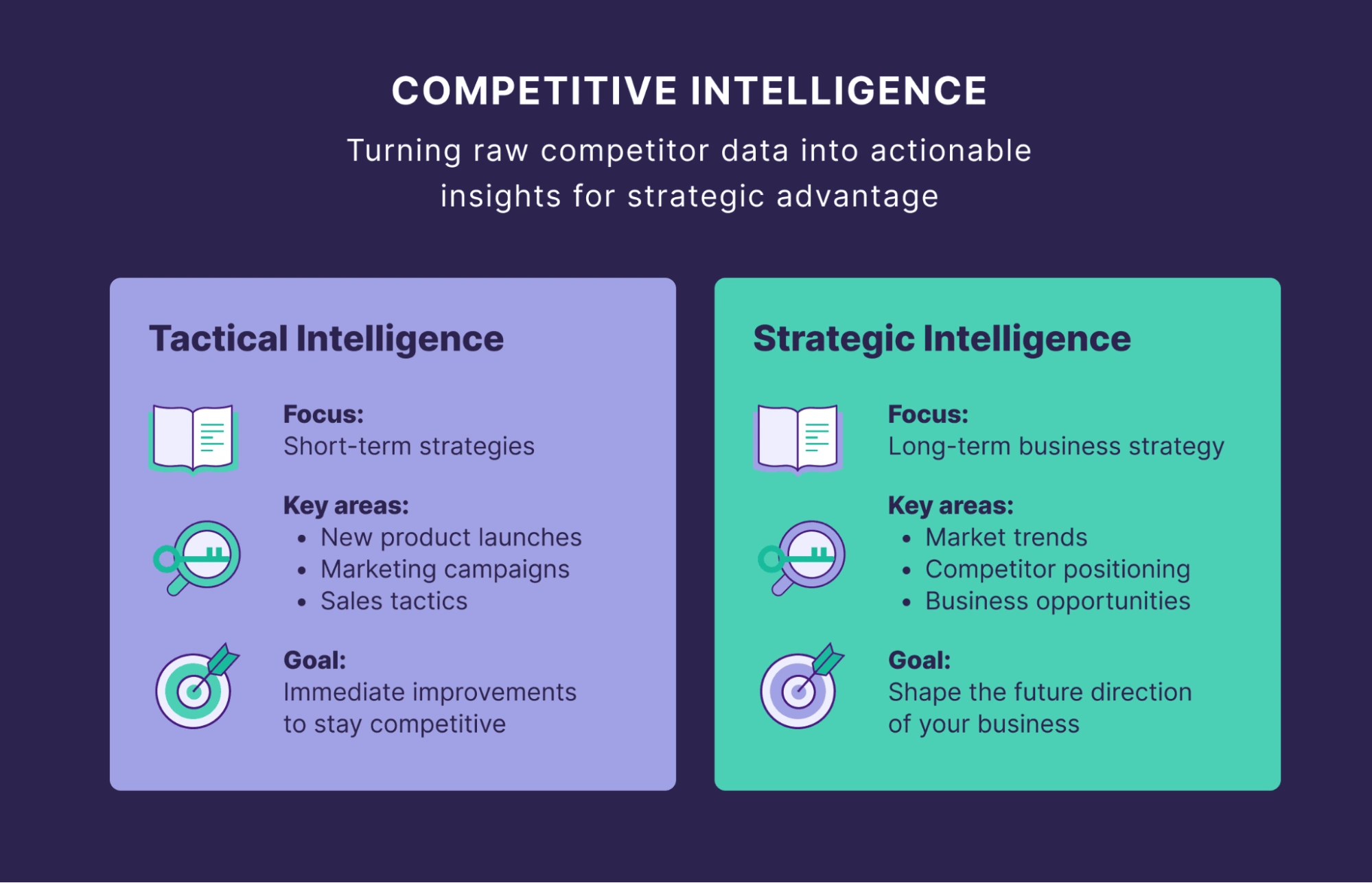
Competitive intelligence generally falls into two categories: strategic and tactical. Both support better decision-making, but they operate on different timelines and answer different business questions.
Strategic intelligence takes a broader, long-term view of the market. It takes into account market trends, industry dynamics, customer behavior, emerging technologies, regulatory changes, and shifts in competitive positioning.
Leadership teams use it to guide business strategy, market entry, product development, investment decisions, risk mitigation, and long-term revenue growth.
Tactical intelligence focuses on immediate competitor activity and short-term actions. It may include monitoring pricing changes, product launches, ad campaigns, website updates, social media activity, customer reviews, and sales tactics.
This is more relevant for brand, marketing, and sales teams. They can use these insights to adjust messaging, update sales battlecards, respond to competitor claims, and improve campaign performance.
Competitor analysis focuses on individual competitors, including their products, pricing, strengths, weaknesses, marketing activities, and market positions. Competitive intelligence is broader.
It combines competitor analysis with customer behavior, market trends, industry dynamics, regulatory developments, and internal performance data to support strategic decision-making. It’s essentially a deeper dive into competitors plus the market as a whole.
Market intelligence is essentially a kind of competitive intelligence. It looks at the overall market landscape, including market size, customer preferences, market segmentation, demand patterns, and growth opportunities.
Competitive intelligence goes one step further to find out how other companies are responding to those conditions. It, along with market intelligence, helps enterprise teams understand both where the market is moving and how existing and new competitors may affect their brand positioning and business strategy.
Competitive intelligence gives enterprise brand teams a clearer view of how their market position is changing. And this has become a near-term priority for many organizations.
In a Semrush survey of 100 marketers, 45% said understanding market trends and expectations was important.
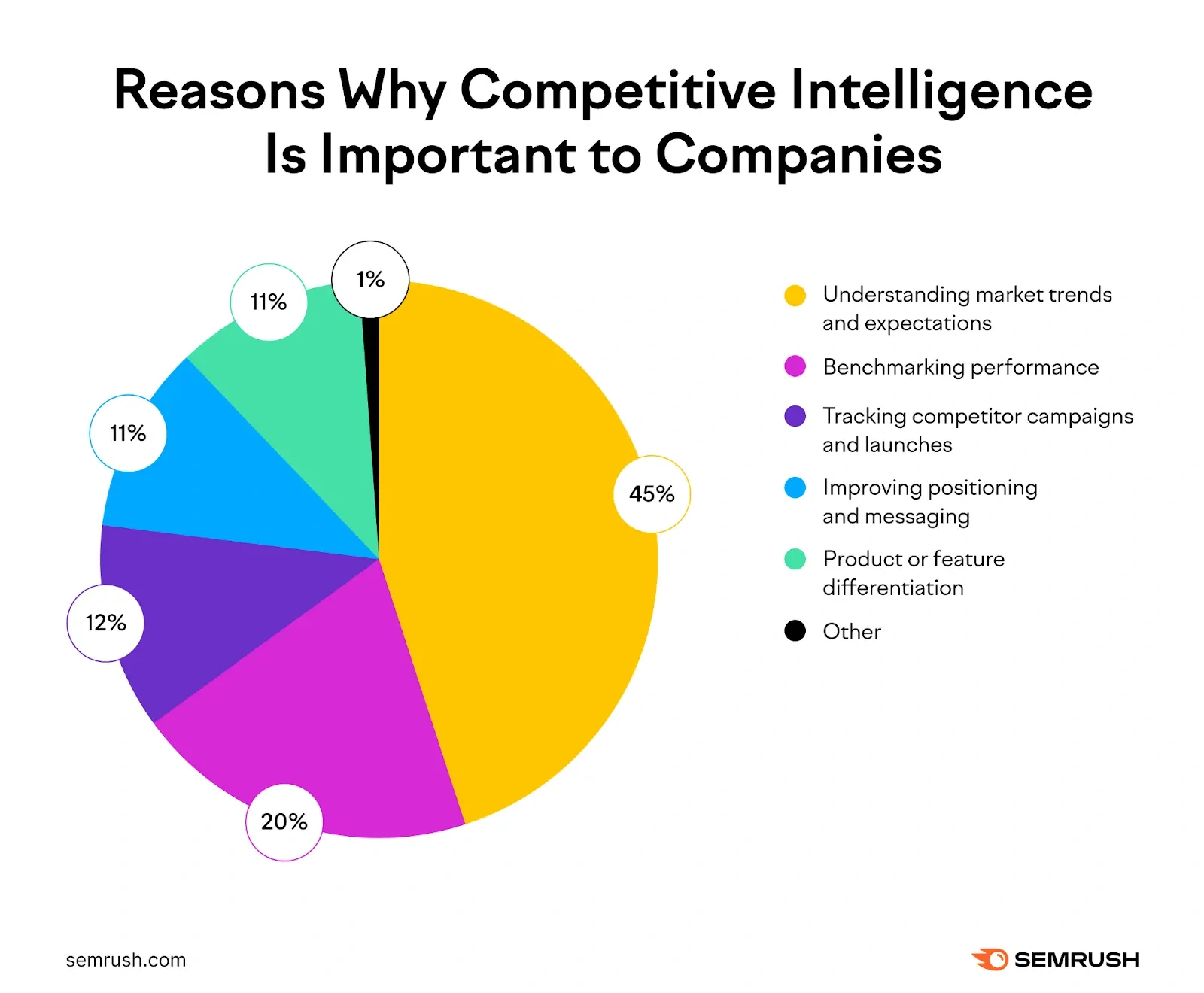
So, let’s dig deeper into the benefits of competitive intelligence and why enterprises invest time and resources into it:
As industries mature, competing brands are typically making similar claims. We’re already seeing this in the tech sector, particularly in SaaS. A term like “AI-powered” has gone from a meaningful differentiator to category convention.
Competitive intelligence helps brand teams monitor competitor websites, product pages, ad campaigns, social media activity, sales materials, and executive messaging to identify where this convergence is happening.
Teams can then determine which parts of their positioning remain distinctive, which claims require stronger evidence, and which market gaps competitors have not credibly occupied.
This is obviously commercially important, especially in saturated markets. Kantar found that brands perceived as meaningfully different by more people can achieve up to five times the market penetration of brands with low meaningful difference.
Competitive analysis gives marketing teams useful context for evaluating their own campaigns. They can compare important signals like:
All these findings, especially from brands bidding on the same ad space as you, can help optimize campaign messaging, creatives, and targeting. This, of course, is the tactical side of competitor intelligence.
This form of monitoring creates an early-warning system.
For instance, a company preparing to enter a new market might begin recruiting specialists, forming partnerships, registering trademarks, or increasing media activity around a particular customer problem. Enterprise teams treat these signals as evidence of a strategic shift by their competitor.
The truth is, important competitive moves don’t happen in a vacuum. They’re usually following a market trend, spotting an opportunity, or even making up for what an already established brand might be lacking.
Executives don’t need a long list of competitor activities. They need to understand what those activities mean for investment, pricing, product development, market entry, innovation, and risk mitigation. And competitive intelligence provides exactly that.
It turns fragmented signals into implications, options, and recommended actions.
A Valona case study describes how air-cleaning company QleanAir used a strategic market analysis to evaluate the market potential for one of its solutions. According to the company, the resulting market insights supported its market-entry decisions and shortened its time-to-market.
The most dangerous competitor is not always the company with the largest current market share. It may be a startup, an adjacent-category brand, a platform company, or a business using a different cost structure, distribution channel, or revenue model. In fact, it can even be changing consumer expectations or new technologies (like in the case of Blockbuster).
Competitive intelligence helps enterprise teams spot these threats by tracking startups, venture funding, new business models, consumer spending, industry reports, regulatory developments, and changing customer expectations.
Competitive intelligence is a superset of competitor, market, product, consumer, and technology intelligence. That’s why there’s no single approach to it. Enterprise teams usually use a variety of methods to collect this kind of intelligence.
Where they have enough data and resources, they turn to dedicated platforms that automate much of the grunt work. Others turn to tactics like Share of Search, social listening, win-loss analysis, and consumer research.
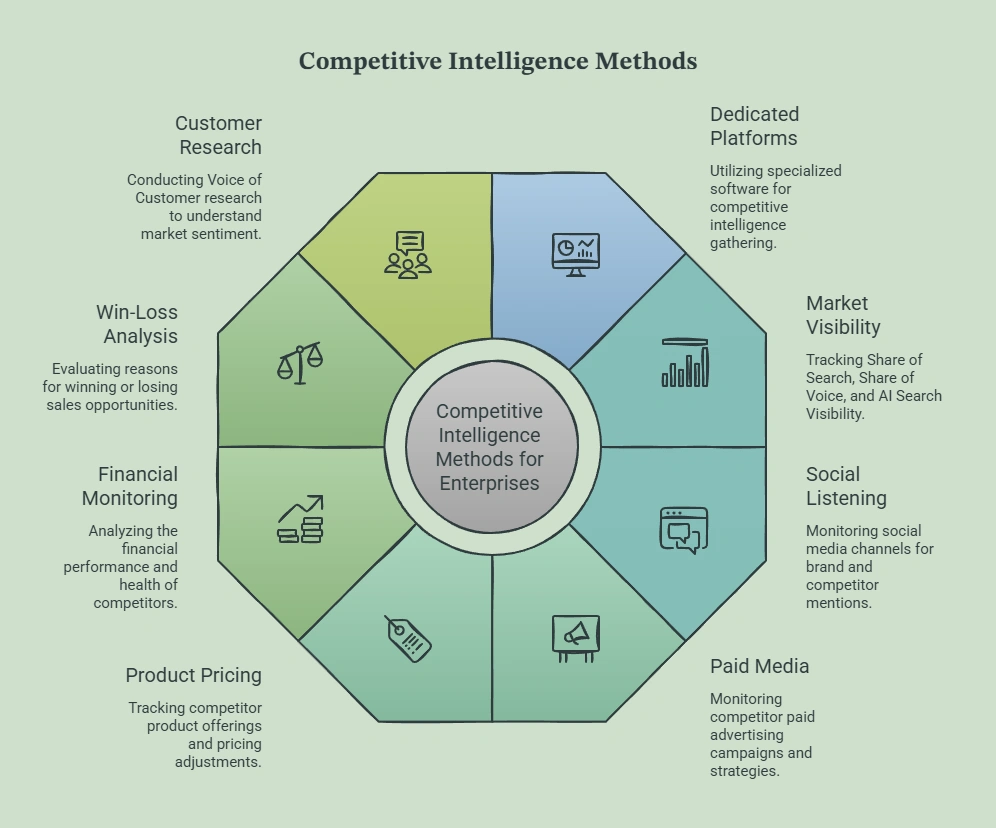
The best methods are those that connect external competitor intelligence with internal performance, customer relationship management (CRM) platform data, customer behavior, and strategic priorities. This is what we’ve seen enterprises use:
Market and competitive intelligence platforms like Valona and Contify help enterprises collect, organize, and analyze information from news coverage, company websites, regulatory filings, industry reports, product updates, and other external sources.
They can automate web monitoring, filter large volumes of information, identify emerging market trends, and distribute relevant insights through dashboards, alerts, reports, and integrations.
Other platforms, including Crayon, Klue, Similarweb, and Brandwatch, support more specialized needs like competitor website tracking, digital performance analysis, and social listening.
Pro Tip: Even if you’re investing in sophisticated competitive intelligence solutions, automation should support rather than replace human analysis, as teams and leaders still need to determine which signals matter and what they mean for strategic decisions.
Share of Search compares a brand's search volume with that of competing brands within the same category. It can help teams evaluate brand interest, customer awareness, campaign effects, and shifts in competitive positioning.
Share of Voice measures how visible a brand is across channels like news coverage, social media, advertising, search results, and industry conversations.
These measures should be tracked by topic, audience, geography, and time period rather than treated as one universal KPI. A growing share of voice may reflect a successful product launch, but it could also be caused by negative publicity.
More recently, enterprises are extending competitive intelligence to large language models (LLMs) and AI search capabilities.
Why? Because AI in search and chatbots are a big part of discovery, research, and recommendations. 37% of consumers are starting their search with generative AI tools rather than Google (Eight Oh Two study).
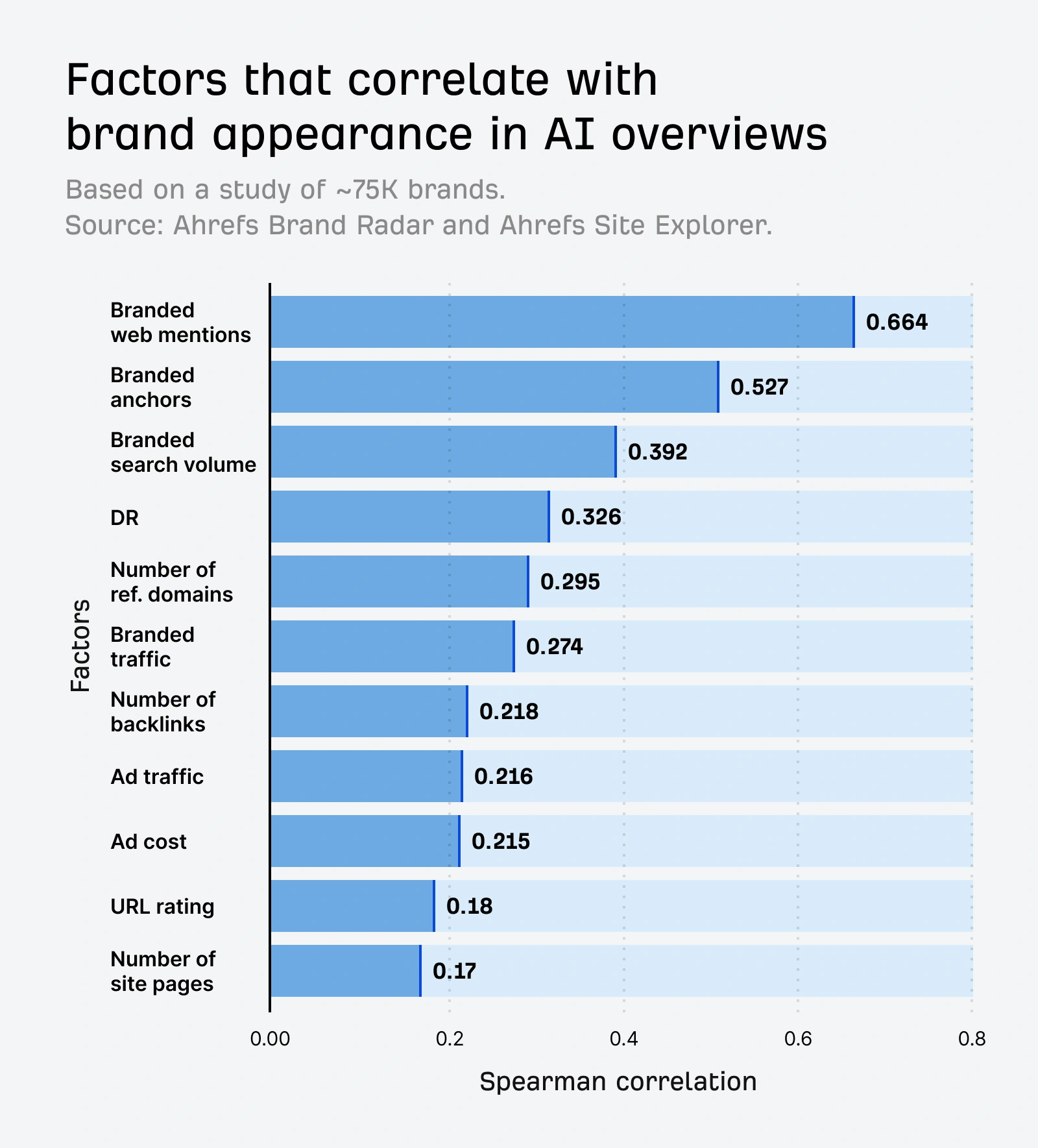
You can monitor how often your brand appears in AI-generated answers, which competitors are recommended, what attributes are associated with each company, and which sources the models cite. Many tools, such as Ahrefs, Similarweb, and Google Search Console, offer AI visibility tracking.
And here are factors that impact appearance in AI overviews and answers:
Social listening analyzes conversations across social networks, forums, blogs, and other online communities. It helps brand teams identify:
The value comes from analyzing patterns rather than counting mentions alone. Teams may compare sentiment, recurring themes, social media engagement, audience language, influencer activity, and user engagement before and after a competitor campaign or product launch. These findings can inform content creation, product development, customer service, and risk mitigation.
Paid media monitoring follows the ads competitors are running, where they appear, how long they remain active, which audiences or regions they target, and how their creative and messaging evolve over time.
Marketing or analytics teams compare formats, offers, calls to action, landing pages, campaign themes, channel choices, estimated spending, and share of voice.
Free resources like the Meta Ad Library and the Google Ads Transparency Center allow teams to review ads served by identified advertisers. And while exact spending figures are hard to find, enterprise tools like Pathmatics by SensorTower provide broader estimates of ad spend, impressions, placements, channel allocation, and creative activity.
Product monitoring tracks things like features, packaging, service levels, integrations, availability, warranties, and launch schedules. Pricing monitoring covers list prices, discounts, subscription tiers, bundles, shipping costs, promotions, and changes to contractual or usage limits.
Staying on top of competitors' products and pricing strategies helps companies determine whether a competitor is moving upmarket, entering a lower-cost segment, repositioning a product, or responding to changing customer behavior.
Retailers and those managing large product catalogs usually invest in automated monitoring for competitor pricing. For instance, Prisync is one such tool that tracks competitor prices on Amazon, Shopify, and other major retailers.
Win-loss analysis investigates why customers chose a company, selected a competitor, delayed a purchase, or decided not to buy at all. Information typically comes from win-loss interviews (with buyers), sales team debriefs, CRM data, call recordings, proposal reviews, and post-decision surveys.
It’s best for B2B companies, and the findings can uncover issues that standard performance dashboards miss. More importantly, it feeds directly into competitor intelligence, especially if the lead chose a competitor instead.
A CRM may show which competitor won a deal but not whether the deciding factor was price, product capability, implementation risk, brand trust, sales experience, or an internal change at the customer.
The findings can improve competitive enablement, sales battlecards, product roadmaps, brand messaging, and sales training.
Autodesk reported double-digit increases in win rates where its Klue-supported competitive intelligence program was used. And its quarterly win-loss reports became one of the company’s most-consumed competitive intelligence resources.
Public-company financial materials can reveal information that is absent from advertising and product pages. Earnings calls, annual reports, quarterly filings, investor presentations, and acquisition announcements may disclose revenue performance, market priorities, research and development spending, geographic expansion, supply chain disruptions, legal risks, restructuring plans, and management’s expectations for future growth.
Competitive intelligence teams examine both the numbers and the language surrounding them. Repeated references to a customer segment, technology, region, or distribution model may suggest a growing strategic priority. Changes in KPIs or reporting segments can also reveal how management wants investors to evaluate the business.
Pro Tip: In the United States, the SEC’s EDGAR database provides free access to public company filings and allows users to search for financial and operational disclosures. Teams should compare executive statements with later investments and performance. Don’t accept earnings-call language at face value.
Voice of Customer research provides primary research directly from customers, prospects, former customers, or category buyers.
Interviews uncover detailed motivations and experiences. Surveys quantify patterns across larger samples. Focus groups allow researchers to explore how participants react to products, messages, concepts, and one another’s views.
These methods help enterprises test assumptions created through competitor analysis. A competitor may appear to be winning because of a new feature, for example, while customer interviews reveal that its simpler onboarding or stronger reputation is the real advantage.
Research can also identify unmet customer needs, changing preferences, market gaps, and positioning ideas that competitors have not yet addressed.
The right operating model depends on the company’s size, structure, geographic reach, and competitive intelligence needs. Most enterprises use one of three approaches: centralized, decentralized, or hub-and-spoke.
In a centralized model, a dedicated competitive intelligence team owns data collection, analysis, reporting, and distribution across the organization. This creates consistent research standards, shared tools, clearer governance, and a single source of truth for competitor intelligence and market insights.
The trade-off is that a central team may be great at understanding the overall market, but miss the day-to-day context available to product, sales, regional, or brand teams. Close collaboration is a must for this to actually work.
In a decentralized model, departments conduct their own competitive intelligence work. Product teams may track features and pricing, sales teams may collect win-loss feedback, brand teams may monitor messaging, and regional teams may follow local market dynamics.
There’s some risk of duplicated work, inconsistent methods, disconnected platforms, and conflicting conclusions.
The hub-and-spoke model combines central governance with distributed expertise. A central competitive intelligence team establishes processes, platforms, legal and ethical standards, reporting formats, and shared priorities. Brand, product, sales, communications, and regional teams then contribute specialized intelligence from their areas.
For large, complex enterprises, this is the most practical model. It preserves consistency while keeping intelligence close to the teams that generate and use it.
Pro Tip: Turn to marketing and data specialists with the right tech stack to conduct competitor intelligence for your teams. Check out the best full-service marketing agencies for Fortune 500.
Competitive intelligence works best as a continuous process. A practical enterprise framework moves through four connected stages: planning, data collection, analysis, and feedback.
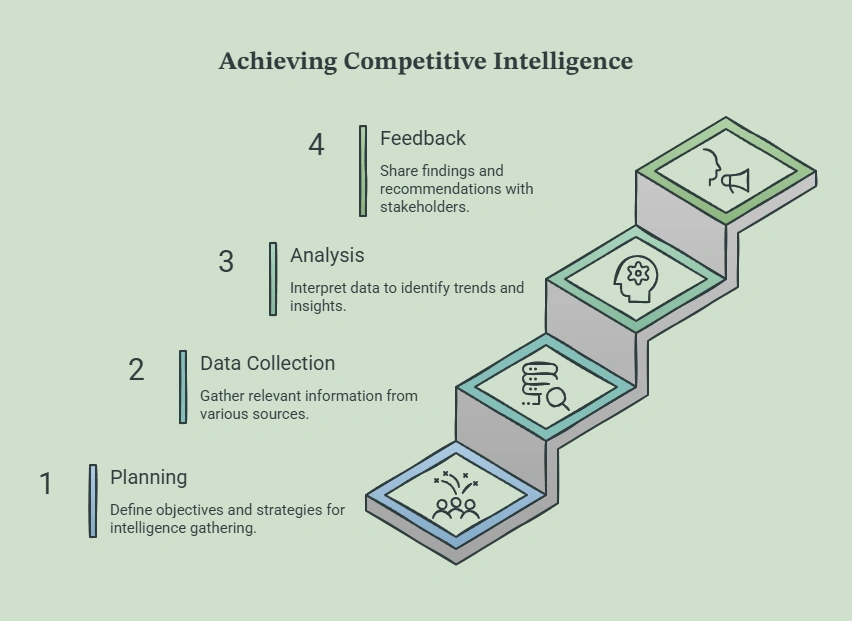
First, define the strategic decision that the intelligence must support. The goal might be to assess a new market, improve brand positioning, prepare for a product launch, understand falling win rates, or identify emerging threats. Goals can change over time as your needs and circumstances change.
Teams should establish:
The next stage is gathering information from a balanced mix of internal and external sources. External inputs may include competitor websites, customer reviews, social media activity, ad campaigns, pricing pages, earnings calls, regulatory filings, industry reports, search data, and product launches.
Internal sources can include CRM data, sales team feedback, customer support conversations, win-loss interviews, and campaign performance.
Choose the sources according to the method/tool you’re using.
Analysis turns collected information into implications for the business. Look for recurring patterns, changes over time, inconsistencies between competitor claims and actions, and connections among different signals. Useful techniques include competitor benchmarking, market segmentation, SWOT analysis, data visualization, and scenario planning.
Competitive intelligence should be shared with the teams that can act on it, including brand, product, sales, communications, and executive leadership. Distribution may take the form of dashboards, briefings, alerts, reports, sales enablement materials, or recommendations tied to a specific decision.
The process should also include feedback from users of the intelligence. Teams should track which insights were useful, whether they influenced decisions, and where information arrived too late or lacked sufficient detail. This feedback helps refine future research questions, data sources, reporting formats, and KPIs.
Competitive intelligence creates an advantage only when the right data reaches the right people in time to influence action. But this is one area where data and technology may not be enough. Farsighted enterprises actually dedicate experts, such as skilled analysts, to such programs. That way, different methods can be used, and their findings correlated.
And where necessary, enterprises turn to external agencies for making sense of it all.
Fieldtrip’s Strategy arm can help gather the data and intelligence relevant to your enterprise brand and turn it into strategic insights for leadership and execution teams.
Our capabilities include market research, consumer segmentation, competitive intelligence, cultural analysis, media planning, and consulting designed to identify category white space and support product, go-to-market, and positioning decisions.
Talk to us about your competitive intelligence needs
Executives, product managers, marketers, sales teams, business development teams, and investors can use competitive intelligence to monitor competitors, identify market trends, and make informed business decisions.
Competitive intelligence improves decision-making by providing timely information about competitors, customers, and market trends. It helps businesses identify opportunities, reduce risks, strengthen competitive positioning, optimize pricing, improve product development, and increase sales performance.
Competitive intelligence is legal when businesses collect information through lawful and ethical methods, like public records, company websites, financial reports, customer feedback, and market research.
Legal and ethical concerns in competitor intelligence include theft of trade secrets, corporate espionage, hacking, misrepresentation, bribery, breaches of confidentiality, and violations of privacy or intellectual property laws. Any such activity can gravely backfire and lead to lawsuits.
The four common pillars of competitive advantage are cost leadership, differentiation, focus, and operational excellence. Businesses build competitive advantage either by offering lower costs, unique products or services, specialized market focus, and consistently superior execution that competitors struggle to replicate.
At Fieldtrip, our expert researchers and analysts combine internal sources such as performance reports and CRM data with publicly available information on competitors and broader market conditions to create detailed reports for strategy, paid media, and creative teams, as well as enterprise leadership.