





















Enterprise brand teams have more customer data than ever, yet the real customer signals can still be hard to find. Feedback sits across surveys, reviews, social comments, sales notes, support tools, dashboards, and team chats.
Meanwhile, customer expectations keep moving. PwC found that 70% of executives say customer expectations are changing faster than their company can keep up. This gap is exactly where Voice of Customer research helps.
VoC helps you understand what people say, what they need, what they feel, and what they do across the full journey.
In this guide, we’ll break down the methods enterprise teams actually use. We’ll also show how those insights turn into better brand, creative, media, and measurement decisions.
Voice of Customer research is the process of collecting and studying what customers say, need, feel, and do so that teams can make better decisions. In simple terms, VoC helps you hear the customer clearly before you make big calls about product, messaging, creative, or growth.
It includes direct feedback, such as surveys, interviews, focus groups, and in-app forms. Also, it includes passive signals, such as support tickets, reviews, sales call notes, chat logs, and behavior data. Together, these inputs give teams a clearer view of the overall experience across the full journey.
For enterprise teams, VoC becomes most useful when it connects feedback with journey stages, customer segments, and revenue impact. This turns a customer needs assessment into something practical.
For example, a customer may say a product is hard to set up. The real issue could be onboarding, unclear instructions, missing help content, or weak messaging before purchase.
Here's why the voice of the customer outperforms market research:
Enterprise brand teams use VoC research to align large teams around one clear customer truth. When a company grows, the customer feedback can become scattered across markets, channels, tools, and departments.
This split creates friction. Brand, creative, media, product, sales, support, and success teams may all see different parts of the customer experience. VoC brings those signals together so teams can plan from real customer evidence instead of internal assumptions.
These are the main reasons enterprise teams use VoC:
This kind of alignment matters because customers feel the gaps between teams. Salesforce says 76% of customers expect consistent interactions across departments, yet 54% feel sales, service, and marketing do not share information. When teams use VoC well, they can close those gaps and create a smoother customer experience.
The stakes are also high when friction goes unfixed. PwC found that 52% of consumers stopped buying from a brand after a bad product or service experience, and 29% stopped because of a poor customer experience. So VoC is also about protecting trust before small issues become lost buyers.
Pro tip: VoC becomes stronger when teams pair customer feedback with brand tracking. If you want to see how brand health can guide media choices, check our guide on brand tracking that informs media decisions.
A strong enterprise VoC program uses more than one feedback source. Each method answers a different question, and the best insights typically appear when teams compare the answers.
These are the main signal types.
Direct feedback includes surveys, interviews, focus groups, customer advisory boards, in-app feedback, and email feedback forms. This method is useful when teams need a clean answer from a specific audience. It can also help validate a problem before a larger team acts on it.
Still, direct feedback has one clear limit. Qualtrics found that less than one-third of consumers give feedback directly to a company. This means surveys and forms can help, but they cannot carry the whole program alone.
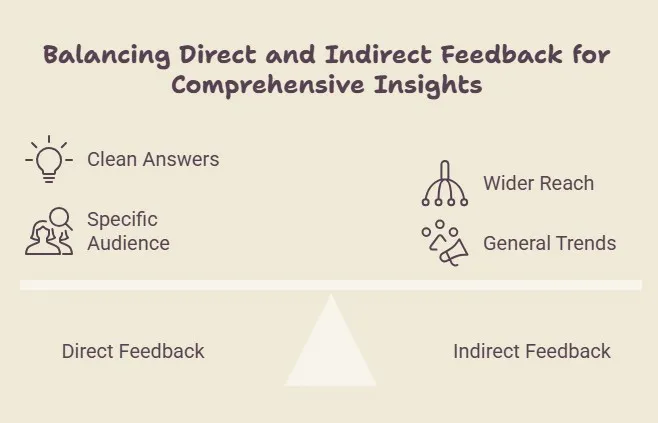
Passive feedback includes reviews, support tickets, chat logs, sales call notes, social media comments, and community posts. These signals are usually more natural because customers share them in the moment.
This is why enterprise teams are adding more text and voice analysis into VoC work. Gartner predicted that 60% of organizations with VoC programs would supplement traditional surveys by analyzing voice and text customer interactions.
That shift makes sense because everyday customer language can reveal pain points that formal surveys miss.
Behavioral signals include website behavior, product usage, session recordings, funnel drop-off, email clicks, content engagement, and purchase behavior. These signals help teams see whether customer words match customer actions.
This is where omnichannel analytics can add real value. A shopper may say price is the issue, yet behavior may show checkout confusion. Also, a buyer may say they love a feature, while usage data shows they rarely use it.
The best VoC programs compare what customers say with what they do, because that is where stronger insights usually appear.
Enterprise teams need methods that can scale, repeat, and create usable decisions. The right method depends on the problem, the stage of the journey, and the team that needs to act.
Some methods give volume, while others give depth. And some reveal language, while others reveal friction. These are the methods enterprise teams use most.
Customer surveys are best for scale. They help teams measure NPS, CSAT, CES, onboarding feedback, and post-purchase feedback across a large audience.
Surveys work best when they are short and tied to a clear journey moment. A post-onboarding survey can reveal setup issues. And a post-purchase survey can show doubts, unmet needs, or marketing preferences. Customer satisfaction surveys can also help teams track patterns over time.
The challenge is that surveys can miss context when questions are too narrow. Gartner says customer surveys are used by 93% of customer service organizations, yet service leaders see them as less valuable than other VoC methods.
But that does not make surveys weak. It means they need to sit beside interviews, reviews, calls, and behavioral data.
Customer interviews are best for depth. They help you understand why customers buy, stay, leave, or hesitate.
This method is strong for brand strategy, positioning, journey research, and message testing. A good interview digs into the moment before purchase, the problem the customer wanted solved, the options they compared, their fears, and what changed after purchase. The best questions to ask focus on real moments rather than broad opinions.
For enterprise teams, in-depth interviews can also reveal the emotional side of choice. Dashboards can show what happened, but interviews can explain why it happened.
Review mining is useful for finding raw customer language. It helps copywriters and brand teams find pains, wants, doubts, values, proof points, and recurring claims.
This method works well for e-commerce, SaaS, apps, services, and marketplaces. Reviews usually show what customers say after they have used the product, which makes them a rich source for messaging. Strong review mining sorts feedback by themes rather than ratings alone.
Reviews also shape how people buy. PowerReviews found that 98% of shoppers see reviews as an important resource when making purchase choices. So, reviews are useful as research and as proof that helps the next customer feel more confident.
Support ticket and chat log analysis show repeat friction. Customer support teams see issues before many other teams do, which makes their data valuable for product, brand, and marketing work.
These logs can show where messaging, onboarding, product UX, or help content may be failing. If the same issue appears every week, the problem may sit earlier in the journey. Maybe the sales page overpromises, maybe the setup guide skips a key step, or maybe the product flow needs a clearer cue.
We believe that the best practice is to tag tickets by contact reason, journey stage, product area, and customer segment. This structure helps teams see which issues affect trust, conversion, retention, or customer lifetime value.
Sales calls and win-loss research help you understand why buyers choose, delay, or reject a brand. It is more useful for B2B and high-consideration purchases.
This method helps brand, product marketing, and sales teams improve messaging, objection handling, proof points, and sales enablement. It also helps explain the customer decision-making process because buyers usually compare options long before the first sales call.
That early research window matters. 6sense found that 81% of buyers already have a preferred vendor at first contact, and 85% have already set purchase requirements before reaching out.
Because of that, win-loss research should study both closed-won and closed-lost deals. So, you can see what shaped the path to purchase before the pipeline showed movement.
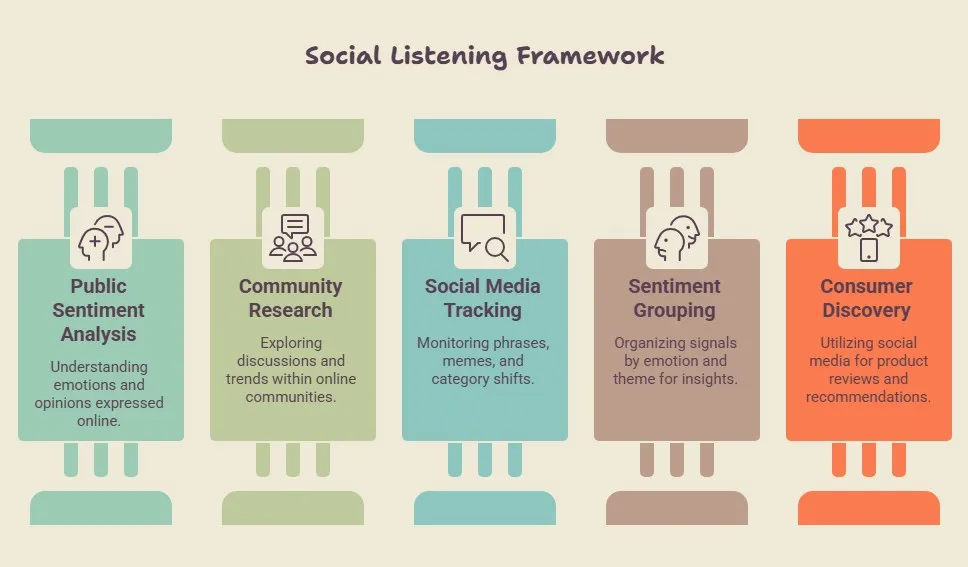
Social listening and community research show public sentiment, common questions, complaints, and cultural cues. This is useful for brand teams that need to know how people speak outside official feedback forms.
People typically share honest opinions in comments, forums, creator content, and communities. Social media tracking helps you spot phrases, frustrations, memes, product comparisons, and emerging category shifts. With sentiment analysis, you can group these signals by emotion and theme.
It also plays a real role in discovery. Sprout Social found that 37% of consumers prefer to use social media first when looking for product reviews and recommendations. This makes social research useful for insight, content planning, and trust-building.
Behavioral and product usage data show where customers click, drop off, return, ignore, or complete actions. It helps teams test whether what customers say matches what they do.
This is useful for digital products, websites, e-commerce, and content journeys. For example, Baymard says around 70% of e-commerce users abandon their cart after adding items. This points to a huge behavior gap, because interest exists, yet completion fails.
The next step is to understand the friction behind the drop-off. Baymard also says the average large e-commerce site can improve conversion by up to 35% through checkout design changes. When you connect behavior data with survey or interview findings, you can fix the right issue instead of relying on assumptions.
Predictive analytics can also help you see which behaviors may lead to conversion, churn risk, or repeat purchase. Still, the model is only as useful as the insight behind it.
Pro tip: Behavioral data works best when teams turn it into creative action. For a deeper breakdown, check our guide on using first-party data in marketing campaigns.
Creative testing and message testing help enterprise teams see which claims, visuals, hooks, offers, and proof points work best. This can include ad testing, landing page tests, concept tests, and customer language tests.
At Fieldtrip, this is where strategy, creative, media, and measurement come together. We always focus on customer insight that can shape the idea, and media data that can test how that idea performs with the target audience. After that, the feedback loop helps us move from opinion to proof.
Creative also has real business weight. Nielsen found that 65% of a brand’s sales lift from advertising came from creative. So, when a team learns which message works, it can improve performance, brand clarity, and future campaign planning at the same time.
Now that you know the main VoC research methods, the next step is choosing the right one for your team.
The best VoC method depends on the decision your team needs to make. A brand team choosing a campaign angle needs a different signal than a product team fixing onboarding.
The clearer the business question, the easier it is to choose the right input. These are the simplest matches:
The best answer is usually a mix. For example, a brand team may use surveys to find the scale of a problem, interviews to learn why it happens, and creative testing to see which message fixes it. Over time, that mix can also support stronger market segmentation and richer customer profiles.
VoC creates value when the insight leaves the research deck and enters the work. This is where enterprise teams typically see the biggest gap. Customer feedback may be collected, but it does not always reach messaging, creative, content, media, or measurement teams in a usable way.
These are practical ways you can apply VoC:
A strong example is our work with ClearScore. ClearScore needed creator-led acquisition campaigns that could drive sign-ups across markets like the UK, Canada, and Australia. We brought strategy, creative, media, and analytics together so the team could keep testing content, learn from campaign signals, and improve performance over time.
For enterprise teams, this is the real value of VoC. Customer feedback should shape messaging, creative tests, landing page updates, and the way teams measure what works.
Many companies still struggle with that handoff. IBM found that 97% of Salesforce customers collect many types of data, but only 24% use it to transform customer experiences. This gap shows why human expertise still matters, because teams need judgment to turn data into ideas that people understand.
Here's a simple example. If customers keep saying they do not understand how a product saves time, you can test clearer, benefit-led ads, a stronger landing page section, and customer-story proof points. This is also where customer journey mapping helps turn insight into action across each step.
A strong enterprise VoC program is a working system. It has a clear purpose, a repeatable flow, and owners who can turn feedback into action. The goal is to connect insight with business objectives before the team collects more data.
These are the core steps:
This level of structure is still rare. Forrester says only 12% of CX pros rate their VoC program maturity as high or very high. That is why teams don't just need a collection. They need workflow, business intelligence, and clear ownership.
We believe a VoC program should never end with a report. It should lead to campaign changes, product fixes, journey updates, better content, stronger creative, and clearer media choices.
In our daily practice, we have seen that enterprise teams can collect huge amounts of feedback and still miss the point. The issue usually comes from weak structure, slow action, or insights that stay inside one team. VoC works best when it connects teams around decisions.
So, these are the common mistakes to avoid:
At Fieldtrip, we usually see VoC programs fall short when no one owns the next step. Strong programs need clean inputs, clear tagging, defined owners, and a regular rhythm for turning customer signals into measurable changes.
%20Mistakes%20Enterprise%20Teams%20Should%20Avoid.webp)
Voice of the Customer creates value when teams turn insight into action. A customer phrase can become a headline, while repeated objections can shape sharper proof points. Journey issues can also lead to landing page tests, new content pieces, or smarter media plans.
At Fieldtrip, we help organizations turn customer insight into practical brand and growth decisions. Our work includes market research, customer segmentation, creative testing, campaign planning, performance reporting, and feedback loops that help teams keep learning in the market.
This matters because customer-led companies grow faster. Forrester says customer-obsessed organizations report 41% faster revenue growth, 49% faster profit growth, and 51% better customer loyalty.
If you want to turn customer insight into stronger brand, creative, and media decisions, contact us.
VoC (Voice of Customer) and CTQ (Critical to Quality) mean different parts of the same customer-led process. VoC captures what customers say, need, feel, and do. CTQ turns those insights into measurable standards a product, service, or experience must meet.
The purpose of a VoC is to help teams make better decisions with real customer insight. It can guide brand strategy, product updates, content, service improvements, campaign planning, and retention work by showing what matters most to customers.
VoC (Voice of Customer) focuses on the customer’s view, while VOP (Voice of Process) focuses on the process view. VOP looks at how internal systems perform, such as speed, cost, quality, and workflow. Together, they help teams connect customer needs with operational fixes.
The best Voice of Customer research methods include surveys, interviews, review mining, support ticket analysis, sales call analysis, social listening, behavior data, and creative testing. The right mix depends on the team’s goal, journey stage, and decision.
Enterprise teams should review VoC signals monthly and run deeper studies quarterly or around major business moments. Reviews, support logs, social comments, and behavior data can be checked regularly. Larger studies work best before launches, rebrands, journey updates, or growth plans.