

























More than one in three global brands say agency relationships have become harder to manage, according to the World Federation of Advertisers’ 2026 study.
A lot of that friction comes down to how the agency is paid. Two agencies can quote the same total fee while pricing completely different amounts of strategy, creative, media, and measurement into it.
That makes the headline number almost useless without knowing what sits underneath. Our guide breaks down the math behind each model, what typically sits inside the fee, and how the economics change as budgets scale.
Let’s find your fit.
Digital marketing agency pricing on Clutch runs from $5,000 to $50,000 a month, based on pricing data from more than 100,000 firms. GoodFirms puts a full-service agency retainer at $10,000+ a month at the top of its range.
The ranges overlap because they describe different scopes. A single-service retainer sits near the low end, and an account that spans several channels and tens of thousands in ad spend sits near the top.
PPC is quoted per project and social media and SEO per month, so put them on the same basis before comparing them.
Retainers and project fees are different units, so compare SEO and content programs with each other and treat website design as a one-time cost.
| Service | Reported cost | Pricing unit | Source |
|---|---|---|---|
| SEO agency retainer | 48% of agencies charge $1,500 to $5,000 a month; 43.3% charge under $1,500 | Monthly retainer | GoodFirms 2026 survey of 300+ agencies |
| Blog posts | $150 to $600 per post | Per piece | Clutch |
| Content programs | 38% of agencies charge $1,001 to $2,500 a month; full-service B2B programs run $5,000 to $15,000 | Monthly retainer | Clutch |
| Website design | $2,000 to $100,000 per project, with $38,105 the average | Fixed project fee | Clutch |
Clutch collects prices from agency listings and client reviews, and GoodFirms surveys agencies directly, so treat these as reference points for the market. Figures for the same service can differ between pages on the same site. SEO scope runs from a few pages to an enterprise program, which is why one retainer can be several times another.
For content-specific agency fees, see our guide to choosing an enterprise content marketing agency.
Agencies use five core pricing models, and contracts can combine them, such as a retainer for ongoing work plus project-based fees for one-time builds. In GoodFirms' 2026 SEO survey, 60.6% of agencies used a monthly retainer as their main model, 16% priced by project, 13.4% used a hybrid, and only 5.5% billed hourly.
| Model | How the fee is set | Reported range |
|---|---|---|
| Monthly retainer | A recurring payment that wraps a flat or hours-based fee into one monthly amount | Depends on scope; see the service tables above |
| Percentage of ad spend | A share of the monthly ad spend | Set as a rate on spend; the examples in this guide use 10%, 15%, and 20% (illustrative) |
| Hourly rates | Hours worked times an agreed rate | $100 to $149 per hour for agencies in the United States, and under $25 in India (Clutch) |
| Project-based fees | A fixed amount for a defined set of deliverables | $10,000 to $49,999 for typical digital marketing projects (Clutch) |
| Performance-based pay | A price per lead, sale, or other result | Set per result |
A media fee covers buying and handling ad spend. A management fee also covers strategy, optimization, and reporting. Check which one a quote means before you compare percentages.
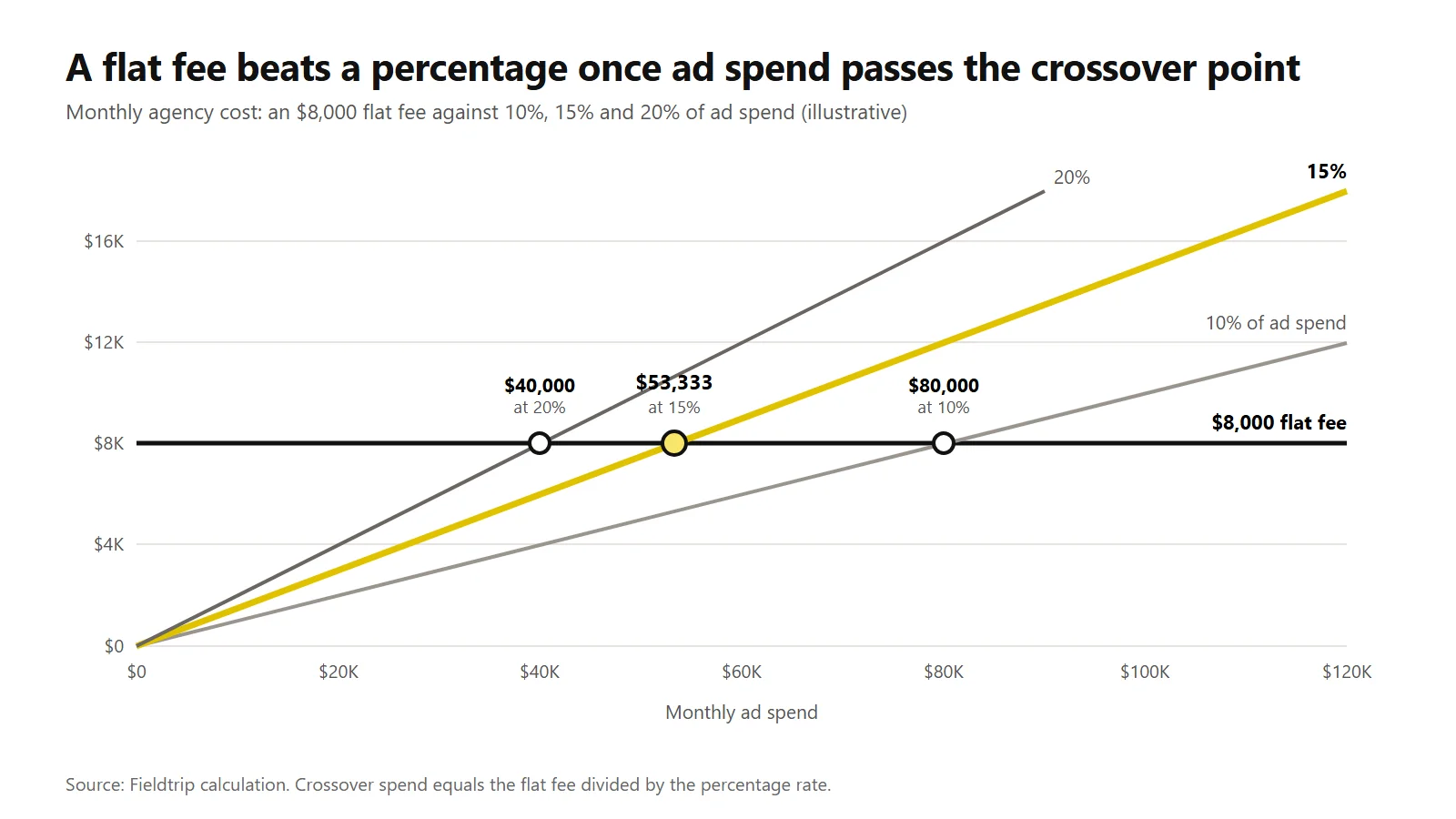
For equivalent scope, a percentage of ad spend costs less than a flat fee below a crossover point and more above it. The crossover is the flat fee divided by the percentage rate.
The fee is the budget times the rate, so doubling ad spend doubles the fee.
| Monthly ad spend | At 10% | At 15% | At 20% |
|---|---|---|---|
| $10,000 | $1,000 | $1,500 | $2,000 |
| $25,000 | $2,500 | $3,750 | $5,000 |
| $50,000 | $5,000 | $7,500 | $10,000 |
| $100,000 | $10,000 | $15,000 | $20,000 |
| $200,000 | $20,000 | $30,000 | $40,000 |
The three rates are illustrative, and the math works for any rate. The fee rises directly with spend: at $200,000 a month, a 15% rate produces a $30,000 fee.
Assume an $8,000 flat fee and a 15% rate cover the same scope. The two are equal at $53,333 of monthly ad spend ($8,000 divided by 0.15).
Below that spend the percentage costs less. Above it the flat fee costs less. The $8,000 figure is illustrative, and the crossover moves with whatever the flat fee covers.
A flat fee keeps the management cost fixed as spend changes. A percentage-of-spend fee makes that management cost rise with the budget, which is why the two diverge as spend grows. A percentage also carries an incentive point: at higher spend the agency earns more when the budget rises, whether or not efficiency improves.
A hybrid combines a fixed component with a spend- or performance-linked component, separating part of the base workload from the part of the fee that can change.
| Hybrid | Formula | Worked example |
|---|---|---|
| Base plus percentage above a threshold | A flat base, plus a lower percentage on spend above a set level | $6,000 plus 8% of spend above $40,000 comes to $10,800 at $100,000 of spend (illustrative) |
| Floor or percentage, whichever is greater | A minimum monthly fee, with the percentage applying once it exceeds the floor | With a $3,000 floor and a 12% rate, $20,000 of spend pays $3,000 and $40,000 pays $4,800 (illustrative) |
| Tiered percentage | The rate falls as spend rises | 15% on the first $20,000, 10% on the next $30,000, and 7% above that comes to $8,100 at $80,000 of spend (illustrative) |
| Flat fee plus media markup | A flat management fee plus a small percentage of ad spend | $5,000 plus 4% of $30,000 comes to $6,200 (illustrative) |
| Base plus performance bonus | A lower base plus bonuses tied to KPIs | A $3,000 base plus two $750 KPI bonuses comes to $4,500 in a strong month (illustrative) |
The floor exists for a practical reason: a percentage of a small budget does not pay for a senior person to look at the account.
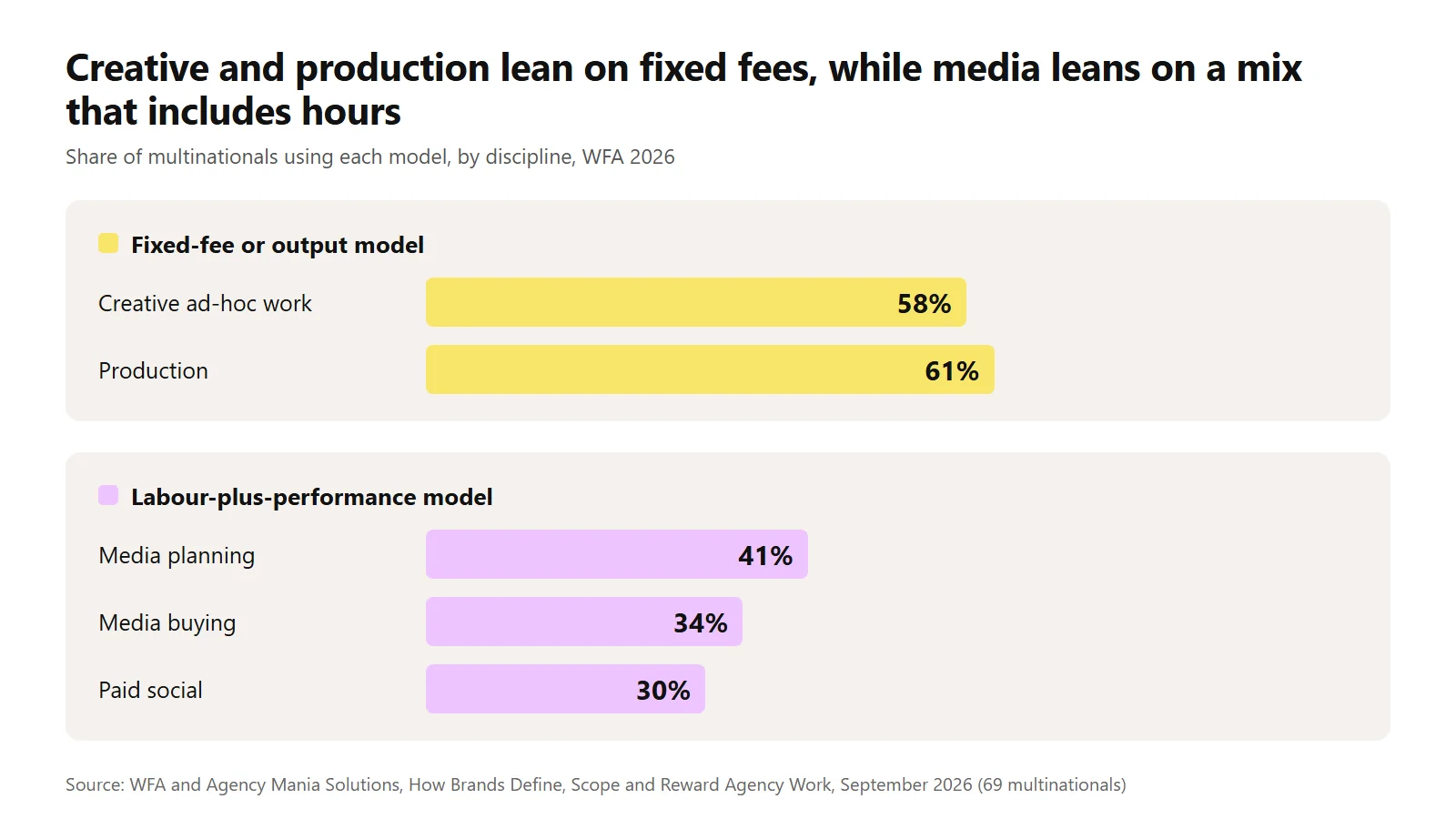
Be careful with the bonus row. Across most disciplines, 67% to 80% of WFA respondents say performance-based pay makes up less than 20% of total agency compensation. Define what counts as a result in the contract, because whoever controls the definition controls the number, and the cheapest way to hit a lead target is to lower the bar.
The WFA's September 2026 study of 69 multinationals found that labour-based pay fell to 19% from 54% in 2011, with fixed-fee or output models at 33% and labour-plus-performance models at 21%.
The split by discipline is what matters for pricing:
The region changes the picture. In the USA and Canada, labour or full-time-equivalent pay is still the most common approach at 38%, so a US-only sample reads differently from the global average.
In the same WFA study, 89% of brands believe they get value for money from their agencies, but only 48% say they have enough transparency into agency costing and profitability.
A percentage of ad spend tracks media work. Creative work tracks the number of ad assets needed.
Performance creative needs fresh variants to fight fatigue, so a brand can need many more assets without spending a dollar more on ads. A single blended percentage drifts out of line as that volume rises.
Of the four layers, media is the one whose workload most directly tracks ad spend.
| Layer | What drives the work | How a percentage of ad spend behaves |
|---|---|---|
| Strategy | Senior hours, research, and planning | Does not move with ad spend |
| Creative | Ad assets, variants, revisions, and brand identity work | Breaks as volume rises, since assets can double while ad spend stays flat |
| Media | Ad spend and the number of platforms | Tracks well |
| Measurement | Analytics platforms, reporting, conversion rates, and testing | Does not move with ad spend |
Creative volume can rise even when media spend stays flat. As performance declines, teams need new variants to test against current winners, adding production work without changing the ad budget.
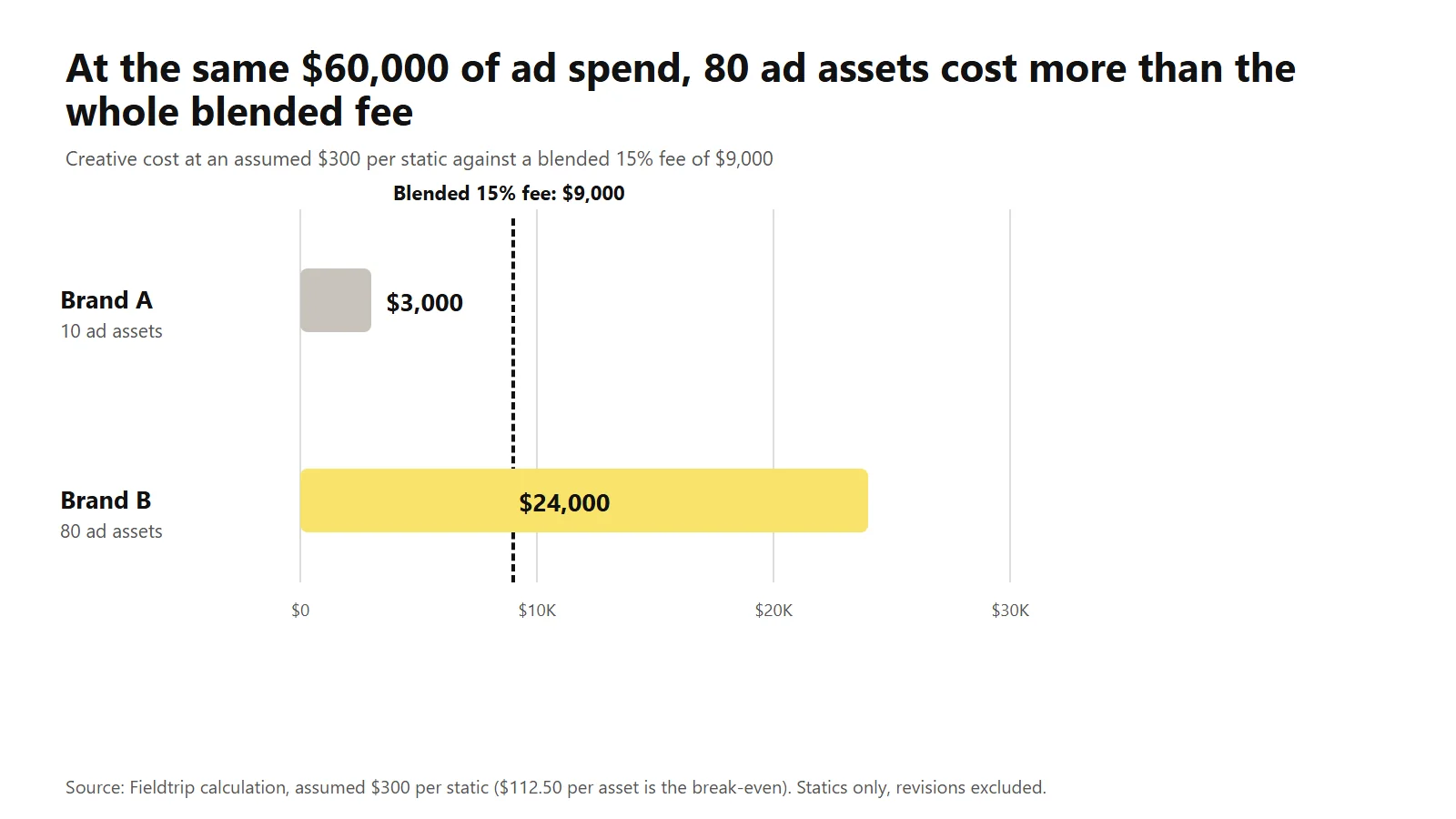
Brand A and Brand B spend the same $60,000 and pay the same fee, but Brand B needs eight times the assets.
| Scenario | Ad spend | Ad assets per month | Blended 15% fee | Creative cost at an assumed $300 per static |
|---|---|---|---|---|
| Brand A | $60,000 | 10 | $9,000 | $3,000 |
| Brand B | $60,000 | 80 | $9,000 | $24,000 |
The $300 price per static is an assumption for the example, so swap in your own quote. Brand B's creative alone costs more than the entire fee at any price above $112.50 per asset ($9,000 divided by 80), before any strategy, media, or measurement work. The agency can ration creative, which starves the account, or raise the percentage for every client, which overcharges Brand A.
The example assumes statics only and ignores revisions. Our guide to media and creative handshakes covers how the two teams share results so extra assets earn their cost.
Price each layer in a way that stays aligned with the work behind it, then add the bands that keep the fee honest.
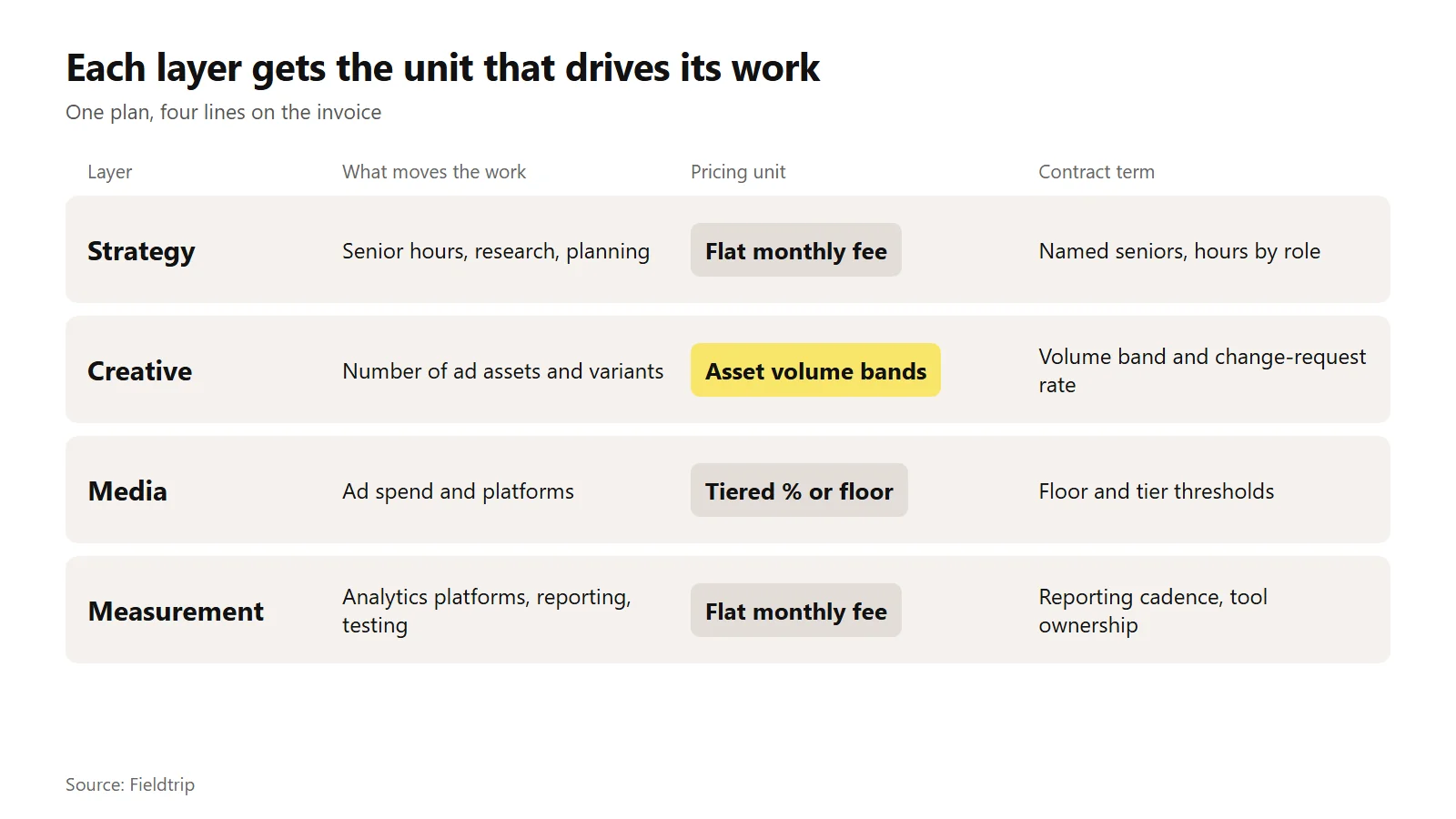
The last column is what to write into the contract for each layer.
| Layer | Pricing unit | Example structure | Contract term to add |
|---|---|---|---|
| Strategy | Flat monthly fee | A named team with committed hours | Named seniors and hours by role |
| Creative | Asset volume | Tiered monthly bands or a per-asset price; a project-based fee for a brand identity | Volume band and change-request rate |
| Media | Ad spend | A tiered percentage, or floor-or-percentage, whichever is greater (formulas in the hybrid section) | Floor and tier thresholds |
| Measurement | Flat monthly fee | Covers analytics platforms, reporting, and conversion rate optimization | Reporting cadence and tool ownership |
In this layered model, the media line is the one tied directly to ad spend.
Four steps set the bands, rates, and tiers that go into the contract:
Agree the bands and the rates before the first invoice, and write them into the contract so both sides price new work the same way. Keep measurement on its own flat line, as in the table above.
Pass-through and setup fees can add to the retainer, and some agencies fold them into hourly rates without listing them. In GoodFirms' 2026 SEO survey, AI search optimization averages $900+ a month as a separate add-on and reaches $2,500 a month at the enterprise tier.
| Fee | What to ask |
|---|---|
| Onboarding costs | Whether discovery is billed or built into hourly rates |
| Technology charges | Who pays for the tools the agency uses |
| Licensing fees | Whether the agency licenses martech on your behalf and takes a cut |
| Platform fees | Which platform fees are billed to you |
| Services markup | Which vendors the agency uses and the markup rate |
| Travel costs | Whether travel is billed separately or inside rates |
| AI search optimization | Whether it is bundled into the retainer or billed as an add-on |
Ask for every line to be listed, even when its price is zero. Our guide to choosing an advertising agency covers how to weigh price against fit.
Two quotes for the same brief can differ by a wide margin. Agency location and size, client industry, and AI tooling can all contribute to that gap.
Clutch lists agency size, years of experience, and location among the factors that move cost, alongside the services provided. In the GoodFirms survey, North American SEO agencies average $2,500 to $10,000+ a month, against $500 to $2,000+ in South Asia. Larger companies add stakeholders and markets, and client requirements for reporting, approvals, and security add hours.
Yes. In the GoodFirms survey, 23.6% of agencies serving finance and fintech clients charge in the top retainer band, against 9.1% of agencies serving education. In that SEO sample, finance and fintech were much more likely than education to fall into the highest retainer band.
Only 20% of WFA respondents have changed their commercial models in response to AI, but 61% intend to. In the GoodFirms survey, 54.3% of SEO agencies raised prices in 2025 and 2026, and 37% of those named AI search optimization as the main reason. Ask what AI tools change in each unit price, and what the agency does with the time saved.
Match the model to your ad spend and creative volume: a flat fee or floor-or-percentage fee for small budgets, a flat fee with a media tier above the crossover, and an asset-banded creative fee when volume is high.
Then check the quote with a structured process such as our marketing RFP process guide.
The table maps six common situations to a structure, and it is a starting point because budgets and internal capacity change the answer.
| Brand situation | Suggested structure | Why | Watch-out |
|---|---|---|---|
| Small ad spend with steady needs | Flat fee, or floor-or-percentage | A percentage of a small budget may not cover senior attention | Check the floor covers the work |
| High ad spend, stable creative | Flat fee with a media tier | At equivalent scope, the flat fee costs less above the crossover | Confirm what the flat fee covers |
| High creative volume | Asset-banded creative fee | The fee follows the number of ad assets | Agree the change-request rate |
| One-time rebrand or site build | Project-based fee | Scope and end date are defined | Scope drift raises cost |
| Agency not yet proven | Short project, then retainer | Tests the fit before a long commitment | Agree success criteria in advance |
| Several agencies with separate fees | Layered fee under a lead agency | One plan and clear pricing units | Align billing periods |
The enterprise RFP template includes budget sections you can reuse for these questions.
Send the same five questions to every agency and compare the answers side by side. A quote that cannot answer them is not ready to sign, and the gaps in the answers usually show where the fee will change later.
Fieldtrip works as a network of flexible, autonomous teams connected by one strategy, so you can start with the capability closest to the problem and add others as priorities change.
We do not start from a rate card. A strategic audit comes first, and a free strategy call shapes the engagement model around your priorities, budget, and channels. Our network brings specialist teams into the layers that need them:
Fieldtrip owns these agencies, so this describes our own model and is no neutral comparison. Reporting shows budget movement and channel contribution to you directly, and we stay accountable for the overall outcome.
Talk to us about the layers in scope, your ad spend, and your creative volume.
Set a floor fee and a tier schedule. This is the floor-or-percentage hybrid described above. Write down how long the floor applies and what scope it covers, so a seasonal pause in ad spend does not quietly change the work you receive.
Ask for the fee split by layer and the hours or output behind each. Ask how production, management, and agency margin divide the fee.
A brand does not need the agency's books. It needs enough detail to compare two quotes line by line and to see what changes when scope changes.
Use a fixed project-based fee with a written scope and a change-request rate. Clutch puts typical web design projects at a wide range, driven by project size, design complexity, and the features included, so price brand identity and site work by deliverable.
No. A small scope can combine strategy and measurement on one flat line, keep creative in a volume band, and put media on a floor-or-percentage fee. Split the lines fully once creative volume or ad spend grows enough that one line starts to subsidize another.
Review it quarterly against actual ad spend and asset counts. Move the bands when volume has moved for two quarters in a row.
%2520(1).png)