






















Content marketing is a core growth channel for large organizations, but the way enterprises approach it is changing. Yes, insanely capable Artificial Intelligence (AI) models are speeding up content production. But the challenges of producing content that’s deeply connected to business outcomes remain largely the same as in the pre-AI era.
In the Content Marketing Institute and MarketingProfs’ 2026 enterprise research, 42% of enterprise content marketers cited resource constraints as the biggest challenge, followed by measuring content effectiveness.
Large organizations have to coordinate multiple products, audiences, markets, internal stakeholders, approval processes, and distribution channels while connecting content to organic growth, demand generation, brand goals, and measurable business outcomes.
That makes choosing the right partner particularly important. The best enterprise content marketing agencies bring the strategy, content development capabilities, analytics, reporting, and scalable content systems to support complex marketing programs.
This guide explains how to choose the right enterprise content marketing agency, what capabilities and qualities to evaluate, and which questions to ask before committing. We’ll also cover nine vetted agency options suited to a variety of content needs.
Choosing the right enterprise content marketing agency comes down to finding a partner that can bring strong content strategy, subject-matter expertise, scalable production, editorial quality, analytics, and multi-channel distribution.
Enterprise teams should assess whether the agency can support content needs specific to their business goals.
AI capability also matters, but only when paired with human review, strong data protection practices, and a clear strategy for improving search and generative visibility.
Ultimately, the best agency is one that can produce high-quality content at scale while tying that work to measurable outcomes like organic growth, customer acquisition, pipeline influence, and stronger brand authority.
Enterprise content marketing is the planning, creation, distribution, and optimization of content for large organizations with complex products, audiences, and markets.
Enterprise content strategy has to serve multiple business units, stakeholders, and customer segments at once, which is where most of the difficulty sits.
In CMI's 2026 enterprise research, 38% of enterprise marketers named measuring content effectiveness as a top challenge, and 33% named cross-departmental collaboration (Content Marketing Institute). Enterprise content marketing is especially relevant to the B2B buying journey, since B2B buyers rely heavily on content during their decision-making.
An enterprise content marketing agency plans, creates, distributes, and measures content for large organizations, usually as an ongoing program. Most agencies lead with one or two core strengths, such as SEO-driven content, thought leadership, or creator-led social content, and build out the remaining services around them.
Depending on the organization, enterprise content marketing services may include:
Few enterprises need every service from one partner. Map the services your program actually needs before shortlisting, since an agency's strongest service is usually the one it was built around.
Most enterprises land on a hybrid model: an internal team owns strategy, brand positioning, and approvals, and an agency adds production capacity and specialist skills. The question is which parts to hand off.
Resource pressure is the usual trigger.
In CMI's 2026 enterprise research, 42% of enterprise marketers named resource constraints as their biggest content challenge, and 21% planned to invest in agencies or outsourcing that year. Only 8% planned to invest in human resources (as per Content Marketing Institute cited above).
Building the same capacity in-house is costly: WebFX estimates an in-house content team at $5,000 to $25,000+ per month once salaries, benefits, and tools are included (WebFX).
| Keep in-house | Consider outsourcing |
|---|---|
| Brand positioning and messaging | Content production at volume |
| Customer and product knowledge | Specialist formats such as video, data visualization, and interactive assets |
| Approvals and compliance review | SEO, GEO, and digital PR |
| Business priorities and budget decisions | Localization for new markets |
| Relationships with internal subject-matter experts | Creator and influencer programs |
An agency makes the most sense when you need a capability for longer than a single project but can't justify a permanent team for it, or when you need to scale output quickly around a launch, a new market, or a new channel.
At enterprise grade, you need a reliable content marketing partner with the exact expertise you’re looking for, plus the tech stack and team size to support content production at scale.
The following suggestions should help you narrow down your choices and vet the potential agencies thoroughly before signing a contract:
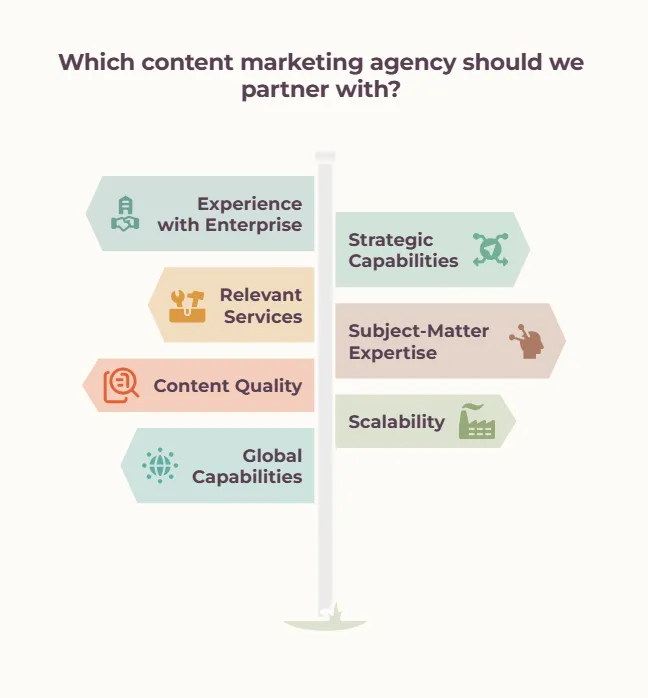
Look for agencies that have worked with enterprise businesses and understand the realities of larger organizations. That includes navigating multiple stakeholders, lengthy approval processes, complex product portfolios, strict brand guidelines, data protection requirements, and coordination across marketing, sales, RevOps, and other departments.
The way to do that is to look at relevant case studies. They can show whether the agency has managed large content ecosystems, maintained strong client relationships, and delivered consistently across complex marketing programs (more on this later).
Content production without strategy won’t move the needle. Your content marketing partner should help shape content strategy, identify search demand, define audiences and ICPs, plan campaign flow, and determine how content supports customer acquisition, demand generation, and broader enterprise marketing strategy.
The right strategy also depends on your industry, sales cycle, and audience. A company with a long, research-heavy buying process may lean on organic search and thought leadership, while a brand with shorter purchase cycles may pair organic content with paid amplification. A good partner builds the channel mix around how your buyers actually make decisions.
Make sure the agency's service mix matches what your organization actually needs. Some enterprises may primarily need long-form content development and thought leadership, while others need an integrated program with digital PR, link building, interactive assets, visual asset creation, and even paid distribution.
It is also worth considering whether you need a specialist or one of the more integrated agencies with multi-channel capabilities.
Enterprise content, especially in verticals like B2B, SaaS, finance, healthcare, manufacturing, and education, covers complex products and services. That means the agency creating the content should, at the very least, have some basic knowledge (and actively collaborate with your experts to ensure accuracy).
Volume should never come at the expense of quality. Ask how the agency handles research, sourcing, fact-checking, editing, brand voice, originality, and quality assurance. Enterprise brands typically need defined editorial processes to ensure every asset meets consistent standards regardless of who creates it.
Enterprise marketing teams may need dozens or even hundreds of assets across different campaigns, products, and markets. The agency should have content systems that let production scale without creating bottlenecks or significant quality variations.
Ask about team capacity, workflows, project management, reporting culture, and how the agency handles sudden demand spikes.
Strong partners should also incorporate feedback from multiple stakeholders without disrupting deadlines or the wider content calendar.
Multinational enterprises typically create content in multiple languages for different markets. Translation alone rarely works for that. Localized content adapts data, references, examples, and cultural context for each market, so it reads as if it were written there.
If your organization needs this, you’ll need a partner that can handle it and operates globally. They should be able to localize messaging, keyword targeting, examples, terminology, and creative for each market while maintaining a consistent global brand identity.
Pro Tip: Look for experience managing international contributors, localization workflows, regional approval processes, and market-specific SEO. Check our tips on choosing a truly global content agency.
AI is, of course, an integral part of content marketing now. 86.4% of marketing teams use AI in at least a few marketing areas, and about a third say it saves their team 10 to 14 hours a week, according to HubSpot.
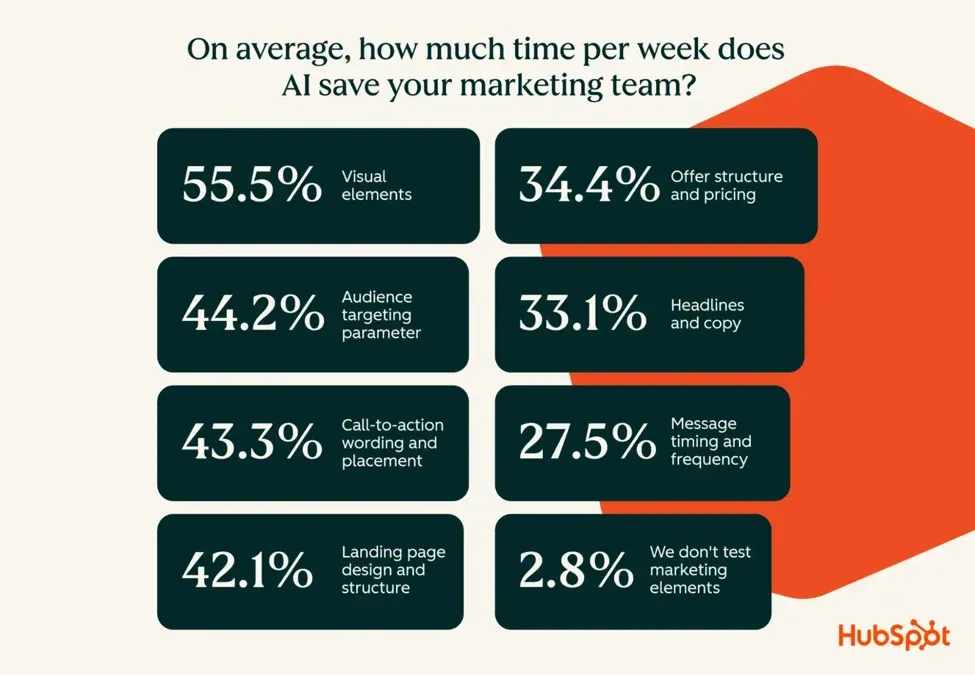
That’s why AI capability matters when evaluating content marketing agencies, but the focus should be on how intelligently the agency uses AI, not simply whether they use it or not.
Your agency partner should apply AI platforms and large language models to speed up research, generate ideas, repurpose existing content, analyze performance data, personalize messaging, and improve workflow efficiency.
AI can also support content optimization, keyword research, competitive analysis, and identifying opportunities across search and generative visibility.
Enterprises should ask exactly where human review fits into these workflows. AI-assisted content still needs experienced writers, editors, strategists, and subject-matter experts to verify facts, protect brand voice, and ensure the final output is genuinely useful.
This is especially important for complex B2B content where inaccurate or generic information can damage credibility.
Data privacy should also be part of the conversation. Agencies need clear policies around what information can be entered into generative AI tools, how confidential client data is handled, and whether their AI systems meet the enterprise's data protection and data governance requirements.
Most importantly, producing more AI-generated content is not the same as having a strong AI content strategy. A good strategy uses AI to make research, planning, production, and analysis more effective while still prioritizing originality, audience value, brand differentiation, and measurable business outcomes.
The agency’s case studies are your best opportunity to learn more about their capabilities and experience. But don’t just look for names or shiny vanity metrics. Instead, deep dive into the strategy, scale of content, and the results produced and how they tie to the organization’s growth.
Note that not every agency may have detailed performance metrics published about clients (or even all client work), so you can always inquire. Here are the questions we’d ask when evaluating past work:
Case studies show what an agency has done for other clients. These questions show how it will work for you:
If an agency's answers sound identical to every other pitch you've heard, ask for a sample report or a working session with the team before you commit.
The agencies below were selected for documented enterprise content work: published case studies, named enterprise clients, and client testimonials. We chose them to cover a range of content specialties, so you can match a partner to the type of program you're running. The numbers are for navigation only and don't indicate rank.
Disclosure: Fieldtrip publishes this guide and appears on this list. We held our own entry to the same selection criteria as every other agency.
Fieldtrip builds growth creative systems for modern brands, with strategy, creative, media, and measurement run by one connected team. Through its network of specialist agencies, including inBeat for creator content and Content Allies for B2B podcasts, it can support enterprise content programs across social, search, and audio.
Our key strength is social-first content made with niche, highly engaged creators on Meta, TikTok, LinkedIn, and YouTube.
We've run campaigns in more than 20 countries and helped brands across CPG, tech, ecommerce, retail, and services grow organic discovery through influencer content production and user-generated content (UGC). On the B2B side, we led the creation and production of OpenAI's B2B podcast from concept to launch, and ran Miro campaigns across LinkedIn, newsletters, and YouTube that reached 60M impressions at a cost per view 10 to 30 times below typical industry benchmarks.
NP Digital is a global performance marketing agency with exceptional content marketing capabilities that specifically pair well with paid amplification. Its approach starts with business outcomes and audience intent, connecting content to organic growth, customer acquisition, and measurable performance.
It can combine content with SEO, analytics, paid media, and performance marketing. NP Digital also uses a six-part content optimization process to refresh and repurpose existing assets. For instance, they can turn articles into comprehensive guides, infographics, surveys, quizzes, and other assets.
Tendo is a B2B content marketing and digital experience agency with extensive experience working with large technology and enterprise organizations. In addition to content services, the agency also handles brand positioning and messaging, UX, digital product design, and web design.
Tendo's team excels at solving complex B2B content challenges at enterprise scale. And their experience proves that. Its published results include $1.6M in pipeline from an HP printer playbook campaign, a 68% click-through-rate increase from a Cisco.com UX and digital strategy redesign, and 50K net-new opt-ins for Informatica.
Siege Media is an SEO-focused content marketing agency that brings strategy, copywriting, design, development, UX, GEO, digital PR, AI-driven search and analytics together under one roof.
Its integrated approach can work well for enterprises that want content to support multiple stages of the funnel, from building organic authority and earning links to capturing high-intent search demand and driving conversions.
It has 13+ years in the business and 5,000+ publisher relationships, and it publishes its terms: an $8,000/month minimum on a 12-month contract with a 30-day out clause.
Brafton is a full-service content marketing agency with a global team, which makes it perfect for enterprises operating in different regions.
Its range is one of its main differentiators. Brafton can combine content strategy and writing with international SEO, GEO, link building, email, video, graphics, social media, PPC, UX, and website design. The agency also offers a platform, Brafton AI Studio, where strategists, marketers, and editors can collaborate with autonomous virtual content teams supporting them.
iPullRank is an enterprise-focused SEO, AI search, and content marketing agency. Its content practice runs on what it calls Resonance Design, which pairs with its Relevance Engineering approach to search: one earns visibility, the other keeps and converts the audience.
They combine traditional search engine optimization with generative engine optimization, content engineering, technical SEO, and audience-focused content strategy to make brands more relevant to their intended audience.
But the biggest differentiator is the agency’s depth in AI search optimization capabilities. They’ve helped Fortune 500 and category-leading brands improve AI search visibility.
Column Five is a B2B content marketing agency focused particularly on SaaS, AI, and technology businesses. They use content to build a clear brand story, then turn that positioning into scalable content systems that stay consistent across channels.
Storytelling is what Column Five does best. The agency combines brand messaging and executive thought leadership with highly visual formats like data visualization, infographics, motion graphics, video, interactive web experiences, reports, and white papers. All of that is incredibly influential in high-stakes B2B buying.
Fractl is a content marketing, organic growth, SEO, and digital PR agency known for building campaigns around original research and data. Its content development model combines search-focused content designed to rank with newsworthy, link-worthy assets that help brands earn media coverage, backlinks, and brand authority.
It's best for companies that want to develop authoritative content, particularly in highly technical niches with specific audience profiles. For instance, they use surveys, original studies, datasets, and data journalism to uncover new findings.
Manifest is an integrated marketing agency that connects content, creative, media, data intelligence, social, technology, and performance marketing. Its editorial capabilities are supported by experienced journalists and creators.
In-house production resources cover everything from branded editorial and thought leadership to photography, digital creative, and larger-scale content production. That combination makes Manifest ideal for enterprises that need both strong editorial storytelling and high-quality visual assets.
Enterprise content marketing costs depend on content volume, subject-matter complexity, strategy requirements, SEO and GEO support, creative production, promotion, and reporting.
As a broad benchmark, WebFX's 2026 pricing research, based partly on a survey of 350 marketers, puts typical content marketing costs at $1,000 to $20,000+ per month. Enterprise programs tend to sit at the upper end of that range or above it, and several agencies on this list publish their own pricing:
| Agency | Published pricing |
|---|---|
| Siege Media | $8,000/month minimum for content marketing, on a 12-month contract with a 30-day out clause |
| Column Five | $25K Foundation Sprint (4 weeks), $60K-150K Content System Implementation (8–16 weeks), then $15K-45K/month for ongoing operation |
Sources: Siege Media, Column Five.
Treat these figures as reference points. A company commissioning a few SEO articles a month will pay far less than an enterprise running a multi-market content ecosystem with original research, video, and localization.
Pro Tip: When comparing proposals, enterprises should therefore look beyond the headline retainer and determine what the fee actually covers. Clarify content volume, strategy hours, revisions, research, reporting, account management, and localization.
AI has made content production much faster, but it hasn't made quality content less important. If anything, the flood of inexpensive AI-generated material has raised the bar.
Enterprises still need original research, credible expertise, distinctive brand stories, useful analysis, and content that satisfies genuine search demand if they want to earn search rankings, organic authority, citations, and visibility across AI-driven search platforms.
Major platforms are actually reinforcing that point. For instance, Google explicitly warns that using generative AI to produce large volumes of pages without adding value can violate its scaled content abuse policy. It has also clarified that its spam policies apply to generative AI responses within Google Search.
Brands need a content ecosystem built around expertise, usefulness, strong editorial standards, search and generative visibility, effective distribution, and measurable business goals. And that’s where an enterprise content marketing agency can be indispensable. They can help you create enterprise-scale content that drives business impact.
An enterprise content marketing agency plans, creates, optimizes, distributes, and measures content for large organizations. The agency can support content marketing for search visibility, AI discovery, and organic social media.
While enterprises can outsource all of their content marketing needs, we recommend retaining some control over content strategy. Internal teams can own brand positioning, customer knowledge, approvals, and business priorities.
Start with the business goals the content is meant to support, then pick metrics that show progress toward them. For most enterprise programs, three layers cover it:
Agree on these metrics with your agency before work starts, and review them on a fixed schedule so everyone judges the program against the same numbers.
A monthly retainer model is the most practical option for enterprise partnerships with content agencies. Content marketing is typically an ongoing process, and companies need assets regularly for their website, socials, and other channels.