






















Most marketing teams know more than their records show. Why a creative route was dropped, which audience result the media team no longer trusts, why the attribution model was patched mid-year: that knowledge often lives with people, and it leaves with them.
When an agency contract ends or a brand lead moves on, the files stay. The judgment behind them does not.
Leadership changes often enough for that loss to matter. The average S&P 500 CMO has been in the role for just 4.1 years, compared with 5.0 years across the C-suite, according to Spencer Stuart.
When teams change, incoming marketers can spend months reconstructing decisions, questioning old assumptions and repeating tests the previous team already ran.
Marketing knowledge management is the practice of preserving that judgment alongside the decks, reports, and campaign files.
This article covers what that practice involves, where knowledge is most likely to disappear during transitions, how to capture tacit knowledge before an agency leaves, how to measure whether the system is working, and how to handle software, AI, and records that gradually become outdated.
Marketing knowledge management is the process of documenting, organizing, sharing, and maintaining the insights behind marketing decisions. It preserves what teams learned from campaigns, why certain decisions were made, and the conditions under which those conclusions remain useful.
Campaign dashboards, reports, and test results provide the evidence. Marketing knowledge management adds the interpretation, decisions, and context that help future teams apply that evidence.
Data storage preserves campaign files and results, while knowledge management records the decisions, reasoning, and context behind them. This allows future teams to understand how previous findings influenced marketing strategy and whether those findings still apply.
Consider a media agency's end-of-campaign deck. It sits on a shared drive, complete and searchable. However, the reason a creative variant was paused in week three exists only in a Slack conversation between two employees who have since left. The next team can see the campaign results but cannot easily reconstruct the decision.
This gap also affects how teams use marketing data. Gartner's 2022 survey of 377 marketing analytics users found that analytics influenced just 53% of marketing decisions. The findings show the importance of making insights accessible and usable in decision-making.
An effective knowledge record would capture the reason for pausing the creative, the supporting evidence, the person responsible, and the date. That gives future teams enough context to evaluate the decision and apply relevant lessons to future campaigns.
Marketing teams produce four main types of learning: strategy, creative, media, and measurement. Each contributes different insights to future campaigns and requires a clear record of what the team discovered.
These records become more useful when teams connect them. For example, a creative test may reveal that a particular message performs well, while media and measurement findings help explain which audiences responded and whether the results justify further investment.
The client organization should own the central marketing knowledge record, with designated internal owners responsible for maintaining it across agency relationships. Each agency should contribute relevant campaign findings, decisions and supporting evidence as part of its regular reporting and handover process.
In a roster with an internal team, creative agency, media agency, and measurement partner, each party typically maintains its own working documents. Without a central owner, insights can become scattered across separate reporting systems and conversations.
A practical starting point is to list the four types of learning your organization produces and assign a responsible owner to each. Check whether every record contains the decision, supporting evidence, date, and any limitations that future teams should know.
Campaign learning disappears during team and agency transitions because important decisions remain undocumented, while existing records become difficult to find, interpret or trust. Incoming teams often receive campaign files without the context needed to understand previous decisions.
These transitions happen regularly. The 2025 ANA and 4As tenure study found that client-agency relationships last approximately seven years on average, while media-only agency relationships average just 3.7 years.
Marketing knowledge is particularly vulnerable in two forms. Tacit knowledge leaves with the people who developed it, while explicit knowledge can remain scattered across documents, platforms, and agency systems. Each creates different challenges when a new team takes over.
Tacit knowledge in marketing is the experience-based judgment that team members develop through campaigns, client relationships, and repeated testing. It includes why certain creative approaches worked, which audience responses were misleading, and why a channel was deprioritized despite promising dashboard results.
Account directors, planners, and creative leads develop this understanding over time. For example, a creative team may know which tone works for a brand, which messages audiences respond to, and which concepts have repeatedly failed.
When a creative partner changes, that understanding can disappear. The incoming team may revisit creative approaches that the previous agency already tested and rejected, simply because the reasoning was never documented.
Handover processes mostly make this worse. Outgoing teams typically transfer campaign reports, assets, and account access, while discussions about failed experiments, abandoned ideas, and important judgment calls receive less attention.
Explicit knowledge includes documented campaign plans, performance reports, creative reviews, and test results. It becomes difficult to use when records are scattered across agency systems, poorly organized, or missing essential context.
An incoming team might find several versions of the same campaign report without knowing which one contains the final results. Even when the document is available, the team may struggle to determine whether the test was reliable or whether later campaigns challenged its findings.
This problem extends beyond marketing. A Gartner survey published in 2023, involving 4,861 digital workers, found that 47% struggled to find the information or data needed to perform their jobs effectively.
For marketing teams, this can mean searching through old folders, contacting former colleagues, or repeatedly asking questions that previous campaigns already answered.
Lost campaign knowledge can increase marketing costs through duplicated tests, repeated research, longer planning cycles, and unnecessary creative revisions. These costs accumulate when teams spend resources rediscovering conclusions that previous teams had already reached.
Consider a new performance agency that repeats an audience test completed eighteen months earlier. The previous agency documented the results in an account director's notes, but those notes were never transferred. The new team invests time and budget in answering the same question.
Similar problems occur when teams reopen settled positioning decisions or develop creative concepts that earlier campaigns already ruled out. Over time, this can slow down campaign planning and weaken brand consistency.
Agency transitions also carry direct financial costs. According to the ANA and 4As research cited above, clients that require agency reviews spend an average of $408,500 per pitch, based on earlier Cost of the Pitch studies. This figure covers the pitch process and does not account for additional costs associated with rebuilding lost campaign knowledge.
To assess the impact on your organization, review your last three agency or team transitions. Identify which decisions had to be revisited, which tests were repeated and how much time teams spent locating previous campaign insights.
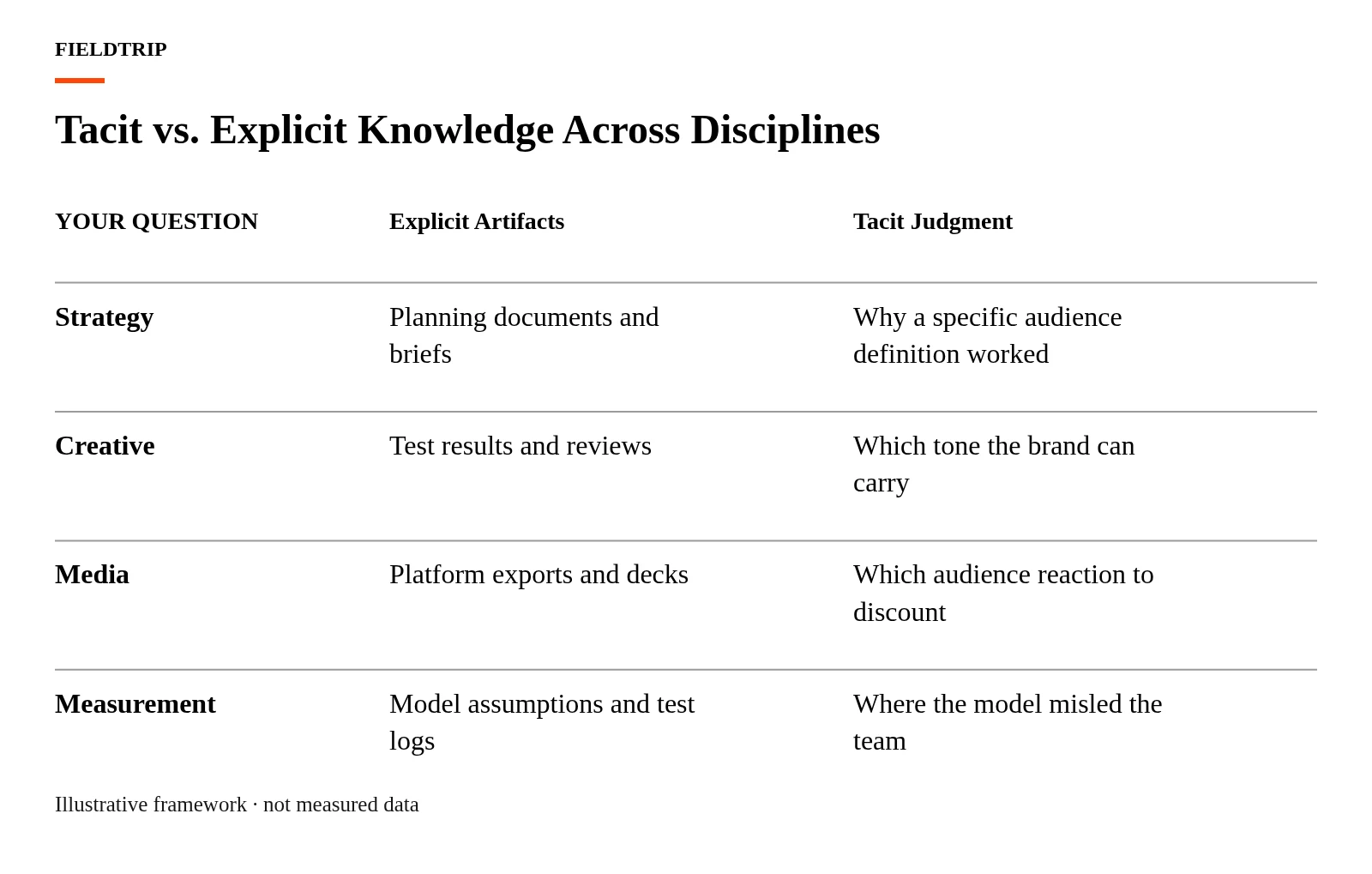
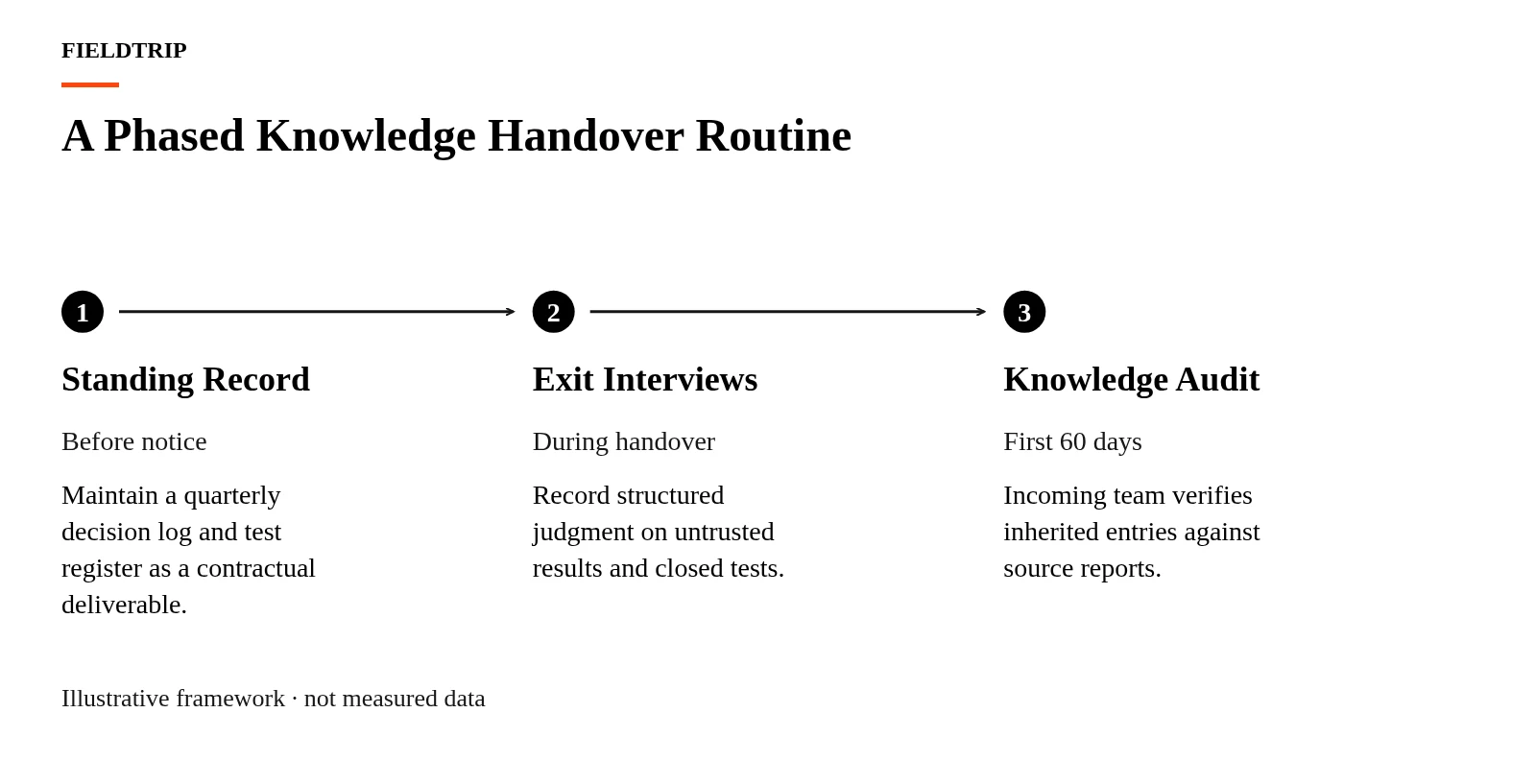
Capture tacit knowledge in three phases: a standing record kept throughout the engagement, a structured handover triggered when notice is given, and an audit by the incoming team during its first 60 days.
The order matters. A handover that starts at notice recovers only what people can remember under time pressure; a standing record turns the handover into a review.
The standing record is owned by the client and written into every agency contract as a named deliverable, alongside reporting. It holds four artifacts: a decision log with rationale, a test register with status, creative learnings organized by audience, and a note of measurement assumptions and known gaps. Each entry carries a date, an owner, and a plain statement of confidence.
Quarterly, the client-side owner reviews it with each agency. This is also where you learn whether a partner contributes well.
An agency that can articulate why it made a decision, and what it would not repeat, shows exactly the judgment you want to retain; the quarterly review makes that reasoning visible in a high-performing agency-client relationship.
The exit interview is a conversation about judgment. Useful questions include:
Record the answers in the decision log with the respondent's name and date.
A hypothetical consolidation shows the discipline: a brand moving from three agencies to one requires each outgoing partner to complete the same five-part handover template, covering decisions, tests, creative learnings, measurement assumptions and open questions, before final invoices are approved.
Tying the handover to final invoices places it inside the commercial relationship, where it belongs.
| Handover artifact | What it records | Owner | When it is updated | How the incoming team verifies it |
|---|---|---|---|---|
| Decision log | Each material decision, its rationale, who made it, and what evidence it rested on | Client knowledge owner, agency contributes | At each decision, reviewed quarterly | Sample five decisions and check rationale against source reports |
| Test register | Every test, hypothesis, result, cleanliness and status (settled, contested, retired) | Client measurement lead | At test close, reviewed quarterly | Rerun one settled test as a calibration check |
| Creative learnings by audience | What resonated, with whom, why, and what was rejected and why | Creative lead, client brand owner signs off | After each campaign review | Compare against current creative and flag unexplained departures |
| Measurement assumptions and gaps | Model choices, known blind spots, platform-reported vs incremental results | Measurement partner, client owns | When models or platforms change | Reconcile against the latest incrementality test |
| Open questions | Unresolved debates and tests not yet run | Client knowledge owner | At handover and quarterly | Confirm each is still open or has been settled elsewhere |
The artifacts above are an operating template; the owner and cadence columns reflect our recommendation that the client holds the record and agencies contribute to it under contract.
The incoming team's first two months are the best window to test the inherited record, because they have not yet absorbed its assumptions. They should verify a sample of decisions against source reports, rerun one settled test as calibration, and date-stamp everything they confirm. Anything they cannot verify is marked contested and kept.
Capturing tacit knowledge requires starting before the contract ends, treating the handover as an exit interview about judgment.
Measure the practice with operational proxies collected before and after any change, and be honest that none of them proves revenue impact. The aim is to find out whether the record changes what gets briefed and tested, because that is the only outcome that justifies the effort.
Set a baseline before changing any tool or process. For two weeks, survey the team on time spent searching for prior results, count how many times the same question is asked across channels, and record how long standard processes take, such as assembling a brief's background section.
The same Gartner survey found the average desk worker now uses 11 applications, up from six in 2019, which is why counting questions across every channel matters.
A hypothetical illustration: a team logs that the same audience-sizing question was asked by four people in one quarter, introduces a governed record with a named owner, then counts recurrences the following quarter. The drop, if it comes, is a direct signal.
Decision velocity is the elapsed time from a question being raised to a decision being settled and recorded. Track it across brief cycles: how long from kickoff to an agreed audience, an agreed creative territory, an agreed test plan. A governed record should shorten the early, argumentative part of each cycle because settled questions stay settled.
Speed alone is not the goal.
In a 721-company survey, MIT's Center for Information Systems Research found firms that were both fast and innovative beat their industry averages by 11.6 percentage points on revenue growth and 9.8 on net margin, while fast but incremental firms did only marginally better than slow ones.
For marketing, the equivalent is faster settling of known questions so more cycle time goes to genuinely new tests.
| Measure | How to collect it | Baseline needed | What it misses |
|---|---|---|---|
| Search time | Two-week team survey plus knowledge base and chat logs | Hours per person per week before change | Self-reported; people underestimate interruptions |
| Repeated questions | Count of identical questions across email, chat and meetings | One quarter of logged questions | Questions asked privately or never asked |
| Decision velocity | Days from question raised to decision recorded, per brief | Three to four brief cycles | Faster decisions are not always better decisions |
| Avoided duplicate tests | Tests proposed that the register showed as already settled | A complete test register | Counterfactual; the test might never have been run anyway |
The measures above are operational proxies for the practice; the search-time and repeated-question methods follow the vendor guidance referenced in the previous section, and none of them demonstrates revenue impact.
Each measure above has a blind spot, listed in the last column.
The useful discipline is to tie each measure back to a decision. If the record is changing which briefs get written and which tests get funded, keep investing. If it is only being admired, stop.
That is the same standard we apply to measurement generally: data earns its place when it changes a decision, and a knowledge record is no exception.
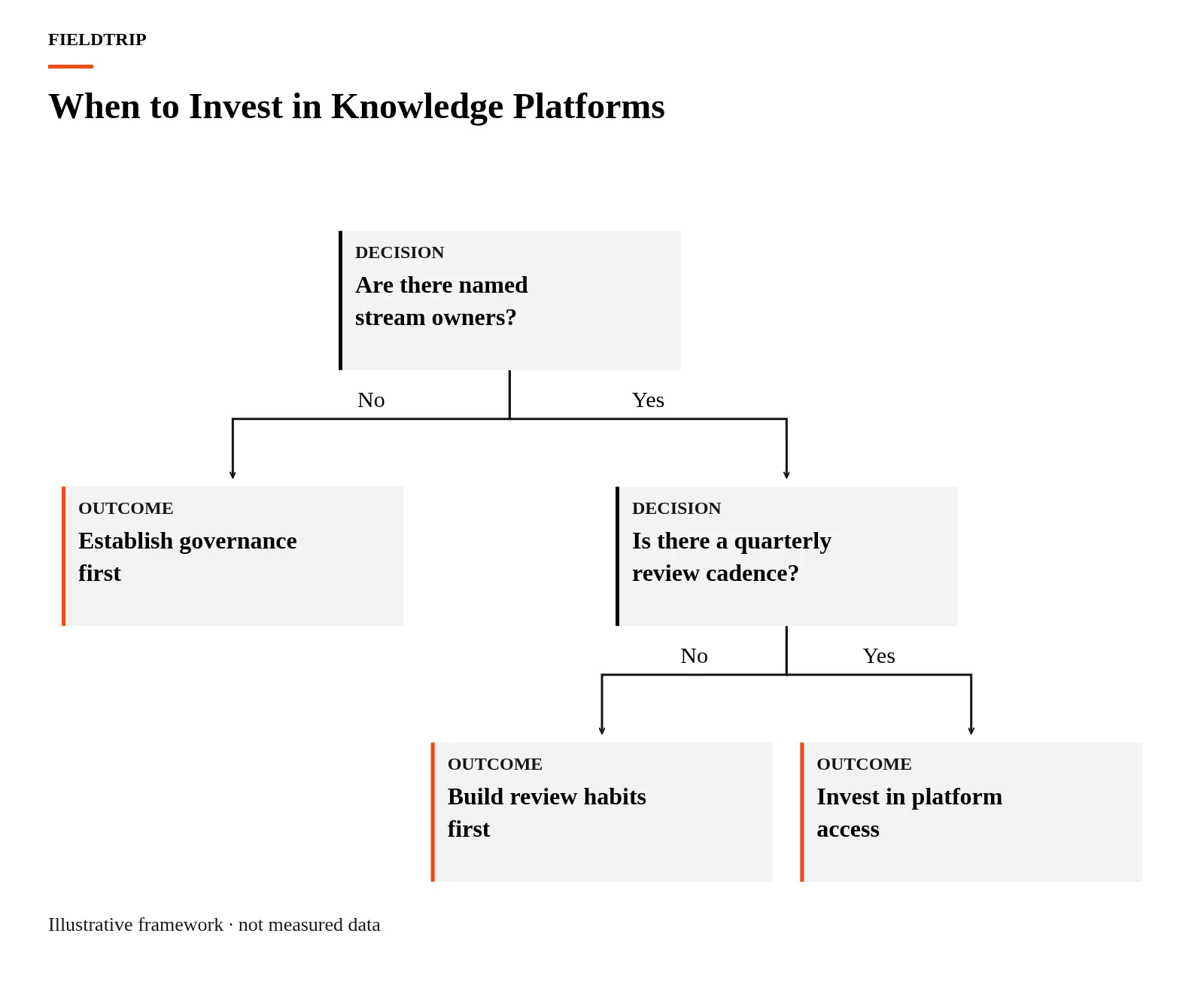
Invest in governance habits first and buy a platform once they have run for a full campaign cycle. A platform amplifies whatever order or disorder it is given.
Pointed at a well-owned, dated, reviewed record, it makes retrieval fast and consistent. Pointed at a pile of undated decks, it makes the pile searchable and lends it an authority it has not earned.
A platform earns its place when three things already exist: named owners for each learning stream, a naming and tagging convention people actually follow, and a review cadence that retires stale entries. At that point the bottleneck is access across tools and teams, which is a problem software solves well. Before that point the bottleneck is behavior, which software does not touch.
A hypothetical case: a brand buys a knowledge platform, migrates 400 decks, and six months later the team still messages the creative director for answers because nobody owns tagging and the search returns everything and nothing. The purchase came before the habits it depended on.
Four habits carry most of the weight, and each is cheap:
Yes. Media results arrive structured and dated from platforms; creative learnings, as the tacit-knowledge section showed, exist mostly as judgment. They need the same record as any creative testing program: audience, hypothesis, outcome, confidence, owner.
The same applies to the decisions behind a brand's visual system, where design rationale is often only remembered. Record the reasoning behind each asset, or the next team will redesign around a problem that was already solved.
A knowledge management platform amplifies existing habits. Investing in software before establishing named owners and review cadences only creates a faster search for outdated files.
AI assistants retrieve and summarize what exists. With a governed record, they are a fast way to surface relevant decisions and tests; with an ungoverned one, they produce confident, well-written answers that may be years out of date. The quality of the answer is bounded by the quality of the record.
Applied to marketing, AI retrieval does useful work: pulling every past test on a given audience into a brief's background section, summarizing creative learnings for a new agency, or flagging that a proposed test resembles one already in the register. For marketing leaders, the point is that governance is what makes the retrieved entries worth acting on.
The trust failure has a specific shape. An assistant surfaces a stale or contradictory entry and presents it as settled fact, in fluent prose, inside a planning document.
A hypothetical example: an assistant cites a 2023 audience finding as current because the entry was never dated or retired, and a brief is written around a segment that has since behaved differently.
Nobody lied; the record was simply never maintained, and the tool had no way to know. Contradictory entries are worse, because the assistant may pick one, and the planner never sees the disagreement that would have prompted a check.
Few organizations are ready for this. A 2024 Gartner survey found 63% of organizations either lack or are unsure they have the right data management practices for AI. And Gartner predicts that through 2026, organizations will abandon 60% of AI projects unsupported by AI-ready data.
Three rules keep retrieval honest:
These rules cost minutes and prevent the most expensive kind of error, the one that looks authoritative. Connect the tools and add the assistant after the owners, dates, and review rules exist, so any gains have somewhere to land.
To keep a marketing knowledge base current, teams need to date their findings, review them regularly and update conclusions as platforms, audiences and market conditions change. Each record should have a clear owner responsible for checking whether the information remains useful.
A campaign insight may lose relevance when a platform changes its algorithm, audience preferences shift, or measurement methods evolve. Regular reviews help teams identify outdated assumptions before they influence new campaign decisions.
Every knowledge base entry should include the date the finding was established, a confidence level, and a review-by date. These details help teams understand when a conclusion was reached, how reliable the supporting evidence is, and when it needs reassessment.
When the review date arrives, the assigned owner should decide whether to:
Historical entries should remain accessible with clear labels explaining when and why they were used. This helps future teams understand past decisions without treating outdated conclusions as current guidance.
Start by adding a review-by date to existing entries. Prioritize findings that influence current budgets, targeting decisions, and campaign strategy.
Marketing teams should regularly re-test conclusions that depend on changing platform features, audience behavior, or market conditions. The review schedule should reflect how quickly those conditions change and how much the business relies on each finding.
For example, a bidding strategy that performed well before a major platform automation update may need another test. The team can retain the original findings as historical context and schedule a new experiment during the next quarterly planning cycle.
Measurement assumptions require similar attention. In its 2024 State of Data report, IAB found that 95% of advertising and data decision-makers expected continued signal loss or privacy legislation.
Another 55% anticipated greater difficulty attributing campaign and channel performance.
These findings illustrate why measurement practices need periodic reassessment. An attribution model developed under earlier tracking conditions may produce less reliable conclusions when the available data changes.
As a practical starting point, teams could select three established assumptions to revisit each year. Prioritize findings that affect current media investments, measurement decisions or important audience strategies. Higher-risk assumptions may need more frequent reviews.
An unused marketing knowledge base gradually becomes outdated, making it harder for teams to trust or apply previous findings. As employees stop consulting it, new campaign decisions and insights also go undocumented.
To encourage regular use, organizations should integrate the knowledge base into existing planning and approval processes. For example, a creative brief template could include a section for relevant past findings, while a test proposal form could require teams to check previous experiments before requesting approval.
This makes the knowledge base part of everyday decision-making and helps teams avoid repeating work unnecessarily.
Assign one person to oversee the knowledge base and conduct quarterly reviews with the relevant stream owners. During each review, check which entries need updating, which findings influenced recent decisions, and whether teams are documenting new learning.
The aim is to keep the knowledge base useful as campaigns evolve, so teams can make decisions using relevant evidence and the experience accumulated across previous campaigns.
Effective marketing knowledge management helps teams preserve campaign insights, understand past decisions and apply what they have learned to future campaigns. Clear ownership, regular reviews and consistent handover processes allow that knowledge to remain useful as teams, agencies and market conditions change.
At Fieldtrip, we bring strategy, creative, media and measurement together through small, specialized teams working toward shared goals. Our connected approach helps align campaign planning, creative development, media execution, and performance measurement, allowing insights from each function to inform decisions across the others.
Whether you're preparing for an agency transition, reviewing your marketing strategy or trying to improve coordination between teams, we can help you identify opportunities for a more connected approach.
Contact us to discuss your marketing challenges and explore how our strategy, creative, media and measurement teams can support your next campaign.
You can require handover of anything the contract names as a deliverable, so name it. Separate the agency's methods and tools, which it may reasonably protect, from conclusions about your brand, audiences and campaigns, which were produced with your budget and belong in your record. Adding the decision log and test register to the contract up front avoids the argument at exit.
One client-side owner holds the record and the authority to mark an entry settled, contested or retired. Each agency contributes to its stream under a shared template and cadence, and conflicts between contributors are logged as open questions until the owner settles them. The quarterly review is where disagreements get aired and dated.
Set a review-by date on every entry and let the stream owner decide at that point. A practical rule is to re-test or mark as historical anything that has lived through two significant platform or market changes without re-confirmation. Learnings about enduring brand truths can stay longer than learnings about bidding or audience behavior.
One shared document with a decision log and a test register, one owner, and a 30-minute quarterly review. Add a date and a confidence level to each entry and require the brief template to reference it. That is enough to stop the most expensive losses, and it scales into a platform later if the habits hold.