

























Most teams put real effort into a brief, then barely look at it once production starts. This disconnect creates vague feedback, delayed approvals, and work that slowly drifts away from the original goals.
A strong brief should stay useful throughout the project. It should give your team one clear reference point for what you’re making, who it’s for, what success looks like, and what needs to happen next.
That’s exactly what our free creative brief template is designed to help with. It gives in-house teams, agencies, brand managers, creative strategists, and campaign owners a practical structure to refer to from kickoff through final approval.
In this guide, we’ll show you how to use the template during planning, production, reviews, approvals, and post-campaign learning, so your creative direction stays clear from start to finish.
Let's get started!
A creative brief is a short strategic document that gives everyone involved in a project the same business objective, audience insight, message, deliverables, constraints, and definition of success.
It clarifies the target audience, key promise, and brand guidelines. This gives marketers, strategists, designers, writers, media teams, agencies, and approvers one shared reference for decisions. That reference should remain active after kickoff to help teams assess concepts, manage changes, and interpret campaign performance.
This matters because many teams stop referring to the brief once production begins. The 2025 BetterIdeas Project survey found that only 15% of marketers and 23% of agencies always use the brief when evaluating creative ideas. This gap shows why the document must stay central throughout the project.
But a project plan serves a different purpose. It organizes tasks, schedules, and resources, while the brief explains what the work must achieve and why.
To write a creative brief that your team will actually use, include the information people need to create the work, review it, approve it, and measure its success. If a field does not help someone make a decision during that process, it probably does not need to be there.
Every field should guide a choice because, according to a report from BetterBriefs in 2021, 89% of marketers and 86% of agencies agree that producing good creative work is difficult without a good brief.
Here are the nine key sections we suggest including:
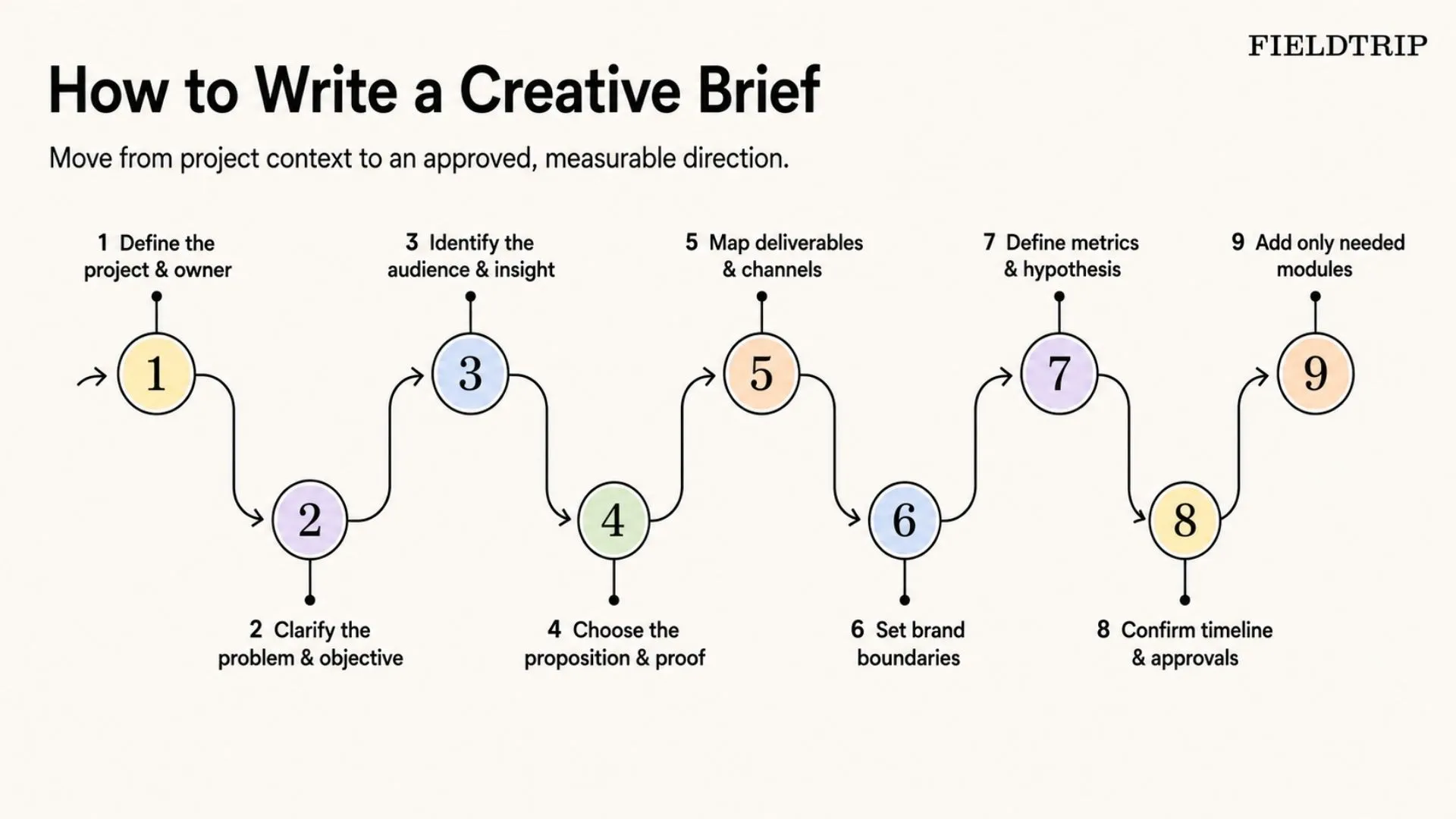
Start with the project name, campaign, product, market, deadline, and brief owner. This gives everyone the basic context before they review the strategy.
The brief owner is responsible for gathering key details, resolving open questions, keeping the document current, and recording approved changes. Also name the final approver so everyone knows who has the authority to sign off on the overall direction.
Add a version number and last-updated date as well. This makes it easier for everyone involved to confirm they are working from the latest approved brief.
Begin with the business problem the creative needs to solve. A request for “six social media videos” tells the team what to make, but it does not explain why the work is needed or what needs to change.
Then translate that problem into a clear creative objective. For example, you might need first-time buyers to understand a complicated product more quickly, encourage a specific audience segment to request a demo, or make an unfamiliar offer feel more relevant to people who have previously ignored it.
According to a BetterBriefs global report, 60% of marketers use the creative process to clarify their strategy.
Ideally, the major positioning, audience, and value proposition questions should already be clear before production starts. In our experience, a structured brand strategy framework helps you work through those decisions before they become creative feedback later.
Define one primary audience and focus on the behavior, motivation, objection, or need that matters for this campaign. A label such as “women aged 25-40” offers little creative direction.
Go further and explain:
Then feed first-party data into your creative briefs through CRM behavior, sales conversations, customer interviews, search data, and past campaign results. Add market research when first-party evidence cannot answer the question.
These inputs create usable insight instead of assumptions.
Define the single-minded proposition as the one core idea you want the audience to take away from the campaign. Your key message then translates that strategic idea into language the creative team can communicate clearly.
Next, give the team evidence that makes the message believable. This could include product capabilities, customer evidence, research, demonstrations, awards, or approved claims. A clear proof section gives writers and designers credible material to work with and helps approvers judge whether the creative supports the intended message.
Insider tip: Our team at Fieldtrip usually prioritizes one message and keeps every supporting point secondary. This helps keep the message hierarchy clear when stakeholders introduce new priorities during later reviews.
List every required asset, quantity, dimension, channel, language, and market. Then explain the role each asset needs to play in the customer journey. For example:
This prevents teams from resizing one generic concept for every placement.
Then, add platform requirements, audience targeting, and media context. Show how assets connect across paid campaigns, owned content marketing, organic channels, creator partnerships, and offline media.
Creative freedom works better when everyone knows what is fixed and where there is room to explore. Your brief should capture the brand voice, visual identity, required product information, approved terminology, disclaimers, legal requirements, accessibility standards, and prohibited claims.
Separate the non-negotiables from areas where the creative team has flexibility. This gives designers, writers, and strategists enough direction without prescribing every executional choice.
Supporting brand, legal, and product documents can live in separate links rather than inside the brief itself. Your core document stays easy to scan, while the team can access additional guidance whenever they need it.
Success is easier to judge when each criterion connects to observable audience or business behavior. One primary metric can represent the goal, while two diagnostic metrics provide context.
The creative hypothesis should be easy to understand. It might read, “We believe this audience will respond to this message because of this insight, and we will measure the response through this result.” Qualified conversions, CPA, ROAS, brand lift, and message recall can support stronger decisions.
A 2026 survey of 115 marketing leaders found that 89% believed their creative had been effective during the previous year. Yet only 36% measured creative as rigorously as media. This gap can weaken ad spend decisions.
Set out the key stages of the project so everyone knows when decisions need to happen. They should cover kickoff, concept review, production, legal review, final approval, launch, and reporting.
Add the working budget too. It can influence the type of concept you pursue, production approach, creator selection, localization, asset volume, and media requirements.
Next, define who needs to contribute at each stage and who has final approval authority. Give reviewers a clear feedback deadline, and one agreed channel for comments.
It also helps to appoint one person to consolidate stakeholder feedback before it reaches the creative team. This makes conflicting requests easier to resolve and reduces unnecessary revision rounds.
Keep the core brief consistent, then add optional modules only when the campaign genuinely needs them. Optional modules can cover localization, creators, production logistics, content development, media placements, compliance, AI use, or creative testing.
Detailed research, transcript technical specifications, and background material work better as linked documents. This keeps the main brief focused on the decisions the creative team needs to understand quickly.
Legacy fields deserve the same scrutiny. When a field never influences concept reviews, approvals, or another project decision, it adds clutter.
A completed example makes it easier to see how each field connects to the next. This fictional brief shows how a B2B productivity platform might prepare to launch a new collaboration feature.
Each row supports a real decision. The audience insight shapes the message, the proposition guides the creative direction, and the metric tells the team what success should look like.
Together, the fields create a shared vision across strategy, production, media, and approvals. Every asset can then be reviewed against the same objective instead of personal preference.
Once you understand how the fields work together, you can put them into practice with our free creative brief template. It keeps the decisions your team needs in one place without forcing people to dig through pages of background material.
The template includes:
Together, these elements help marketing teams make and preserve decisions from planning through execution. They also align media and creative teams around one brief by connecting the original project goals with production, distribution, approvals, and measurement.
Completing the brief is only the starting point. The next challenge is making it easy for people to refer to during real project conversations without adding another layer of admin.
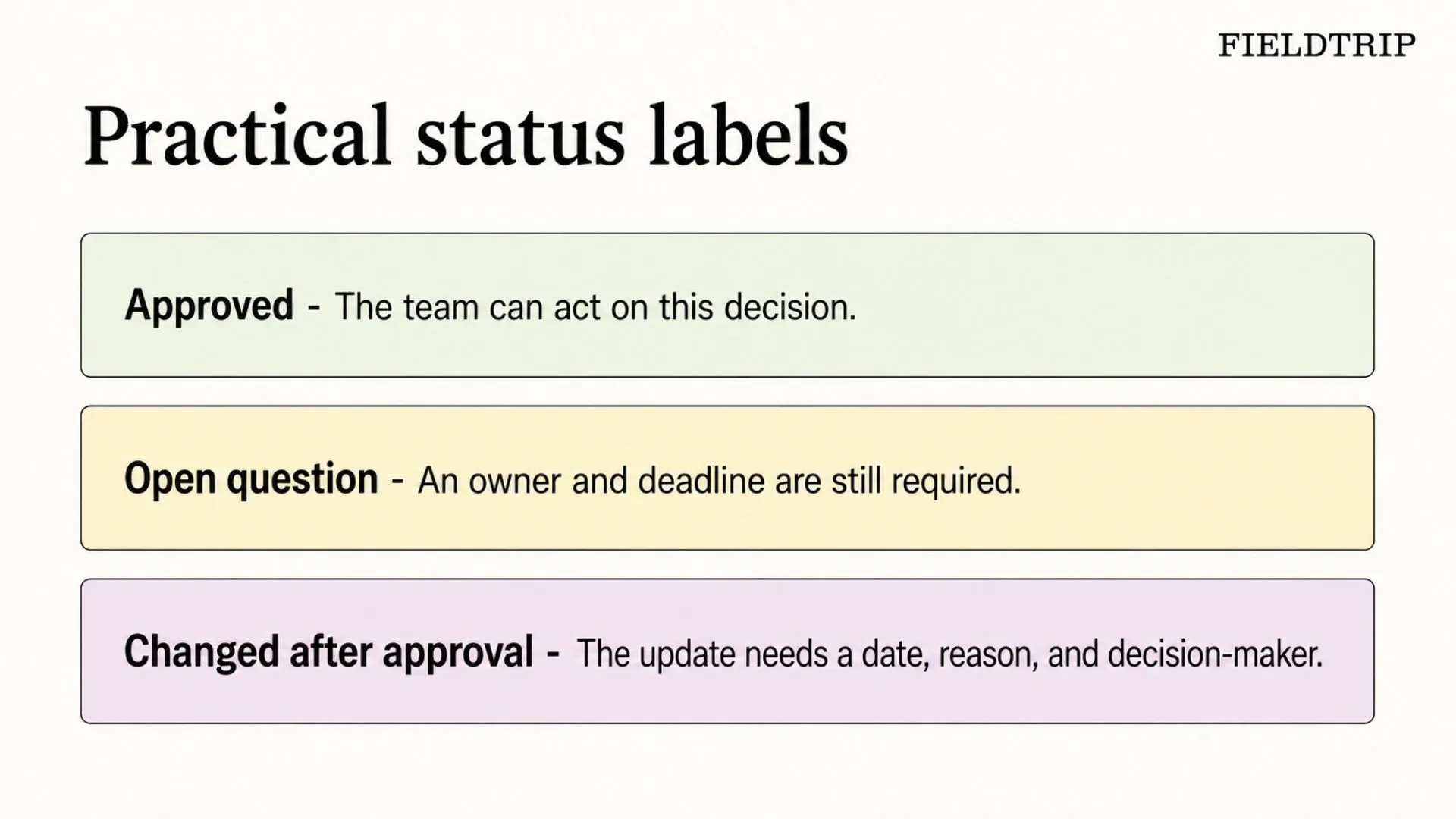
A simple workflow can help:
Practical status labels:
AI can help with the mechanical parts of briefing. You can use it to organize research, summarize approved customer evidence, identify incomplete fields, compare information across source documents, or adapt a completed brief for different collaborators.
Be more careful when AI moves from organizing information to creating it. Audience insights, positioning, product claims, cultural assumptions, and supporting proof should come from verified sources rather than model-generated conclusions.
The need for oversight is clear. In a 2025 IAB survey, 70% of US advertising executives reported at least one AI-related incident. Those incidents included hallucinated facts, biased material, regulatory failures, and off-brand content.
Human oversight should therefore remain mandatory whenever AI contributes to a creative brief. Someone on the team needs to verify the audience insight, positioning, product claims, cultural context, legal requirements, and final strategic direction before the brief is approved.
Give AI approved source material and use it to organize information, surface gaps, or challenge incomplete reasoning. Do not let it fill missing strategic decisions with invented assumptions.
Prompt example:
"Review this brief using only the evidence provided. Identify missing decisions, unclear ownership, and unsupported claims. Ask questions wherever evidence is missing. Do not invent customer insights or product proof."
Read next: Generative AI Won’t Save Bad Strategy: The Real Limits of AI Creative for Enterprise
Every brief begins with a hypothesis about who the audience is, which message will resonate, how the offer should appear, which format fits, and what response the campaign should create. Once the work reaches the market, performance provides evidence that can strengthen or challenge those assumptions.
The learning loop follows this sequence:
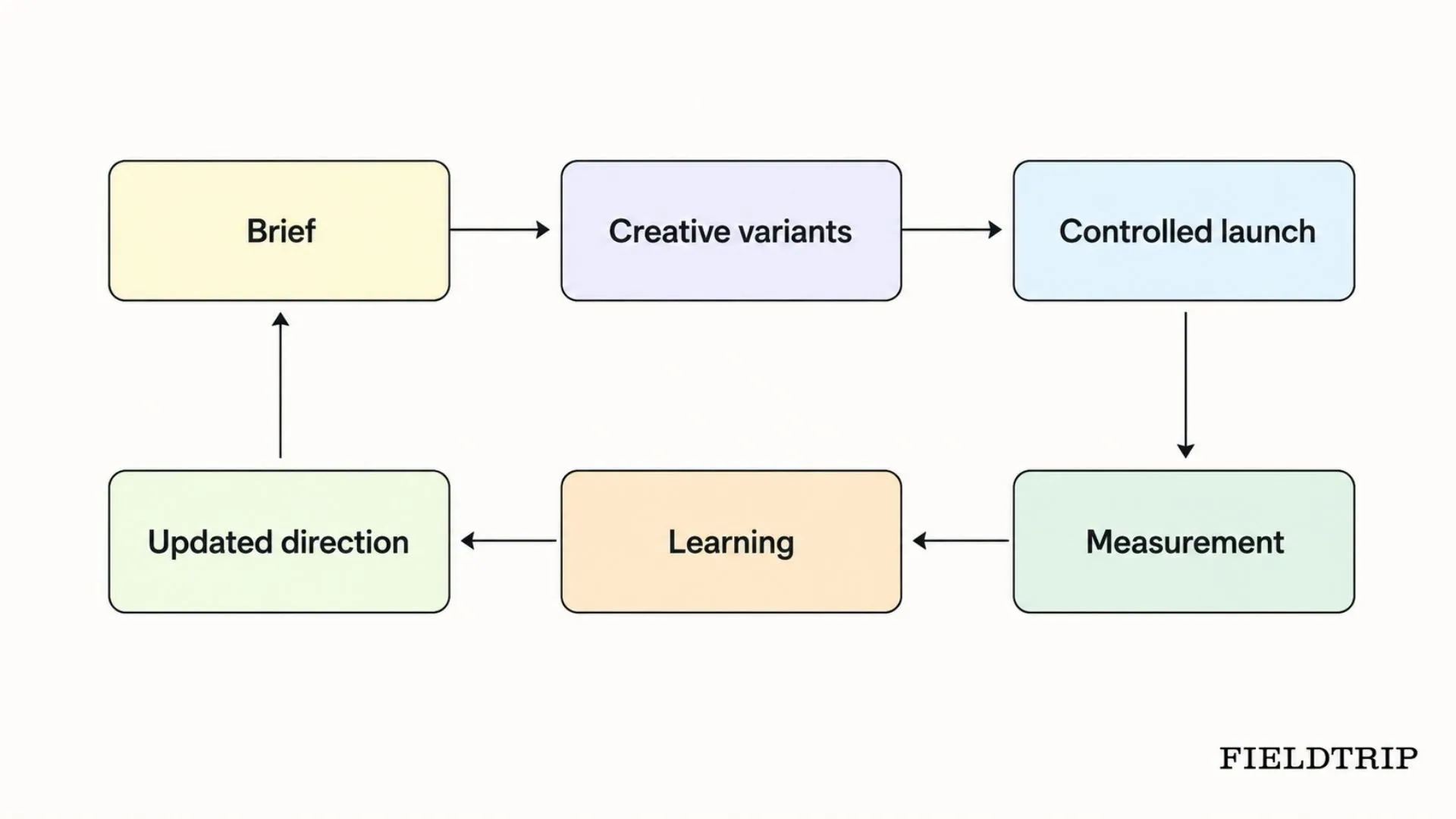
A creative testing and measurement framework gives teams a consistent way to move evidence back into future decisions. After each cycle, the team should record what changed, what remains uncertain, and which insight deserves to carry into the next campaign.
Over time, these records become institutional knowledge. They keep valuable findings from getting trapped inside dashboards and help each new brief start from a stronger position.
An approved brief gives your team direction. The next step is turning that direction into creative work built for the channels where your audience will actually encounter it.
Fieldtrip brings strategy, creative, media, and measurement into small cross-functional teams that work from the same brief. Through our creative production services, brands can move from an approved brief into brand and design systems, UGC, influencer content, video production, social-first campaigns, visual-content retainers, and out-of-home creative.
This connected approach also makes it easier to test ideas once they reach the market and refine future creative decisions with real performance data.
We used this approach for Hurom. Our teams developed performance-tested creator variations from audience-segment behavior. Fast tests revealed early signals and shaped later creative decisions. The campaign reduced CPA by 60% and tripled ROAS. Our wider 360-degree strategy increased customer value by 150%.
Need help shaping the brief, refining the creative direction, or turning it into campaign-ready work? Let’s discuss your project.
A creative brief is important because it keeps stakeholders aligned around the same objective, audience, message, deliverables, and success criteria. That shared direction reduces subjective feedback, scope changes, duplicated work, approval delays, and avoidable revisions throughout the project.
A creative brief should usually be one or two pages long. Complex campaigns can place research, production details, localization requirements, media specifications, and compliance information in linked modules or supporting documents. Decision clarity matters more than a rigid page count.
A creative brief works best as a structured, editable document that everyone can access from a central location. Google Docs, Microsoft Word, Notion, project-management platforms, and shared workspaces all work. Teams can export a PDF and keep the editable source under version control.
