

























Marketing playbook sounds powerful on paper, but here’s the hot take: it’s no longer the most practical solution for the modern marketing team.
Allow me to explain (with some data).
Gartner’s 2026 CMO Spend Survey found that marketing budgets rose only slightly to 7.8% of company revenue. And 56% of CMOs said they lacked the budget required to deliver their plans, and 54% reported insufficient resources.
Despite those constraints, organizations now allocate an average of 15.3% of their marketing budgets to AI, even though only 30% describe their AI readiness as mature or fully developed.
This exposes the central weakness of the traditional marketing playbook. A playbook assumes that the environment will remain stable long enough for yesterday’s successful process to be documented, distributed, and repeated. In reality, the market changes before the document even reaches your team.
You can already see this shift in how people discover and evaluate brands.
Google and its CEO Sundar Pichai reported in May 2026 that its AI Overviews had surpassed 2.5 billion monthly active users, while AI Mode exceeded 1 billion monthly users within its first year.
Those changes go far beyond another AI feature. They reshape how buyers research problems, compare vendors, and build shortlists before your team sees any clear buying signal.
At the heart of it all is evolving technologies, platforms, and consumer behavior.
A fixed marketing strategy can tell your team which activities to execute. It can't reliably tell them what to do when search experiences evolve, buyer questions change, cultural conversations shift, competitors copy successful ideas, or reliable data becomes incomplete.
The companies staying ahead are moving away from rigid playbooks. They're building marketing systems that recognize change early, interpret it correctly, and respond without losing strategic direction.
You know what else is over? The idea that a brand can buy relevance. Download Fieldtrip’s report on ‘Brand as a System’ that proposes three archetypes for brands to win relevance in the online world.
Traditional playbooks became popular for a good reason. They turned individual expertise into an organizational capability.
When an experienced operator discovered a reliable sequence for planning campaigns, qualifying prospects, or following up by email, the company could document that sequence and teach it to the rest of the team, or even the whole Internet, if they’re feeling generous.
Instead of asking every employee to reinvent the process, leaders could distribute the same templates, checkpoints, and quality standards.
Normally, the best playbooks delivered four forms of leverage:
This approach was effective when the dominant marketing channels changed relatively slowly, and there were fewer of them.
A company could develop a repeatable search, outbound, or nurture system, refine it over several quarters, and reasonably expect the underlying mechanics to remain useful.
Similarly, when there were fewer platforms, fewer buying touchpoints, and less automation, codifying the “right way” to execute improved both speed and quality.
This does not mean these systems were simplistic. Effective playbooks captured several valuable elements at once, such as the team’s accumulated experience, approved brand language, and a consistent evaluation process.
They also protected the organization from unnecessary variation. A new hire did not need to decide how many follow-ups to send, how to structure a landing page, or which steps required managerial approval. The playbook had already absorbed those decisions.
In my experience, playbooks remain important for work that is frequent, operational, and unlikely to change radically from one week to the next. We still document brand approvals, campaign launches, reporting hygiene, and regulatory checks.
Remember: documenting repeatable work is not the problem. Problems begin when a process built for yesterday’s conditions becomes the basis for predicting what will work tomorrow.
The traditional playbook has always had its limitations. Those weaknesses have become harder to ignore because many of the assumptions behind them are no longer reliable.
Platforms are less stable, customer journeys are harder to observe, and content production is no longer scarce. Plus, tracking signals are less complete, and competitors can replicate successful ideas much faster.
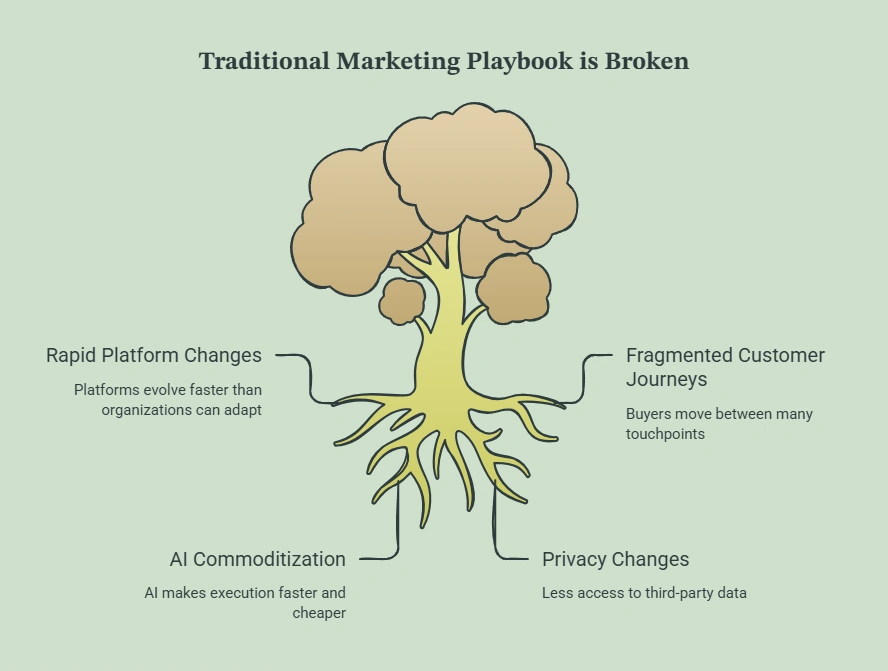
A conventional digital marketing plan assumes that channel mechanics will remain reasonably stable throughout the planning period.
In reality, the platforms can change targeting, bidding, creative generation, inventory, and reporting while your annual plan is still moving through stakeholder approval.
Google’s 2026 transition toward AI Max illustrates the problem. An April announcement initially said Dynamic Search Ads would begin automatically upgrading in September 2026. The June update moved the DSA sunset to February 2027 while retaining September 2026 upgrades for other legacy settings.
Google also reported that advertisers using AI Max’s full feature set saw an average of 7% more conversions or conversion value at a similar CPA or ROAS than those using search-term matching alone.
The issue is not whether AI Max is good or bad. A PPC team simply cannot treat a documented Google Ads configuration as a lasting source of competitive advantage. The configuration may change before the team has finished standardizing it.
The modern buyer journey rarely follows a clean, linear path.
In a B2B scenario, a decision-maker may encounter your company in an AI-generated answer, read an executive’s post, ask colleagues for recommendations, listen to a webinar recording, and return through an unbranded search weeks later.
On the other hand, your B2B playbook assumes that account-based approaches like a highly targeted LinkedIn campaign followed by nurturing thought leadership content will get the job done.
In fact, Gartner’s 2026 survey of 646 B2B buyers found that 67% preferred a rep-free buying experience, while 45% had used AI during a recent purchase.
This means much of the research shaping the final decision can happen outside the interactions your systems can directly connect to a known buyer.
Attribution becomes less precise at the same time leadership expects greater precision. This also widens the gap between marketing and sales because each team sees only part of the journey.
Your dashboards can assign credit to the final observable touch. However, they cannot reliably explain which combination of recommendations, content, searches, conversations, and AI-generated answers gave the buying group enough confidence to act.
Generative AI has dramatically reduced the effort required to produce acceptable first drafts.
Adobe reported in April 2025 that Firefly users had generated more than 22 billion assets in less than two years.
When nearly every competitor can quickly generate headlines, social posts, images, scripts, landing-page variants and email templates, production speed alone becomes a weaker differentiator. The substance behind the asset matters far more.
This does not mean that AI-generated content assets are worthless or that marketers shouldn’t use AI to speed up things. The problem is that the same tools also make successful ideas easier to imitate.
Plus, much of your visible execution is publicly searchable. Google’s Ads Transparency Center lets users search for verified advertisers by name or website and review their ads across different dates and regions.
Meta’s Ad Library provides similar visibility into ads running across its platforms. Its European transparency requirements provide additional details about ad timing, targeting criteria, and the audiences that received an ad.
These tools serve an important public-accountability purpose, but they also make it easy for competitors to inspect positioning, offers, formats and creative patterns across Facebook ads and other paid placements.
A competitor may not be able to copy the thinking behind your campaign. They can copy its visible execution within hours.
Privacy reforms have reduced the availability of the person-level tracking signals on which many familiar targeting and reporting systems were built. Since the iOS 14.5 privacy update, Apple has required apps to obtain permission before tracking a user across other companies’ apps and websites.
Opt-in rates vary depending on the app category and how they are calculated. However, Adjust reported that 35% of users who were shown the tracking prompt granted permission in the second quarter of 2025.
.webp)
This means even under this relatively favorable denominator, most prompted users did not grant tracking permission.
This is a positive step for user control, but it changes what marketers can responsibly promise through attribution. You can no longer assume that every interaction will connect neatly to a known person or campaign.
That creates a dire need for first-party data, clearer consent practices, and better integration between your website, product systems, and customer relationship management (CRM) platform.
Measurement still matters. It simply has to rely less on complete user-level visibility and more on consented data, experimentation, aggregated signals, and evidence gathered across multiple systems.
Static playbooks are being replaced by adaptive marketing systems. These systems give your team a clear strategic direction while allowing plans, budgets, and execution to evolve as new evidence appears.
A dynamic operating model has six connected components.
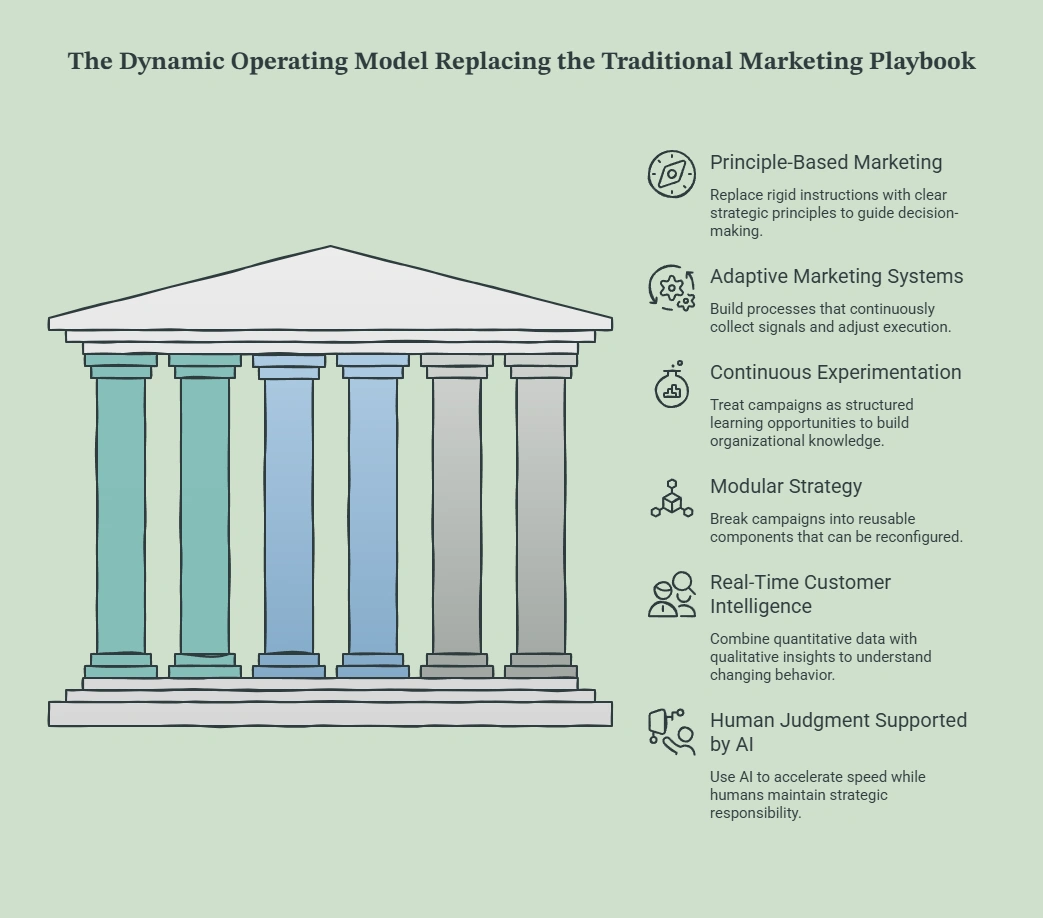
A playbook tells your team what to do in a known situation. A principle helps them decide what to do in a situation the company has never encountered.
Good marketing principles are specific enough to resolve real trade-offs. Examples might include:
P&G provides a useful illustration of this distinction. The company has described itself as willing to change “anything and everything” required to compete, except its purpose, values and principles.
Your principles should sit above SMART goals and channel plans. Goals define what your team expects to achieve within a set period. Principles guide how the team pursues those goals when platforms, evidence, or customer behavior changes.
An adaptive marketing system continuously moves through four activities:
This is different from making reactive adjustments whenever a dashboard turns red. Your team should define clear thresholds, decision rights, and approval requirements in advance.
For example, you might allow budgets to move automatically between approved campaigns when performance crosses a set threshold. Larger decisions, such as entering a new market, changing brand positioning, or revising the pricing proposition, would still require leadership approval.
Traditional plans treat testing as a campaign phase. But a learning engine treats experimentation as a permanent management capability.
Booking.com is a good example of experimentation embedded in the very culture. The company has reported running more than 1,000 concurrent experiments across products and audiences at a given time.
Its culture of experimentation allows teams to test changes with real users rather than relying solely on seniority or opinion.
However, experimentation also has limitations. An A/B test can optimize a page while weakening the overall sales narrative, reward short-term clicks at the expense of qualified pipeline, or produce a false positive when teams test too many variations. Teams that test too many variations can also mistake a false positive for a meaningful finding.
Your KPIs therefore need to include commercial outcomes and clear guardrails alongside the metric being tested.
Don’t ask, “Did the test win?” Instead, ask “Which assumption became more or less credible, and what decision changes because of that?”
A rigid playbook is difficult to update because its components are tightly connected. A change to one part can force your team to revise the entire system.
A modular strategy separates the elements that should remain consistent from those your team can adjust as platforms, algorithms, and audience behavior change.
The stable core normally includes:
Modular components may include:
Modular content systems make experimentation more manageable because your team can test one component without rebuilding the entire strategy.
Similarly, they make localization attainable. The strategic core keeps the message consistent, while modular elements allow your team to adapt the language, examples, formats, and channels for different audiences and markets.
Read Next: How to Localize Creative Without Losing Brand Codes
Traditional research and planning processes create a timing problem. Customer behavior may have changed again before your team compiles the findings, presents them to stakeholders, and incorporates them into a plan.
The problem is clear on social media, where audience interests and conversations can shift within hours. A fixed content calendar cannot always tell your team which developments deserve attention or how the brand should respond.
Real-time customer intelligence reduces the distance between a meaningful signal and an informed response.
Signals can include:
Axis Bank provides one example of this approach. The bank used Adobe Target and connected customer data to create more relevant experiences within its mobile app.
Adobe reports that these efforts produced a 15% to 25% uplift in conversion, a 12% to 18% uplift in revenue, and influenced 20% to 30% of new product applications initiated through the app.
The gist is that near-real-time consumer intelligence helps your team do more than personalize messages. It allows you to recognize meaningful changes, decide which ones require action, and respond while the opportunity is still relevant.
AI can help your organization process more signals, compare more options, and prepare execution faster. But human experts should still make the final call when decisions involve brand reputation, customer trust, legal risk, or significant commercial consequences.
Many marketing teams responded to the generative AI boom by adding AI tools throughout planning, content production, and performance analysis. The efficiency gains are real, but faster execution cannot rescue a weak strategy.
And that’s exactly where human expertise comes in.
Human judgment remains essential because someone still needs to interpret context, challenge flawed assumptions, and decide which outputs are safe and commercially sound.
One study on the use of AI in economic research showed the importance of human involvement in preventing errors. In 280 AI-assisted research runs, an unconstrained multi-agent system experienced critical failures in 72% of runs. Adding deterministic data processing and three human decision gates reduced the failure rate to 16%.
In the context of marketing, workflow architecture and human checkpoints can matter as much as the underlying model.
The marketing playbook isn’t inherently bad. Templates, standards, and documented processes still matter for onboarding, compliance, and repeatable execution.
What leaders must abandon is the assumption that last year’s successful tactic should dictate the next decision.
Your marketing strategy should preserve positioning, customer promises, and commercial guardrails. But you should treat the channel mix, creative direction, and the conversion plan as hypotheses that can change in light of new evidence.
This is why at Fieldtrip, we’ve cultivated a culture of constant learning through creative testing, campaign monitoring, brand tracking, and competitive intelligence. Each capability helps your team learn faster, respond with greater confidence, and keep execution aligned with the wider strategy.
Marketing has changed dramatically over the past few years. The teams that perform well are those that can recognize change, interpret it correctly, and act before the opportunity disappears.
If your current playbook is limiting how quickly your team can learn and respond, get in touch with marketing experts at Fieldtrip.
A marketing playbook usually defines the target audience, buyer persona, positioning, marketing channels, campaign workflow, responsibilities, KPIs, approved templates, and measurement rules.
The purpose of a marketing playbook is to align stakeholders and internal teams on consistent decisions, reduce repetitive work, and help new marketers execute proven processes more quickly.
Set business outcome-based goals, run controlled experiments, and document which assumptions each result supports or disproves. Include incrementality testing where possible, because it estimates what happened because of an activity rather than merely assigning attribution to an observed conversion.
Most teams need a CRM, analytics and experimentation tools, as well as channel platforms for actually running campaigns. AI-assisted research or production tools should also form part of the marketing technology stack. For B2B marketing, attribution tools are also super important.
%2520(1).png)