






















Enterprise B2B marketing requires a different level of strategy, coordination, and execution. Business buyers rarely act after one interaction. They research, compare options, involve multiple stakeholders, and weigh long-term value before moving forward.
This makes marketing harder for enterprise teams. Campaigns need precise targeting, strong content, clean data, and sales alignment to reach the right decision-makers at the right stage.
On top of that, the buying process adds more pressure. Gartner reported that 74% of B2B buyer teams experience unhealthy conflict during purchase decisions, which makes clear, stakeholder-focused messaging even more important.
In short, for teams managing ambitious growth targets and complex buying committees, the right B2B marketing agency can bring the expertise and execution support needed to build stronger demand programs.
In this guide, we have shared 10 of the most promising B2B marketing agencies, selected for their enterprise experience, B2B channel expertise, service capabilities, and client reputation.
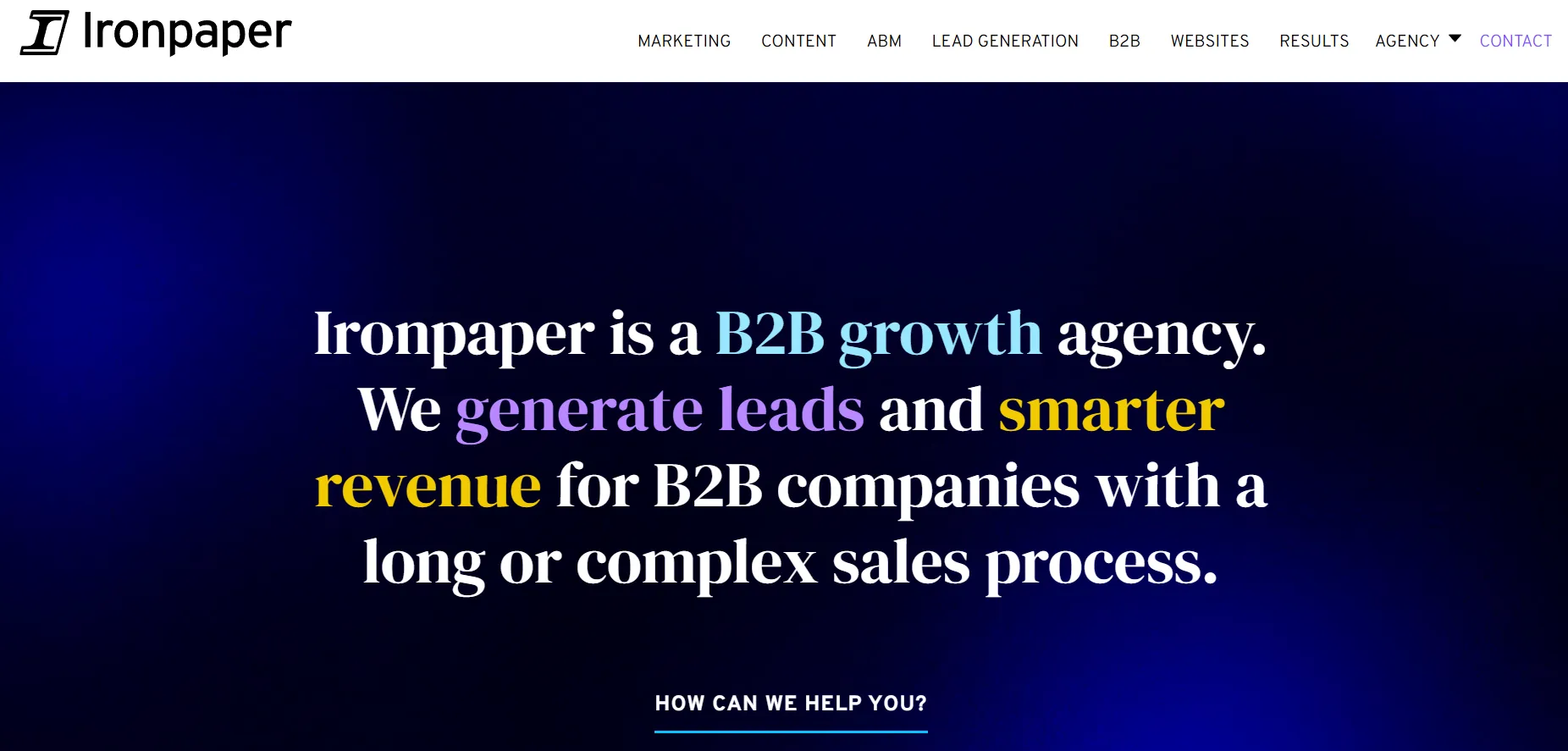
Ironpaper is a New York-based marketing agency serving enterprise and mid-market B2B companies seeking stronger pipeline outcomes from their marketing programs. As a growth-focused agency, it covers demand generation campaigns, account-based marketing (ABM) programs, B2B content, sales enablement, qualified leads, and broader marketing efforts that support sales success.
Its work is a strong fit for companies with complex sales cycles, where content marketing, paid media, conversion strategy, and sales nurturing need to work together rather than operate as separate programs. Ironpaper brings experience across sectors such as technology, healthcare, industrial, telecom, SaaS, and professional services.
One reported case study shows the scale of its impact. A telecom and IoT provider saw a 3,000% increase in lead generation after working with Ironpaper.
Pros:
Con:
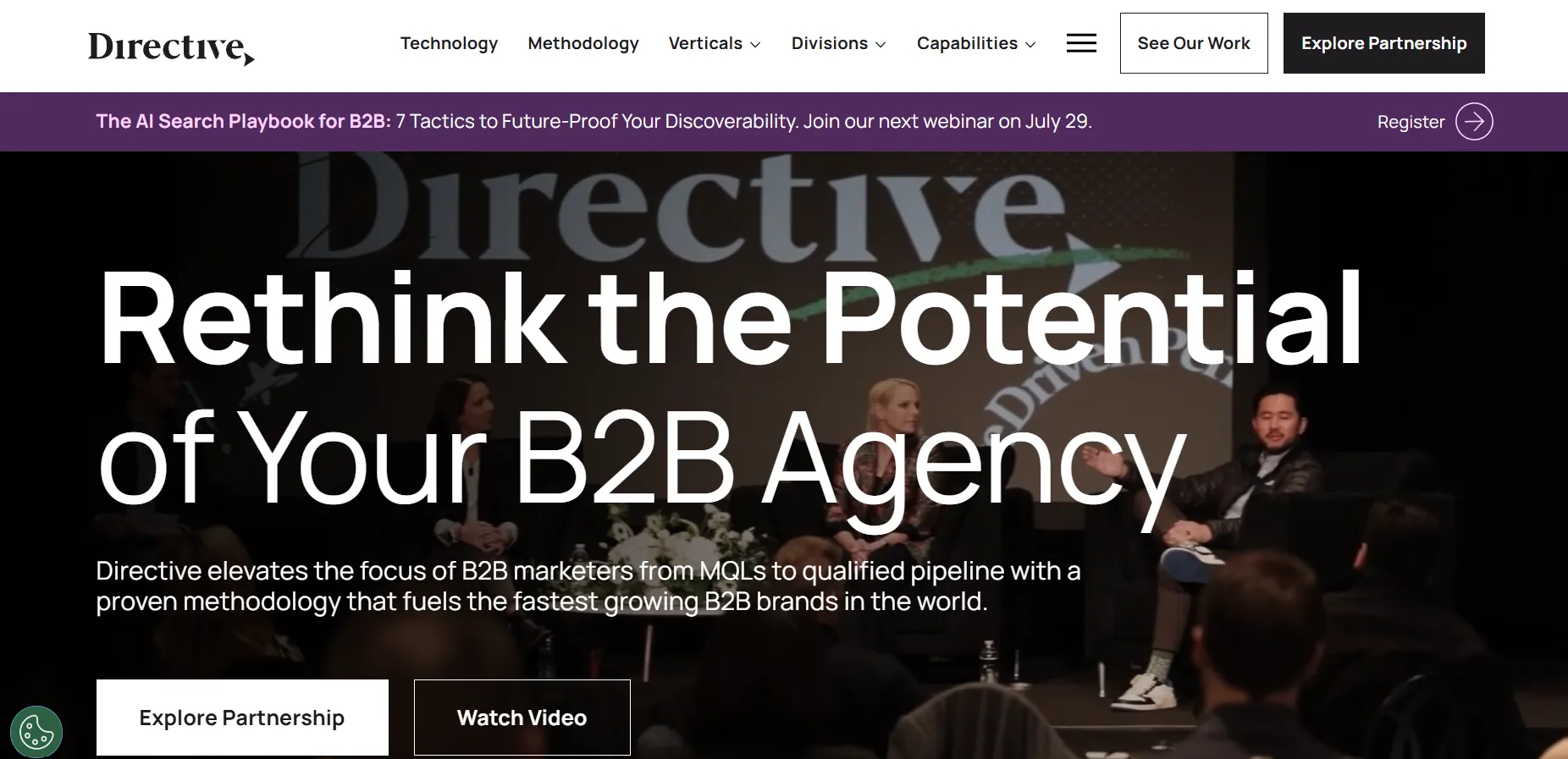
Directive has the most experience with B2B SaaS and technology companies. For instance, it helped Seagate Technologies increase organic traffic by 75%, and Skillable, another tech company, drive 50% pipeline growth.
The agency helps B2B teams move beyond MQL reporting toward a qualified pipeline. Its team includes 100+ marketing strategists, and it has worked with 420+ brands, including Cisco, Amazon, Gong, Redis, and Adobe.
Directive’s services cover full-funnel B2B growth across paid media, SEO, revenue operations, programmatic advertising, and marketing strategy. This makes it relevant for enterprise teams that need channel execution connected to measurable business outcomes.
Pros:
Cons:
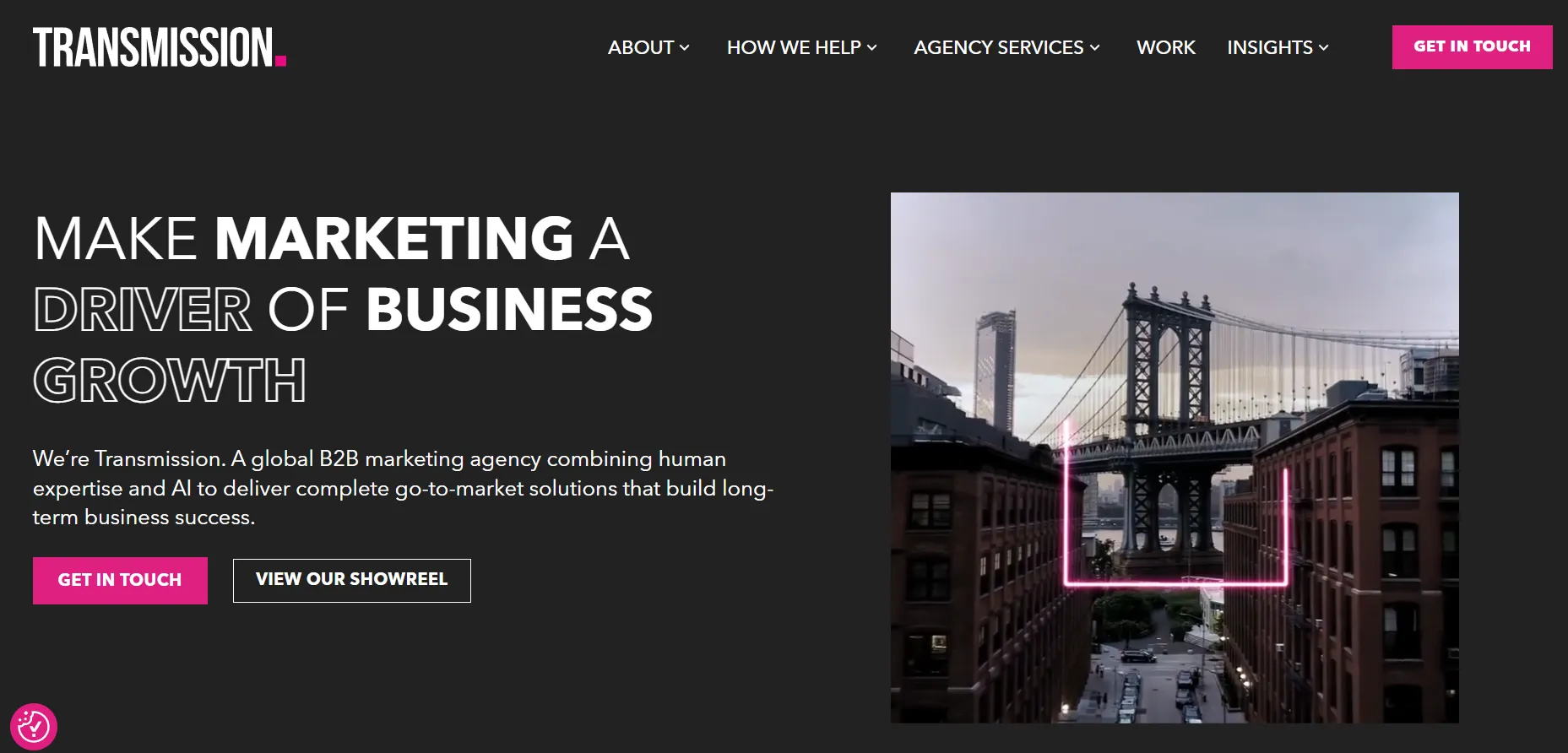
Transmission is a global B2B marketing agency built for enterprise brands that need strategy, creative, media, data, content, and go-to-market (GTM) execution under one roof. It’s among the largest global independent B2B marketing agencies, with 250+ employees worldwide.
We like how Transmission combines enterprise B2B expertise with AI-supported workflows while keeping strategy, creative, and go-to-market execution connected. This balance makes it relevant for brands operating across multiple markets, regulated categories, or long enterprise sales cycles.
Its services are relevant for large B2B companies that need help with growth consulting, brand experience, creative, content, paid media, data science, analytics, and demand conversion across multiple markets.
The agency can also be a strong strategic partner for new companies launching their product. In one campaign, Transmission helped Bricsys, a new player in CAD, see a 16% increase in downloads and a 4.13% conversion rate in paid search.
Pros:
Cons:
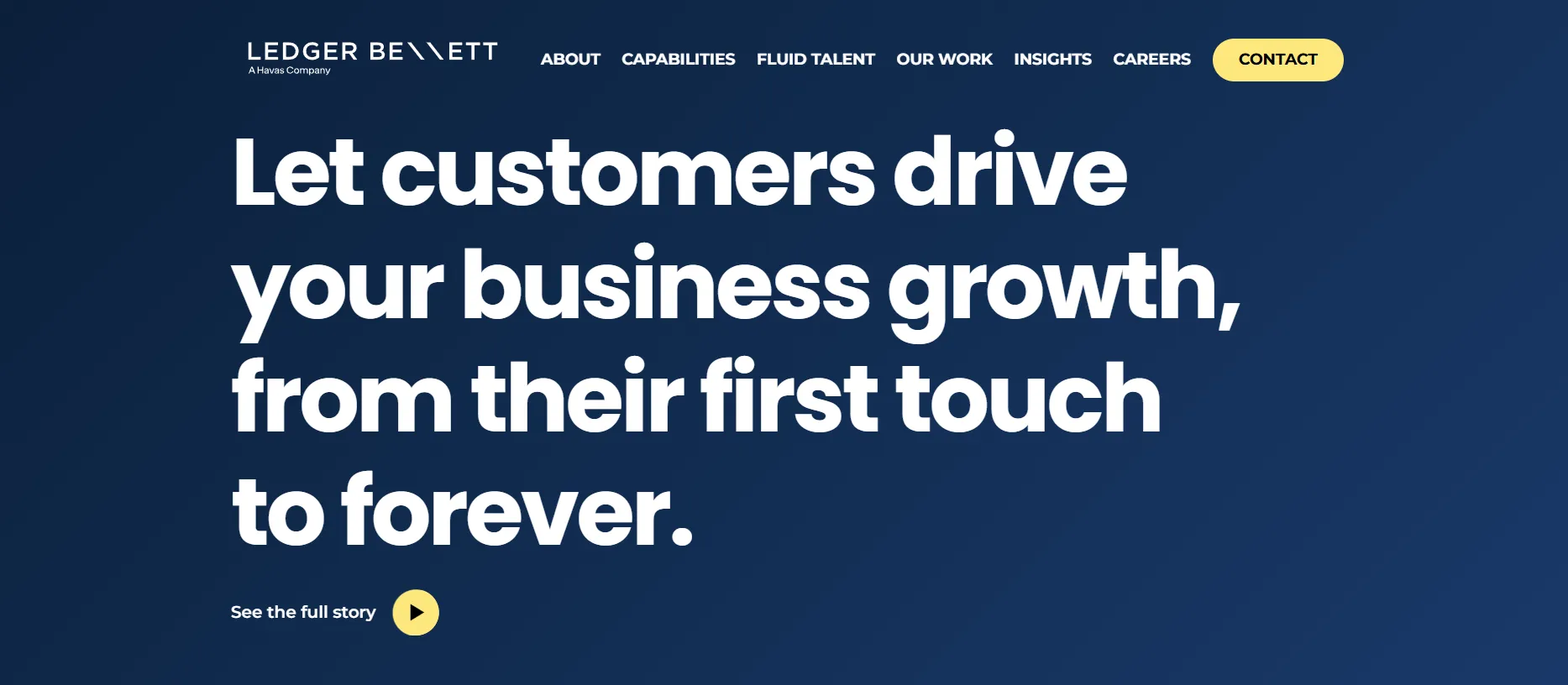
Ledger Bennett is a strong option for enterprise B2B companies seeking a full-service agency with a clear focus on revenue generation across the customer lifecycle. It’s recommended for B2B brands with high-ticket offerings that need complete support across strategy, campaign activity, content, and ABM.
Its “Forever Customer” concept makes it ideal for enterprise clients who don’t want marketing to stop at MQLs but want programs that support long-term revenue.
Havas acquired Ledger Bennett in 2024, and now the agency operates across EMEA, APAC, and North America.
It serves B2B clients across industrial, tech, and services categories, including big names like GE Digital and LinkedIn. For GE’s software product, the agency exceeded the agreed-upon benchmark, reaching 96% of targeted accounts.
Pros:
Cons:
Fieldtrip is a full-funnel marketing agency for growth-stage B2B companies that need creative, media, and measurement functions in one place. Its ecosystem also comprises specialist agencies in media buying, performance creative, influencer marketing, and attribution, all of which can collaborate for B2B marketing channels like organic search, AI search, and paid social.
Although the focus isn’t exclusively on the B2B sector, Fieldtrip’s expertise in creator-led marketing can be a good fit for brands looking to leverage executives, industry leaders, and analysts to nurture leads through thought leadership and highly targeted ad creatives. And its podcast planning and production arm can also run B2B podcasts that feed into the pipeline.
Fieldtrip’s work with Booksy shows its strength in social-first growth. For the booking platform, Fieldtrip used TikTok-native UGC to reach nail technicians, barbers, and other service professionals with pain points like no-shows, double bookings, and workload management.
The campaign drove a 1,700%+ increase in business registrations in 3 months, a 637% month-over-month jump in app installs, and a 92% drop in cost per business registration month over month.
Pros
Con:
Walker Sands is a U.S.-based B2B marketing specialist with an ‘outcome-based marketing’ approach. And with that approach, it tackles strategy, content, creative, strategic communications, and digital marketing (SEO, GEO, marketing automation, and paid media).
While there’s a strong focus on the technology sector, the agency also has experience in healthcare, manufacturing, and supply chain. Case studies show actual outcome achievement. For example, promevo, a Cloud service provider, saw $320K in pipeline generation.
It’s a viable choice for B2B companies that need integrated marketing and PR support instead of a purely performance-led or content-only agency.
The agency also expanded its demand generation capabilities through its 2023 acquisition of KoMarketing, which added deeper B2B digital marketing expertise.
Pros:
Cons:
New North is best suited for B2B technology companies that need a practical strategy-and-execution partner. The agency offers personalized marketing strategy, research, campaign execution, and ongoing analysis. Its services include branding and positioning, content creation, paid media, ABM, marketing operations, and sales enablement.
What we like about New North is how clearly it serves “small, scrappy” B2B tech teams that need more structure without building a large internal department. It feels like a strong fit for smaller or newer tech companies that need senior marketing thinking, steady execution, and flexible support.
The Maryland-based agency has a simple pricing structure, which is based on points, not hours. And those points are based on deliverables. This kind of model is unique and can be great for bootstrapped B2B startups with a limited marketing budget.
Pros:
Con:
NinjaPromo is a full-service digital marketing agency that may be a good fit for B2B companies looking for a flexible, subscription-based alternative to hiring separate teams for specific channels. Over 250 startups have already worked with this agency.
Its model is built around giving clients access to an integrated marketing team, with services covering marketing strategy, paid advertising, SEO, CRO, email marketing, PR, content marketing, web analytics, digital design, and AI marketing.
It’s not a B2B specialist per se, as it also caters to B2C brands. But it brings the most diverse experience across industries, with work spanning SaaS, financial services, crypto, healthcare, real estate, gaming, and other sectors. For instance, it helped Incit achieve over 20K downloads for its app at just $0.1 CPI on Google Ads.
Pros:
Cons:
Elevation Marketing is another full-service B2B marketing agency, ideal for companies that need help with strategy, sales alignment, and campaign execution. It covers virtually all types of marketing and advertising services, which can be good for B2B brands looking to maximize their channel coverage.
Elevation is useful for complex B2B companies in sectors like manufacturing, industrial, aviation, technology, healthcare, financial services, and professional services. Its demand generation approach is based on research, martech, buyer knowledge, tailored messaging, and high-value account targeting.
The agency has worked with brands such as Equinix, IBM, AWS, and Pfizer, which shows its ability to support enterprise-grade marketing programs. That makes Elevation a good match for companies with long sales cycles, technical products, and buying committees with several stakeholders.
Pros:
Cons:
Sköna is a Swedish-U.S. B2B creative agency for B2B technology companies that need sharper brand positioning, stronger creative, and a more memorable market presence. It brings over two decades of experience and combines tech with human expertise.
It is better suited for companies that need brand strategy, messaging, visual identity, campaign ideas, website experiences, motion, and creative systems. Since its design methods are rooted in Scandinavian minimalism, it can help complex B2B products feel clearer and more differentiated.
Its Snowflake case study shows how the agency can support a long-term strategic partnership that moves from demand generation into broader brand-building, engagement, and enterprise credibility.
Pros
Cons
P.S. Need help with a creative agency partner? Learn what makes a creative agency the right partner for enterprises.
Arketi Group is an Atlanta-based B2B marketing specialist that integrates PR and marketing into a single, conversion-focused system. It also has extensive experience working with leading B2B companies across verticals such as enterprise software, cybersecurity, medical tech, fintech, business services, and energy.
Most of its work seems more project-focused, like GTM, market expansion, and thought leadership campaigns. But almost all examples have clear results. For example, Defensestorm, a cybersecurity solution, saw a 20% increase in leads.
The agency says it helps B2B tech companies engage audiences, fill the funnel, and convert prospects into customers. But that’s not all, as it also covers creative with strategic branding, messaging, and product marketing.
Arketi is recommended for challenger brands and established technology companies that need to explain complex products, strengthen market credibility, and support revenue growth.
Pros:
Con:

UnboundIA is a B2B marketing company that connects branding and marketing to revenue. More importantly, it’s a good fit for B2B companies that want brand, demand generation, ABM, and revenue operations to work as one connected growth system.
Its solutions cover GTM strategy and consulting, marketing and revenue ops, brand and content, demand generation, ABM, and channel or partner go-to-market. This makes it relevant for enterprise teams trying to connect strategy with execution.
UnboundIA’s strength is its focus on pipeline movement rather than lead volume alone. Its demand generation approach is built around integrated programs across media, creative, content, partner activity, and paid channels. And there’s a clear emphasis on qualified pipeline.
Pros
Con:
We recommend looking for B2B agencies that match your specific requirements, sales cycle, and target buyers. We believe the strongest agencies do more than run campaigns. They understand how enterprise buyers research, compare options, and move through complex buying committees.
We also suggest looking for strategic depth across channels like traditional search, AI search, paid search, LinkedIn, and ABM. Most importantly, your agency should connect marketing and advertising activity with pipeline, revenue, and customer growth.
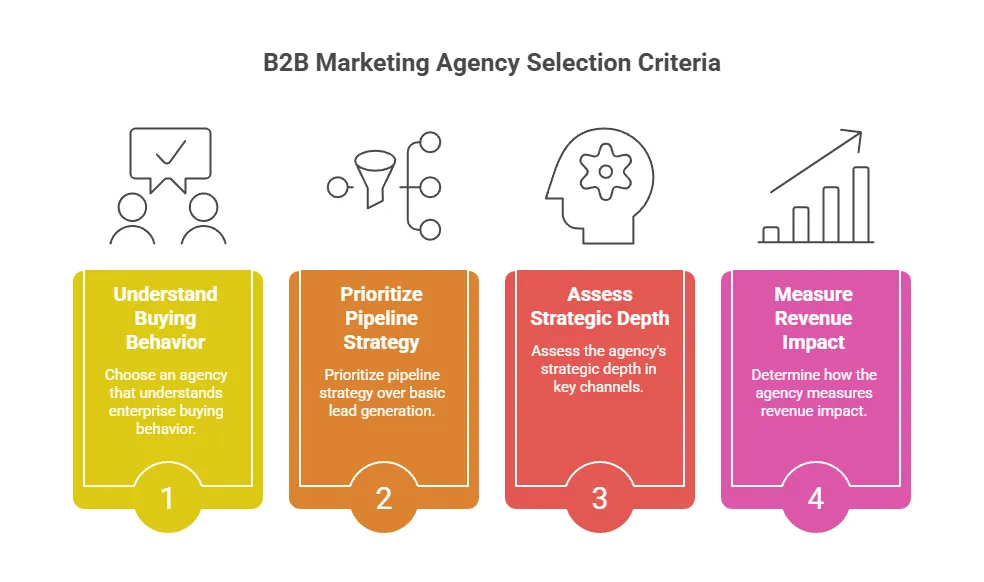
Here’s a more detailed description of what exactly to look for when deciding which B2B advertising agency to work with:
Enterprise B2B marketing is not built around one decision-maker. It has to influence a full buying committee that may include executives, finance, procurement, IT, legal, technical users, and department leaders.
In fact, data from LinkedIn shows that B2B buying committees typically include 6 to 10 people and can reach up to 20 in some cases. This means your B2B marketing agency should know how to build programs for multiple stakeholders, not just one buyer persona.
For example, if you sell into high-tech industries, healthcare, higher education, or other complex B2B categories, your agency should be able to create marketing content for both strategic and technical audiences.
A CFO may care about CAC efficiency and long-term business success, while a technical buyer may need product documentation, demos, whitepapers, comparison pages, or technical training program content. The right agency should understand how these different business buyers interact across the full sales cycle.
Lead generation matters, but enterprise teams need more than contact volume. Form fills, webinar registrations, and low-intent leads do not always translate into real opportunities.
Look for an agency that can build a qualified pipeline, support sales enablement, and connect campaigns to revenue goals.
When evaluating a B2B marketing agency, we recommend asking how it integrates demand generation, account-based marketing, paid media, content marketing, email campaigns, content syndication, and sales consultation into a pipeline.
Enterprise companies need help with bigger questions than campaign execution.
A strong marketing agency should be able to support:
Basically, they should have the expertise and knowledge to drive big changes that ultimately move the needle.
This is crucial when leadership teams are under boardroom pressure to show revenue growth while improving efficiency.
For instance, an agency that only offers pay-per-click or content creation may help with short-term acquisition channels, but it may not be able to diagnose whether the real issue is poor buyer fit, unclear messaging, weak category positioning, or misalignment between marketing and sales.
Enterprise marketing leaders need to defend ad budgets, retainers, and agency investments. Of course, this means you need a partner who reports the actual revenue impact of marketing spend (preferably in great detail).
In practical terms, the agency should be able to report on engagement, lead quality, pipeline contribution, sales cycle movement, CAC efficiency, attribution, and revenue goals.
It should also be able to work with your automation space, CRM, and performance marketing dashboards to show what is actually working.
A good agency should also be honest about measurement limitations. Not every touchpoint in a long enterprise sales cycle can be perfectly attributed, especially when buying committees engage across multiple channels and devices. That said, the agency should still have a practical measurement model that connects marketing programs to pipeline growth.
Before you sign with a B2B marketing agency, you need to understand how they think, how they measure success, how they work with enterprise teams, and whether they can support your revenue goals across long sales cycles.
These questions can help leadership and marketing teams separate a tactical vendor from a true enterprise growth partner.
1. What types of enterprise B2B clients have you worked with before?
Ask for examples that match your industry, sales cycle, deal size, buying committee, and GTM motion.
2. How do you define success for a B2B marketing program?
In our opinion, if an agency is only talking impressions, clicks, traffic, or form fills, they’re not revenue-focused. Your potential partner should be able to connect campaign performance to qualified leads, demos, sales opportunities, pipeline growth, and revenue.
This matters for enterprise companies where marketing programs must support sales teams and account executives.
3. How do you approach ICP and buyer persona development?
Enterprise B2B companies usually sell to several stakeholders across one buying committee. Ask how the agency identifies buyer fit, maps business buyers, understands complex buying committee behavior, and builds messaging for each role.
Their answer should go beyond basic buyer personas and show how they turn ICP expertise into content strategy, paid media targeting, ABM, and sales consultation.
4. How will you align with our sales team?
Revenue alignment is one of the biggest factors in enterprise marketing success. Ask how the agency will work with sales leadership, account executives, RevOps, and customer-facing teams.
5. What channels do you recommend for our stage of growth?
The agency should not recommend the same channel mix for every client. Ask how they evaluate acquisition channels such as organic search, PPC, social media, email campaigns, webinars, affiliate marketing, and AI search.
6. How do you build and test messaging?
For enterprise B2B companies, messaging has to work across executives, technical buyers, procurement teams, and end users. Ask how the agency tests brand positioning, value propositions, creative concepts, landing pages, and marketing content.
7. What is your approach to content marketing?
Ask how the agency develops a content strategy that supports awareness, demand generation, lead generation, sales enablement, organic search, AI visibility, and category education.
Remember: the best agencies can create thought leadership, whitepapers, infographics, product pages, comparison pages, case studies, and original proprietary research that helps business buyers move through the sales cycle.
8. How are you adapting to AI search and generative AI?
We believe AI discovery is becoming more important for B2B marketing. Inquire if they consider AI Overviews, AI-generated answers, structured data, and overall AI visibility important. Their answer should show they understand how search engines and AI tools are changing the way enterprise buyers research vendors.
9. How do you measure attribution and pipeline impact?
Attribution is difficult in enterprise B2B because buyers interact with many channels before speaking to sales. Ask what attribution model the agency uses, what tools they work with, and how they connect marketing engagement to pipeline and revenue.
10. What does your engagement model look like?
Ask how the agency structures its retainer, communication rhythm, reporting cadence, planning cycles, and approval process. You should know how frequently you will meet, how fast they can turn around work, how they handle urgent requests, and how they manage collaboration with internal stakeholders.
11. How do you handle compliance, brand governance, and approvals?
Enterprise marketing involves legal review, brand architecture, regional teams, product teams, and compliance requirements. Ask how the agency manages approvals, version control, brand guidelines, regulated content, and stakeholder feedback.
12. How will you improve performance over time?
Enterprise marketing partnerships should become more valuable as the agency learns more about your audiences, buying committee, sales cycle, and acquisition channels. Ask how they review performance, optimize campaigns, test new ideas, improve CAC efficiency, and adjust strategy based on results.
Note: Answers to all of the above questions should give you a clear idea of which agency partner best fits your goals and has the potential to solve your specific marketing problems.
At Fieldtrip, we’re ready to answer your questions and show you exactly how our B2B marketing team can help you attain growth with both new and existing clients.
Schedule a meeting with our B2B marketing experts
At the enterprise level, a B2B marketing agency can cost anywhere from $10,000 to $30,000+ per month, depending on the scope, seniority of the team, number of channels, content volume, and reporting complexity.
A B2B marketing agency can support marketing strategy, demand generation, lead generation, account-based marketing, paid media, content marketing, SEO, AI search visibility, email campaigns, marketing automation, sales enablement, attribution, and campaign success analytics.
For enterprise B2B partnerships, a monthly retainer with performance- or milestone-based incentives is usually the strongest model because it provides the agency with enough stability to support long sales cycles while still tying part of the relationship to outcomes.
The most important B2B growth channels are usually organic search, generative engine optimization (GEO), LinkedIn, email campaigns, webinars, and account-based marketing.