

























Most marketing rosters were built for coverage: one vendor made the creative, another bought the media, and a third measured the results. That structure worked when channels and responsibilities stayed relatively separate.
Today, the same ad has to feel native in a feed, sound credible in a creator’s voice, and perform inside an auction that rewards constant iteration. Yet the teams shaping each part often sync only when the monthly deck arrives.
That gap is getting harder to ignore. Ebiquity’s 2026 Media Budgets Report found that 66% of marketers plan greater integration between creative and media.
An integrated marketing agency closes that gap by putting creative, media, and measurement behind one brief, one feedback loop, and one set of numbers.
Let’s see how it works.
P.S. If you'd rather see the model than read about it, here is how Fieldtrip's ecosystem works.
An integrated marketing agency is one partner that plans, produces, buys, and measures against a single brief and a shared performance framework. That is an operating model, and the name on the door doesn't guarantee it.
The model brings omnichannel capabilities under one plan, so social, search, video, and creator content answer to the same message and the same reporting. It differs from a holding company, which owns many agencies under one parent, and from a specialist roster, where each vendor holds one function. Fieldtrip's integrated marketing services page lists what the work covers.
Not always. Some full-service agencies run strategy, creative, and media as separate departments with separate targets. Others work from one plan. The test is whether a result in one function changes the next decision in the others.
Growth slows because each vendor optimizes its own metric on a delay, and the gaps between vendors belong to no one. Four mechanisms drive the loss.
Creative written without media data is a guess about attention. The brief arrives with a persona and a message, but without the hook that held viewers on which placement last month. Omnichannel messaging then gets drafted for every channel at once and tested properly on none.
NCSolutions and Nielsen studied about 500 FMCG campaigns and found that weak creative produced weak sales lift, and that lift was credited mostly to media. Strong creative lifted results and depended less on media. The data is from 2017, and the mechanism still describes what media buyers see today.
Fatigue adds a clock. Meta describes it as performance declining because people have seen an ad too many times, and says it affects every ad eventually. In our experience, a replacement brief starts only after the media vendor reports the decline.
A media buyer can change budgets, bids, audiences, and placements, and our guide to how media and creative lift ROAS covers why those levers only go so far. A media buyer can't change what the ad says. When the problem is the message, the levers a media-only vendor holds treat symptoms: CPMs, frequency caps, audience exclusions. The account looks busy and the cost per result stays exactly where it was, quarter after quarter.
Independent measurement can strengthen accountability, especially when the same agency also buys media. The problem starts when the measurement team receives channel outputs without the decisions behind them. A new hook, changed offer, or audience shift may move acquisition cost, yet the analyst sees only the resulting numbers. Multi-touch attribution and marketing mix modeling already answer different questions; when measurement sits outside the feedback loop, those differences can turn into competing explanations instead of a shared view of what changed.
Every handoff compresses context into a document, so a finding from week two reaches the next brief in week eight or never arrives. A decision one team could make in an afternoon becomes a request, a ticket, and a call with a different company.
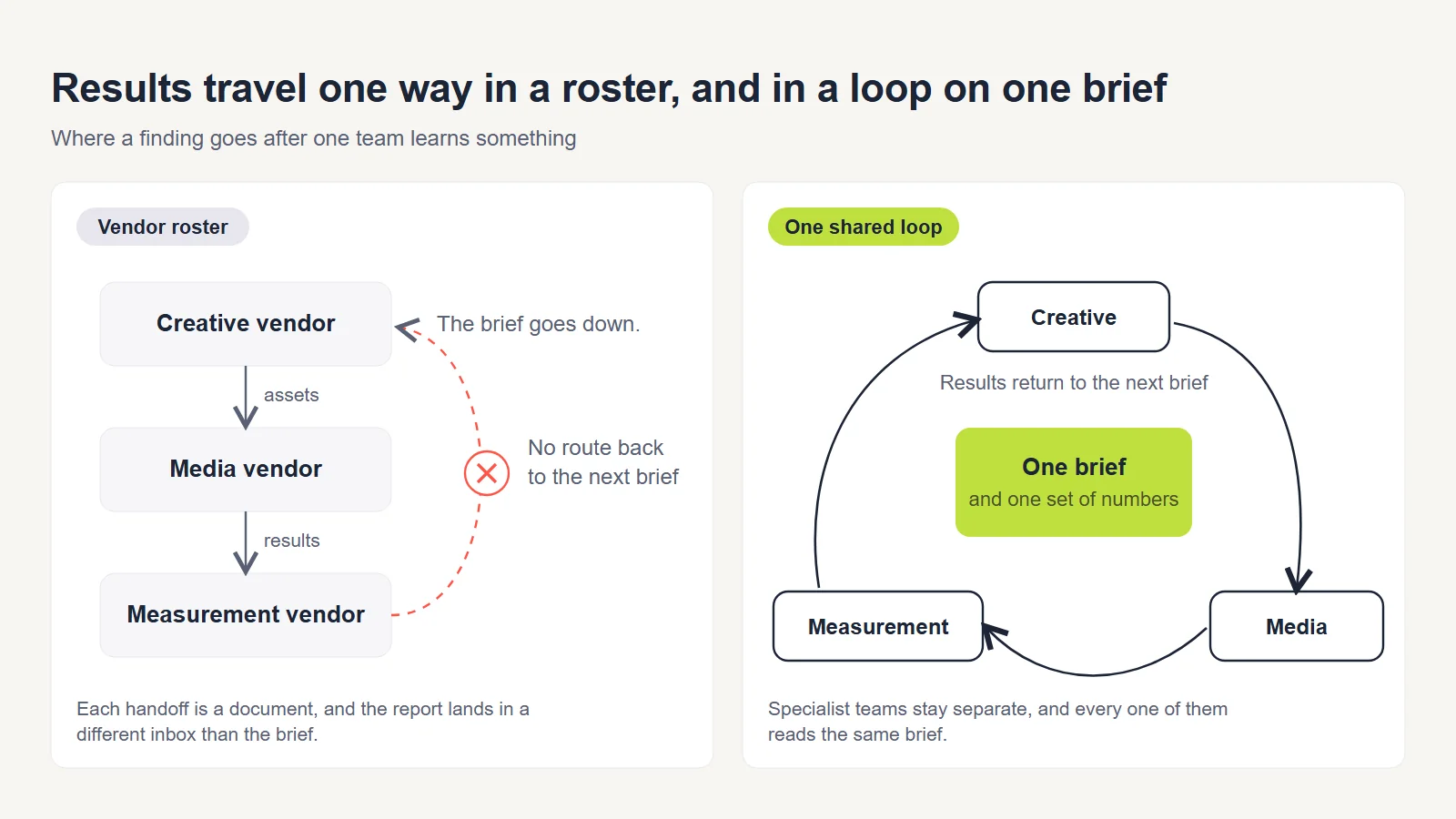
The table shows what each handoff loses and who notices first.
| Handoff | What gets lost | Who sees it first |
|---|---|---|
| Strategy to creative | Why the audience was chosen and which trade-offs were set aside | The creative team, when the first concepts miss |
| Creative to media | The intent behind each variant and which one was the hypothesis | The media buyer, when results arrive with no plan for reading them |
| Media to measurement | Audience and placement changes made mid-flight | The analyst, when the numbers don't reconcile |
| Measurement to strategy | What the data says about the message, beyond the channel | Often no one, because the report and the brief go to different inboxes |
An integrated marketing agency offers the shortest path from a result to the next brief. A specialist roster offers the deepest craft in each channel, a holding company offers one commercial relationship, and an in-house team offers control. The right choice depends on who in the organization can act as the integrator.
| Model | Who owns strategy | Handoffs and speed of learning | Accountability | Works best when |
|---|---|---|---|---|
| Integrated marketing agency | One brief owned jointly by the agency and the client | Few; results reach the next brief in the same planning cycle | One partner | Creative, media, and measurement need to move together |
| Specialist roster (channel experts) | The client or a lead vendor | One at every vendor boundary; learning moves as fast as the client carries it | Split by function | A strong internal integrator directs a few high-spend channels |
| Holding company | The parent group, usually through a lead agency | Fewer contracts, though the internal matrix can keep several teams | One contract shared across agency brands | Large global accounts want one commercial relationship |
| In-house marketing department | Internal leadership | Few; limited by headcount and specialist depth | Internal | Channels are stable and the internal bench is deep |
| In-house department with fractional CMO leadership and specialists | The fractional CMO | Depends on how well specialists are briefed | Fractional CMO for strategy, specialists for execution | A smaller team needs senior direction without a full-time hire |
Consolidation is moving fast at the top of the market. In February 2026, The Drum reported that Bayer Healthcare consolidated nearly $800 million in media and creative business into IPG in 2025, and that Jaguar Land Rover moved a $500 million creative and media account to WPP in January 2026.
Fewer contracts don't automatically mean integrated work. AKQA's founder Ajaz Ahmed told The Drum that the holding-company matrix has been formalized into hierarchies, and that each layer still needs its own leadership, coordination, and reporting.
Agency size changes the picture as well. Our view: pick the integrated model when the business problem sits between functions, and pick specialists when it sits inside one.
Hurom shows what that difference looks like in practice when creative decisions and performance data stay inside the same feedback loop.
Hurom provides a concrete example of the integrated model described above. The program brought creator-led creative, iterative testing, paid performance, and search into the same learning cycle, with results feeding back into the next round of creative decisions.
The original case study was published by inBeat, Fieldtrip's creator and performance marketing team.

Hurom's cost per acquisition was rising because of creative fatigue and outdated, overly promotional ad designs. Profitability was low, since marketing costs had increased while return on ad spend stayed weak. The brand also leaned on promotional discounts and sales-driven messaging to hit its sales targets. In our reading, the problems reinforced each other: discount-led creative fatigued while acquisition costs continued to rise.
The first change was the message. The program shifted from an always-on-sale approach to health-focused messaging that spoke to concerns such as gut health and skin issues. Creator-made UGC carried the new message, with the aim of making the brand more relatable and more trustworthy.
A dedicated creative strategist then analyzed what made the UGC work: the hooks, the variations in calls to action, and the social proof. The goal was to turn those findings into the next round of UGC briefs rather than leave the learning inside the media account.
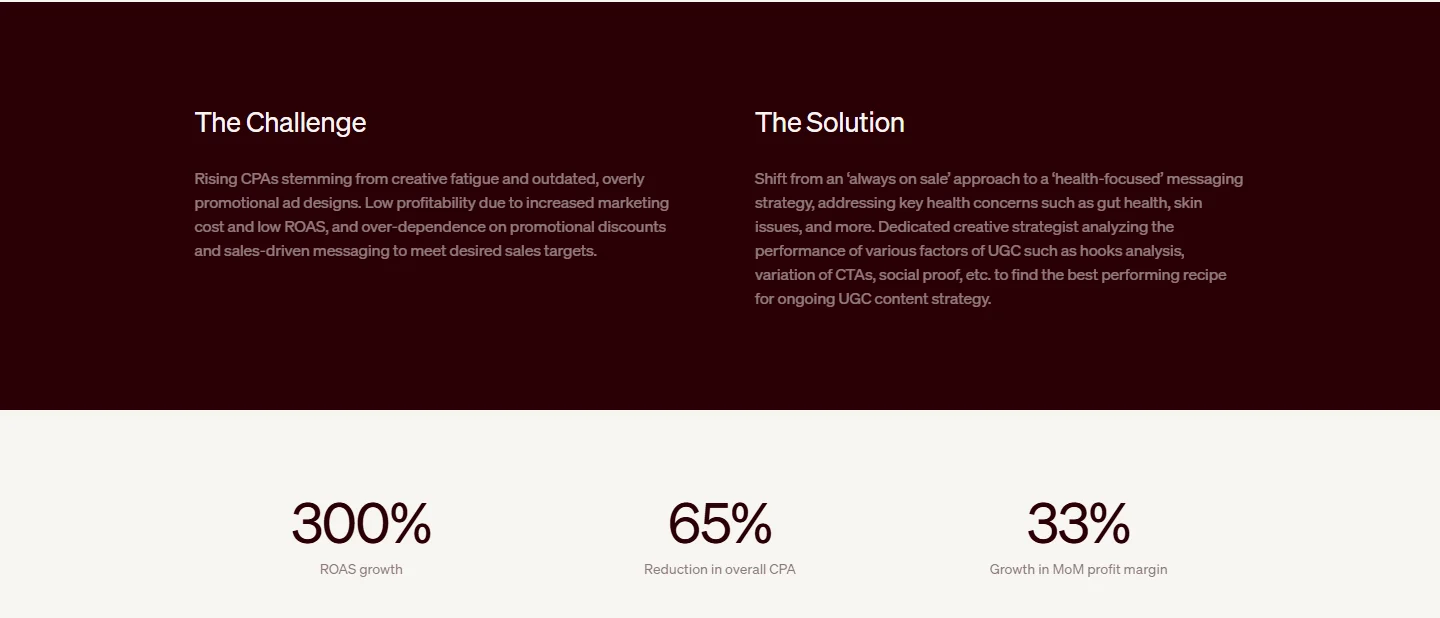
Cost per acquisition is a paid media number, yet it improved alongside a change in creative strategy. That is the point where the functions meet. In our reading, test results had to travel from the ads back into the next brief, and the strategist's hook, call-to-action, and social proof analysis did that.

The case study also reports month-over-month profit margin alongside ROAS and CPA, adding a profitability check rather than judging the program on acquisition cost alone.
| Metric | Published figure |
|---|---|
| Cost per acquisition | Overall CPA reduced by 65% |
| Return on ad spend | ROAS growth of 300% |
| Profit margin | Month-over-month profit margin growth of 33% |
These figures come from inBeat's published case study, and Hurom is a client of the network. Treat them as campaign-reported numbers. The mechanism transfers more reliably than the percentages, because a brand with a different starting point starts from different numbers. Full case studies from across the network are available on our work page.
A roster slows growth when the same questions keep crossing company lines. The patterns below show up before the numbers do, and each one has a quick check.
| Pattern | What it usually means | What to check |
|---|---|---|
| Reports from different vendors disagree on the same metric | Each vendor uses its own conversion definition or attribution window | Compare definitions and windows before comparing results |
| Every new vendor kickoff repeats the same background | Strategy lives in decks, with no shared brief | Whether one current document explains audience, offer, and goals |
| No one owns the customer journey end to end | Each vendor owns a stage or a channel | Who can describe what a customer sees between the first ad and the purchase |
| Scope disputes over where one vendor's work ends | Contracts split by deliverable, with no shared outcome | Which tasks sit in no one's scope |
| Test results stay with the vendor that ran them | No shared learning log | Where creative test results are stored and who reads them |
| Strategy changes reach vendors in different weeks | Briefing runs vendor by vendor | How long a positioning change takes to show up in live ads |
The fifth row costs the most to fix later, and a shared testing log is the usual remedy; our guide to creative testing and measurement for large brands shows how to set one up.
Customer journey mapping is the quickest test of the third row. A team that maps the path from first ad to repeat purchase and finds three owners along it has found its answer.
Organizations that describe themselves as digital-first often still split ownership by tool, with one vendor for the ad platform, another for the site, and a third for email. The map shows where a customer crosses those lines and who is watching when they do.
Best-of-breed specialists win where domain knowledge decides the outcome, and an integrated agency can bring them in under one brief. Bain's analysis of agency consolidation from February 2026 tells CMOs to integrate tightly where it pays, in measurement, data, and workflow, and to keep creative excellence and brand voice distinct.
Rare disease expertise means knowing which claims a regulator permits and where patients and clinicians look for information. Public sector marketing and government relations work depend on procurement rules, election calendars, and stakeholder maps that a generalist team takes months to learn. A specialist in these areas is worth the extra handoff, provided the specialist works from the shared brief and reports into the same measurement framework.
Buyers in freight logistics and warehouse automation evaluate vendors through engineers and operations leads, so sector fluency counts before channel fluency. A writer who understands dock scheduling and slotting earns trust that a generalist can't. The integrated agency's job is to carry that voice consistently through paid, search, and sales content.
The integrated model adds the least where an in-house team already acts as the integrator. Bain makes the point directly: a brand that wants a lead integrator agency needs an internal integrator too. Where that role exists and works, specialists directed by the in-house lead can outperform a bundled partner.
Consolidation creates dependence, and Bain names four forms:
The evaluation questions below turn each into something to ask before signing.
Fieldtrip works in small, autonomous teams connected by shared strategy, which keeps the work focused and nimble without losing scale. Each team is built to work alone or beside a client's own people, and all of them work from the same plan.
Strategy comes first and feeds every other team. Our strategy work covers:
That output becomes the brief creative, media, and measurement all read, and it underpins the growth strategies we build for each brand.
A brand can start with the team closest to the problem and add others as priorities emerge. The specialist brands in the group cover creator and influencer programs, studio production and UGC, paid and programmatic media, and SEO. Design covers branding, design systems, and web design and development, the UX/UI Design behind the touchpoints a customer uses.
The work also moves off screens. Out-of-home and experiential marketing sit inside the same plan as the paid work, so an in-person activation answers to the same brief and reporting framework as a paid social campaign.
Knowledge moves between teams through shared planning, reporting, and review cycles, so media findings reach creative briefs and creative tests inform media plans. Measurement and Analytics owns the shared view, including attribution, creative testing, and funnel diagnostics.
Tooling matters here too: Gartner's 2025 survey found that only 49% of martech tools are actively used, and one shared stack is one way to avoid adding to that gap.
A long service list says little about whether an agency is integrated, so evaluate how it connects functions. The questions below separate a shared operating model from a bundle of departments.
| Question | What a strong answer includes | Warning sign |
|---|---|---|
| Who owns the brief? | One living document that the agency and client both edit | A new deck for every function |
| What is the one source of truth for results? | One dashboard, defined metrics, and a named owner | Separate reports per channel |
| How are creative and media budgets decided together? | A single planning meeting with test results on the table | Budgets set in different meetings by different people |
| Who owns data and assets if the relationship ends? | Written ownership terms with export formats | Silence, or "we'll work it out" |
| Who audits measurement when the agency also buys media? | An outside check on headline numbers or access to raw platform data | The buyer grades its own results |
| How is a specialist added or removed mid-engagement? | A defined process under the same brief | A new contract and a new kickoff |
| Which case study shows each function's contribution? | A program that names what creative, media, and measurement each changed | A single headline number with no mechanism |
Platform-reported and independently verified results are different things, and a credible case study says which it is.
Move in sequence, keep campaigns running, and let contract dates set the pace.
Marketing operations strategies are the internal counterpart to this plan. Someone on the brand side has to govern the workflow, the data, and the reporting rhythm, which is why marketing operations for enterprise teams deserves its own plan before the first vendor rolls off.
Integrated marketing agency pricing comes in three structures, a flat fee, a percentage of spend, or a base fee plus performance, and the scope sets the price. Budget and resource constraints are the top challenge for 63% of CMOs, according to Gartner's survey of 174 senior marketing leaders, so overhead gets scrutiny.
A fragmented roster carries duplicate account management, separate contracts, and separate reporting. Consolidation removes the duplication, though it doesn't lower fees on its own. Three structures cover most engagements:
The Hurom program changed the message and the testing together, and its published results followed. That is the model Fieldtrip runs: shared strategy, specialist teams, and one connected feedback loop. A brand can start with one team and expand as priorities grow.
Talk to Fieldtrip about how your current vendors connect. The first call covers where handoffs cost time, which team to start with, and what a first quarter could look like.
It should define each metric and attribution window in writing, give the brand access to raw platform data, and allow an outside check on headline numbers. The evaluation table above lists the question to ask. The contract wording is what makes the answer enforceable.
Creator-made UGC was the vehicle in this program, and the mechanism was the loop from message to testing to the next brief. That is our reading, and no one has measured it. A brand with strong product video or founder content could run the same loop on different material.
%2520(1).png)