






















A target’s growth story usually arrives as a deck: a revenue chart bending upward, screenshots of advertising dashboards, and a market-sizing slide borrowed from a syndicated report.
A buyer paying a multiple on that growth is really paying for demand that keeps arriving after the founder, the launch budget, and the introductory discount are gone.
The stakes are high. According to Harvard Business Review, companies spend more than $2 trillion on acquisitions every year, yet study after study puts the failure rate of mergers and acquisitions between 70% and 90%.
Marketing due diligence is the work of testing whether the growth you are paying for will last. It sits beside the commercial due diligence most deal teams already commission and goes further into how the company actually acquires customers.
This article sets out what to verify, in what order, which warning signs to escalate, and how to judge what the work is worth.
Marketing due diligence is the buyer’s check of whether a target’s growth engine can keep producing demand, revenue, and customers after the acquisition closes.
It applies the discipline of M&A due diligence, the structured check of what a buyer is actually purchasing before the price becomes final, to marketing. That is a different question from how large the market is.
As a marketing due diligence checklist, the work comes down to five tasks:
Watch: Why marketing due diligence is important for SaaS acquisitions?

Commercial due diligence evaluates market attractiveness, competitive positioning and customer demand. Marketing due diligence examines how a company acquires customers, what that acquisition costs, and whether its growth is sustainable.
Together, they help buyers assess both the market opportunity and the target company's ability to capture it.
Commercial due diligence answers whether the market is worth being in. It typically covers market size and growth, competitive position, customer segmentation and customer sentiment, often gathered through interviews and surveys of the target’s buyers and the wider category. A thorough B2B commercial scope will also look at product fit, brand perception and the quality of the commercial team.
What it rarely does is open the acquisition machinery itself: which channels produce customers, at what cost, through which measurement setup and with how much dependence on particular people.
Marketing due diligence picks up where that scope stops. It examines:
Market attractiveness says little about whether this particular company can capture the market, and the marketing workstream exists to answer that second question.
| Question | Commercial due diligence | Marketing due diligence | Typical source of evidence |
|---|---|---|---|
| How big is the market and is it growing? | Yes | Only as context | Secondary reports traced to primary sources, expert interviews |
| How is the target positioned against competitors? | Yes | Partly, through share of voice and pricing | Customer interviews, competitor review |
| What do customers think of the brand? | Yes | Yes, with emphasis on why they bought | Surveys, interviews, review data |
| Which channels produce customers and at what cost? | Rarely | Yes | Raw platform exports, CRM, finance reconciliation |
| Can the reported acquisition metrics be reproduced? | No | Yes | Tracking audit, attribution review, holdout tests |
| Does growth depend on specific people or partners? | Partly | Yes | Team and agency interviews, contract review |
Run both when digital acquisition accounts for a meaningful share of enterprise value. If paid search, social or affiliate channels drive most new revenue, a favorable market view without a channel-level audit leaves the buyer exposed on exactly the variable the price depends on.
Decide which of the table’s questions your current provider already answers and commission a separate workstream for the rest. Trademark, licensing and advertising compliance checks belong to legal diligence.
Build the data request list before exclusivity begins, with an owner and a deadline attached to each of the five stages below. The sequence matters because each stage produces the evidence the next one tests.
Ask for raw exports, since summaries hide the gaps: monthly platform spend and conversion data from each advertising account, CRM records with acquisition source and date, monthly customer cohorts with revenue and churn, and the finance ledger that recognizes that revenue.
The deliverable is a reconciled dataset in which the marketing team’s customer counts and the finance team’s revenue agree, or a documented list of where they do not.
Break monthly acquisition into its components and separate genuine market pull from temporary spikes driven by promotions, launches, or one-off spend.
Overlay the promotional calendar, product launches and monthly media spend on the new-revenue series. The deliverable is a baseline growth rate with the anomalies labeled and explained.
For each channel, chart cost, volume, and trend over at least the period covered by the growth story. Bring in specialists where the moat depends on a channel: a paid media analyst for auction-based channels, an organic search specialist where rankings carry the business, a partnerships reviewer where affiliates or resellers originate revenue.
The deliverable is a channel scorecard showing efficiency, direction of travel, and concentration.
Interview or survey a sample of recent customers about why they bought, what alternatives they considered, and how they found the company. Speak to the market as well, including lost prospects where access permits.
This stage tests the stories told by the deck and the dashboards against people who have no stake in the valuation, and it replaces syndicated market figures that cannot be traced to a source. The deliverable is a short research summary with sample size, method, and limits stated.
Translate everything into the four decisions the workstream exists to inform. A growth rate that falls materially once promotions are stripped out argues for a price adjustment. Dependence on one channel or one person argues for an earn-out, a retention agreement or a covenant.
Measurement gaps that cannot be closed before signing become the first items of a first-100-days marketing plan. Where the gap between story and evidence is wide enough, the finding is to walk away. The deliverable is a one-page memo listing each finding, the evidence behind it, and the decision it supports.
Timing should follow the exclusivity window. Stages 1 and 2 can begin the day the data room opens; stages 3 and 4 run in parallel once the reconciled dataset exists; stage 5 should land before the final price negotiation.

Red flags in due diligence are patterns that usually mean the reported picture is better than the underlying one. Score the target against the three families below, and escalate any item that cannot be cleared with primary evidence.
The first family concerns the growth line itself. Monthly recurring revenue, or MRR, that jumps in months with heavy discounting, a single large media burst, or one product launch describes the calendar, and says little about demand.
The same applies when customer counts rise while average revenue per customer falls, or when cohorts acquired during a promotion churn faster than the rest.
As a hypothetical illustration, a company that reports 40 percent year-on-year revenue growth but acquired a third of its new customers during two discount events has a very different underlying growth rate from one that grew each month steadily; the diligence task is to compute that second number before accepting the first.
The second family concerns where customers come from. Heavy dependence on a single advertising platform exposes the business to auction price inflation and policy changes outside its control.
On Meta alone, the average price per ad rose 12% year over year in the second quarter of 2026, so a target whose growth rests on one auction is buying the same customers at a steadily higher price.
Dependence on one affiliate or reseller means a contract renegotiation can reset the growth rate. Dependence on a founder’s personal following, a creator relationship, or a partner’s email list is borrowed audience, and borrowed audiences tend to leave with the person who lent them.
Rising cost per acquisition with flat or falling volume is the quieter version of the same problem: the channel has been mined, and the remaining growth is more expensive than the historical average implies.
The third family concerns the evidence itself. Market-sizing figures in the deck often trace to syndicated reports, and some of those reports give no verifiable primary source for the number.
The practical test is simple: follow the footnote. If the trail ends at another summary, treat the figure as unverified.
Reported return on advertising spend that cannot be reconciled to recognized revenue, or attribution that counts the same conversion in several channels so that channel totals exceed finance totals, belongs in the same category. So does knowledge that lives only in the heads of a few people or an agency whose contract ends at close.
| Red flag | What it usually signals | Evidence to request | Test to run |
|---|---|---|---|
| Revenue spikes aligned with discounts or launches | Promotion-driven rather than demand-driven growth | Promotional calendar, monthly cohorts, average revenue per customer | Recompute growth with promotion months normalized |
| One channel above half of new customers | Exposure to platform pricing and policy | Spend and conversion by channel by month | Model cost per acquisition if the channel’s cost rises materially |
| Founder or partner audience as main source | Audience leaves with the person | Traffic and lead source by referrer, partner contracts | Interview partners; check what remains under a change of control |
| Market size from syndicated report | Unverified addressable market | Original report and its methodology | Trace to primary source or commission primary research |
| Platform return exceeds finance revenue | Attribution double counting | Platform exports and ledger for the same months | Reconcile totals; flag channels whose sum exceeds recognized revenue |
| Key knowledge held by few people or an agency | Post-close execution risk | Organization chart, agency contracts, documentation | Interview holders; test whether a successor could run the channel from documents alone |
The red flags in the table extend the growth decomposition described by Advertising Week and the source-tracing argument made by Bell & Holmes, both cited above.
Verify reported marketing metrics by reconciling advertising returns with financial records, auditing the measurement infrastructure, and testing whether marketing spend generates incremental revenue.
Together, these checks help buyers assess whether the target's reported growth is reliable, sustainable, and supported by actual customer demand.
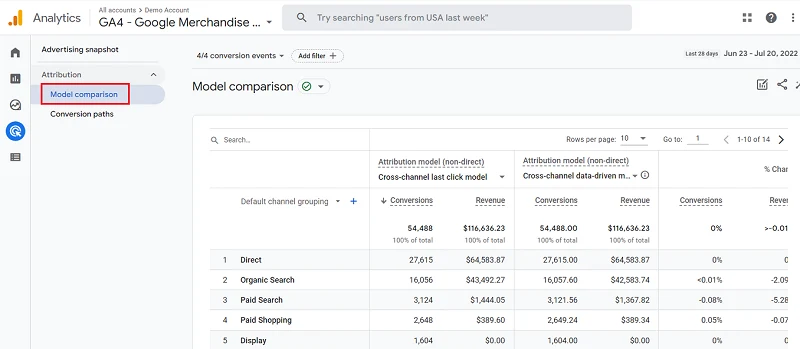
A return on advertising spend (ROAS) reported inside an advertising platform reflects that platform's attribution model. Different platforms may claim credit for the same conversion under their respective attribution rules, so their combined attributed revenue can exceed what the business actually earns.
Require a reconciliation covering the same reporting periods, with platform-attributed revenue compared against recognized revenue and new-customer sales recorded in the company's financial and CRM systems. Investigate unexplained differences by channel rather than accepting dashboard figures at face value.
Check whether reported customer acquisition costs include agency fees, creative production, promotional discounts, and other relevant acquisition expenses. A channel may look profitable in an advertising dashboard but deliver a weaker return once these costs are included.
Use reconciled financial and acquisition data, rather than platform-reported returns alone, to inform valuation assumptions.
Next, audit the setup that generates the numbers:
Tracking changes are common enough to matter: Meta told investors that Apple’s App Tracking Transparency prompt would cost it about $10 billion in 2022 revenue, and every advertiser measuring through those signals saw its reported numbers shift at the same time.
Marketing data is often the largest customer dataset the target holds, and its problems transfer to the buyer.
The UK Information Commissioner’s Office fined Marriott £18.4 million in 2020 over a breach of Starwood’s guest systems, after Marriott said it had only been able to carry out limited due diligence on Starwood’s data processing during the acquisition.
When breaches surface before signing, they move the price: Verizon cut $350 million from its offer for Yahoo’s core business after two large data breaches came to light. Treat gaps here as both a measurement problem and a liability question for the legal workstream.
Where paid media carries the growth story, reconciliation is still not enough. Reconciled revenue tells you what customers paid; it cannot show whether the advertising caused them to buy. Incrementality is the difference between what happened with the spend and what would have happened without it.
The cleanest way to estimate it is an experiment: a holdout in which a comparable group of users or regions is withheld from the channel for a period, or a geo test that varies spend across matched markets. The answer differs by business.
When eBay switched off branded search ads, 99.5% of that traffic still arrived through organic results; when Edmunds ran a similar test, less than half of it did. Only a test on the target’s own channels shows which case you are buying.
Our media practice treats this distinction between platform-reported and incremental return as central to planning spend, and it is equally central to pricing a business built on that spend.
An experiment takes weeks and needs the seller’s cooperation, so it may not fit before signing. In that case, the deliverable is a clear statement: what the available data supports, what it cannot show, and which experiment, run in the first quarter after close, would settle the open question.
Require at least one such test on the largest channel, and reflect the uncertainty in the price or structure until it runs.

The cost depends on three variables: how many channels need auditing, whether primary research is needed, and how compressed the exclusivity window is. There is no fixed fee range, because the cost depends on the deal, so a deal committee should weigh it against the exposure it covers.
The cost of skipping the work shows up later and larger:
Unverifiable market sizing is the clearest example: a price built on an addressable market that cannot be traced is a price built on an assumption, and discovering that after close leaves no remedy except the earn-out.
The practical rule is proportion. Estimate how much of the enterprise value rests on marketing-led growth continuing at or near its reported rate, set the diligence budget as a fraction of that exposure, and write the reasoning down so the committee can see what it is insuring.
During marketing due diligence, buyers should evaluate untapped acquisition channels, underserved customer segments, and opportunities to improve measurement and creative performance.
Each opportunity needs supporting evidence, an estimated investment requirement, and a validation plan. Keep potential post-acquisition gains separate from proven performance when assessing the target's value.
Start with the channel performance scorecard developed during diligence. Look for channels the target has never tested, experiments that ended without conclusive results, and customer segments that research suggests are underserved.
For each opportunity, estimate the potential revenue, acquisition costs, and investment needed to reach those customers. Use comparable channel performance, customer research, and historical conversion data to support the assumptions.
Record the evidence, expected time to impact, and a test that could validate the opportunity. An untested channel is a potential growth opportunity, not proof of additional demand.
A target may have grown without reliable attribution or a disciplined creative testing program. Improving these capabilities may help the business allocate spending more effectively, identify stronger messages, and reduce wasted investment.
At Fieldtrip, our creative practice evaluates creative against business outcomes. A target without systematic creative testing may have room to improve, but the potential gains still need evidence.
Assess the cost of better tracking, analytics tools, creative production, and testing. Identify who would implement each improvement, how long it would take, and which performance metrics would demonstrate success.
Separate the target's demonstrated performance from growth that depends on improvements after acquisition.
For each opportunity, estimate four factors:
Use these estimates to develop a post-close growth plan with clear costs, responsibilities and validation milestones.
Avoid treating speculative improvements as guaranteed returns in the purchase price. Where a seller expects payment for future growth, consider whether an earn-out tied to clearly defined, reconciled performance metrics could better allocate the risk.
Marketing due diligence connects decisions across strategy, media, and measurement. At Fieldtrip, we bring these perspectives together to give deal teams a clearer view of whether growth is sustainable, what the data supports, and which risks need further investigation.
Our approach focuses on evidence that changes decisions. A revenue reconciliation that affects valuation, an incrementality test that informs an earn-out, or a channel audit that reshapes the first 100 days after acquisition offers more value than another dashboard confirming the seller's growth story.
We start with the question that matters most to the deal. If the valuation depends heavily on paid acquisition, that might mean verifying channel performance and testing incrementality. From there, we focus on the areas where further analysis could materially influence the investment decision.
If you're evaluating an acquisition and need a clearer picture of what's driving the target's growth, contact Fieldtrip to discuss where marketing due diligence could add value to your decision.
B2B marketing due diligence focuses on lead quality, pipeline conversion, sales-cycle length, and revenue attribution across multiple decision-makers. Direct-to-consumer (DTC) diligence places greater emphasis on transaction data, acquisition costs, and repeat purchases. B2B assessments also require longer evaluation periods because customers may take months to move from initial contact to purchase.
A red-flag report identifies material marketing risks that need immediate attention before a deal progresses. A full marketing due diligence report examines acquisition performance, supporting evidence, and operational dependencies in greater depth. Buyers may commission a red-flag review first when timelines are tight, then expand the investigation based on its findings.
Buyers can request anonymized customer records, aggregated performance reports, or independently verified data extracts. Sensitive information may also be reviewed through a clean team under agreed confidentiality restrictions. If material gaps remain, buyers should document the limitations and assess whether additional deal protections or further investigation are necessary.
A marketing due diligence team typically includes specialists in paid media, organic search, analytics, and customer research, depending on the target's acquisition model. Finance professionals help reconcile marketing performance with revenue, while legal advisers review relevant data and contractual risks. A designated diligence lead coordinates findings and communicates their implications to the deal team.