

























Agency selection usually gets judged on strategy, creative and fees. Questions about who owns the ad accounts, tracking setup, and performance history usually get pushed to onboarding, when somebody fills out an access form in week one.
This timing matters because most agency relationships end eventually. The ANA and 4As put the average tenure of media-only agencies at 44 months, or about 3.7 years. If ownership and access terms are unclear from the start, changing agencies later can mean lost history, disrupted tracking, or accounts your team cannot fully control.
This guide covers the questions to ask for each data layer, the contract clauses that answer them, and the offboarding sequence that protects your history.
P.S. We believe clients should know where their marketing data lives, who controls it, and what they can take with them if the relationship ends. That principle shapes how we approach measurement and account setup at Fieldtrip.
We build creative, media and measurement side by side because each one teaches the others. The real asset an agency relationship produces is the learning record: which audiences, messages and formats were tested, what won, and why.
That record compounds.
When it lives inside an agency's accounts and dashboards, the brand ends up renting its own history, and every change of partner resets the learning curve. Data access terms decide whether that loop survives a handover. They belong in the first conversation.
Data access in an agency contract defines who owns each marketing system and data set, what permission the agency gets, and what happens to both when the contract ends.
Pitches merge three separate questions into one vague promise of "full transparency":
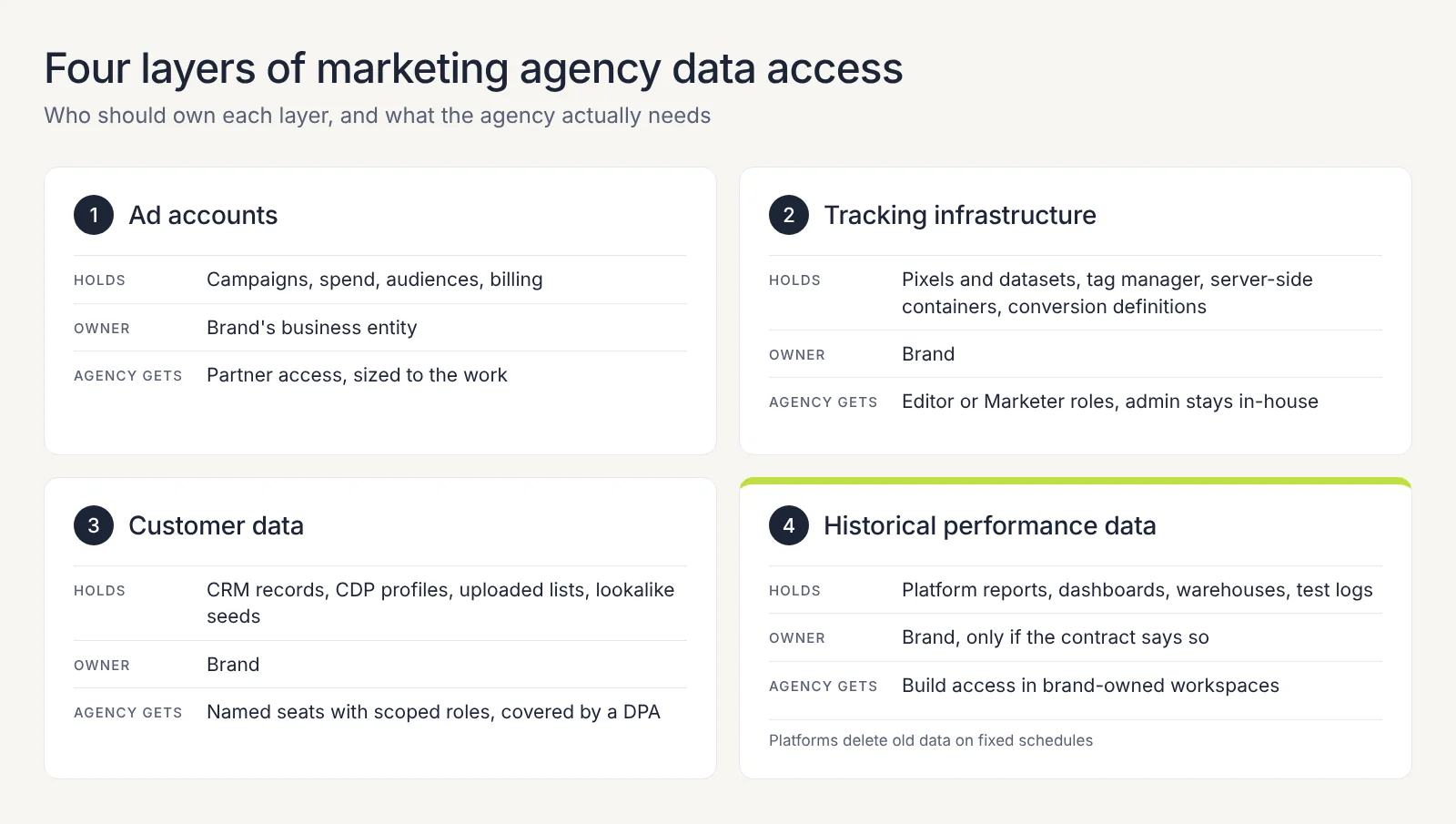
Marketing agency data access spans four layers. The rest of this guide takes them in order.
| Layer | What it holds | Who should own it | Covered in |
|---|---|---|---|
| Ad accounts | Campaigns, spend, audiences, billing | The brand's business entity | Ad account access questions |
| Tracking infrastructure | Pixels, datasets, tag manager, conversion definitions | The brand | Who Should Own the Pixel, Conversions API and Tag Manager? |
| Customer data | CRM records, CDP profiles, uploaded lists | The brand, with agency use limited by contract | CRM and CDP permissions |
| Historical performance data | Reports, dashboards, warehouses, test logs | The brand, if the contract says so | Historical performance data |
Agency data ownership mostly gets decided during onboarding by whoever creates the accounts. At that point, the contract is already signed and the account structure may be taking shape before ownership and transfer rules have been properly discussed.
Those first setup decisions can be difficult to reverse. On some platforms, accounts created inside an agency-controlled business entity cannot simply be transferred later, as the next section explains. By the time the client asks who controls the account, the available options may already be limited.
The problem becomes more expensive when the relationship ends. The same ANA research cited earlier puts the average cost of an agency search at $408,500.
A new agency search becomes harder when the incoming partner also has to rebuild reporting context, audiences, testing history, or account structures that were never fully accessible to the client.
Notice periods can make that handoff even tighter. A few remaining weeks on a retainer may not leave much time to resolve ownership questions, transfer access, document tracking, and preserve historical data.
The better time to settle those questions is during the pitch. Ask each finalist for a written account-creation plan covering who will create each account, which entity will own it, what level of access the agency needs, and how data and assets will be shared.
Adding those questions to the RFP makes the answers easier to compare across finalists. Our guide to the marketing RFP process shows where those requirements can sit.
The client should own the ad account, and the agency should be added as a partner at the lowest access level that lets it do the work. Each platform handles this differently, and the differences decide what you can still fix later.
Meta's rules make the first setup permanent. According to Meta's help center, "each ad account can only be in 1 business portfolio," and accounts already linked to a portfolio "can't be moved to another one."
Creating a new account inside a portfolio is also final. Meta states that a new ad account created in a business portfolio "will permanently be a part of that portfolio." If the agency creates your account inside its own portfolio (formerly called Business Manager), that account belongs to the agency for good.
The right setup uses Meta's sharing route. Your portfolio owns the account, and the agency requests access, so "the account will remain in their portfolio, but access will be shared with your portfolio." Even a partner with full control cannot share the asset onward to another business. Only the owner can.
Questions to ask:
Google Ads is more forgiving. A Google Ads account linked to an agency's manager account (MCC, sometimes called a master account) still belongs to the client. Google's documentation says "the client account still owns its data and has the ability to remove ownership access by unlinking."
Linking alone doesn't hand over control either. Google notes that a manager linking an existing account "won't have ownership of that newly linked client account by default."
The available access levels are:
The risk sits in account creation. When an agency creates the account from its MCC with its own login as the only admin, the brand has to get admin rights added before it can unlink anything. Unlinking requires administrative access on the client account.
Questions to ask:
TikTok allows ownership transfers, with conditions. Its Business Center transfer rules say active campaigns pause during a transfer. Linked assets such as pixels, catalogs and audiences don't move automatically.
The sending Business Center must be the current owner, and TikTok warns the feature "may not be available to you yet."
LinkedIn, Pinterest, Snapchat and Microsoft Ads each have their own ownership and partner models. The working rule is the same everywhere: create the account under your company's entity, then add the agency.
Question to ask: which of our platforms allow a later transfer, and which make the first setup permanent?
Billing ties ownership together. When media is billed to the agency's card or credit line, the account usually ends up in the agency's entity, because the payer and the owner tend to be the same business on most platforms. This includes setups where the agency fronts media spend on its own credit and invoices you later.
Some agencies also offer agency ad accounts: accounts they own, usually with higher spend limits or credit lines, rented to clients. This can make sense for a short test, but treat it as temporary and plan the move to a brand-owned account before spend scales.
Your payment method on the account keeps ownership clear and makes spend auditable at the platform level. If the agency does bill media, the contract should state the markup, if any, and give you read access to platform invoices.
Question to ask: will the media be billed to our payment method, or passed through your invoices?
| Platform | Brand should own | Agency access level to grant | Can ownership move later? |
|---|---|---|---|
| Meta | Ad account, pages, datasets in the brand's business portfolio | Partner access, partial or full control as the work requires | No, once an account is in a portfolio |
| Google Ads | Ad account with brand admins | Standard via MCC link | Yes, the client can unlink a manager |
| TikTok | Ad account in the brand's Business Center | Partner access | Sometimes, with paused campaigns and assets left behind |
| LinkedIn and others | Ad account under the brand's company page or entity | Campaign manager or equivalent role | Varies by platform, so check before setup |
An agency needs scoped user roles in your CRM or CDP, never super-admin, and its access should belong to named people with an end date. These systems hold your first-party data: customer records, lifecycle stages, revenue and consent status.
Each agency user should get a named seat with only the permissions their work needs. Shared agency logins make it impossible to see who changed what, or to remove one person's access without breaking everyone else's.
Some platforms build these limits in. HubSpot's partner access rules say Partner Admins cannot add or remove Super Admins, change billing settings or manage sensitive data. Once all partner users are removed, HubSpot ends the managed relationship 60 days after the last qualifying partner activity.
Put this in the statement of work:
Integrations usually hold more access than any human user. Ad platform syncs, reverse ETL jobs and private apps run on API keys or tokens that someone registers and someone owns.
Ask who will create each integration and under which account. The cleanest answer is that your team creates the private app or service account, then grants the agency use of it. Keep a register of every connector, its owner and its scopes.
Uploaded customer lists are your personal data, whichever platform they end up in. Audiences built from them, including lookalike seeds and exclusion lists, live wherever the ad account lives. An audience built in an agency-owned portfolio stays there, under the Meta rules covered above.
A first-party data strategy only pays off if those audiences stay with the brand. Ask the agency to build every audience inside your accounts and to document the source list behind each one.
Because CRM and CDP work involves personal data, it also needs a data processing agreement. The contract section below covers what that agreement must include.
| Question to ask | A good answer | Red flag |
|---|---|---|
| Will each of your people have a named login? | Yes, with roles listed in the SOW | "We use one shared agency login" |
| What role do you need? | A scoped role for specific objects | "We'll need super admin to move fast" |
| Who creates API keys and integrations? | Your team creates them, we use them | "We'll connect it through our tools" |
| Where will audiences be built? | In your ad accounts, with source lists documented | "In our account, we'll share them with you" |
| Will you sign a DPA? | Yes, here's our standard version | "Our MSA covers it" with no data terms |
Tracking assets should be owned by the brand, because they decide how every past and future result gets counted. That covers pixels and datasets, server-side containers, tag manager and conversion definitions.
On Meta, the pixel now sits inside a dataset, and datasets are owned by a business portfolio. Partners get access through "Assign partners" using their portfolio ID. A dataset created in the agency's portfolio carries the same lock-in as an ad account.
Google Analytics 4 and Google Tag Manager work best with Administrator access kept in-house. GA4 offers five roles:
It also supports "No Cost Metrics" and "No Revenue Metrics" restrictions.
Editor or Marketer covers most agency work. Administrator means the agency can manage users, including removing yours.
Server-side tagging and Conversions API setups add a layer most agency checklists skip. A server-side container runs in a cloud project with its own billing account. If that project belongs to the agency, the tracking stops when the agency leaves.
Configuration is also data. Conversion event definitions, attribution windows, UTM conventions and campaign naming rules decide whether this year's numbers compare cleanly with last year's. Whichever attribution approach you use, the brand should own the documented settings behind it.
Ask for a tracking map as an onboarding deliverable, with four columns: asset, owner, agency role and configuration notes. It's a small task at onboarding and a large one at exit.
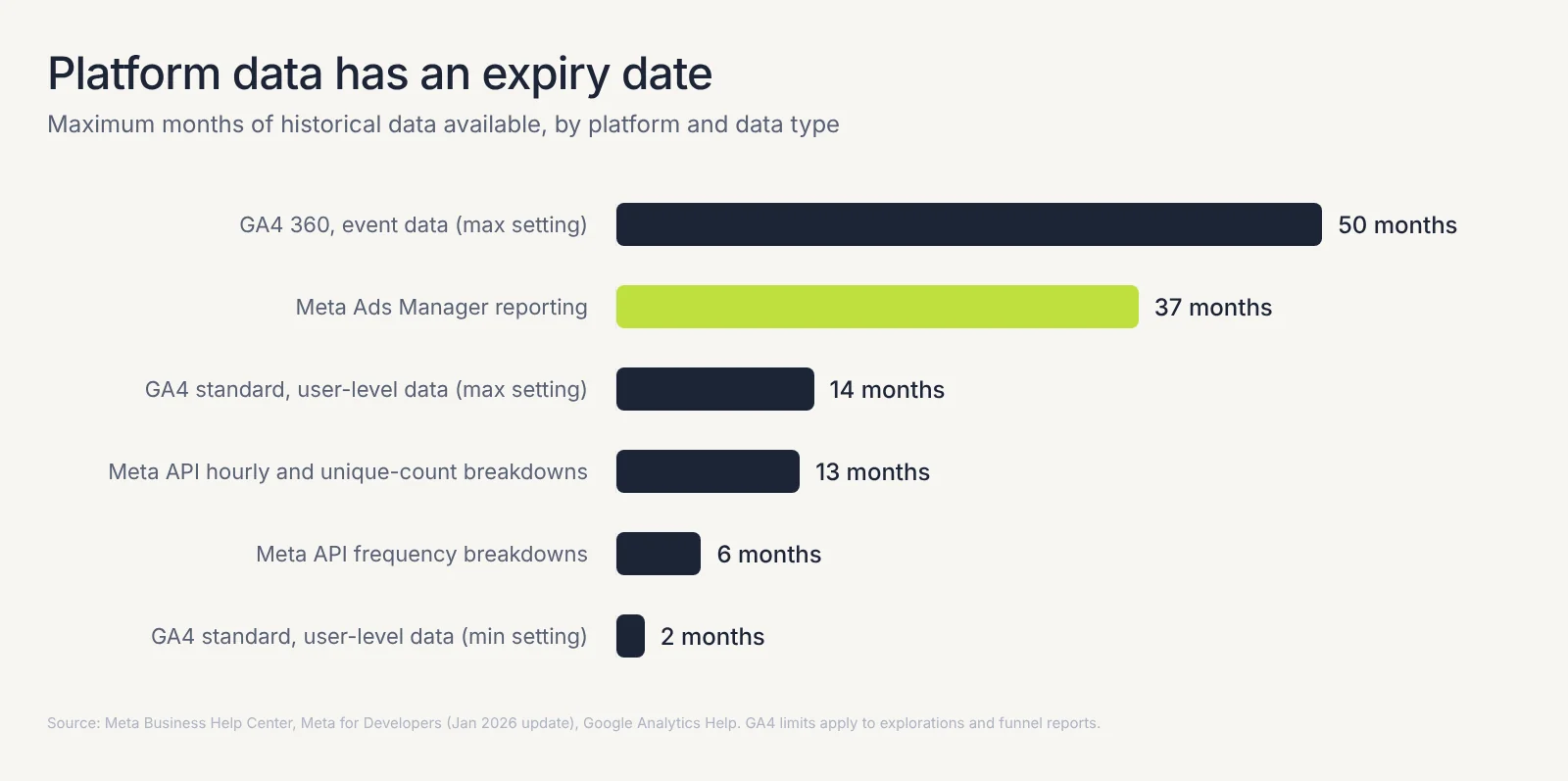
Platform data stays with whoever owns the account. Agency-built reports, dashboards, warehouses and test logs belong to the brand only if the contract says so. And platform data expires on its own.
Even a brand that owns every account loses history it never exported.
Every major platform caps how far back its reporting goes:
The GA4 retention setting applies to explorations and funnel reports. Standard aggregated reports keep their data. Still, a team that wants to compare cohorts or paths across two years needs its own copy.
The fix is a scheduled raw data export, run quarterly during the contract into a warehouse your company owns. GA4's BigQuery export, or a platform connector writing to your own BigQuery or Snowflake project, does the job.
Dashboards are where agency data ownership gets murky. A Looker Studio report, a BigQuery project or a Power BI workspace created under an agency's Google or Microsoft account belongs to the agency. Connector licenses, such as Supermetrics or Funnel, often sit on the agency's subscription.
At exit, a shared copy of a dashboard usually breaks once the agency's connectors stop paying. A transfer of ownership keeps the data source, the logic and the history intact.
Good agency reporting can be built either way, so ask before work starts:
Test logs are the hardest history to rebuild, because no platform stores the reasoning. Ask the agency to keep a running log in a workspace you own, with these fields for every test:
A shared sheet or database is enough. What matters is that it lives on your side. Our guide to creative testing measurement covers how to structure the tests themselves.
| Data type | Where it lives | Retention limit | Export format |
|---|---|---|---|
| Ad platform metrics | Meta, Google Ads, TikTok, LinkedIn | Meta: 37 months in reporting | CSV or API pull by campaign, ad set, ad and day |
| Web analytics events | GA4 | 2 or 14 months for user-level data (standard) | BigQuery export, raw events |
| Dashboards | Looker Studio, Power BI, agency BI tools | As long as the owner's account and connectors run | Ownership transfer plus query documentation |
| Warehouse tables | BigQuery, Snowflake, Redshift | Set by the project owner | Table copy into a brand-owned project |
| Test logs | Sheets, Notion, Airtable, agency tools | No platform limit, lost when access ends | Full export with linked creative |
| Creative files | Agency drive, ad platforms, DAM | Varies | Original files with usage terms |
Four clauses cover most of the risk: ownership and access, data return and deletion, transition assistance, and audit rights.
Note: This section provides general information to discuss with your legal counsel. It is not legal advice.
The brand should own every account, dataset and data set created or used during the engagement, along with the intellectual property in work product it has paid for. The agency's access works as a license that ends with the contract.
Starting-point wording for your counsel:
"Client owns all advertising accounts, analytics properties, tracking assets, audiences and data created or used under this Agreement. Agency receives access solely to perform the Services, and that access terminates on expiry or termination of this Agreement."
GDPR sets the baseline for personal data. Article 28 requires a processor contract to state that the processor, "at the choice of the controller, deletes or returns all the personal data to the controller after the end of the provision of services," and deletes existing copies.
The contract should add the practical detail:
Any agency that touches CRM or CDP records needs a data processing agreement with these terms.
This clause commits the agency to helping the next team succeed. It should name:
Audit rights let you check what the agency did with your data and your money. Under California's privacy regulations, service-provider contracts must limit use of personal information to the stated business purpose and give the business the right to assess compliance at least once every 12 months. GDPR Article 28 also requires processors to "allow for and contribute to audits."
Media buying deserves its own audit terms. The ANA's model media contract added a definition of "Transaction Data" so advertisers can see data that vendors might otherwise restrict, and its 2023 update kept unlimited audits.
The case for this is in the numbers. The ANA's programmatic study found that only 36 cents of every dollar entering a DSP effectively reached the consumer.
By Q3 2025, the share of spend reaching publishers had risen to 47.1%, up 11 points since 2023, which the ANA attributes to stronger accountability and data-driven optimization. Half of participants now have direct supplier contracts.
Write these requirements into your RFP template so every agency prices them in from the start.
| Clause | What it should say | Common weak version |
|---|---|---|
| Ownership and access | Client owns all accounts, assets and data, and agency access ends with the contract | "Agency will provide client access on request" |
| Data return and deletion | Return in named formats within a set number of days, plus a deletion certificate | "Agency will delete data per its retention policy" |
| Transition assistance | Defined handover, final export, read-only period and knowledge transfer | "Agency will cooperate reasonably" |
| Audit rights | Access to platform and transaction data, with regular audits | No audit clause, or audits "at agency's discretion" |
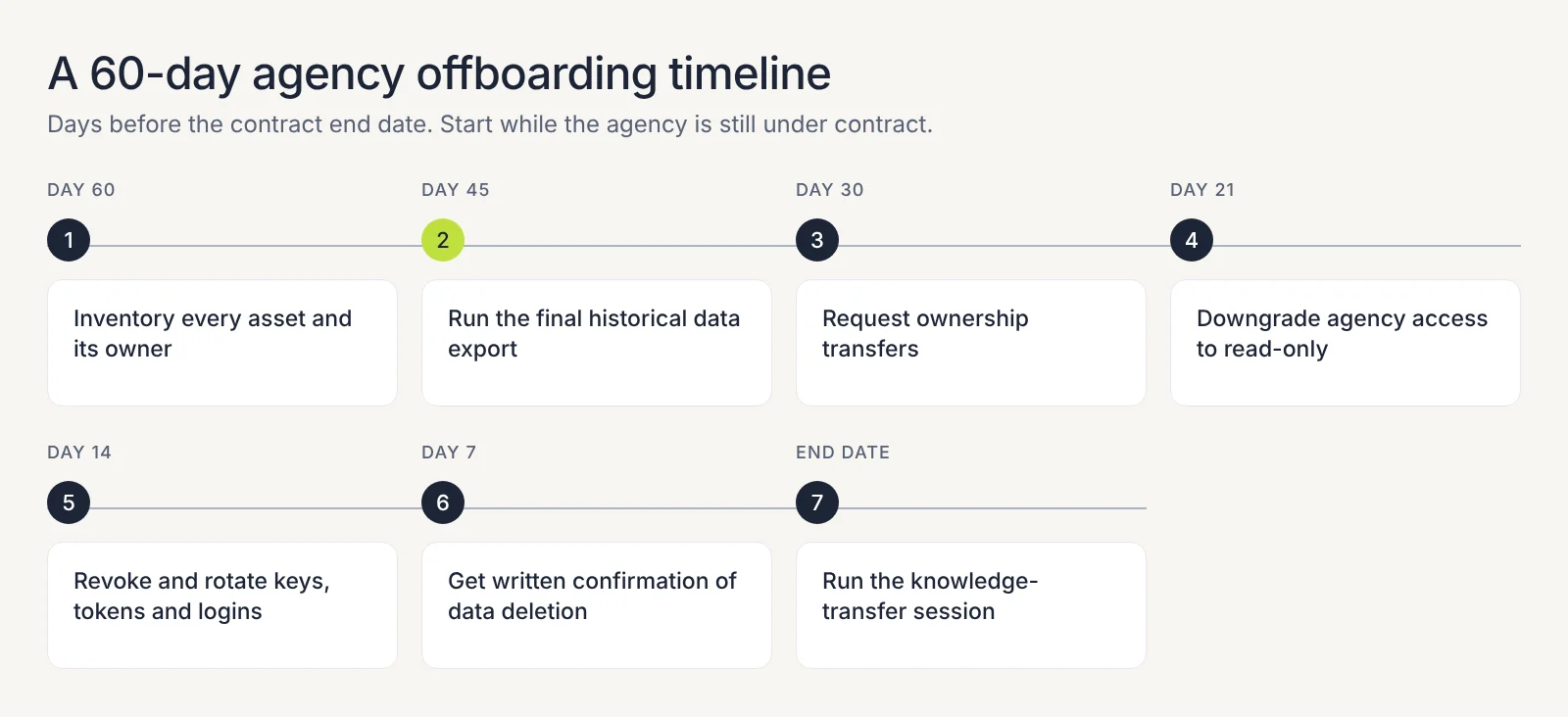
Start offboarding 60 days before the contract end date, so transfers, exports and credential changes finish while the agency is still paid to help.
Then work through these steps in order:
Handled this way, an exit doesn't have to sour the relationship. The habits that make for a high-performing agency-client relationship, such as shared documentation and clear ownership, also make a clean exit possible.
Ask in writing for an ownership transfer or partner access first. Where the platform blocks transfers, build new accounts you own and migrate before the contract ends.
Google Ads is the easiest case, since the client can unlink a manager account once it has admin access. Meta accounts already inside an agency portfolio can't move, so the route there is a new ad account and dataset in your own portfolio. TikTok sits in between, as covered in the ad account section.
When you're switching agencies, the final invoice is your strongest bargaining point. Tie its payment to the asset handover listed in the transition clause. If the agency refuses access to accounts your company paid for, involve counsel early.
Rebuilding has real costs, and it's worth knowing them before you start:
A strategic marketing audit before the migration shows what's worth rebuilding and what can go.
You can ask Fieldtrip to set up your engagement the way this guide recommends, and to put it in writing. This means ad accounts, datasets and analytics properties stay in your business entity, with our teams added as partners.
Test logs and dashboards can live in your workspace, so the learning record stays yours whatever happens next. Offboarding terms can go into the contract from day one.
Our measurement team also audits the systems behind your reporting: tracking setup, attribution logic, CRM integration and how data flows between tools. If you're about to sign with a new agency, or you're not sure who owns your current accounts, that audit is a good place to start.
Talk to our team about your accounts, your tracking and what a clean, brand-owned setup would look like for your business.
Ownership then falls back to the platform rules and general contract law. In practice, whoever's business entity holds the account keeps it. A silent contract also gives you no deadline for exports and no deletion certificate, so add a data access addendum before the next renewal.
Only if the contract allows it. Some agency MSAs include a broad right to use "aggregated and anonymized" data, which can cover benchmarking and model training. If that matters to you, define what counts as aggregated, require opt-in for AI training, and exclude personal data entirely.
Each agency should get its own partner connection and the narrowest role its work needs, with the brand as the only owner. Name one internal owner per platform who approves access changes. Keep a shared naming convention and test log so results stay comparable across agencies.
The environment itself should be contracted in the brand's name, with the agency as an authorized user. Clean room outputs usually feed audiences and measurement, so the contract should cover the queries, the match rules and the output tables, along with the raw data. Confirm which partner data can leave the clean room at exit.
A data processing agreement covers personal data. Aggregated campaign metrics, such as spend, impressions and conversions by ad, usually fall outside it. That's why the ownership and transition clauses need to cover performance data separately.
%2520(1).png)