

























Long agency relationships leave more behind than campaign history. According to the 2025 4As and ANA tenure study, the average client-agency relationship now lasts seven years, more than double the 2016 figure. Over that time, access gets buried in agency master accounts, creative libraries spread across platforms, and creator agreements end up signed by different teams under different terms.
That is what makes agency roster consolidation tricky: everything has to move while the campaigns keep running.
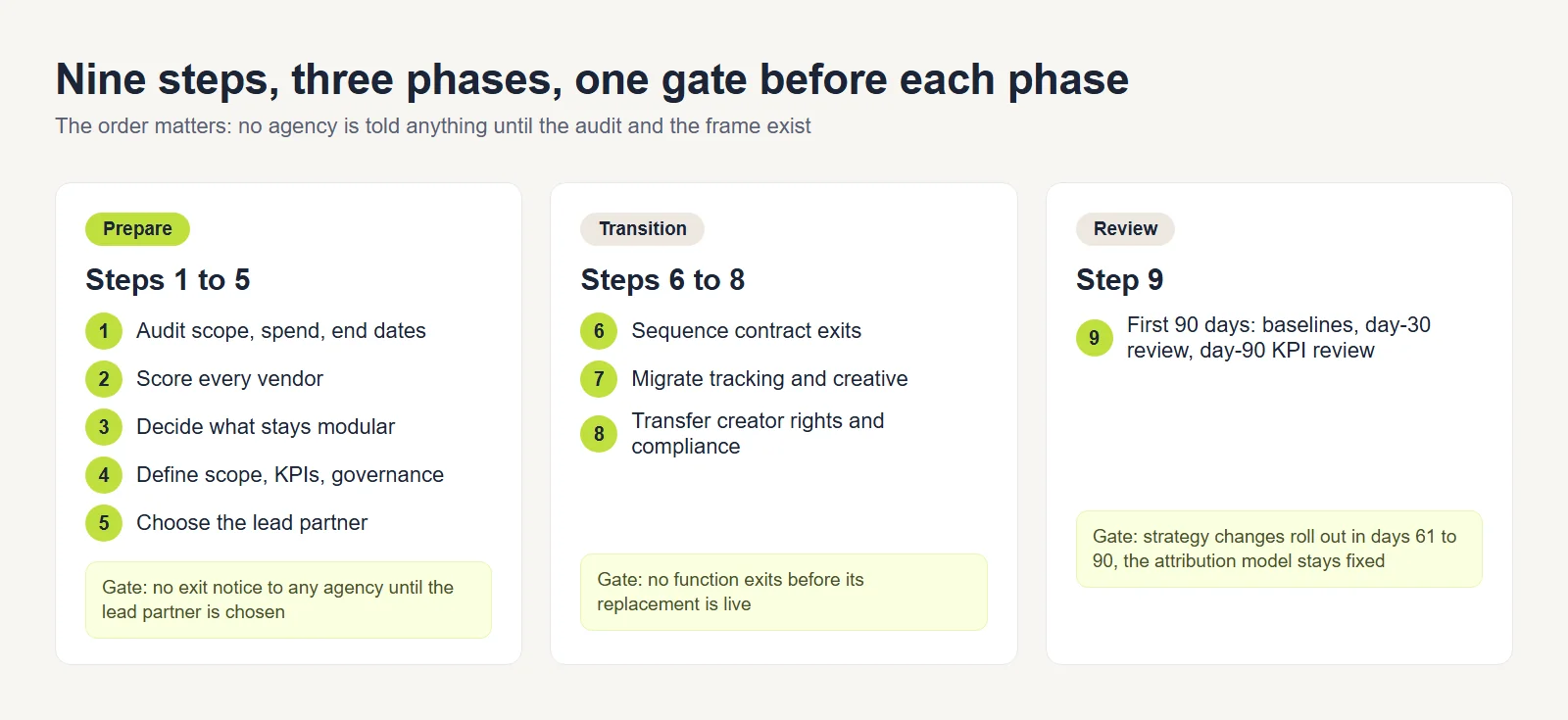
This checklist breaks the transition into nine steps, from the first audit through the day-90 review.
Let’s break it down.
Fragmented rosters lose value in the handoffs between vendors, and shortening those handoffs is the point of consolidating. Run the move like a campaign: make it in small stages, launch each one, read what broke, and adjust before the next stage. The checklist below follows that rhythm.
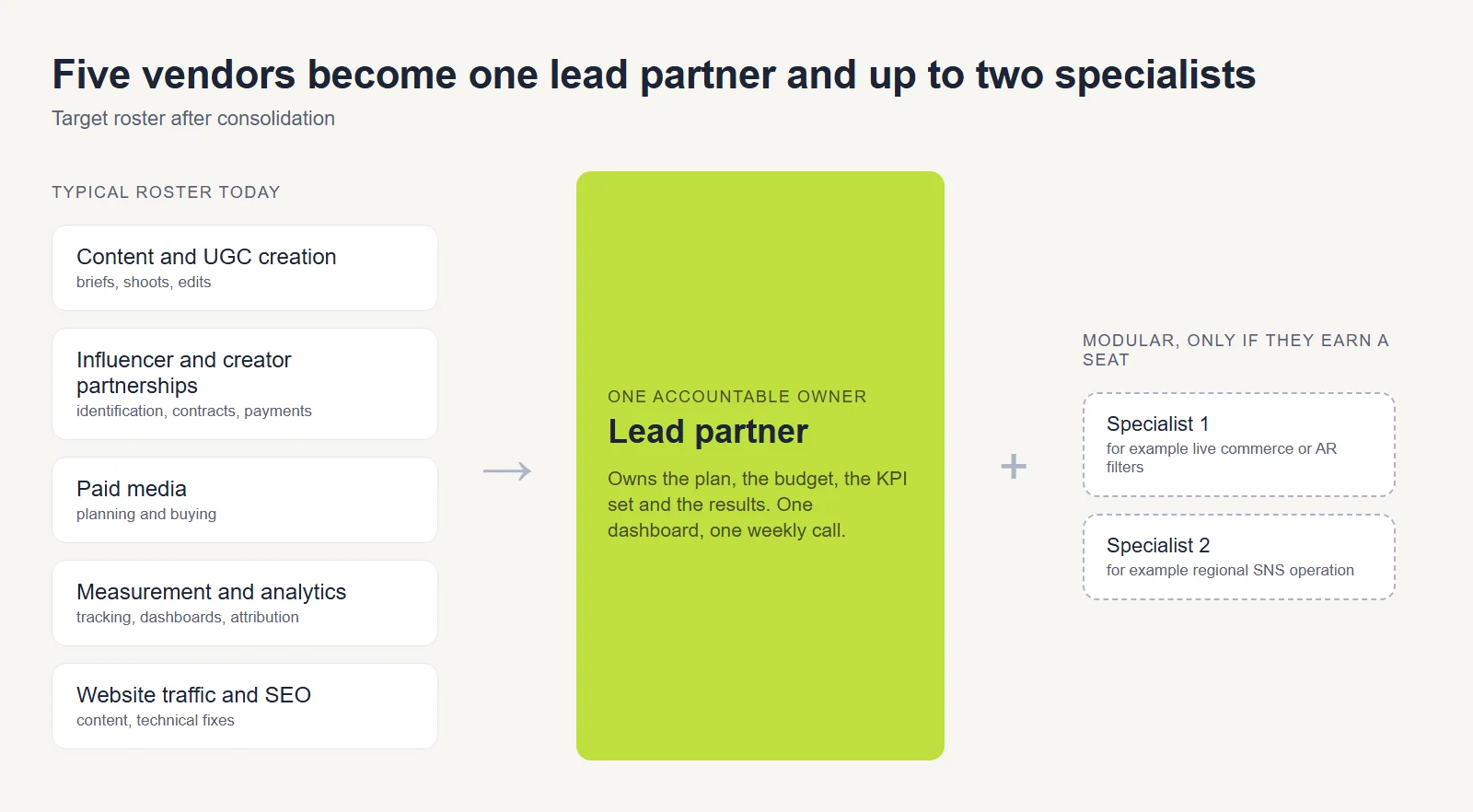
Marketing agency consolidation is the process of moving planning, creative, media and measurement under one accountable lead partner, with specialists kept only where they earn a seat.
In this article, "one" means one accountable partner. A typical five-vendor roster covers content development, influencer and creator work, paid media, measurement and website traffic through SEO, with a few niche specialists on the side. After consolidation, the lead partner owns the plan, the budget and the results, and zero to two specialists stay modular under that plan.
Collect facts on every vendor before you tell any agency about the project. This step records what exists. Scoring and decisions come later.
Copy the table below and build one row per vendor with scope, monthly spend, contract end date and notice period, and pull 12 months of invoices to fill it in.
| Vendor Type | Typical Scope | Monthly Spend | Contract End Date | Notice Period |
|---|---|---|---|---|
| Content development and UGC creation | Briefs, shoots, edits, creator-style video | |||
| Influencer and creator partnerships | Creator identification, outreach, contracts, payments | |||
| Paid media | Planning and buying across digital platforms | |||
| Measurement and analytics | Tracking setup, dashboards, attribution | |||
| Website traffic and SEO | Content, technical fixes, reporting | |||
| Niche specialists | AR filters, live commerce, SNS operation |
Once the table is filled, mark overlapping deliverables and duplicate roles. Two vendors both billing for strategy, or three account managers who each run a weekly status call, show where the consolidation will save the most coordination time.
The brand should own every ad account, analytics property, domain and source file, whoever set them up.
Advertising spend is typically the second or third largest spend a company carries after people and real estate, which is why the ANA's media agency contract template insists the agreement be detailed and precise. Ownership terms are part of that detail.
Check each of these and note any that sit under an agency's own master account:
Leave pixels and UTM rules for Step 7. Here you only need to know who holds what.
Score every incumbent on the criteria that apply to its scope, then normalize the result to a 100-point scale. Use the final score alongside capability coverage to sort each vendor into one of three outcomes: lead candidate, modular specialist, or exit.
The scorecard turns a feeling about each agency into a number you can defend in a budget meeting. The weights below are a starting point. Mark any criterion outside a vendor’s contracted scope as N/A, then redistribute its weight across the applicable criteria before calculating the final score.
| Criterion | Weight | Evidence to Collect | Red Flag |
|---|---|---|---|
| Results against agreed targets | 25 | Last four quarters of reporting against the original KPI set | Targets were rewritten mid-year without a stated reason |
| Cross-channel coordination | 15 | Examples where the vendor changed its plan because of another vendor's data | Every handoff goes through the brand's internal team |
| Measurement rigor | 15 | Documented tracking plan, naming rules, test design | Reports only platform-reported results |
| Creative output and testing cadence | 15 | Assets shipped per month, number of tests, what the last three tests taught | Volume without a written learning |
| Creator and influencer capability | 10 | Past creator results, vetting files, repeat-creator rate, where creator work is in scope | No vetting file for creators already paid |
| Documentation quality | 10 | Handoff-ready files, briefs, change logs | Knowledge sits with one account manager |
| Commercial terms | 10 | Fee structure, renewal terms, exit costs | Auto-renewal with a long notice window |
Pull the creative row from the agency's own testing log.
After scoring, sort vendors into three groups:
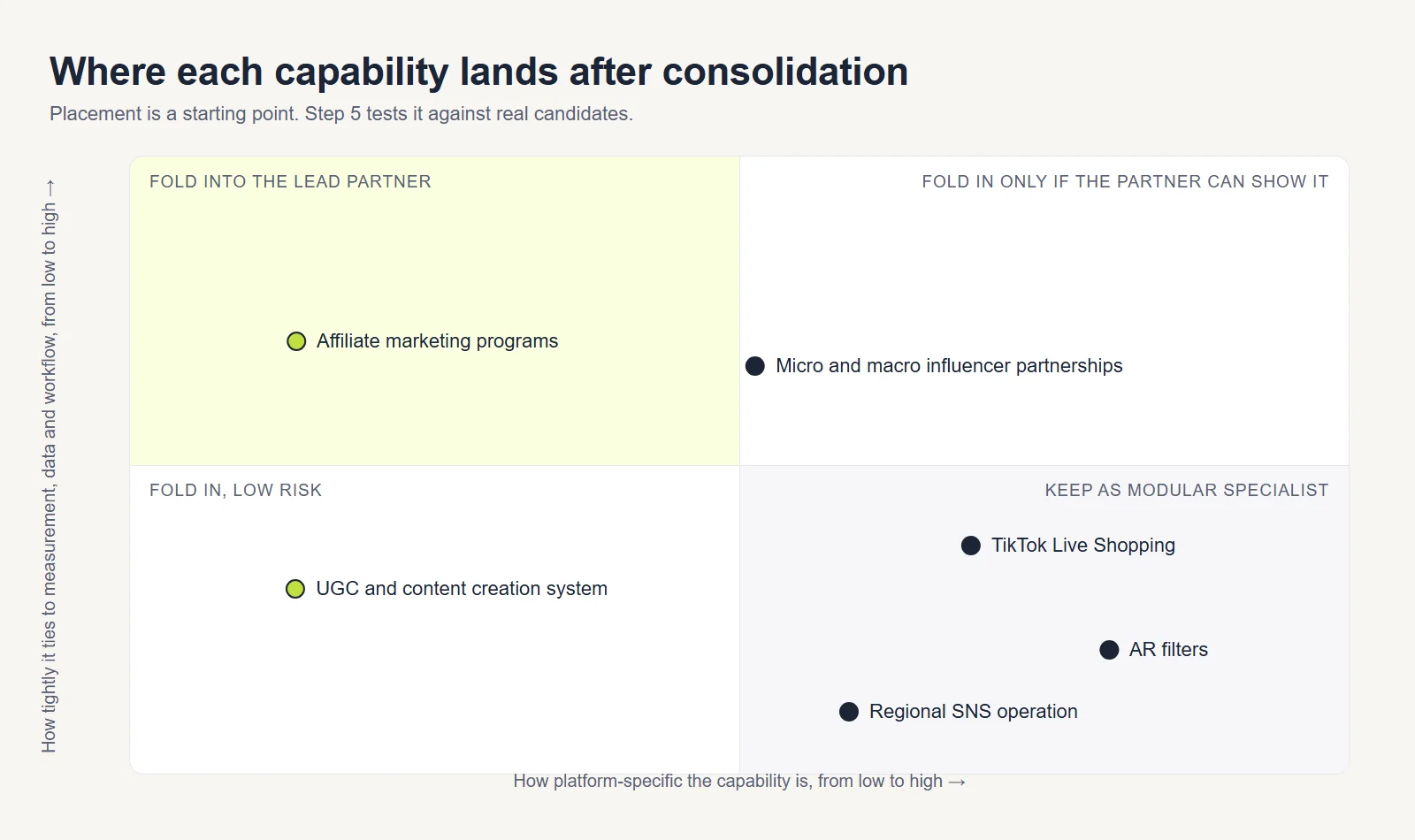
Fold a capability into the lead partner only when the partner can show it. Keep a specialist when the capability is rare, platform-specific and measurable on its own.
This step sets the rule. In Step 5, check each finalist against the evidence column before you fold anything in, so the table below names a default for each capability and the evidence that flips it.
| Capability | Fold In When | Keep as Specialist When |
|---|---|---|
| UGC and content creation system | The lead partner runs a repeatable creator-brief and editing pipeline | Volume needs exceed what the lead partner can ship in a month |
| Micro and macro influencer partnerships | The lead partner can show creator vetting files and past results | Creators sit in a niche or market the lead partner has no track record in |
| TikTok Live Shopping | The lead partner has hosted live commerce with sales attribution | Live formats need a dedicated host roster and studio |
| AR filters and other creation technology | The lead partner has shipped the format on the target platform | The format needs a specialist engine or licensed tooling |
| SNS operation for regional social channels | The lead partner staffs the target language and market | Local platforms or regulations need native operators |
| Affiliate marketing programs | Payouts can run through the lead partner's tracking | A network contract or payout system is already in place |
Bain's guidance fits this step: integrate tightly where measurement, data and workflow are involved, and keep creative excellence and brand voice distinct. The same logic applies to platform-specific strategies, where a specialist often knows a format's quirks better than a generalist. For more on the trade-offs, see the difference between boutique and enterprise agency partners.
Write the scope, KPI set and governance model before you choose a lead partner, so every candidate bids against the same frame.
Bain advises defining the internal operating model first, and adds that a lead integrator agency needs an internal integrator on the brand side. Without both, the lead partner inherits the confusion that the five-vendor roster created.
Pro tip: The internal owner role is easier to fill when the brand has a marketing operations function. Our overview of marketing operations for enterprise teams covers the roles that function usually holds.
Write the frame down on one page and share that page with every candidate in Step 5. Keep it short enough that a candidate can read it in five minutes and reply with a plan. Leave the pricing model for Step 5.
Pick the lead partner with a paid test project and four structured questions, because the scorecard and the Step 4 frame already did the heavy lifting.
The 4As and ANA studies The Cost of the Pitch (2023 and 2024) showed that unnecessary reviews carry real cost for both sides, which is why a compact test project is a better use of time than a long pitch. Finalists are the best-scoring incumbent plus two or three outside candidates.
| Question | What a Good Answer Contains | Evidence to Ask For |
|---|---|---|
| Can one team own the operating model across our core channels and coordinate the specialists that remain modular? | A named lead team, clear decision rights, and a workflow for coordinating internal teams and specialist partners | Org chart, sample RACI, cross-partner workflow, and an example of a campaign involving an external specialist |
| How does your data and tooling improve targeting and insight? | Clear ownership, export formats and integration points | Data-handling terms, tool list with ownership |
| Where do AI tools help and where do they add dependency? | Specific tasks with a human checkpoint | A recent example with before and after |
| Which processes will sit with you and which with us? | A written split with decision rights | A draft RACI |
The questions come from Bain's framework for the consolidation era.
Agree the pricing model at this point. Bain recommends a scorecard that mixes business outcomes, operational metrics and brand-building indicators, which rewards performance without pushing the partner toward short-term behavior.
If the test project cannot separate two finalists, move to a formal process.
Contract management for the old agreements means reading each termination clause, calendaring every notice window and ordering the exits so no function goes uncovered.
This step covers only the agreements themselves. The exit triggers below are met by the migration work in Steps 7 and 8, which runs during the overlap.
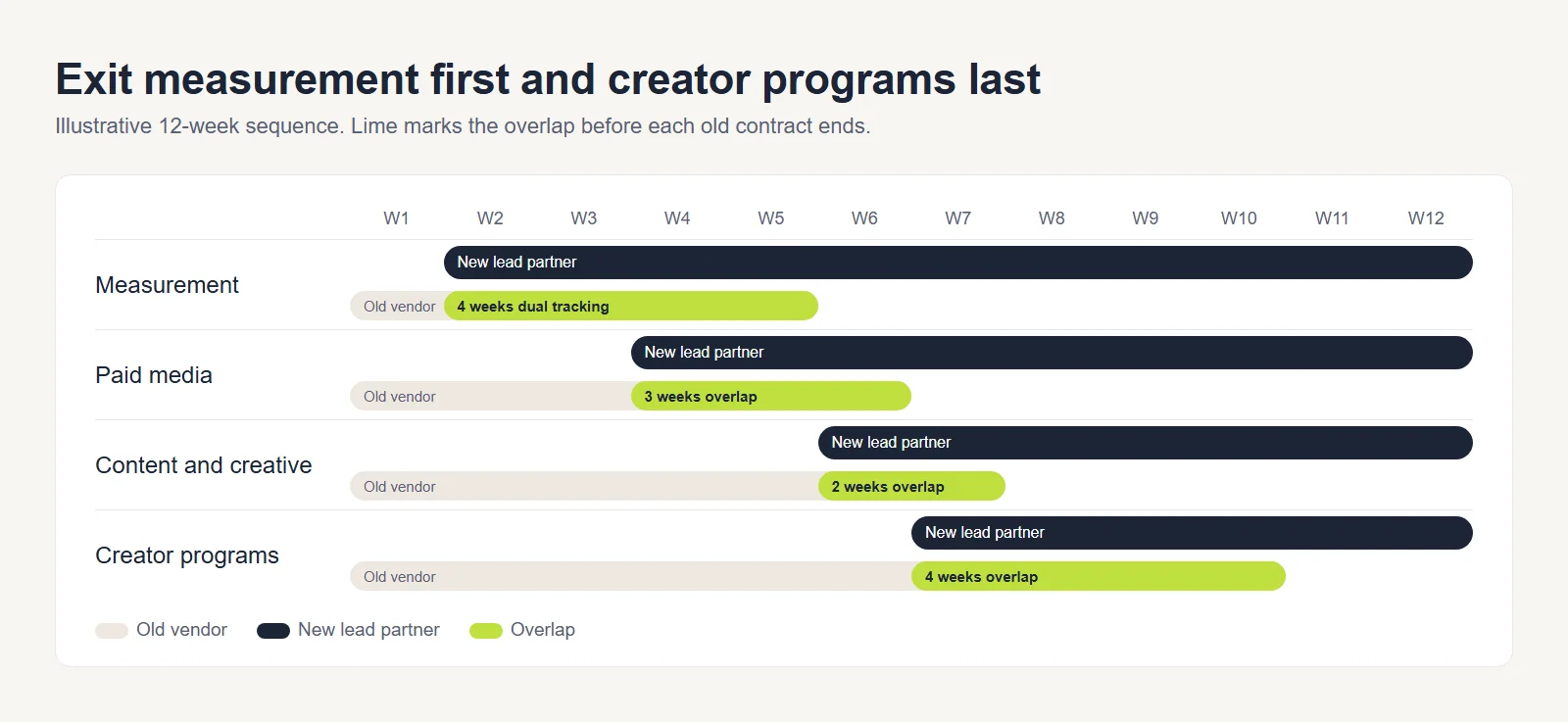
| Function | Exit Trigger | Overlap Needed | Gap Risk |
|---|---|---|---|
| Measurement | Lead partner's tracking plan approved | 4 weeks of dual tracking | Reporting breaks at cutover |
| Paid media | Accounts and audiences transferred | 2 to 4 weeks | Spend continues without optimization |
| Content and creative | Source files and briefs delivered | 2 weeks | Creative pipeline stalls |
| Creator programs | Contracts and payments transferred | 4 weeks | Creators paid late or lose access |
Measurement exits first because everything else depends on it. Creator programs exit last because they involve people who respond to inconsistency.
Keep outgoing agencies' access active until the incoming team confirms each handoff. Pulling access early removes the data you need to verify the move.
The technical handoff breaks silently, so treat it as its own workstream with an owner and a checklist.
Keep existing brand-owned pixels, datasets, and analytics properties in place wherever possible. Transfer access to the incoming team, then migrate tag containers, UTM rules, and tracking documentation without creating a replacement data history.
Snapshot 12 months of reporting before cutover and store it where the incoming team can reach it. That baseline protects historical comparisons if reporting definitions, tag-manager setups, or attribution settings change during the handoff. Before the outgoing team loses access, validate that the incoming setup preserves the same events, parameters, and conversion definitions, and document every custom event name.
A new lead partner often changes the attribution model, which breaks quarter-over-quarter comparison.
Hold the model fixed for two quarters, or report old and new models side by side. Strategy changes roll out on the Step 9 schedule while the measurement model stays fixed.
Our comparison of multi-touch attribution and marketing mix modeling explains what each approach can and cannot show, which helps when you decide which model the lead partner should own.
Collect native source files with license terms, plus the written rationale behind past tests. This is the folder the incoming team will open first, and the quality of its contents sets the pace for the first month.
Pro tip: ask the outgoing team to annotate the brand guidelines with the exceptions they have learned in practice, such as approved phrasing, banned claims and the creative formats that ran into platform review. Those notes rarely exist in writing until someone asks.
The handoff folder should include:
Creator relationships, contractual usage rights, platform access, payments in flight, and disclosure duties each follow a different handoff path when an agency changes.
The consolidation checklists we reviewed skip this step. For brands running creators it carries real legal exposure, because the disclosure duties stay with the brand.
| Item | Who Holds It Today | Transfer Action | Compliance Check |
|---|---|---|---|
| Creator contracts and exclusivity | Outgoing agency or brand | Keep brand-signed agreements in place. If the agency is the contracting party, review assignment and consent terms before assigning, replacing, or renewing the agreement. | Confirm contracting party, assignment terms, consent requirements, term, territory, and exclusivity. |
| Paid usage rights | Brand, agency, or creator agreement | Keep existing rights where the brand already holds them. If rights sit with the outgoing agency, review whether they can be assigned or need to be re-granted. | Confirm term, territory, platforms, editing rights, and paid-media permissions. |
| Whitelisting / partnership ad access | Creator and connected ad account | Re-grant platform access to the new agency or brand account. | Confirm creator authorization and remove obsolete agency access after cutover. |
| Influencer vetting files | Outgoing agency | Request full files, including past audits | Keep records of brand-safety checks |
| Affiliate marketing programs and codes | Agency or network account | Transfer the account or reissue codes | Confirm payout terms and cookie windows |
| Disclosure language | Brief and contract | Copy the approved wording into the new brief | Match current FTC expectations |
The Federal Trade Commission is clear on who is responsible: the ultimate responsibility for clear disclosure rests with both the influencer and the brand. The FTC also says that when enforcement is needed, its focus usually falls on advertisers or their ad agencies and public relations firms. A change of agency does not reset that responsibility.
For brands running creators in other markets, local regulatory bodies set their own disclosure rules, so add each market to the compliance column.
Influencer track records deserve the same care as contracts. A creator who performed well for the outgoing agency has data that the incoming team should see before deciding who stays.
Leave decisions about the mix of micro and macro creators to Step 3.
Lock baselines before cutover, then follow a 30-60-90 plan in which each window has a fixed job.
| Window | What Moves | What Stays Frozen |
|---|---|---|
| Days 1 to 30 | Access transfer, audits, weekly handoff sync | Strategy and attribution model |
| Days 31 to 60 | Strategy validation, small optimizations | Attribution model and reporting definitions |
| Days 61 to 90 | Full rollout of the new plan | Attribution model, until the end of the second quarter |
Reviews work best when both sides agree on the format in advance. Our guide to a high-performing agency-client relationship explains how to set expectations and run them.
Do not compress the timeline. Launching new strategy in week one, before the incoming team has read the historical data, causes the dip the project was meant to avoid.
The main risk after consolidation is lock-in, because one partner now holds more of the workflow, data and tooling.
Bain describes four types, and notes that lock-in has moved into the architecture of workflows, data and tools. Write controls for each into the new lead partner's contract.
| Lock-In Type | What It Looks Like | Control to Write Into the Contract |
|---|---|---|
| Workflow | The agency owns briefs, approvals and reporting end to end | Documented process, brand-owned workspace |
| Data and identity | Audience data sits in the agency's graph | Brand-owned data, defined export formats |
| Technology | Measurement or AI tools only run inside the agency's stack | Ownership and portability terms for every tool |
| Strategy and brand stewardship | The brand team shrinks to briefing and project management | Named internal owners for strategy decisions |
Review the controls every quarter, alongside the specialist review from Step 9.
Consolidation has three cost lines (overlap fees, internal time and a short performance dip) and three sources of savings (removed duplicate roles, volume pricing and less coordination).
| Cost or Saving | When It Occurs | How to Limit or Capture It |
|---|---|---|
| Overlap fees | Weeks 1 to 6 | Keep overlap to two to four weeks per function |
| Internal time | Throughout | Name one internal owner in Step 4 |
| Performance dip | Days 1 to 60 | Freeze strategy and the attribution model early |
| Duplicate roles | Steady state | Remove repeated strategy and account roles |
| Volume pricing | At the new contract | Negotiate tiers once spend sits with one partner |
| Coordination time | Steady state | Move to one dashboard and one weekly call |
General procurement guidance from SVB notes that fewer vendors with higher volume can unlock tiered pricing and a stronger negotiating position on price, payment terms and service levels. Agency fees follow the same logic.
Confirm the actual savings after day 90, once the overlap fees and the dip are behind you.
The nine steps above work whether you run them in-house or with a partner. Fieldtrip combines strategy, creative, media and measurement as one connected system, with small teams that plug in where the work needs them.
If you would like a second pair of eyes on your roster audit and vendor scorecard, book a call with our team and bring both documents. We will review them with you and map the shortest path to one lead partner.
Start with the contract. Ownership and transition-assistance clauses usually decide the outcome, and the written notice from Step 6 should reference them. If the agency still resists, escalate through the contract's dispute path and keep a dated record of each request.
A lead partner that plans, buys and measures grades its own work. Keep an independent audit of the main reporting, run by an internal analyst or a separate measurement specialist, even after consolidating. Put the audit on a fixed schedule so it never reads as a vote of no confidence.
A global lead with regional specialists suits most brands, because strategy, measurement and brand voice stay consistent while local operators handle language and platform quirks. Our guide to global influencer content production shows how that split works for creator programs.
Keep strategy decisions, data ownership and approvals in-house, and give the lead partner execution and analysis against the Step 4 KPI set. The internal team becomes the integrator that the lead partner reports to.
Often yes, because coordination work does not shrink with budget. The Step 2 vendor scorecard still applies, though the final roster may be one lead partner and no modular specialists.
%2520(1).png)