






















Selling a payments platform, a treasury API, or a commercial credit line has always meant selling to more than one person. What has changed is how many people now sit around the table, and how much of the decision gets made before a salesperson is invited in.
Forrester's 2026 buyer research counts 13 internal stakeholders and nine external influencers shaping the average business purchase.
Each of those people evaluates a different risk. When marketing, sales, and the campaign speak to only one of them, the deal stalls in a meeting your team never sees.
This guide shows how to map that buying group, align your sales team around it, and build and measure a campaign that reaches every role.
P.S. If you'd rather run this with one team across strategy, creative, media, and measurement, our financial services integrated marketing services are built for exactly that.
One thing before the mechanics. We think the people who make the creative, the people who buy the media, and the people who sell should work from the same buyer map, because each shapes what the others can do.
In financial services, that map is the buying group. The creative does the targeting: a CFO, a head of payments, and a security lead each need to see their own question answered on screen.
Measurement then tells you which roles you reached and which ones you missed. Most stalled deals we see trace back to a role nobody planned for.
B2B financial services marketing is the work of selling financial products and financial infrastructure to businesses, where a group of people takes on financial, technical, and regulatory risk together.
The buyer might be a CFO choosing a payments provider, a bank evaluating a core banking vendor, or a finance team replacing its accounts payable software.
The category covers more ground than most guides admit. The table below splits it into the segments that behave differently in a sales cycle.
| Segment | Example offer | Who usually starts the evaluation | What the buyer is risking |
|---|---|---|---|
| Payments and merchant acquiring | Card acceptance, payouts, cross-border collection | Treasurer or head of payments | Authorization rates, settlement timing, fraud exposure |
| Financial infrastructure | Banking-as-a-service, card issuing, treasury and payment APIs | Product or engineering lead | Integration effort, uptime, regulatory standing of the partner |
| B2B lending and commercial banking | Credit lines, asset finance, cash management | CFO or finance director | Cost of capital, covenants, bank relationship |
| Finance-team software | AP automation, spend management, expense cards | Controller or finance operations | ERP fit, workflow disruption, audit trail |
| Institutional asset management | Funds and mandates sold to pension funds or insurers | Investment committee or consultant | Performance, fees, fiduciary exposure |
B2B finance marketing persuades a group, where consumer financial marketing persuades one person. A consumer opens an account alone. A business choosing a payments partner needs sign-off from finance, technology, risk, and procurement, and each of them can say no.
That changes three things:
Some financial brands sell through partners to reach end customers, which adds another layer. That calls for B2B2C marketing.
Most stalled B2B financial services deals die of indecision, with no competitor involved.
Matt Dixon and Ted McKenna's study of 2.5 million sales calls found that 40% to 60% of qualified pipeline is lost to no decision, and that fear of failure drives nearly 60% of those losses.
Financial services makes that fear worse. A bad payments decision shows up in failed transactions, a frozen account, or an audit finding. Three forces turn that fear into a stalled deal.
The CFO weighs cost and working capital. Engineering weighs integration work. Risk weighs the partner's regulatory standing. Procurement weighs terms.
Forrester found procurement acts as a decision-maker in 53% of business purchases and joins from the start of the process.
When a campaign answers only the CFO's question, the other members fill the gap with their own worst case. In practice:
Undifferentiated categories create indecision because nobody in the group can defend one choice over another.
LinkedIn's 2024 survey of financial services buyers found that 75% of buyers struggle to tell payments solutions apart, 49% say purchases take longer to complete, and 47% say their buying group has grown.
If your messaging leads with features every competitor also lists, you're asking the group to break the tie on its own. Give them a reason to choose that each role can repeat inside the company.
Buyers do most of their deciding alone.
6sense's 2025 buyer survey found buyers make first contact with a vendor 61% of the way through their journey, and the vendor they favored before that contact wins about 80% of deals.
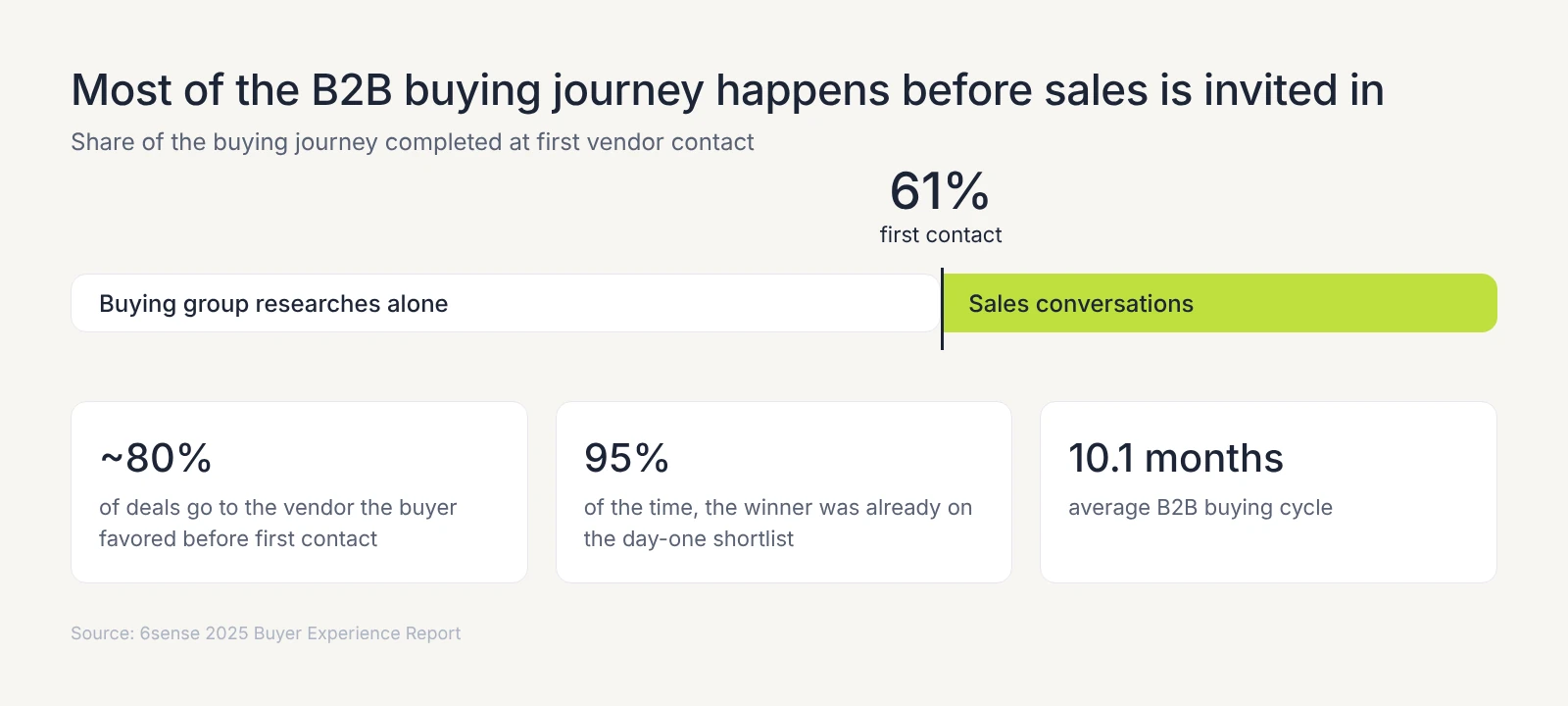
Financial services is no exception. The same LinkedIn research found 75% of financial services buyers already know which supplier they want before they draw up a shortlist.
So the campaign has to reach the whole group during that silent stretch, before anyone fills in a form. And that’s usually the job of strategy.
A payments or financial infrastructure buying group usually includes:
Each one asks a different question and trusts a different kind of proof.
| Role | Accountable for | Question they need answered | Asset that answers it | Where they meet it |
|---|---|---|---|---|
| CFO | Cost, working capital, strategic risk | Will this lower total cost and keep cash visible? | Business case with cost model | LinkedIn, peer events, analyst briefings |
| Treasurer or head of payments | Payment performance, bank and provider relationships | Will this improve acceptance, settlement and control? | Performance benchmarks, migration plan | Industry newsletters, conferences |
| Controller or finance operations | Daily workflow, reconciliation, audit trail | Will my team do less manual work? | Product walkthrough, reconciliation demo | Search, webinars, review sites |
| CTO or engineering lead | Integration, uptime, maintenance | How much engineering time will this take? | API docs, sandbox, integration guide | Developer docs, GitHub, technical blogs |
| CISO, risk and compliance | Security, regulatory exposure, vendor risk | Is this partner safe to rely on? | Security documentation, licensing and audit evidence | Direct request during due diligence |
| Procurement | Terms, price, vendor consolidation | Are the terms and total cost defensible? | Pricing logic, contract summary | RFP, vendor portals |
| External advisers | Independent judgment | Would I put my name on this choice? | Analyst coverage, customer references | Analyst firms, consultants, peers |
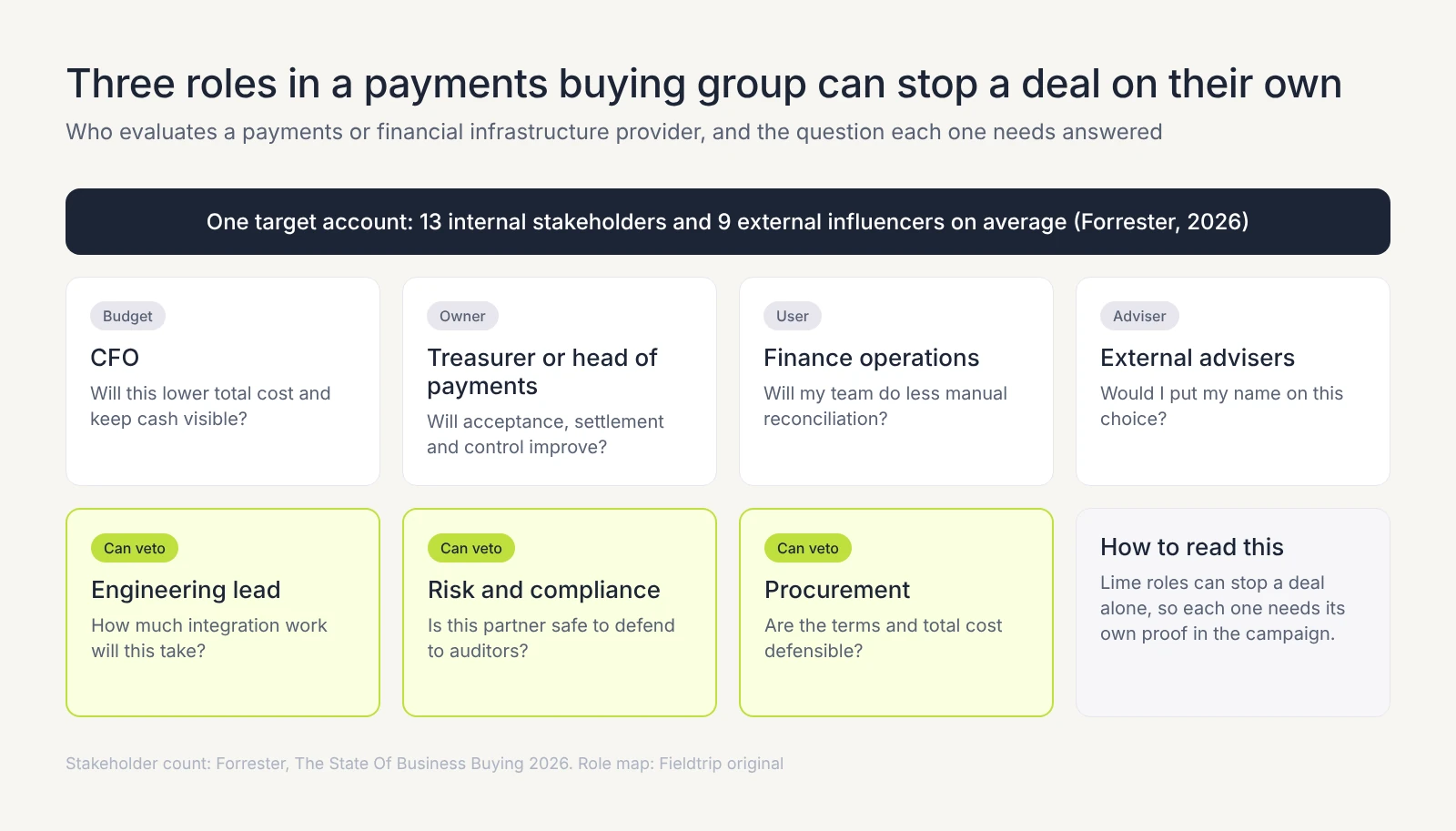
The exact mix shifts by segment and company size. A mid-sized company buying AP software may run the whole decision through finance with a quick IT check. A global merchant changing acquirers will involve every role in the table.
Map your own accounts before you assume a standard group.
In payments B2B marketing, the conversation often starts in treasury and moves fast into technology.
A Treasury Today feature on treasurers' changing role describes merchant processing projects that begin with treasury and shift to the head of payments or the CTO once technical requirements come up.
Consolidation is pushing these buying groups wider.
Adyen and Boston Consulting Group surveyed nearly 300 CFOs and treasurers and found the average enterprise uses 12 different payment providers, split between pay-ins and payouts, alongside five to six banks.
A consolidation project touches every team that relies on those providers, so more people get a vote.
For payments marketers, this means:
In financial infrastructure marketing, the engineering evaluator may carry as much weight as the budget holder.
PYMNTS Intelligence found that 58% of small and mid-sized businesses rank integration as very or extremely important when evaluating payment technology, slightly ahead of the 56% who said the same about price, and 62% named ERP integration as the top factor in choosing AP automation.
That makes your documentation part of the campaign. Treat API references, sandbox access, and integration guides as marketing assets with owners and launch dates.
Track which accounts' engineers visit them, and pass that signal to sales. If your contact data for those roles sits in separate systems, a first-party data strategy is the first fix.
Sales and marketing align when they share one account list, one definition of an engaged buying group, and one handoff contract. Everything else follows from those three agreements. Run the process in this order:
| Handoff field | Owned by | Why the sales team needs it |
|---|---|---|
| Roles engaged and roles missing | Marketing | Shows who to reach next and who might block |
| Content each role consumed | Marketing | Tells the rep what the buyer already believes |
| Open objections by role | Sales and marketing | Lets the rep start on the real concern |
| Trigger event (consolidation, launch, audit, funding) | Sales | Explains why the account is moving now |
| Compliance status of assets shared | Marketing | Confirms what the rep can forward without review |
Payhawk, a spend management company selling to CFOs and finance directors, offers a useful example of this loop.
Its marketing team built content around pain points gathered from the sales team, which produced one of its best-performing content pieces, a guide for CFOs.
When reps asked for job titles to prioritize outreach, marketing added the field to its lead forms, even though it raised cost per lead. Payhawk judges marketing on cost per demo, and its LinkedIn cost per lead still ended up 85% below industry benchmarks.
Pro Tip: If several teams and agencies touch the same launch, our guide to campaign orchestration covers shared briefs and decision ownership in more depth.
A campaign reaches the whole buying group when it carries one core story and swaps the proof for each role. The CFO, the engineer, and the risk lead should recognize the same promise, then see the evidence they personally need.
Write the core claim once, in a sentence any role could repeat in an internal meeting. Then build a proof layer per role. The message matrix below is the working document for briefs, media plans, and compliance review.
| Role | Core claim, adapted | Proof format | Compliance flag |
|---|---|---|---|
| CFO | Fewer providers, clearer cash position | Cost model, customer reference | Any savings figure needs substantiation |
| Treasurer or head of payments | Faster settlement with more control | Benchmark data, migration timeline | Performance claims need a dated source |
| Engineering lead | One integration replaces several | Sandbox, code samples, uptime history | Uptime figures must match the SLA |
| Risk and compliance | A partner you can defend to auditors | Licensing, audit and security documentation | Certifications must be current |
| Procurement | Predictable terms and pricing | Pricing logic, contract summary | Pricing must match current rate cards |
Most of your future buyers are not buying today, so the campaign has to build memory before it can capture demand.
The LinkedIn B2B Institute's research with the Ehrenberg-Bass Institute found that 80% of companies change banking services only once every five years. Any given quarter, only a small share of your market is choosing a provider.
That has practical consequences for the media plan:
People inside the buying group trust named people more than brand pages.
The same 2024 LinkedIn research (Business of Influence in Financial Services) found 76% of B2B payment solution buyers cite the opinions of providers' executives as an important influence, and 85% use information they find on LinkedIn to guide their choices.
So put your experts on camera and in the feed. A head of risk explaining how your licensing works will reach a CISO in a way a product page can't. Concrete formats that work in this category:
The Secret to B2B Growth | How Founder-Led Content | Ads are Changing the Game
Run memory-building formats while accounts are out of market, then switch to proof assets once a shortlist forms. Use this sequence to plan which assets run when, and for whom.
| Stage | Goal | Formats | Roles targeted |
|---|---|---|---|
| Out of market | Be remembered by the right roles | Executive video, research reports, podcasts | CFO, treasurer, engineering lead |
| Problem framing | Shape how the group defines the problem | Benchmarks, cost calculators, comparison guides | CFO, treasurer, controller |
| Shortlist | Earn a place on the list | Case studies, analyst coverage, review sites | Whole buying group, external advisers |
| Evaluation | Remove each role's objection | Sandbox, security documentation, migration plan | Engineering, risk, procurement |
| Decision | Give the group a defensible choice | Business case template, reference calls | CFO, procurement |
When buyers struggle to tell providers apart, test the words before you scale the spend.
Payhawk tested "company cards" against "cashless" in its A/B tests and found "cashless" performed better.
Run the same kind of test on your core claim: two or three phrasings, one audience per role, and a read on which version gets engaged accounts to the next stage.
Our media team builds these tests into the plan from the first flight.
A B2B fintech marketing strategy needs LinkedIn, content marketing for search and AI answers, developer documentation, industry events and review sites, with sales outreach saved for accounts past the engaged threshold.
Each channel reaches a different part of the buying group at a different stage.
| Channel | Roles it reaches best | Stage it serves | What to watch |
|---|---|---|---|
| LinkedIn paid and Thought Leader Ads | CFO, treasurer, risk and procurement at target accounts | Out of market to shortlist | Frequency across roles in the same account |
| Search and AI answers (SEO, GEO, paid search) | Controller, treasurer and engineering researching a problem | Problem framing and shortlist | Whether AI answers cite your pages |
| Developer documentation and sandbox | Engineering lead | Evaluation | Visits from target accounts, passed to sales |
| Industry events (Money20/20, Sibos, treasury forums) | Treasurer, head of payments, CFO | Out of market and shortlist | Meetings booked with target accounts |
| Review sites and analyst coverage | Procurement, external advisers | Shortlist | Profile completeness and recent reviews |
| Sales outreach and email | Accounts past the engaged threshold | Evaluation and decision | Which roles respond, by account |
Search needs one extra step now. Forrester found 94% of business buyers use AI during their buying process, then check what it tells them against peers, analysts, and product experts.
Write pages that answer each role's question in the first sentence, cite your sources, and get your experts quoted by the publications those buyers already trust.
Compliance review keeps pace when you tier assets by risk and pre-approve a library of claims. Most delays come from sending every asset through the same queue, regardless of what it says or who will see it.
Start with the audience.
For US broker-dealers, FINRA Rule 2210 treats communications sent only to institutional investors differently from retail ones: institutional communications need written supervisory procedures but no principal approval before use.
Retail communications currently need that pre-approval.
Rules differ by product and jurisdiction, so confirm your own obligations with counsel. This guide is not legal advice.
The rules are also moving. In July 2026, FINRA's Regulatory Notice 26-14 proposed replacing blanket pre-use approval of retail communications with risk-based procedures that each firm sets for itself. Watch how that lands if your campaigns reach retail audiences.
Then set up review tiers with your compliance team:
| Asset tier | Examples | Review path |
|---|---|---|
| Tier 1: pre-approved claims only | Social posts, ads and emails built from the claims library | Spot-check under agreed procedures |
| Tier 2: new claims, institutional audience | Research reports, sales decks, webinars for institutions | Full review on an agreed turnaround |
| Tier 3: performance, pricing or retail exposure | Savings figures, uptime promises, anything a consumer could see | Full review plus legal sign-off |
Build the claims library from the message matrix above. Every approved claim gets a source, an expiry date and an owner.
Compliance reviews new claims once, and the campaign team builds from approved ones for months. Building these layers and processes is what marketing risk management is all about.
Measure B2B financial services marketing by how many roles in each target account you've reached, and whether those accounts turn into opportunities that close.
Lead counts miss the point when a 13-person group makes the call, and the average B2B buying cycle runs about 10 months, according to 6sense research.
| Metric | What it tells you | What it replaces |
|---|---|---|
| Roles engaged per target account | Whether the campaign reaches the whole group | Lead volume |
| Opportunity rate by roles engaged | Whether broader coverage creates more pipeline | Cost per lead |
| No-decision rate | Whether the group reaches consensus | Win rate alone |
| Win rate and deal size by segment | Which segments the campaign actually serves | Blended win rate |
| Sales cycle length by roles engaged | Whether coverage shortens deals | Average cycle length |
| CAC payback by segment | Whether spend earns back in a sensible time | Channel ROAS |
If you can only add one metric this quarter, add opportunity rate split by number of roles engaged. It tells you, from your own data, whether reaching more of the group pays.
Attribution gets harder at that scale. Account-level journeys help for day-to-day decisions, and our comparison of multi-touch attribution and marketing mix modeling covers when each fits.
For causal proof that the campaign moved pipeline, hold out regions or account groups and compare, using a geo-lift test.
Use this diagnostic table when the numbers look wrong:
| What you see | Likely cause | What to check |
|---|---|---|
| Plenty of leads, few opportunities | Single-role engagement, usually the champion | Roles engaged per account at handoff |
| Deals stall at security or vendor review | No assets for risk and compliance | Whether security documentation is easy to request |
| Deals stall after the technical demo | Engineering doubts integration effort | Sandbox usage and documentation visits |
| Many losses marked "no decision" | Group never reached consensus | Which role went quiet before the stall |
| Strong engagement, weak shortlist rate | Message doesn't separate you from rivals | Results of differentiation language tests |
Before you sign off a quarterly plan, check it against this list:
Our measurement team builds these dashboards and tests for clients who need a single view.
The most common B2B fintech marketing mistake is marketing to one champion and hoping that person sells the deal internally. Here are the five we see most, each with the section that fixes it.
B2B financial services marketing works when the buying group, the sales team, and the campaign share one map. That means a role table your reps trust, one engaged-account definition, creative with proof for each role, review tiers that keep pace, and account-level measurement.
Fieldtrip runs strategy, creative, media, and measurement as one team, so the role map you agree on in week one shapes the briefs, the media plan, and the dashboard. We work across more than 20 countries and adapt the buying group to each market.
Book a call with our team. We'll walk through your current buying group map, show where coverage drops off, and outline a first campaign to test it.
Banks add formal vendor risk management, so risk, compliance, and procurement join earlier and hold more power. Expect longer security reviews and requests for audit evidence before a pilot. Fintech buyers usually move faster but put more weight on engineering's view of integration. Build both groups into your role table separately.
Yes, with a shared core claim. Developers need documentation, a sandbox, and code samples, while the CFO needs a cost case and cash visibility. Run separate creative and media for each, then report both at the account level so sales sees the whole picture.
Set the threshold from your own data. Start with three roles for mid-market deals and four for enterprise, then compare opportunity rates at each level after a quarter. Lower the threshold for accounts with a clear trigger event, such as a funding round or a provider consolidation project.
Yes, if their claims come from your pre-approved library and the partnership is disclosed. Brief outside voices on what they can and can't say about performance or pricing. Route anything new through tier 2 or tier 3 review before it runs.