






















Banks can see more about what a customer needs next than almost any other business, because the paycheck, the bills, and the card spending all pass through them.
Customers, meanwhile, move money between institutions more casually than ever. The average retail checking customer now keeps deposit accounts at three different institutions, according to a 2026 JD Power study.
The movement of money is exactly what bank cross-selling is meant to catch. Most programs still miss it, because the offer follows the product calendar while the customer follows their own life.
This guide covers what makes a cross-sell offer relevant, how to build the program step by step, which channels and metrics to use, and where cross-selling becomes a compliance problem.
P.S. If you want one team planning the data, creative, and media behind your next cross-sell program, that's what our integrated marketing services are built for.
TL;DR
Our view: cross-selling breaks when the people who own the customer data, the people who write the offer, and the people who buy the media work in separate rooms. CRM picks a product, creative dresses it up, media pushes it out, and nobody owns the question of whether this customer should hear it at all.
We run those three as one loop. As ad platforms narrow who financial brands can target, the message itself has to do the selecting, naming the situation it's for so clearly that the wrong customer scrolls past. Then a holdout group decides which offers earned the next send.
Cross-selling in banking is offering an existing customer a different product that meets a related need.
Think of a savings account for a checking customer, or a credit card for a mortgage holder. It works because the bank already has the relationship, verified identity, and transaction data that show what the customer may need next.
Bank cross-selling covers deposits, lending, cards, insurance, and wealth products. It runs through every channel a bank owns: the app, email, the branch, the contact center, and paid media aimed at existing customers.
Upselling moves a customer to a higher tier of a product they already have, while cross-selling adds a different product. Both support a broader goal: getting more of the customer's financial life to run through one bank.
| Term | What it means | Banking example |
|---|---|---|
| Cross-selling | A different product for a related need | A checking customer opens a high-yield savings account |
| Upselling | A higher tier of the same product | A standard card holder moves to a premium rewards card |
| Relationship deepening | More of the customer's activity moves to the bank | A customer switches direct deposit and bill pay from another bank |
Relationship banking is the goal, and cross-selling is one tool for reaching it.
A relationship bank wants to be the customer's primary financial institution, the one that receives the paycheck and handles most transfers.
A cross-sell offer that adds a product but costs trust moves the bank further from that goal. That's why the rest of this guide treats relevance as the test every offer has to pass before it goes out.
The most commonly cross-sold bank products are:
Each pairing works when the second product makes the first one easier to use or adds to what it does.
| Customer already has | Common next product | Why it fits |
|---|---|---|
| Checking account | High-yield savings, CD, or money market account | A place for money that isn't needed for this month's bills |
| Mortgage | Checking with autopay, homeowners insurance through the bank's partner, later a home equity line | Simpler payments and cover for the same asset |
| Debit card with heavy everyday spending | Rewards credit card | Earns back on spending that already happens |
| Auto loan | Checking with autopay, auto insurance through a partner | The same logic as the mortgage pairing |
| Growing deposit balances | Wealth, retirement, or advisory accounts | Money past a cash cushion often belongs in longer-term accounts |
| Personal account held by a business owner | Business checking, merchant services | Keeps business and personal money apart |
Which pairing to offer a given customer, and when, is a question of signals and timing. The relevance tests further down cover both.
Cross-selling matters because existing customers cost less to reach and respond more often, and every relevant product that sticks makes the bank harder to leave.
A consultant writing in the ABA Banking Journal estimates that existing-customer marketing returns roughly 10 times what new-customer marketing does, with response rates 5 to 10 times a prospect's.
He adds that lifetime value commonly doubles for customers a good cross-sell program reaches.
Treat those figures as estimates to test against your own holdout group, covered in the measurement section.
The deeper payoff is primacy: a customer whose paycheck, savings, and loan sit at one bank has fewer reasons to look elsewhere, and gives the bank more of the signals that make the next offer relevant.
Bank cross-selling is harder because customers now spread their money across several institutions, and the bank that shows up when a need appears usually wins the next product. Four shifts explain most of it:
Inertia still keeps plenty of accounts in place. A CSI survey found 51% of account holders stay mainly because switching feels hard. That's a thin kind of loyalty, and it tends to disappear the first time a competitor makes a relevant offer at the right moment.

A bank cross-sell offer is relevant when it passes four tests:
Fail any one of them and the offer reads as the bank selling, whatever the propensity model scored it.
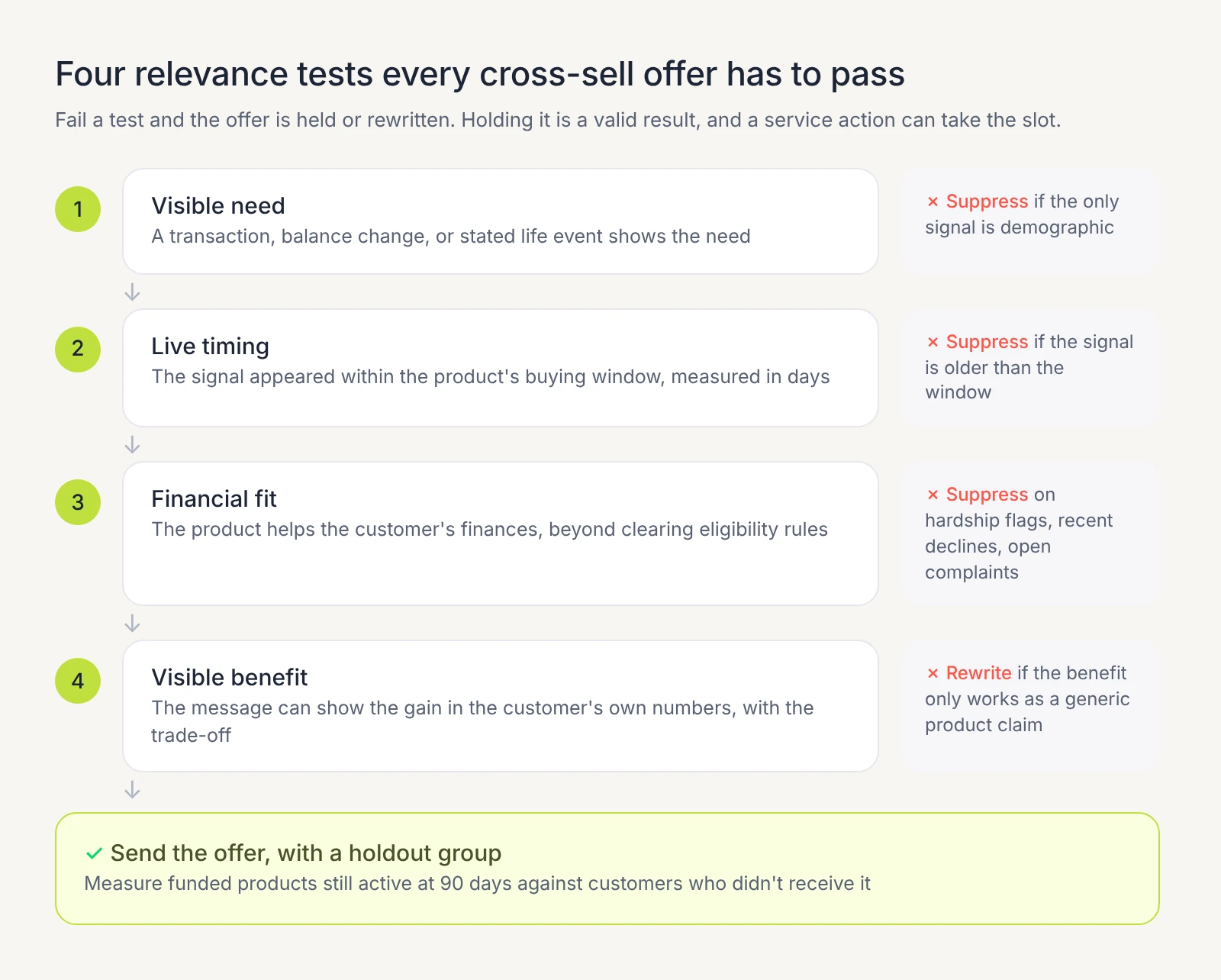
The need has to show up in data the bank actually holds, such as a transaction pattern, a balance change, or a life event the customer has shared. Demographics alone only support a guess. Signals worth building on include:
Before a product goes into a campaign, write down the specific signal that proves the need. If you can't name one, drop the product from that campaign.
Timing decides most cross-sell outcomes, because an offer sent the week a need appears has no competition and the same offer sent a month later competes with whoever got there first.
Transaction data often lags the decision. By the time money starts leaving, the customer has usually chosen the other institution. Set triggers to fire within days of the signal, and check eligibility every day.
A product can pass the eligibility rules and still be wrong for the customer. A credit-line increase offered to someone who overdrew twice this month may clear underwriting, and it can still deepen a problem the bank can already see.
Treat suppression as part of relevance. Hold offers when the customer has:
The message should show the benefit in the customer's own numbers. "Earn 3% back" describes a card. "You'd have earned $41 back on last month's groceries" describes this customer's life.
J.D. Power's 2025 advice study ranks the drivers of customer satisfaction with bank advice as quality, concern for needs, relevancy, clarity, and frequency, in that order. Frequency comes last.
Write each headline around a customer outcome, and include the trade-off in the body (the fee, the minimum balance, the rate after the promo).
No offer is the best next offer whenever the customer has an open problem the bank hasn't solved.
McKinsey describes a company that made sure customer care steps happened before any outbound marketing, which lifted its net promoter score to the market leader's level and improved both cross-sell and churn.
Rank service actions above sales actions in your decisioning rules. A fee reversal or a fraud follow-up earns the right to the next offer. Customer effort score shows where to spot the friction worth fixing first.
| Relevance test | Question to ask | Data that answers it | Signal to suppress the offer |
|---|---|---|---|
| Visible need | What does the customer's behavior say they need? | Transactions, balances, stated goals | No behavioral signal, demographics only |
| Timing | Did the need appear in the last few days or weeks? | Trigger timestamps, event feeds | Signal older than the product's buying window |
| Financial fit | Will this product help or strain the customer? | Credit data, overdraft history, hardship flags | Hardship flag, recent decline, rising overdrafts |
| Visible benefit | Can we show the gain in the customer's own numbers? | Spending categories, balances, rates | Benefit only works as a generic product claim |
Build the strategy in eight steps, starting with the customer file and ending with a holdout test, so every offer that goes out has a signal, a rule, a message, and a measurement behind it.
Our strategy team starts every engagement with a strategic audit that covers steps 1 and 2.
| Trigger signal | Likely need | Candidate offer | Message angle |
|---|---|---|---|
| Paycheck rises 15%+ for two cycles | Somewhere to put the extra | High-yield savings with auto-transfer | "Your last two paychecks were bigger. Here's a place for the difference." |
| Recurring payment to another lender | Lower cost of existing debt | Refinance or balance transfer review | "See what that payment would be with us, no application needed." |
| Checking balance idle above a threshold for 60 days | Earn on idle cash | CD or money market account | "You've kept $8,000 parked for two months. Here's what it could earn." |
| Mortgage application in progress | Simpler payments | Checking account with autopay | "Pay your new mortgage automatically from the same bank." |
| First childcare or tuition payment | Planning for education costs | 529 or goal-based savings | "Starting childcare costs? Set a savings goal next to the payment." |
| Large one-off deposit | Investment or tax planning | Wealth or advisory conversation | "Want a second opinion on what to do with it? Book 20 minutes." |
The cross-selling examples customers welcome share one trait: the offer, or the conversation before it, solves something the customer already cared about.
Commonwealth Bank of Australia calls its decisioning output a "next best conversation," on purpose, and its engine returns one around 20 million times a day across 18 channels. Many of those conversations sell nothing.
In 2017, the bank reported that its credit card payment reminders, sent to help customers avoid extra charges, lifted customer satisfaction 5% against a control group. Its Benefits Finder points customers to government rebates they may qualify for. Both build the trust that makes a later product offer land.
A mortgage applicant who is offered a checking account during the application, so payments can come out automatically, gets a product that makes the loan easier to manage.
Blend describes this pattern in its cross-selling examples, with the deposit application prefilled from the mortgage data so it takes minutes.
Personetics describes banks that turn transaction data into nudges, such as telling a customer they can safely set aside $25 a week and suggesting a savings account with a recurring transfer.
The same approach works for cards, by showing the rewards the customer would have earned on last month's grocery spending.
Bank relationship marketing changes the plan by putting service, guidance, and recognition on the calendar before the sales message, so the offer reaches a customer who already feels the bank is paying attention.
Customers want more guidance from their bank than they get. In J.D. Power's 2025 advice study, 26% of customers said they were "very interested" in bank advice, up from 19% in 2021, yet the 2026 follow-up found engagement with that advice remains inconsistent.
Build advice touches into the same journey as the offer, with the advice going first. Mapping that journey end to end is part of customer experience design.
Guidance content gives the customer a reason to engage before there's anything to buy. In the CSI survey, three-quarters of respondents said they want guidance tailored to their life milestones.
A first-home series that covers saving for a deposit, then pre-approval, then moving costs, leads naturally to a mortgage conversation.
Use social as a sensor here. The questions customers ask in comments, app reviews, and support chats tell you which milestones to write for. Our voice-of-customer research methods cover how to collect them.
Long-standing customers notice when new-account bonuses outrank their loyalty. One customer quoted in Rivel's focus group research for The Financial Brand asked why a stranger matters more than someone who has banked there for years.
Give existing customers the same rate or bonus a new customer would get, and say so in the offer.
Relationship pricing, where rates or fees improve as the customer adds products, builds the same recognition into the product itself.
| Relationship touch | What it earns | Offer it unlocks later |
|---|---|---|
| Fee reversal or fast problem fix | Trust after a bad moment | Any offer, once the case is closed |
| Life-milestone guidance series | Attention before the need peaks | Mortgage, savings, 529, insurance |
| Savings or spending insight in the app | Proof the bank reads their data for them | Savings, card, budgeting tools |
| Tenure recognition | A reason to stay put | Rate matches, preapproved credit |
The digital banking app and email carry most cross-sell offers, and branch and contact center staff close a large share of them. Paid media works best as reinforcement for customers the bank has already identified.
| Channel | Best for | Constraint | How to measure |
|---|---|---|---|
| Digital banking app | Trigger offers and insights at the moment of use | Short sessions, banner blindness | In-app response and funded accounts against a holdout |
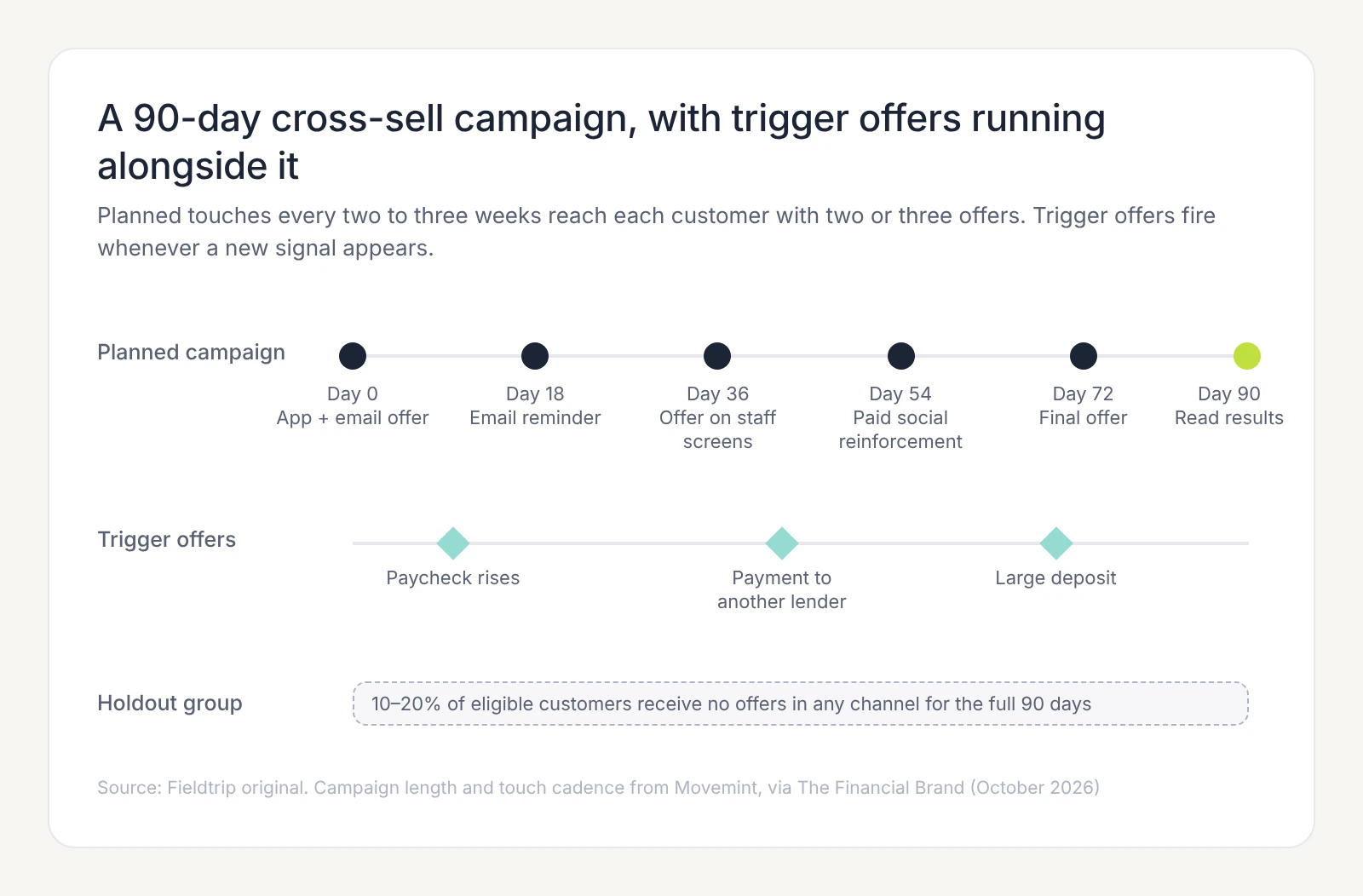
| Campaign cadence across 60 to 90 days | Inbox fatigue, needs current addresses | Opens are noise. Track funded accounts per send | |
| Branch and contact center | Complex products and closing preapproved offers | Staff need the offer and the reason on screen | Redemptions per interaction, complaints after sale |
| Direct mail | Older segments, preapproved credit offers | Cost per piece, slow feedback | Response codes and holdout comparison |
| Paid social and search to existing customers | Reinforcing an offer the customer has already seen | Special ad category audience limits on Meta | Lift studies or geo tests, with platform ROAS as a secondary read |
Plan these as one journey, so each channel knows what the others already sent. Our media planning and buying team can build that schedule around frequency limits per customer.
Since January 2025, advertisers promoting financial products to US audiences on Meta must use the Financial Products and Services special ad category, which carries the same audience restrictions as housing and employment ads.
Detailed targeting is narrowed, lookalike audiences are restricted, and customer-list audiences must meet Meta's certification rules.
Once those targeting levers are gone, the creative has to carry the targeting, which changes how performance marketing for banks gets planned. Practical moves:
Measure bank cross-selling by whether the relationship got stronger: primacy, products still active after 90 days, and incremental lift against a holdout group.
Products per customer on its own rewards the exact behavior behind the industry's worst cross-selling scandals.
| Metric | What it tells you | How it gets gamed |
|---|---|---|
| Products per customer | Breadth of the relationship | Opening low-value or unwanted accounts |
| Offer response rate | Whether the message got attention | Sending only to customers who would have bought anyway |
| Primacy (direct deposit at the bank) | Whether the bank holds the core relationship | Hard to game, which is why it's useful |
| Products funded and active at 90 days | Whether the product met a real need | Short-term funding bonuses that churn out |
| Incremental lift against a holdout | What the program caused | Shrinking the holdout until results look noisy-good |
| Complaints and closures within 90 days | Whether the sale was a good one | Routing complaints outside the program's reports |
| Contribution margin per customer | Whether the relationship pays | Ignoring promo rate costs |
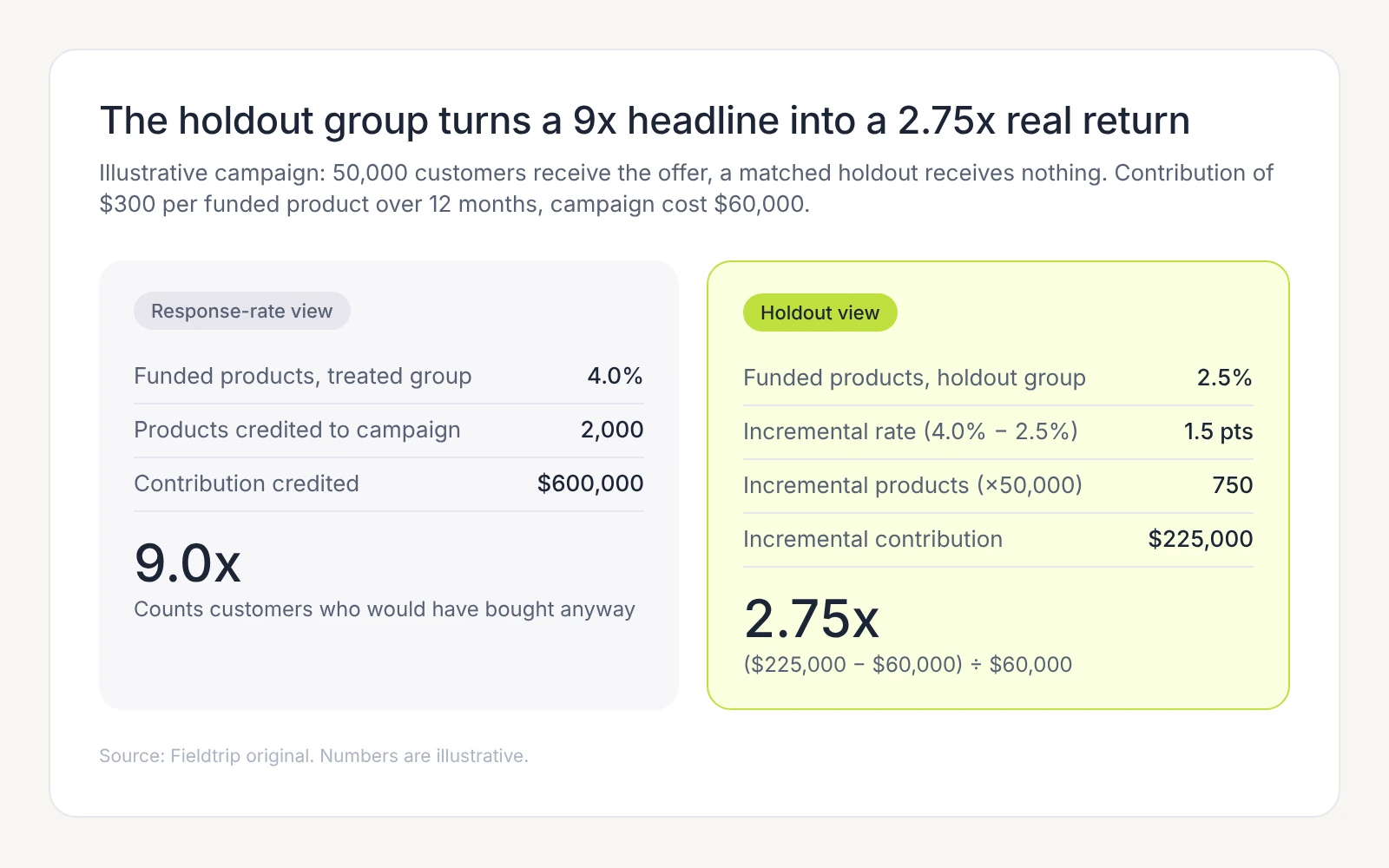
Cross-sell ROI is the incremental contribution the campaign caused, minus its cost, divided by its cost. The holdout group tells you what "incremental" means.
Hold the ABA consultant's estimate from the section on why cross-selling matters to this test, because a campaign that only reaches customers who would have bought anyway can show a strong response rate and almost no lift. A dedicated marketing measurement service can help set these holdouts.
A cross-sell program costs less than acquisition media, but it isn't free. Budget for:
If you plan to score customers by predicted value, our piece on why predictive LTV fails when it's disconnected from strategy covers the governance that keeps the score useful.
Cross-selling is good for customers when the product meets a real need and harmful when sales goals reward account counts. The biggest risks are incentive design, consumer protection enforcement, and offers that exploit inertia.
Account-count goals are the most documented cause of cross-selling misconduct.
Wells Fargo once aimed for eight financial products per customer. Under that pressure, employees opened millions of accounts without customer authorization between 2002 and 2016, and the bank agreed to pay $3 billion to resolve the DOJ and SEC investigations. Its own values statement had promised to start from customer needs.
Pay staff on funded products still active after 90 days, cap individual product goals, and audit new accounts for signs of no customer activity.
Cross-sell offers fall under the same consumer protection rules as any other financial promotion. In the US, the CFPB treats unauthorized accounts and misleading bonus terms as violations, as the Bank of America order from 2023 shows.
In the UK, the FCA's Consumer Duty, in force since July 2023, requires firms to act in good faith, avoid foreseeable harm, and help customers pursue their financial objectives.
An offer aimed at a customer showing signs of financial strain is the kind of harm a regulator would call foreseeable.
Next-best-action decisioning in banking runs on four layers: customer data, a decisioning engine, channel delivery, and measurement.
Smaller banks can start with an email platform and a spreadsheet, as the ABA article notes, and add layers once the first triggers prove themselves.
AI now sits inside most decisioning layers, scoring which customers fit an offer and drafting message variants. Use it to rank and suggest, and keep suppression rules and final offer wording under human review.
Customers are wary: 61% say their financial provider should know their needs, but only 32% trust AI to help manage their finances, according to MX research.
| Layer | Job | Example tools |
|---|---|---|
| Customer data | Unify accounts, households, and events | Core banking data, a customer data platform such as Salesforce Data Cloud or Adobe Real-Time CDP |
| Decisioning | Pick the next best action per customer, with suppression | Pega Customer Decision Hub, Salesforce Financial Services Cloud, Personetics |
| Delivery | Send the action through the right channel | Digital banking platform, marketing automation, Meta Conversions API |
| Measurement | Prove incremental impact | A data warehouse with holdout tracking, geo tests, marketing mix modeling |
Relationship Banking or Just a Hostage Situation?
Fieldtrip plans the trigger, the offer, the channel plan, and the holdout as one piece of work, because strategy, creative, media, and measurement sit in one system.
For banks, credit unions, and fintech brands, that means a cross-sell program built around signals you already hold, offer messages written for each customer situation, media that works within special ad category rules, and measurement that counts funded, retained products.
Schedule a meeting and let’s start with the data you can reach today and the two or three products worth testing first for winning cross-selling in banking.
Start with the holdout range from the ROI steps above, and run it for the full campaign length plus enough time for products to fund. Smaller banks may need a larger share, or a longer test, to see a difference above normal variation. Keep the holdout random and keep it out of every channel, including branch talk tracks.
Yes, with conditions. Financial product ads must run under the special ad category, and customer-list audiences must meet Meta's certification and sharing rules, which affected some lists from 2025 onward. Check eligibility for each list in Ads Manager before launch, and expect the creative to do more of the targeting.
Yes. Suppress sales offers while a complaint is open or a hardship flag is active, and resume only after the case is resolved and a cool-off period has passed. Service actions, such as fee reversals or payment plan options, should take that slot in the customer's journey.
Credit unions follow the same relevance tests, with two differences. Members often expect advice-led conversations given the cooperative model, and smaller data teams make simple trigger rules more realistic than complex models. Rate parity for long-standing members matters even more, because membership itself is part of the value members expect.