






















A customer may not move away from a bank in one move. They open an account somewhere else, route part of the paycheck there, and let the old balance drift lower for a few months. The closure, if it ever comes, is the last step.
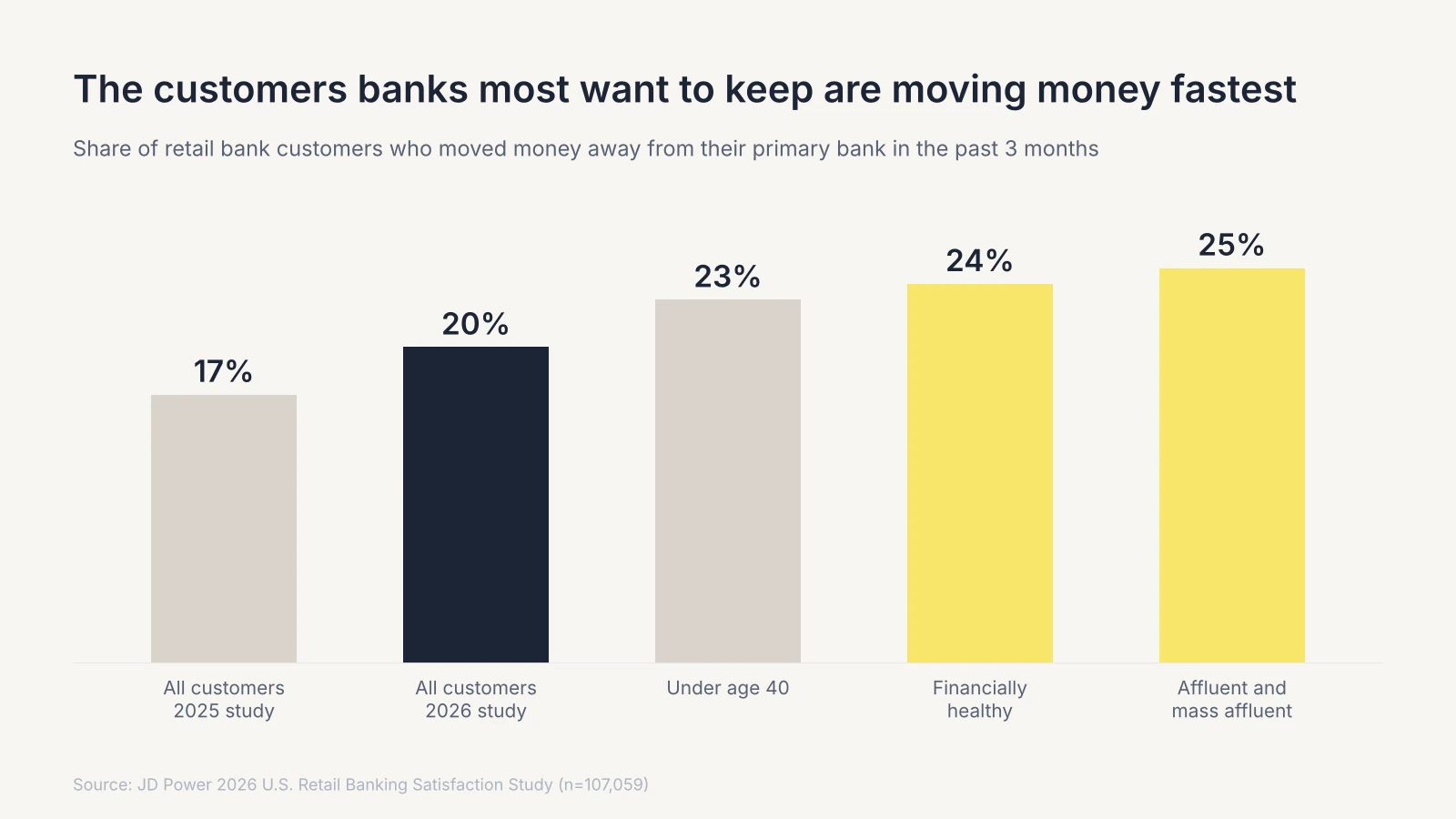
That pattern is now measurable. 20% of retail bank customers moved money away from their primary bank in the past three months, up from 17% a year earlier, according to a 2026 JD Power US Retail Banking Satisfaction study.
It also found that the average checking customer now keeps deposit accounts at three different institutions.
This guide covers how to spot that movement early, which service moments set it off, and how to run retention marketing that answers it before the money is gone.
P.S. Retention requires marketing that speaks to the issues and desires that come after acquisition. Our financial services marketing programs extend to current customers to improve their lifetime value.
One view shapes everything below. We treat creative, media, and measurement as one system, because in retention they can’t be pulled apart. The first signs of attrition tend to show up in places marketing teams already watch: app reviews, complaint threads, comments under a fee change.
The response is a message and a messenger chosen together, since who explains a fee matters as much as the explanation. And every retention play needs a control group. A campaign that “saves” customers who were never leaving has only spent money.
Retention is the most measurable job in bank marketing, and it’s rarely measured that way.
Bank customer retention is the share of customers who keep an active relationship with your bank over a period, whatever their reason for staying.
Bank customer loyalty is the reason.
Experian draws a clear line: loyalty is an emotional connection, while retention is behavior.
A customer can be retained without being loyal, staying only because moving accounts is a chore. As one community bank marketer told Independent Banker, “inertia isn’t loyalty.”
That gap matters more every year, because inertia is weakening. Opening an account now takes minutes on a phone, so the customers who stayed out of habit have the easiest exit they’ve ever had.
| Term | What it measures | What it misses | Where it shows up in your data |
|---|---|---|---|
| Bank customer retention | Customers still active at the end of a period | Money that left while the account stayed open | Core banking account status |
| Bank customer loyalty | Willingness to choose and recommend the bank again | Whether balances actually stay | Surveys, NPS, reviews |
| Bank customer attrition | Accounts closed or abandoned | The months of decline before closure | Closure and dormancy reports |
| Soft switching | Money and activity moving to other providers while the account stays open | Little, if you track it; most reports don’t | Direct deposit changes, outbound transfers, balance trends |
| Primacy | Whether you hold the paycheck and daily transactions | Engagement outside checking | Direct deposit plus monthly transaction counts |
Customers now keep the old account open and quietly move money to other institutions first, a pattern JD Power calls soft switching in its 2026 study.
It surveyed 107,059 customers and found that weak moments in the customer journey prompt people to open accounts elsewhere and gradually shift funds, long before anything closes.
The uncomfortable part (as shown in the figure below) is that the groups most likely to move money are the ones carrying the largest balances and the longest future value.
Credit unions aren’t immune. In JD Power’s 2026 credit union study, 59% of members now hold checking, and 56% hold savings at another institution.
Accenture’s global data points from 2025 are the same: 73% of customers engage with banks beyond their main bank.
What to do this month: Add a soft-switching line to your attrition report. Count customers whose direct deposit fell or split, and customers whose outbound transfers to other institutions rose. That number moves months before closures do.
Losing a primary customer costs roughly ten times the deposits of losing a non-primary one. Curinos data, reported by ABA Banking Journal, shows primary customers hold 10 times more deposits and generate 8 times more fee revenue. Replacing them is getting more expensive, too.
To size your own exposure, use this formula:
Annual value at risk = soft-switching customers × average balance moved × net interest margin + soft-switching customers × annual fee revenue per customer
An illustrative example: a bank with 100,000 checking customers and a 20% soft-switching rate has 20,000 money-movers. If each moved $5,000 and the margin is 3%, that’s $3 million in net interest income a year, before counting a single fee.
Banking Customer Retention: Turn 100 Days Into 5 Years
Five routine moments cause most bank customer attrition:
JD Power ranks trust first among the seven dimensions it measures. Its 2026 data also shows the top-performing banks treat everyday moments (alerts, transfers, fees, and face-to-face visits) as chances to reinforce clarity.
Each moment below either builds that trust or spends it.
Unexplained fees are the fastest way to spend trust. In JD Power’s credit union study, 36% of members incurred a fee in the past three months, and only 39% say they fully understand the fee structure, down from 44%.
A problem that takes two calls to fix tells the customer the bank isn’t paying attention. Satisfaction with problem resolution rose to 587 at national banks (up 49 points from 2024) and fell to 548 at midsize banks (down 27), as per JD Power 2026 findings. Track your repeat-contact rate by issue type, and give front-line staff the authority to reverse a first-time fee on the spot.
Customers with large idle balances are the easiest targets for online banks. JD Power’s direct banking study found online-only providers build emotional connections by helping customers grow money and avoid fees, with online-bank high-yield savings scoring 689. Tell customers with large checking balances about your best savings option before a competitor does.
A move, a new job, a home purchase, or an inheritance changes where money goes, and each one is a moment when a customer reconsiders the primary bank. Most banks see the signal (a new address, a different payroll source, a mortgage inquiry) and never act on it. Set a trigger for each of those changes and assign a response.
Most of the messages banks send are the ones customers value least. JD Power found credit unions communicate most often about new products and special offers, which deliver low satisfaction, while ways to save money and financial advice drive higher satisfaction and are sent less often.
The bank customer retention strategies that work fix the trust moments above first, then use marketing to show that fix to the customers most likely to leave.
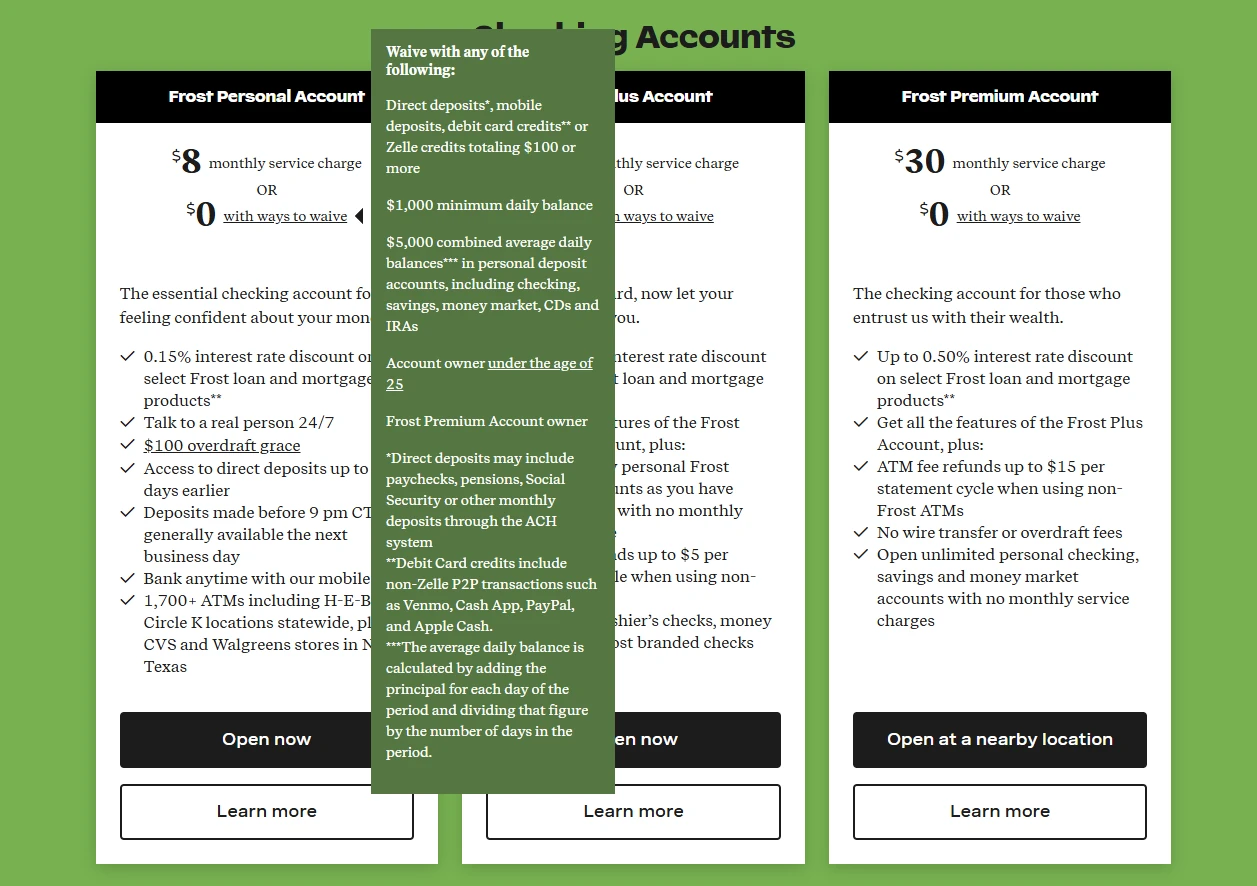
Start with the service problems your own customers name. Frost Bank sends daily email surveys and reviews the results monthly. Its team learned that many customers were paid by methods other than direct deposit, so a fee waiver tied only to direct deposit left them out.
The bank now also waives monthly fees for Zelle credits and mobile deposits, and has added the savings-goal feature customers requested.
Frost has ranked highest in Texas in JD Power’s study for 17 consecutive years, with a score of 757 in 2026.
A survey program won’t produce that alone, but closing the loop on what customers say is a visible part of it.
Make “how to keep more of your money” the default message, and let product offers ride along only when they solve the problem named.
The credit union data above shows why: help is what earns satisfaction.
This is where voice-of-customer research can come in handy. Ask about money problems before product preferences. Audit last quarter’s sends by type and see which side of that split your calendar sits on.
Price for the whole relationship, and reach rate-sensitive customers before they go shopping. McKinsey lists relationship-based incentives and integrated rewards among the three main ways banks deepen primacy.
In practice, contact customers 30 days before a CD or promotional rate matures with the best rate their relationship qualifies for.
Primacy now depends on daily use as much as on the paycheck. In the UK, McKinsey found the share of customers receiving salary into their primary account stayed flat between 2023 and 2025 while transaction primacy fell about two points, as challengers became the everyday bank.
Make direct deposit switching a two-minute task with pre-filled forms, and promote the app features people open daily, such as balance alerts and spending categories.
Community banks should name exactly what they do locally, and repeat it. Ben Pankonin of Social Assurance told Independent Banker that young customers often name megabanks as the most locally active, because those banks market it.
BTC Bank hosts customer appreciation lunches in 25 communities, drawing 200 to 650 people each, and Bank Five Nine’s CEO visits a small business customer every month in a Facebook series called Tim’s Treat.
Younger customers learn about money where trusted experts rarely show up.
A 2023 FINRA Foundation and CFA Institute study found 48% of US Gen Z investors learn about investing on social media, yet only 12% call it their most trusted source, behind family (27%) and financial professionals (24%).
Put your own experts, branch staff, and vetted creators into that feed, with compliance review and clear disclosure baked into the creative strategy.
| Strategy | Trust problem it answers | First move this quarter | Metric to watch |
|---|---|---|---|
| Fee clarity and first-contact resolution | Surprise fees, repeat contacts | Rewrite top three fee disclosures; add pre-fee alerts | Fee disputes, repeat-contact rate |
| Money help over product offers | Messages that feel like selling | Rebalance the send calendar toward savings and advice | Opt-outs, balance trend after sends |
| Relationship pricing | Rate shopping at maturity | Pre-maturity outreach with relationship rate | Renewal rate on maturing balances |
| Direct deposit and daily app use | Loss of everyday relevance | Pre-filled direct deposit switch flow | Primacy rate, monthly active users |
| Specific local proof | “Big banks do more here” perception | Monthly local story series | Local share of new accounts |
| Trusted people in the feed | Young customers learning elsewhere | Pilot with staff experts and two vetted creators | Under-40 money-mover rate |
The earliest sign of bank customer attrition is usually a payroll change: direct deposit reduced, split, or redirected to another institution.
Other signals follow a recognizable pattern. This table is a working diagnostic for churn analytics in banking.
| Signal | What it likely means | What to check next | Who acts |
|---|---|---|---|
| Direct deposit reduced or split | Customer opened an account elsewhere | Destination of new outbound transfers | Retention marketing |
| New recurring transfers to another bank or fintech | Soft switching is underway | Total monthly outflow compared with the prior quarter | Retention marketing |
| Average balance down three months in a row | Money is being moved deliberately | Whether it’s one large withdrawal or a steady drift | Relationship or branch team |
| App logins falling | Daily banking moved to another app | Card spend on your debit card | Digital team |
| Fee disputes or unresolved complaints | Trust damaged recently | Whether the complaint closed in one contact | Service team |
| CD or promotional rate maturing | Rate-shopping window opening | Customer’s total relationship value | Deposit pricing |
| Address change or mortgage inquiry | Life event underway | Products the event usually needs | Retention marketing |
| Negative review or social mention | Public signal of a private problem | Account history for that customer | Service and social teams |
Use a predictive churn model once a points-based score is running and your first-party data is joined up. Before that, the model has nothing reliable to learn from.
Start with a points-based score before investing in a model. Assign points per signal, rank customers weekly, and work the top of the list.
Predictive models help later, but they fail when they’re disconnected from strategy, and a model is only as good as the first-party data it feeds on.
A banking retention marketing program connects four things: the trigger that shows risk, the message that answers it, the messenger who delivers it, and a holdout that proves it worked.
| Trigger | Message | Messenger | Channel | Success metric |
|---|---|---|---|---|
| Direct deposit split | What you’d lose by moving, plus easy ways back | Relationship manager or branch lead | Call, then email | Direct deposit restored |
| CD maturing in 30 days | Relationship rate available today | Bank, personalized | Email and in-app | Renewal rate |
| Fee incurred | Why it happened and how to avoid it next time | Service team | In-app message | Repeat fees, disputes |
| Complaint closed after 2+ contacts | Apology and what changed | Named manager | Phone | Balance trend over 90 days |
| Address change | Local branch, new-home checklist | Local branch staff | Email, mail | Products opened |
| Balance down 3 months | Savings help sized to their balance | Financial coach or vetted creator content | Paid social, email | Balance stabilized |
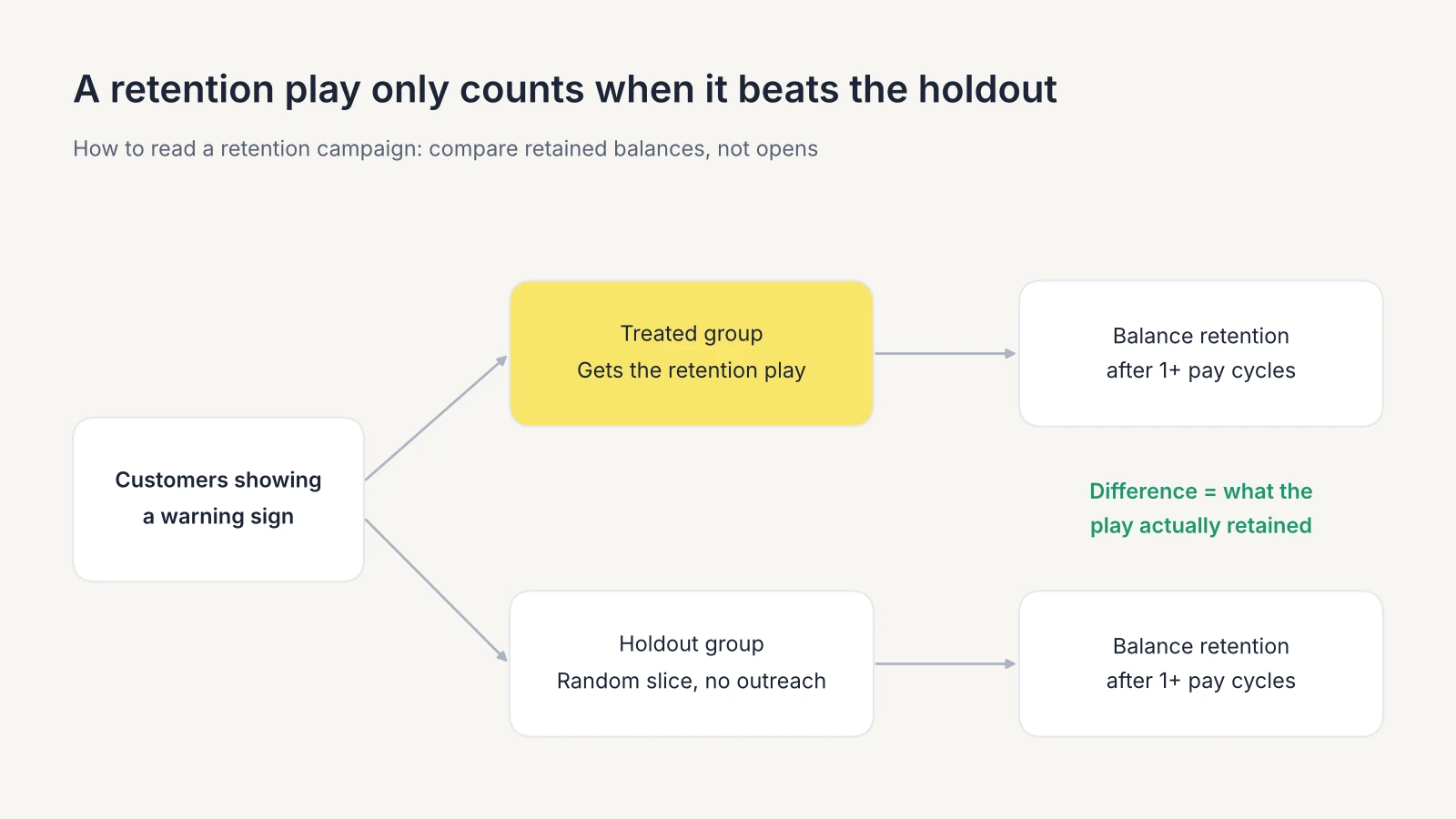
Steps 5 and 6 are where most programs fall apart, and they’re the parts our measurement team sets up before the first send.
Win back soft switchers first: their account, login, and relationship history are still in place, so one well-aimed message can restore the relationship.
| Customer state | Win-back move | What to avoid |
|---|---|---|
| Soft switcher: account open, money moving out | Personal outreach naming the problem and the fix, plus relationship pricing if value justifies it | Generic promos that ignore why they moved |
| Dormant: account open, no activity | Reactivation offer tied to a real need, such as early pay or savings goals | Fee charges that push them to close |
| Closed in the last 90 days | One message acknowledging the reason they left and what has changed | Repeated sequences that read as pressure |
| Closed more than a year ago | Include in acquisition targeting, with no win-back framing | Treating them as a retention audience |
Know when to stop.
A customer who has ignored two different messages from two different messengers has given you an answer, and that budget does more good on customers who are slipping but haven’t gone.
Incremental balances retained against a holdout group is the one bank customer retention metric that shows whether marketing changed anything.
The standard retention rate still belongs on the dashboard. Calculate it as ((E − N) ÷ S) × 100, where S is customers at the start of the period, E is customers at the end, and N is new customers acquired during it.
| Metric | How to calculate | What it shows | Caveat |
|---|---|---|---|
| Customer retention rate | ((E − N) ÷ S) × 100 | Accounts kept | Misses soft switching entirely |
| Primacy rate | Customers with direct deposit and regular monthly transactions ÷ active customers | Who treats you as their main bank | Definitions vary; fix yours and keep it |
| Balance retention | Balances at period end from customers active at start ÷ starting balances | Money kept, including soft switchers | Rate moves can distort it |
| Products per primary customer | Products held ÷ primary customers | Relationship depth | Product count can be inflated by bundles |
| First-contact resolution | Issues resolved in one contact ÷ all issues | Service trust | Needs consistent tagging |
| Incremental retained balances | Treated group balance retention minus holdout balance retention | What marketing actually changed | Needs a random holdout |
Around 85% a year is a realistic reference point, considering ABA Banking Journal, citing Kearney, puts typical bank attrition at 15% a year.
Treat published benchmarks with care. A 1990 study by Bain’s Fred Reichheld and David Kenny in the Journal of Retail Banking found the average retail bank retained 80% to 85% of its depositors, a useful historical anchor.
Many newer figures trace back to cross-industry roundups: Experian’s 75% banking benchmark, for example, cites a Shopify data page. Your own trend line is the more reliable comparison.
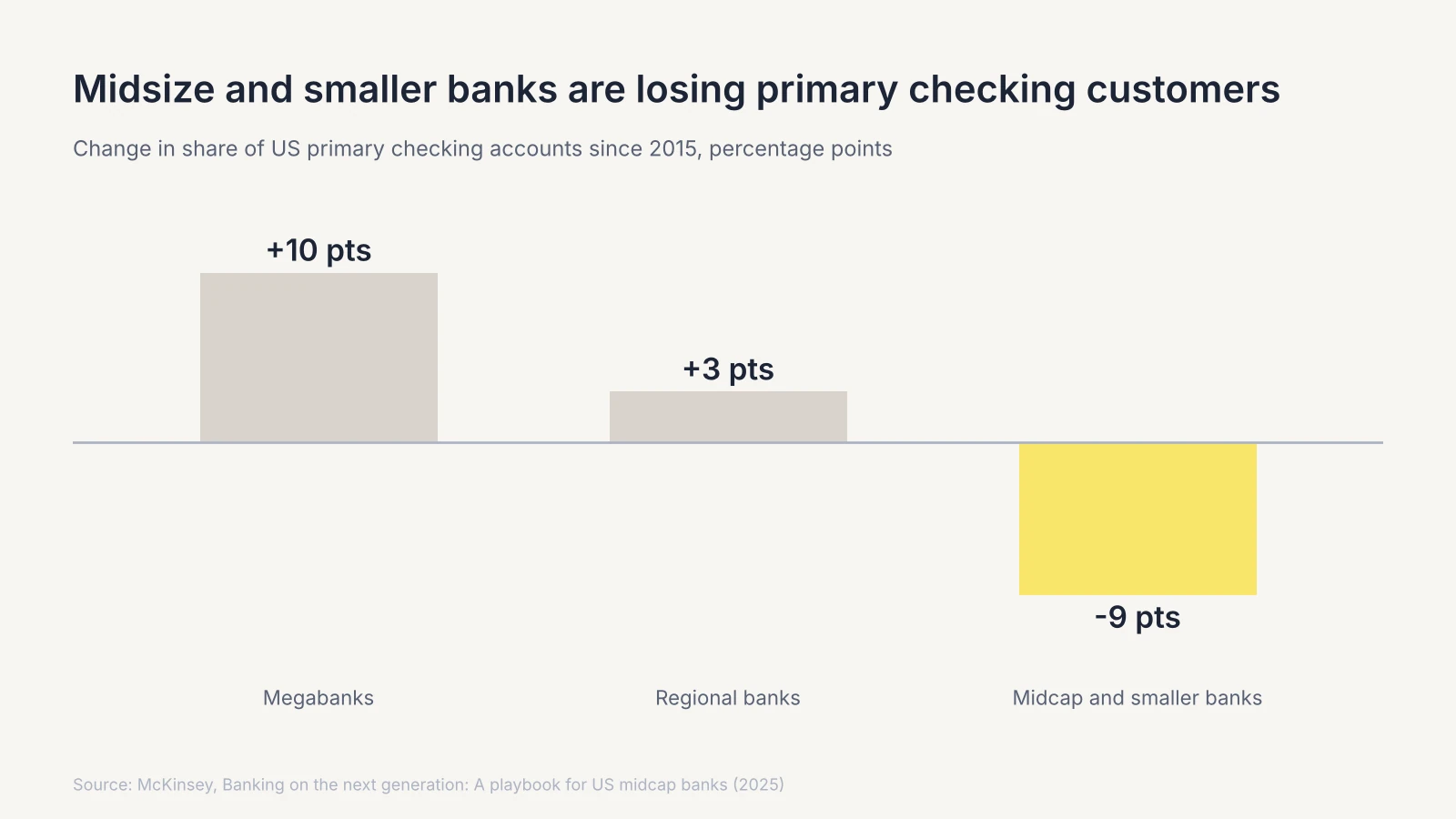
Midsize and smaller banks face the steepest primacy losses: their share of primary checking accounts is down nine points since 2015, according to McKinsey.
| Bank type | Retention advantage | Retention risk | First priority |
|---|---|---|---|
| Midsize and smaller banks | Local relationships and named people | Primary checking share down 9 points (McKinsey); problem resolution at 548 and falling (JD Power) | Fix problem resolution and show local proof |
| Regional banks | Gained 3 points of primary checking share (McKinsey) | Customers compare them to national banks’ digital tools | Daily app use and direct deposit |
| National banks and megabanks | Gained 10 points of primary share (McKinsey); problem resolution up 49 points (JD Power) | Scale makes routine moments feel impersonal | Personalized alerts and money help |
| Online banks and neobanks | Emotional connection through personalization; online checking scores 674 (JD Power direct banking study) | Neobank checking scores 622, with weaker service and fraud handling | Service quality and fraud resolution |
| Credit unions | 725, 68 points above retail banks (JD Power) | Score down 4 points; 59% of members bank elsewhere | Send help in place of offers |
Fieldtrip can help banks and fintechs find where customers are slipping and build the marketing that keeps them. Engagements start with a strategic audit of channels, content, reporting, and performance gaps.
Small teams work from one shared strategy, and Fieldtrip stays accountable for the overall outcome. You can start with the one specialist team closest to the problem, whether that’s measurement, creative, or media, and add more later.
Specialist agencies in the Fieldtrip network, such as inBeat for creator content, plug into the same plan.
Book a call with Fieldtrip to review your attrition and soft-switching data, identify the segments at highest risk, and outline the first three retention plays worth testing.
Only for customers whose total relationship justifies it. A blanket rate match reprices balances that were never leaving. Offer relationship pricing to primary customers who show soft-switching signals, and test it against a holdout so you can see how much retained balance the rate actually bought.
Watch your side of every transfer. Direct deposit amounts, outbound transfer destinations, and the apps customers pay from your account are all signals you already hold. Recurring transfers to named online banks or fintechs are the clearest one.
Yes, with the same review any ad gets, plus clear disclosure. Paid relationships need disclosure under FTC endorsement guidance, and bank advertising rules on deposit insurance and accurate rate claims still apply to a creator’s script. Brief the claims in writing, review the final cut, and keep records of both.
It would make switching easier if it takes effect. The rule was finalized in October 2024 with a first compliance date of April 1, 2026, but it is now enjoined and under reconsideration. Plan retention as if customers will soon be able to move their data to a competitor in a few taps.
At least one full pay cycle after the outreach, and past the balance decision the play targets, such as a CD maturity date.