






















Banks hold years of transaction history on every customer, and customers have never found it easier to leave quietly. Most don’t close the account. They open another one somewhere else and let the balance drift.
JD Power’s 2026 U.S. Retail Banking Satisfaction Study found the average checking customer now keeps deposit accounts at three different institutions, and 20% moved money away from their primary bank in the past three months, up from 17% a year earlier.
Segments built on age and income can’t see that movement. Segments built on behavior can.
This guide gives you a test for which bank customer segments deserve a plan, the retail segments worth building, and how to activate and measure them.
P.S. If you’d like a second pair of eyes on your current segments, our strategy team can run this exercise with you.
One view shapes everything below. We run creative, media, and measurement as one system, and segmentation is the brief that connects them. A segment that never reaches a creative brief is a spreadsheet tab.
As ad platforms close off demographic targeting for financial products, the segment has to travel inside the ad itself: the person on screen, the money worry they name, the moment of life they’re in.
Media buying then becomes the place where each segment proves it deserves its budget. Some segments will fail that test. That’s the system working.
Bank customer segmentation is grouping customers by what they need from the bank’s marketing: a different offer, message, channel, budget, or timing.
Most definitions stop at “shared characteristics.” That’s accurate and not very useful, because two customers can share an age, an income band, and a ZIP code and still need opposite things from their bank.
A segment and a persona do different jobs:
You need both. The segment tells media and CRM who to reach. The persona tells the creative team what to say.
Bank customer segmentation usually fails at activation: segments get built, but they never reach the offer, creative, or media plan.
When segments do reach the plan, the benefits of customer segmentation in banking are measurable.
McKinsey found that banks running a codified personalization model earned 5 to 15% higher revenue from their campaigns and launched them two to four times faster. Getting there is rare. In the same research:
Bank marketers describe the same gap. In ABA’s 2026 survey, only 9.7% of respondents use data to customize interactions at the individual customer level.
The pattern behind those numbers is consistent. Segments get built for a report, then stall because they have:
Fix any one of those and the segment starts earning its keep. Fix none, and it stays a slide.

Banks use six main types of customer segmentation: demographic and geographic, behavioral, needs-based, life stage, value-based, and relationship or primacy. Most working segments combine two or three of them.
Demographic and geographic segmentation sorts customers by age, income, household size, occupation, and location. This data is easy to get and easy to explain to a board, which is why it dominates most segmentation decks.
It’s also the weakest predictor of what a customer will do next with their money, and the type most restricted in paid media. Use it to filter other segments, for example by branch proximity for an advisory offer.
Behavioral segmentation groups customers by channel use, transaction frequency, balance trends, product usage, and money movement. Your core banking system already records this data, and it changes when the customer’s intent changes. A customer whose transfers to another institution doubled this quarter is telling you something no income band can.
Needs-based segmentation groups customers by financial goals, risk tolerance, attitudes toward debt and confidence with money. These rarely sit in a transaction log, so you collect them through surveys, onboarding questions, and voice-of-customer research. Needs-based segments are the most useful for creative, because they tell you what the ad should say.
Life-stage segmentation tracks where a customer is (first job, family, retirement), and life-event segmentation marks the moment their banking needs change: a move, a marriage, a new child, a home purchase. Events matter more for marketing because they come with a deadline.
Value-based segmentation ranks customers by profitability, share of wallet, and projected customer lifetime value (CLV). Value segments decide budget: how much you can afford to spend to acquire, keep or grow a customer. Projected value is only as good as the assumptions behind it, which is why predictive LTV models often fail when they’re disconnected from strategy.
Relationship segmentation separates customers who use you as their primary bank from secondary and dormant relationships. The clearest primacy signal is direct deposit plus regular bill payments. Most banks skip this type, and given the soft-switching data above, it’s the one that matters most right now.
| Type | Typical data source | Plan lever it usually changes | Main weakness |
|---|---|---|---|
| Demographic and geographic | Account-opening data, census data | Channel | Weak predictor of behavior; restricted in paid media |
| Behavioral and transactional | Core banking, card and digital logs | Timing, offer | Needs clean, current data |
| Needs-based and psychographic | Surveys, onboarding questions, voice-of-customer research | Message | Hard to scale across the full base |
| Life stage and life events | Transaction signals, CRM updates, applications | Timing, offer | Events are easy to detect late |
| Value-based (CLV) | Profitability and product data | Budget | Projections drift without recalibration |
| Relationship and primacy | Direct deposit, bill pay, external transfers | Offer, message, budget | Requires tracking money leaving the bank |
Choose a bank customer segment only if it changes at least one of five plan levers: offer, message, channel, budget, or timing.
The plan-change test is a five-question check you run on every candidate segment before it gets a campaign. For each lever, ask whether this segment needs something different from your default:
If the answer is no to all five, the segment doesn’t need its own plan. Merge it with the closest segment or delete it. A segment that changes only the channel usually belongs inside another segment, with the channel difference handled in the media plan.

Pro Tip: Run step 3 with the creative lead and the media buyer in the room. If neither can describe what they’d do differently for a segment, it has failed the test, however clean the clustering looks.
Use a scorecard like this one to record each decision. The rows below are illustrative.
| Candidate segment | Lever it changes | Size | Value at stake | Reachable channels | Decision |
|---|---|---|---|---|---|
| Affluent customers moving money out | Offer, message, channel, budget, timing | Medium | High | CRM, advisor, email, broad paid social | Keep |
| New checking customers without direct deposit | Message, timing | Large | Medium | Onboarding email, app, SMS | Keep |
| Mortgage holders with no savings product | Offer, message | Medium | Medium | CRM, app, direct mail | Keep |
| Customers who visited a branch in the past year | Channel only | Large | Mixed | Branch, mail | Merge |
| Customers aged 35 to 54 | None | Large | Mixed | Restricted in paid social and search | Kill |
Here’s the test applied to one segment. In early 2026, JD Power found that 25% of affluent and mass-affluent customers moved money away from their primary bank in the past three months, the highest rate of any group the study reported.
Define the segment by behavior: affluent-tier customers whose outbound transfers to other institutions rose in the last 90 days.
“Customers aged 35 to 54” fails the same test. It changes no lever on its own, and on Meta and Google you can’t target it for a banking product anyway.
Most banks can start customer segmentation with data and systems they already own: transaction and product data, a place to define segment rules, a way to trigger campaigns, and a way to measure holdouts. External data helps later, once a specific lever needs it.
The data behind the segments in this article:
The tools that turn those segments into campaigns:
Build in that order. A bank with clean transaction data and a working trigger in its CRM can run every segment in the next section.
Six retail banking customer segments belong in most 2026 strategies: soft switchers, new-to-bank customers, product-gap households, life-event customers, at-risk affluent customers, and digital-first customers under 40.
Soft switchers still bank with you but are moving money elsewhere. Given how many customers now spread deposits across banks, this segment is usually larger than attrition reports show. Define it by declining balances, falling transaction counts, new external transfers or a lost direct deposit.
The plan: a retention message tied to what they already use you for, triggered by the first signal.
New-to-bank customers are the most fragile segment you have. In a 2024 Digital Banking Report survey of more than 200 financial institution executives worldwide, respondents estimated that 34% of new accounts left within the first year, and direct deposit penetration among new accounts was only 55%.

Onboarding campaigns triggered by account opening drew an 8.84% response rate across 2,989 campaigns in Marquis’s 2025 client data, the highest of any campaign type.
Give the onboarding sequence two jobs: direct deposit and a second product.
Product-gap households are missing a product that similar households hold, such as a checking customer with no savings account or a mortgage at another lender. In the same Marquis data, cross-sell campaigns built on gaps relative to peer households averaged a 6.74% response rate.
This segment changes the offer and the message: the specific product, framed around the gap.
Life-event customers show signals of a move, a home purchase, a new child, or a retirement. Those signals include address changes, new recurring payments, large deposits, and mortgage inquiries. Events change timing more than any other lever, so build the trigger first and the creative second.
At-risk affluent customers combine the highest value with the highest movement rate in JD Power’s data. The worked example above covers the full plan. The extra decision here is service: route these customers to a named person before any automated sequence starts.
JD Power found 23% of customers under 40 moved money in the past three months. Treat age as context and define the segment by behavior: app-only usage, no branch visits, frequent peer-to-peer payments.
Here’s a quick cheat sheet:
| Segment | Defining signal | Plan change | Primary KPI |
|---|---|---|---|
| Soft switchers | Falling balances, new external transfers | Message, timing | Balance retention |
| New-to-bank (first 90 days) | Account opened in last 90 days, no direct deposit | Message, timing | Direct deposit rate |
| Product-gap households | Missing a product peer households hold | Offer, message | Product penetration |
| Life-event customers | Address change, new recurring payments, large deposit | Timing, offer | Conversion inside the event window |
| At-risk affluent | Affluent tier plus rising outbound transfers | Offer, channel, budget | Balances retained |
| Digital-first under 40 | App-only usage, peer-to-peer payments | Channel, message | Active-use rate |
Each of these segments needs a media plan built around its own trigger and channel mix. If you want help building those plans, our media team plans and buys segment-level campaigns across paid social and search.
In the US, Meta and Google stop bank advertisers from targeting by age, gender, or ZIP code, and TikTok applies the same limits to credit ads, so most demographic segments can’t be targeted in paid media at all.
| Platform | Products covered | Restricted targeting | In force since | Regions |
|---|---|---|---|---|
| Meta (Facebook, Instagram) | Financial products and services, including bank accounts, credit, insurance, and investments | Age fixed at 18 to 65+, all genders, no ZIP codes, 15-mile minimum radius, no lookalike or saved audiences, no location or detailed-targeting exclusions | January 2025 (credit since 2019) | US; credit ads also Canada and parts of Europe |
| Google Ads | Consumer finance, including credit, banking and checking accounts | No gender, age, parental status, marital status, or ZIP code targeting; radius at least 1 km | February 2024 (credit since October 2020) | US and Canada |
| TikTok | Credit opportunities such as cards and loans | Age 18+ only, no gender, no ZIP code | Not dated in TikTok’s help center; Special Ad Category toggle required | US and Canada |
Meta’s rules are the broadest. Its developer documentation says audience restrictions for financial products and services are enforced with a hard error, so a non-compliant ad set doesn’t launch. Customer-list custom audiences can still be included, subject to an eligibility check.
Google applies the same demographic limits to banking and checking account ads. TikTok’s category is written around credit, so a deposit-only campaign may fall outside it; confirm the classification with your compliance team before launch.
Platform rules are the floor. The Equal Credit Opportunity Act and Regulation B prohibit discouraging applicants on a prohibited basis, and compliance teams apply that to how credit is marketed and to whom.
The regulatory signal has shifted. In 2022, the CFPB issued an interpretive rule saying digital marketers who select audiences for financial firms can be liable as service providers. The Bureau withdrew that rule on May 12, 2025, along with dozens of other guidance documents.
The underlying statutes didn’t change. Treat the withdrawal as a change in enforcement posture and keep fair-lending review inside your segment approval process and your wider marketing risk management. Your compliance team owns that call.
Note: This section describes the rules and is not legal advice.
When the platform won’t let you pick the audience, the creative picks it. Delivery systems show ads to the people who engage with them, so an ad that names a specific situation reaches the people living it.
Build each segment’s creative around three choices:
Then test several persona-and-objection combinations with broad targeting and let delivery data show which combinations find their audience. Your own first-party data can shape that creative without being used for targeting at all.
Judge the variants with the same rigor as any other creative test.
Pro Tip: Write the segment definition into the creative brief as a sentence a viewer would say about themselves. “I just moved, and my bank still thinks I live across town” is a brief. “Recent movers, 25 to 44” is a targeting spec you can’t use.
The following table maps segments to the way creative can be used to target them:
| Segment | Targeting you’d have used | What’s still available | How the creative carries it |
|---|---|---|---|
| Soft switchers | Lookalikes of churned customers | Broad targeting, eligible customer lists | Names the hassle of juggling accounts across banks |
| New-to-bank | Age bands and new-mover interests | Eligible customer lists, broad targeting | Shows a direct deposit switch done in minutes |
| Digital-first under 40 | Ages 18 to 39 | Broad targeting, engagement custom audiences | Creator-style video of a real money routine in the app |
| Home buyers | ZIP codes near new developments | 15-mile radius around cities | Speaks to closing-day stress and the first bills in a new home |
Turn each kept segment into a plan by writing one decision per lever: the message, the channel mix, the budget weight, and the trigger.
Write each segment’s message around the job the customer is trying to get done.
McKinsey describes banks moving from sales lines like “Try our zero percent introductory rate” to journey-based messages like “Here’s how to make your holiday stress-free.”
The rate stays in the offer, and the message leads with the customer’s situation.
Our creative team builds these persona-by-objection variants for paid and owned channels.
Match the channel to the segment’s behavior, and combine channels where the stakes justify it.
In Marquis’s data, campaigns combining direct mail and email averaged a 5.13% response rate, against 3.34% for email alone.
Coordinating that across CRM, mail, and paid media is a campaign orchestration job as much as a creative one.
Weight budget by the value at stake per customer. Most banks still weight it toward cold acquisition: in ABA’s 2026 survey, deposit growth, new customer acquisition and loan growth took 73% of the average marketing budget, with relationship deepening and retention at 26%.
The response data points the other way. Use your media planning process to set spend per segment against value at stake, then move it as holdout results come in.

Trigger campaigns from customer behavior wherever you can.
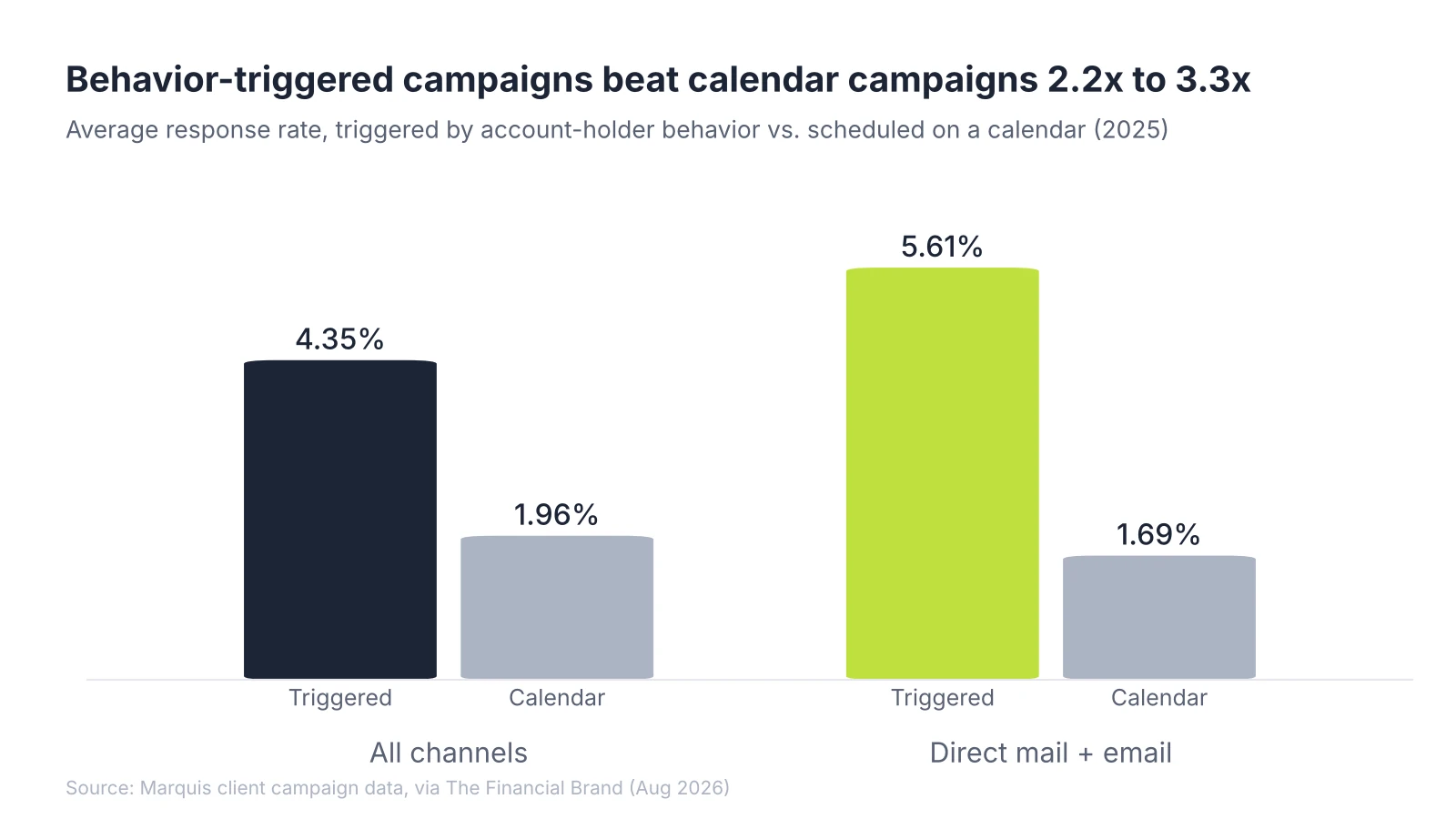
Automated, behavior-triggered campaigns averaged a 4.35% response rate against 1.96% for calendar-based campaigns, and triggered mail-plus-email campaigns reached 5.61% (Marquis dataset).
Keep the gap between signal and outreach short, because the decision a trigger points to doesn’t stay open for long.
AI changes bank customer segmentation in two ways: clustering models find segments people wouldn’t define by hand, and propensity models decide which customer gets which message next.
Clustering algorithms such as k-means and DBSCAN group customers by patterns across many variables at once.
In a peer-reviewed study of a Portuguese bank’s fixed-deposit customers, a combined k-means and DBSCAN model improved clustering accuracy by 15%, split customers into four groups, and linked the marketing plans built for those groups to 16.08% average revenue growth.
The output still has to pass the plan-change test. A cluster nobody can name or brief is a statistical finding with no marketing use.
Propensity models score each customer’s likelihood to need a product or to leave, and next-best-action engines pick the single message to show.
For instance, Commonwealth Bank of Australia’s Customer Engagement Engine now runs more than 2,000 real-time machine learning models across its channels.
Speed matters as much as scale: CBA built one next-best conversation about unused credit card points and had it live across its branch network for roughly 600,000 customers by 2pm the same day.
Measure each segment against a holdout group: a random slice of the segment that gets no campaign, so the difference in outcomes shows what the marketing caused.
Dashboards report what customers in a segment did. A holdout tells you what they did because of you. Three practices keep segment measurement honest:
| KPI | What it shows | Segments it matters most for | Warning sign |
|---|---|---|---|
| Direct deposit and primacy rate | Whether you’re becoming the main bank | New-to-bank, soft switchers | Accounts opened, direct deposit never set up |
| Product penetration | Depth of the relationship | Product-gap households | Cross-sell responses with no retained product |
| Balance retention | Whether money is staying | At-risk affluent, soft switchers | Stable account count, falling balances |
| Customer lifetime value | Long-run value of the segment | All segments, for budget decisions | Projected CLV rising while realized CLV stays flat |
| Incremental response against holdout | What the campaign caused | All segments | Treated and holdout groups converting at similar rates |
Our measurement team sets up segment-level holdouts and reads them alongside the rest of the media plan.

The four most common mistakes are running more segments than you can create for, defining segments by demographics alone, refreshing segments once a year, and weighting budget toward cold acquisition.
Bank customer segmentation pays off when the people who define a segment also shape its creative, buy its media and read its holdout. When those jobs sit with separate teams, segments stall at every handoff.
Fieldtrip’s integrated marketing services keep strategy, creative, media, and measurement in one team, so a segment moves from definition to live campaign to measured result without changing hands.
Talk to our team about your bank’s customer segments and how best to reach them where they’re at.
A regional bank can run as many segments as it can give distinct creative, a named owner, and a measurable holdout. For most regional banks, creative and analyst capacity set that limit well before the data does. Start with the segments tied to your top business decision, and add a new one only after an existing one proves its lift.
Commercial segmentation starts from the business: industry, revenue band, cash-flow pattern, and the owner’s existing relationship with the bank. The plan-change test still applies, but the levers shift toward relationship-manager coverage, treasury products and credit timing. Small-business owners often blend personal and business banking, so a household view of the owner helps.
Document every input variable, remove protected characteristics and close proxies such as ZIP code, and test segment outputs for disparate impact before activation. Keep model segments explainable enough that compliance can see what drives membership. Run that review every time the model is retrained.