





















Artificial Intelligence (AI) is now an integral part of marketing. It’s ingrained in how modern teams plan campaigns, understand customer behavior, create content, optimize media spend, and improve conversion rates.
In fact, HubSpot’s 2026 State of Marketing Report found that 61% of marketers believe AI is causing the biggest disruption the industry has seen in 20 years, while 80% already use AI for content creation.
A separate SAS study reported that 93% of CMOs and 83% of marketing teams are seeing clear ROI from generative AI.
This shift creates a new expectation for brands. If companies are using machine learning, automation, predictive analytics, and AI-powered tools internally, their agency partners need to be on the same bandwidth.
The best AI marketing agencies go beyond using ChatGPT for faster copy or visuals. They build smarter workflows for campaign optimization, audience targeting, customer data analysis, content generation, personalization, performance monitoring, and marketing automation.
Disclaimer: This list focuses on marketing agencies that are big on using AI technologies to improve digital advertising results for clients. It does not cover AI search or generative engine optimization (GEO). For that category, check our list of the top Generative Engine Optimization agencies.
An AI marketing agency helps you leverage technologies such as generative AI, machine learning, and advanced analytics to make marketing faster, smarter, and more efficient.
Basically, such agencies use AI tools for a variety of purposes and processes within the marketing and advertising ecosystems.
In practice, this can include:
In short, they use AI wherever possible to deliver better results. Some agencies even have their own proprietary AI platforms where their clients' data is consolidated and analyzed for insights.
The following Bloomberg video explains how AI is changing marketing (which makes working with an AI-oriented agency partner all the more important).
Below, we have shared the top AI marketing agencies globally, selected after rigorous research and vetting for expertise, experience, and use of AI technologies.
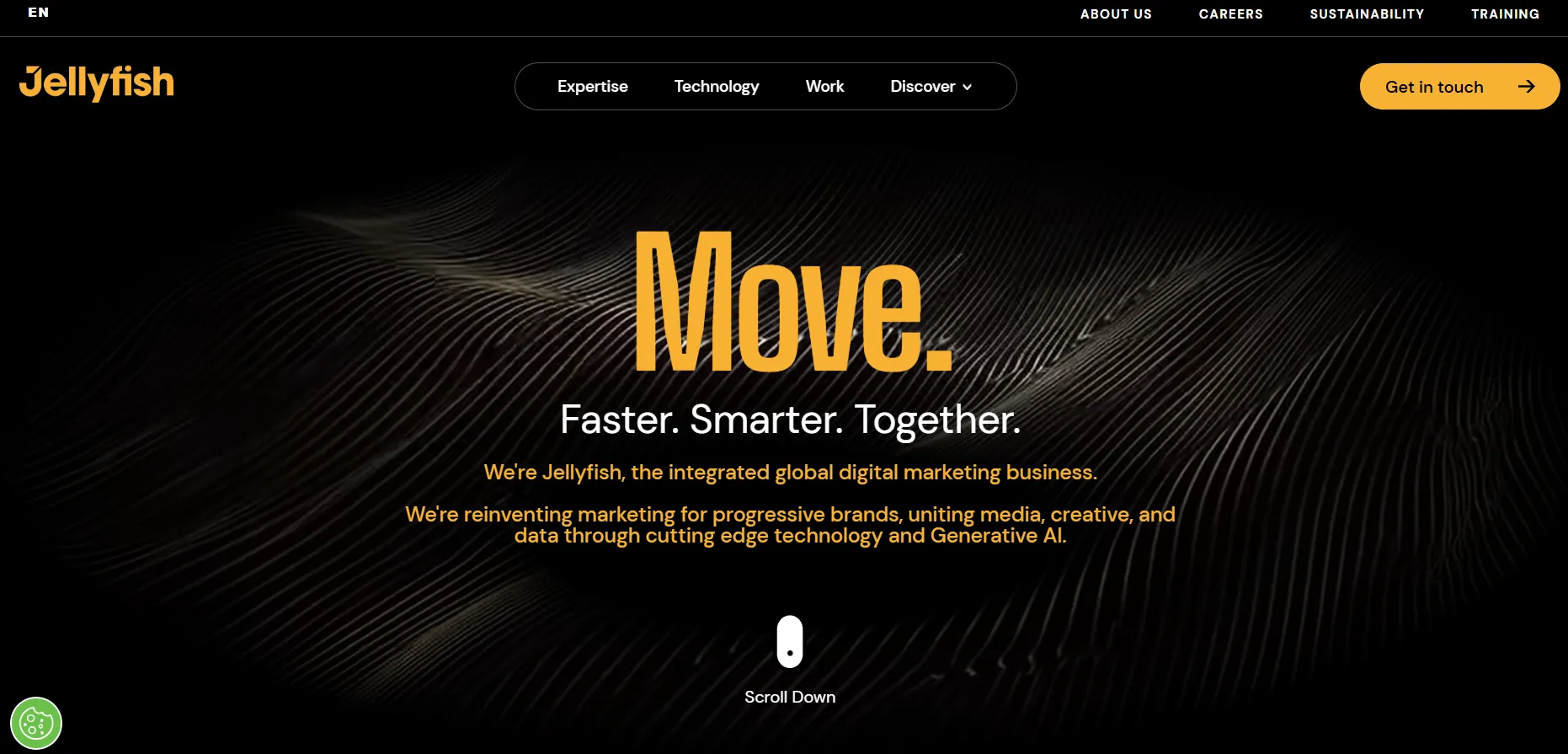
Jellyfish is a global digital marketing business that brings together media, creative, data, technology, and generative AI for enterprise brands. The agency helps you move faster and smarter by using AI across campaign planning, creative production, media optimization, audience insights, and performance measurement.
We appreciate how Jellyfish uses proprietary tools Pencil for faster asset creation, Now Next Soon for AI-powered media-plan simulations, J+ Bidding for dynamic budget optimization, and Social Agents for tracking cultural signals in real time.
In addition to using AI for content creation and automation, Jellyfish has built a broader AI-enabled marketing system. It supports creative testing, media buying, data analysis, campaign optimization, and multilingual content delivery. Jellyfish says its AI platform helps deliver thousands of assets 55% faster.
A 2025 report on its AI-powered media in-housing platform said its agentic workflows can reduce campaign launch times by 65%, lower infrastructure costs by 22%, and improve campaign performance by an average of 30%.
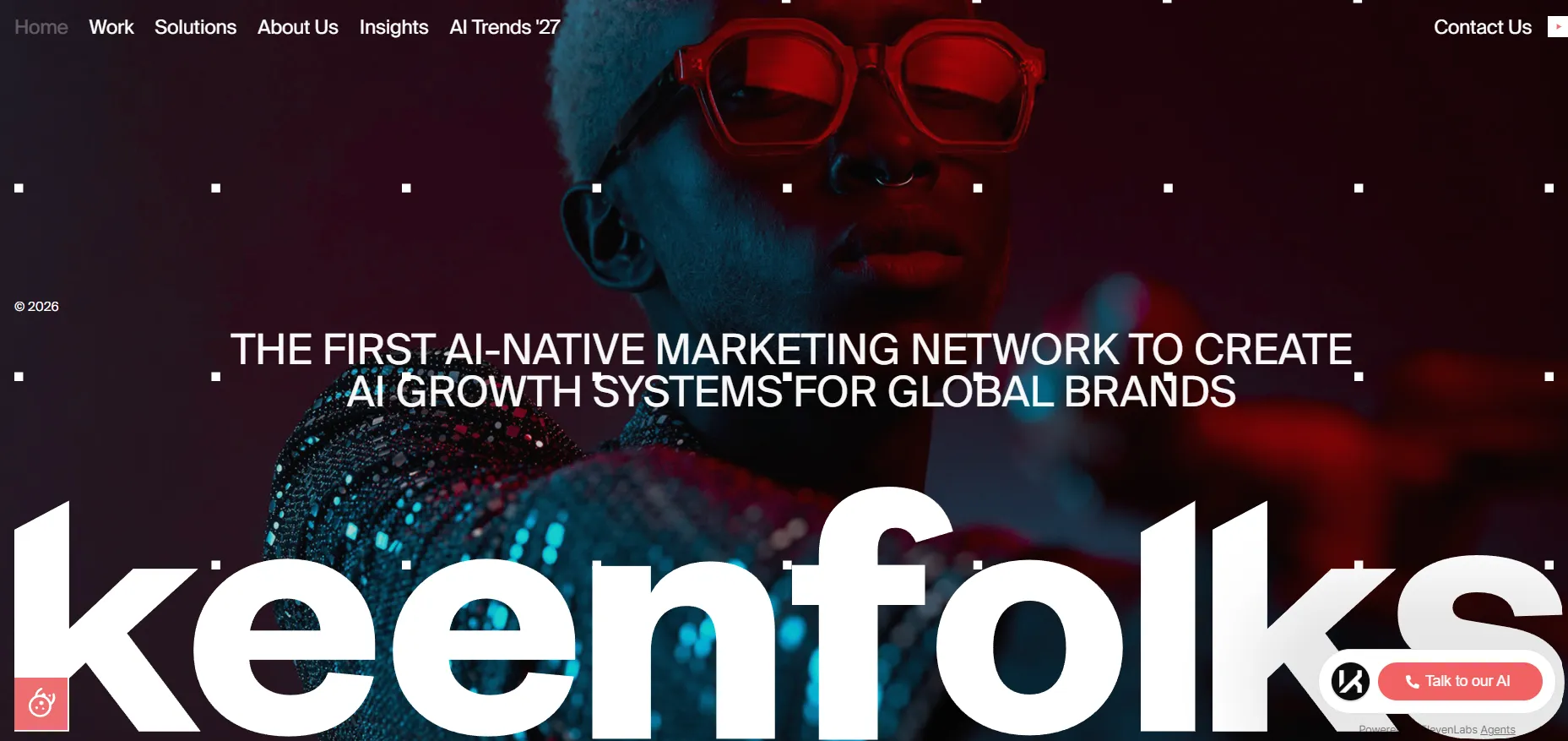
KeenFolks is an AI-native marketing agency network built for large, complex brands that want to connect data, technology, customer experience, and marketing execution. The agency offers proprietary Integrative AI® methodology and K OS_, a marketing operating system designed to connect intelligence, platforms, workflows, and experiences into “AI Growth Systems” for enterprise brands.
They’ve worked across global strategy, regional adaptation, and local implementation in more than 40 markets. For brands looking beyond basic AI tools, Keenfolks is a good choice because it focuses on using AI to fix fragmented marketing operations, not just speed up content creation.
Its AI marketing solutions include an AI Interactive Media Dashboard for media performance, budget allocation, and audience optimization; AI Experience Agents for website guidance and customer support automation; and AI Profiling Engagement for customer data integration, personalization, and loyalty.
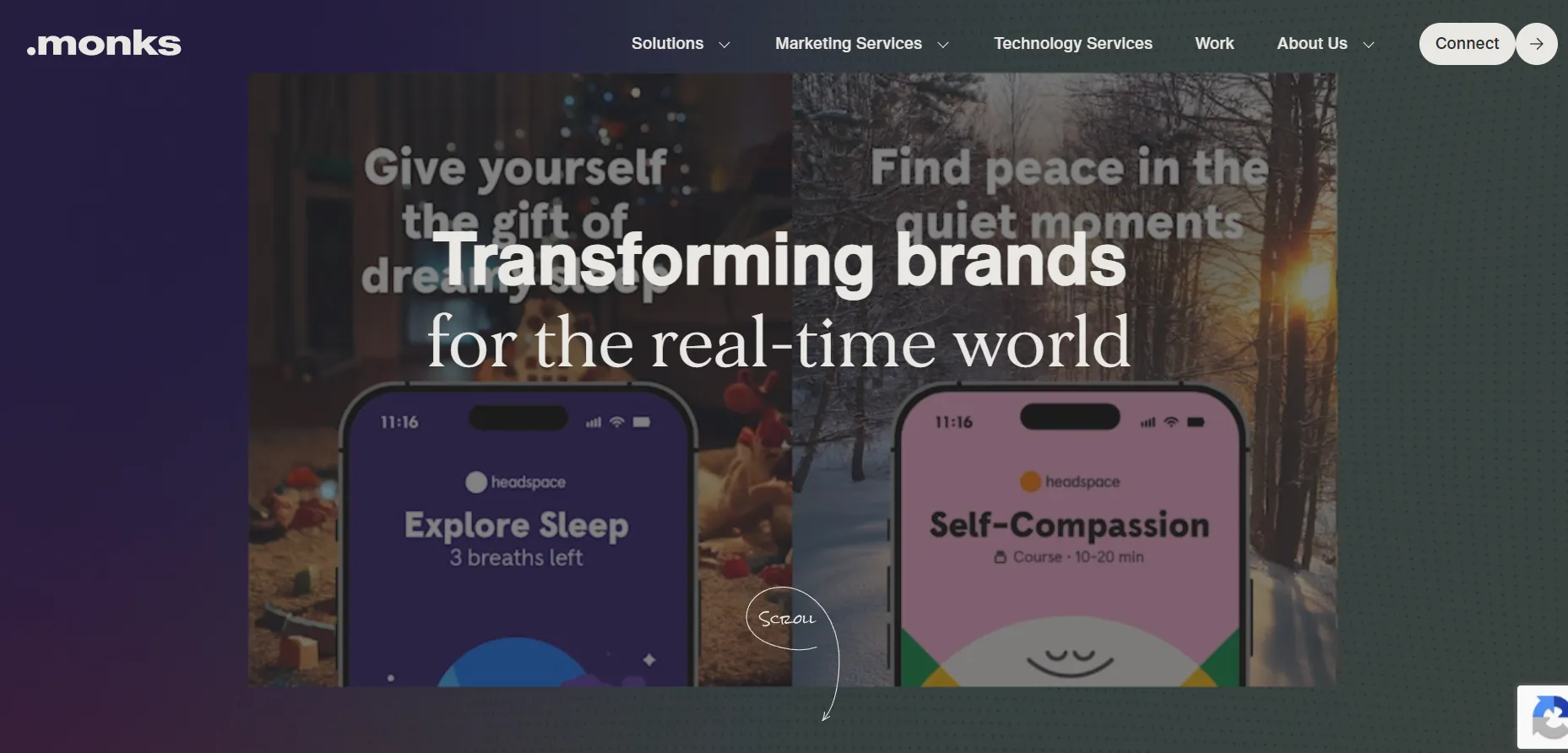
Monks is a global digital-first marketing and technology services company that combines content, data, media, creative, experience, platforms, commerce, and AI. The agency says it helps brands operate in a “real-time world,” with services such as Media Acceleration, Marketing Orchestration, Real-Time Brands, and AI Transformation.
Its AI offering is built to move marketing teams beyond manual workloads to AI-native strategy, orchestration, and execution. Monks.Flow is an AI-powered managed service that deploys specialized agents across the marketing ecosystem.
With its global presence and AI-centric tech stack, it’s better suited for enterprise brands that need automation in everything from media planning to ad testing. Plus, its AI Campaigns solution is designed to improve creative production, cultural relevance, performance optimization, and production costs.
We also like that Monks offers AI consulting for AI readiness, workflow transformation, and scaling human-centric technology solutions. It was even named Adweek’s inaugural AI Agency of the Year.
Fieldtrip is a full-service marketing agency that integrates strategy, creative, media, and measurement into a single operating system for AI-focused brands. The agency is relevant for companies that want AI-era marketing without fragmented handoffs between creative teams, paid media buyers, analysts, and strategists.
Fieldtrip leverages AI tools and features across media buying, creative production, and measurement/attribution, turning them into a unified ecosystem. Its nimble, dedicated teams balance AI efficiency with human intervention to consistently test strategies, creators, and ad assets for paid social, paid search, programmatic, and connected TV campaigns.
For brands evaluating AI-powered agencies, Fieldtrip is a strong fit because its model is built around data-driven creative systems, fast testing, performance analytics, and continuous optimization. Fieldtrip has delivered campaigns in more than 20 countries with a truly global, multilingual team of marketers.
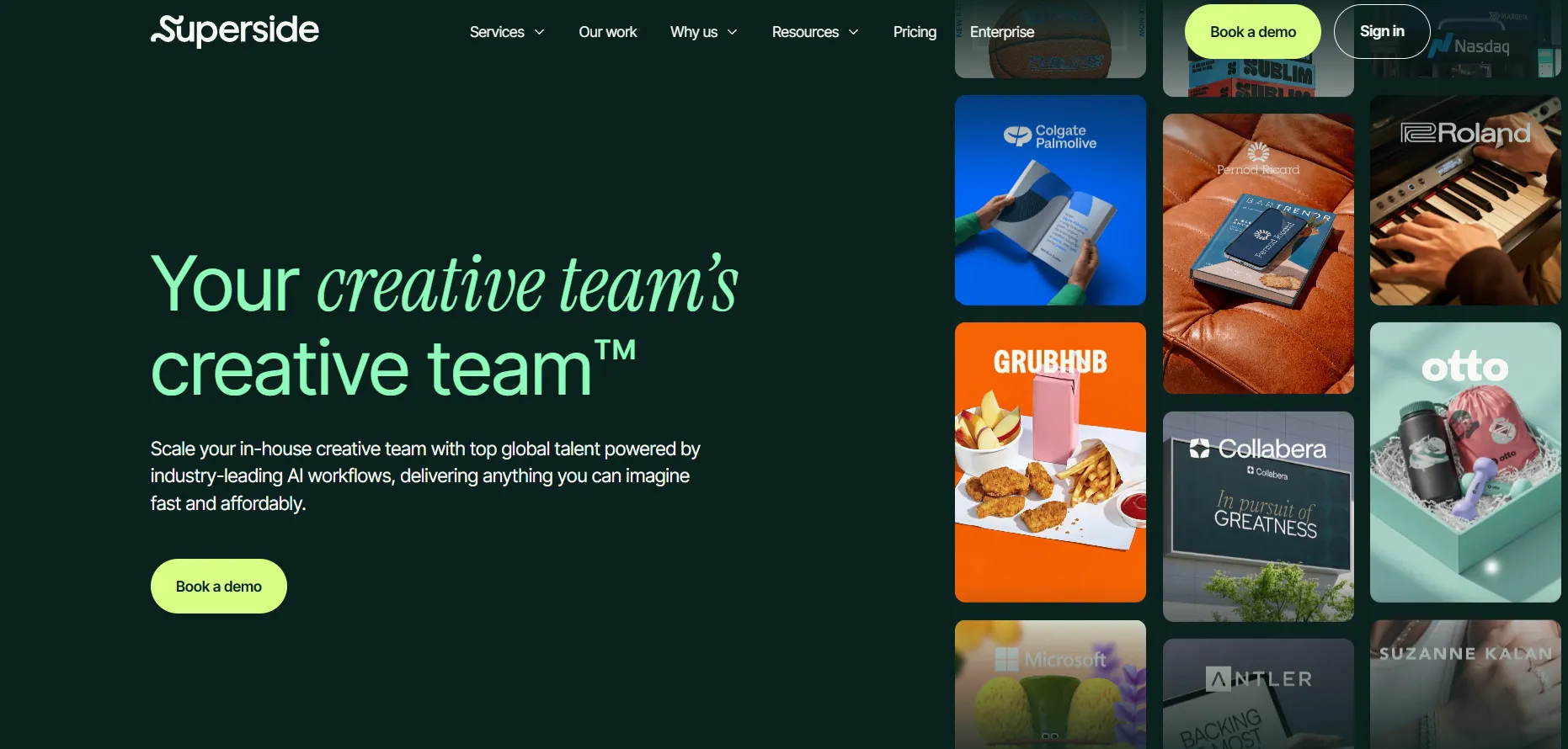
Superside is an AI-powered creative service built to help in-house marketing and creative teams scale production without relying only on freelancers, traditional agencies, or standalone AI tools.
The company calls itself “your creative team’s creative team,” which explains exactly what they do. They offer global creative talent, AI-first creative systems, and a flexible subscription model for enterprises and mid-market companies to empower their own creative teams.
Its services cover ad creative, video production, motion design, email creation, web design, design systems, product design, copywriting, and campaign strategy. So it’s more of a creative agency than a full-fledged marketing agency that also runs and measures campaigns.
It’s a good fit for teams facing creative challenges that need faster campaign assets, more ad creative variations, and better brand consistency. It can also create AI-generated content for ads and organic social for brands that want to explore AI with their audiences.
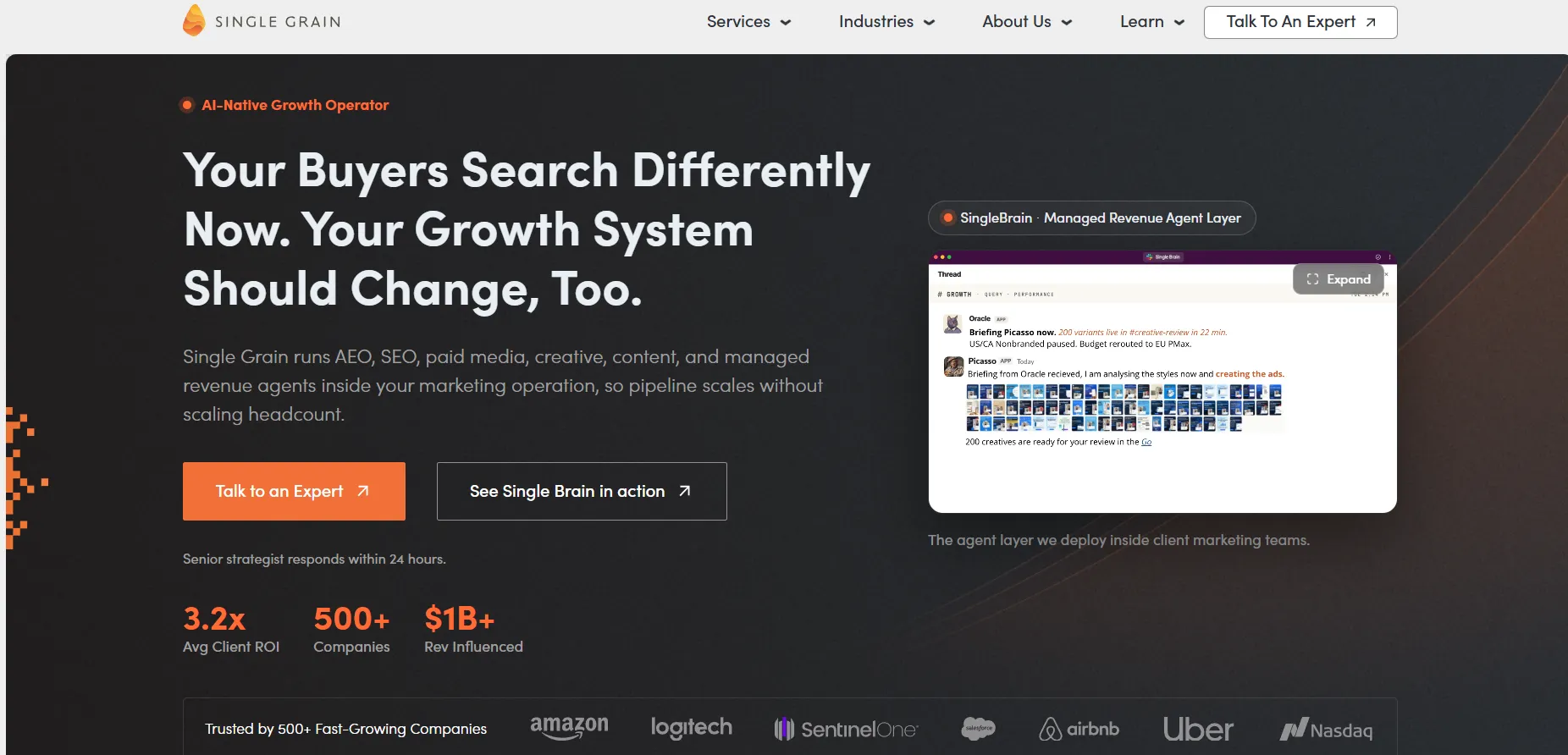
Single Grain is a revenue-focused digital marketing agency that covers SEO, paid media, creative, content, CRO, analytics, and AI-driven growth strategy. It works with both B2B and B2C companies, particularly at the enterprise level.
The agency builds “pipeline-focused systems” instead of one-off campaigns, which makes it a better fit for long-term growth programs across SEO, paid media, AEO, and conversion strategy.
On the AI side, Single Grain uses proprietary tools while also integrating with each client’s existing stack. This can work well for companies that have already invested in internal AI tools and need an agency partner that can connect strategy, execution, and measurement.
The agency also has AI-enabled products and systems such as ClickFlow for AI-powered content optimization, Karrot for B2B LinkedIn advertising, and Single Brain as a client operating layer for AI agent execution.
Wpromote is an independent full-funnel digital marketing agency that covers strategy, media, creative, and data to help brands improve both brand growth and business performance. They say they break down the barrier between “brand and bottom line,” with services built across media, creative, data, and strategy.
And to do that, they use AI-powered marketing technology to support campaign monitoring, forecasting, creative analysis, media optimization, and measurement.
The agency’s proprietary platform, Polaris IQ, is central to its AI-enabled offering. It’s a growth system that connects creative, media, data, and measurement insights, with features for AI-ready data foundations, creative testing, bid and budget optimization, forecasting, and budget allocation.
WPromote has won awards such as the US Agency Award and the Clio Awards.
VCCP is a creative agency that calls itself a ‘global challenger network’ for building big brand platforms and integrated campaigns for major brands. Within VCCP, there’s a dedicated AI creative agency called faith, which it launched in 2023 as the group’s generative AI creative shop for new and existing clients.
faith works across its international offices and supports its global client roster, with AI already used across media, data, planning, production, and UX/UI capabilities.
VCCP’s AI approach is best suited for brands that want to use generative AI to accelerate creative development while keeping strong human oversight. Its AI team includes technologists, prompt engineers, creatives, strategists, makers, and data analysts. Plus, its AI policy is built around transparency, authenticity, compliance, and ethical use.
But it’s a marketing agency at its core, with capabilities like advertising, branding and design, B2B, content, social, influence, and data analysis. So it can cover virtually all marketing and advertising needs of a brand.
Brainlabs is a full-service media agency built around the idea that marketing should be measured against revenue. The agency combines people, processes, and AI agents to support full-funnel media, measurement, and creative, with services across paid media, analytics, performance creative, influencer marketing, SEO, retail media, site experience, and Google Marketing Platform.
Brainlabs’ AI is trained on 13 years of experiments through Cortex AI and Hippocampus, its proprietary repository of more than 2,500 logged experiments across hundreds of clients.
The agency is strongest in AI-powered media buying, experimentation, and performance optimization. Its proprietary Cortex platform combines AI-driven optimization, intelligent automation, and live reporting. In fact, according to Microsoft Advertising, Cortex includes hundreds of features to automate the marketing lifecycle.
Power (Power Digital) is a tech-enabled growth marketing agency that combines marketing strategy, consulting, data intelligence, creative, and performance media. The agency is best suited for brands that want AI marketing directly tied to revenue, customer value, and profitability.
Its proprietary platform, nova, analyzes first-party data to help teams uncover insights, reduce wasted ad spend, forecast revenue, and make smarter marketing decisions. Power Digital says nova is trusted by 400+ brands and manages more than $800 million in ad spend.
The agency offers a wide range of advertising services across virtually every medium. It also supports creative and strategy, so clients can get the whole nine yards of marketing with a single vendor.
Generative AI can be instrumental in the behind-the-scenes work of a successful campaign. Gen AI tools can power creative ideation, content design, testing, and dashboards for campaign monitoring.
You should work with an agency that balances the benefits of gen AI with human marketing expertise. Such an agency will do better than one that doesn’t use AI tools at all or relies too much on them.
Let’s explore why you should work with one of the AI marketing agencies listed above:
We recommend looking for actual AI use in services agencies offer, creative testing, CRM/CDP experience, predictive analytics, revenue-focused reporting, and transparency around the tech stack.
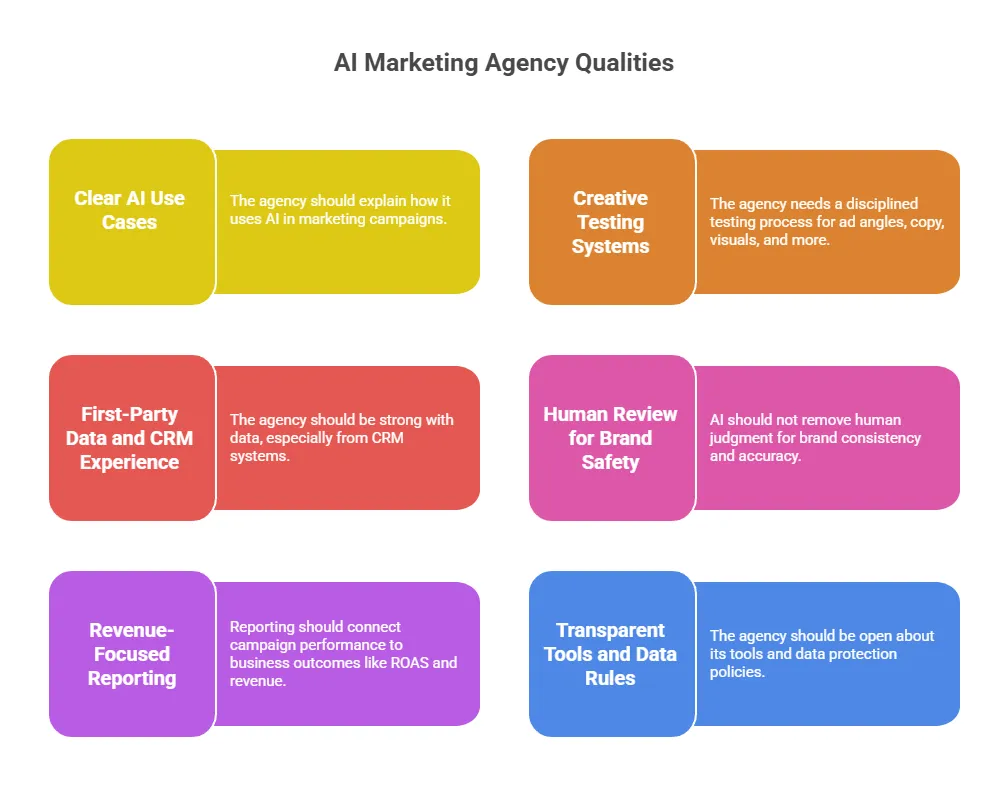
Let’s dive into specifics:
The agency should be able to explain exactly how it uses AI in marketing campaigns. Look for practical use cases like paid media testing, content workflows, customer segmentation, SEO research, lead scoring, reporting automation, customer journey mapping, or campaign optimization.
For instance, an agency that offers ‘AI-powered media buying’ should know how to use AI tools for bidding, budget pacing, audience testing, campaign structure, and spend allocation.
Testing is one area where AI makes a big impact. Marketers can easily create and test more ad variations (many platforms even have native testing options backed by AI). Still, the agency needs a disciplined testing process.
We suggest asking how they test ad angles, copy, visuals, landing pages, CTAs, offers, audience segments, and campaign messaging to improve click-through rates, conversion rates, and overall campaign performance.
If you’re working with a digital advertising agency for better targeting or marketing data analysis, you obviously want to work with a company that’s strong with data.
These are usually the ones that know how to work with customer data from customer relationship management (CRM) systems, customer lists, purchase history, website behavior, lead quality data, and audience segments.
This matters because first-party data can make personalization, targeting, and customer journey automation much more relevant.
AI can speed up content creation, ad creation, visuals, social media captions, and campaign deployment times, but it should not remove human judgment. Strategists, editors, designers, and media buyers should still review campaigns before anything goes live to protect brand consistency, accuracy, tone, and compliance.
Reporting should go beyond impressions, clicks, and website traffic.
A good AI marketing agency should connect campaign performance to CAC, ROAS, conversion rate, pipeline quality, average order value, retention, customer engagement, and revenue so you can see whether AI-powered optimization is actually improving business outcomes.
Ask about how they report performance (through platform-native dashboards or proprietary tools). If you’re working with an agency across different channels, you want cleaner measurement and attribution to make smarter decisions with the next cycle of campaigns.
The agency should be open about which AI-powered tools, generative AI platforms, LLMs, CRM systems, analytics platforms, and automation tools it uses. It should also explain how customer data is protected, who owns the outputs, how AI-generated content is reviewed, and what privacy, approval, and brand safety rules are in place.
If these are the capabilities you want in one partner, Fieldtrip is built around that kind of connected model. We bring strategy, media, creative, and measurement together, then support the work with leading AI-enabled tools for testing, production, and performance analysis.
Book a consultation for AI-enabled growth!
Yes, an AI marketing agency supports a company’s internal marketing team and may even handle strategy, execution, and reporting. On the other hand, AI marketing platforms are essentially tools for planning, monitoring, and analyzing advertising campaigns.
Fieldtrip uses some of the best platforms for marketing and analytics to plan, execute, and optimize campaigns across channels such as paid social, paid search, programmatic, and Connected TV. The team taps the AI capabilities of both the advertising platforms and tools for content creation, project management, and data analysis.
The cost of AI-centric marketing agencies varies greatly and typically depends on types of services, scope of work, and deliverables. At the enterprise level, you can expect to pay retainers starting at $10,000 for ad campaigns for search, paid social, or influencer marketing. Strategy, creative production, and analytics may increase the monthly or project cost.