






















Most brand audits answer the wrong question with great precision. They report what share of assets used the approved logo lockup and the right hex codes.
What they rarely report is whether a customer who saw the billboard, the paid social post, and the retail display would recognize them as the same brand with the same point of view. That second question is the one that pays.
Long-run research on TV advertising links consistency to stronger brands, and the consistency it rewards is repeated creative foundations over years.
This guide explains how to measure that kind of consistency with a few owned signals, how to build an operating rhythm around them, and how to govern a brand without turning your design team into a compliance desk.
A hypothetical audit that reports 94% template compliance while customers can't name the brand from its logo-masked ads shows the gap these points describe.
Brand compliance measures whether assets follow the rulebook. Brand consistency measures whether customers experience one recognizable brand, with one tone, offer and experience, wherever they meet it.
A compliance score counts rule adherence: approved logo, correct clear space, permitted colors, sanctioned templates. Most ranking guides on this topic are built around that model. Siteimprove scores message consistency by auditing content against brand guidelines, and Templafy positions enforcement through controlled templates.
Both are useful for operational hygiene. Neither tells you whether the rules protect the things customers actually use to recognize you. A rulebook can be followed perfectly and still fix the wrong elements, or teams can meet the letter of it while quietly working around its intent.
Customers don't read guidelines. They accumulate impressions across channels and decide, mostly without thinking, whether this looks and sounds like the brand they already know.
Salesforce's State of the Connected Customer research found 79% of customers expect consistent interactions across departments, while 55% say dealing with a company generally feels like dealing with separate departments. Consistency in this sense includes the tone of a support reply, the promise in a product page and whether the humor in a social post belongs to the same personality as the TV spot.
A single sentence naming the elements customers should recognize across channels gives you a better yardstick than the rulebook, and the rest of this guide measures against that sentence.
Yes. The strongest evidence ties consistency to stronger brand and business effects over years; the revenue-uplift percentages in vendor content rest on far weaker surveys.
The Compound Creativity study, built on IPA Effectiveness Databank data, examined 56 brands and more than 4,000 TV ads across a five-year period and concluded that consistency is central to building stronger brands.
The IPA's summary of that work frames the effect as creative foundations repeated over time, so each campaign builds on recognition the last one earned. The most consistent brands, the top 20%, achieved 28% more Very Large Business Effects, measured through IPA effectiveness-award entries.
The ads it analyzed were TV ads, although the consistency features it scored included cross-channel consistency, so its findings apply most directly to TV. It also shows an association over a long window and isn't a controlled test. Those limits matter when you quote it, but they don't undermine the core finding.
You’ve probably seen the claim that consistent branding lifts revenue by up to a third. It comes from a 2019 Lucidpress press release reporting a survey of more than 200 organizations, and we couldn’t trace it to a measured revenue analysis. Statistics roundups still repeat it as if it were a measured revenue effect.
Treat these as marketing for brand software. A finance director shouldn't accept them as evidence. Trust effects are plausible, and Edelman's 2025 brand trust research found that four in five people trust the brands they use, a higher share than trust business, media, government or NGOs, in a 15,000-person survey.
The defensible argument has two parts:
Neither part needs a survey-based uplift percentage. Replace any such figure in your business case with the mechanism and the study scope you can actually cite.
Three metrics cover most of what a leadership team needs: a brand recognition score, a message consistency score, and a creative consistency measure over time. Pick two or three, assign an owner and a quarterly cadence, and define the decision each score should trigger.
Brand recognition score = Respondents who correctly name the brand from logo-masked creative ÷ Respondents shown it × 100.
It measures whether people identify the brand from its distinctive assets when the logo is removed. Show a sample of your live creative with the name and logo masked and ask who made it, unaided first and then aided with a short list. Sample by channel and market, because an asset that registers on TV may be invisible in a feed. Color, shape, sonic cues and recurring characters are the usual candidates.
Expect most to fall short: in an Ipsos study of more than 26,000 respondents, only 15% of the logos, slogans, mascots, colors and products tested were truly distinctive, and only 4% of colors.
The data source is a periodic survey, ideally run on the same panel structure each wave so results are comparable, and it fits naturally into brand tracking that informs media decisions. The owner is measurement, working with the brand team on what to test. The decision it informs is which elements deserve fixed status in your guidelines, and whether the media mix is giving those elements enough exposure to be learned. Our measurement practice treats this as the baseline most brands skip.
Message consistency score = The share of sampled live assets that pass the rubric, as a percentage.
Message consistency asks what share of live assets carry the agreed core proposition and tone. A keyword match won't work; the same idea gets expressed in different words on different platforms. Use a short rubric instead, with three or four criteria such as core promise present, tone within range, and offer framed consistently, each scored by two reviewers.
Check that the reviewers agree before you trust the number. A research partner will test that agreement with an inter-rater reliability measure such as Cohen's kappa. As a rule of thumb from clinical research, a kappa below 0.60 signals inadequate agreement, and many texts set 80% raw agreement as the minimum.
Sample live assets each quarter across paid, owned, and retail touchpoints. The owner is the brand team, because they hold the proposition. The decision it informs is whether briefs need tightening or whether a channel team has drifted into its own messaging.
This applies the Compound Creativity study's five-year view to your own work: what share of campaigns reuse the fixed brand foundations year over year? Lay the last two or three years of hero executions side by side and score each against the fixed layer.
Asset-library and template tools can help organize the asset history, but the judgment is human. Owner: creative leadership, with measurement attending. Decision informed: whether the next campaign should build on existing foundations or whether a documented evolution is due.
| Metric | What it measures | Data source | Owner | Decision it informs |
|---|---|---|---|---|
| Brand recognition score | Unaided and aided identification of the brand from logo-masked assets, by channel and market | Periodic recognition survey on a stable panel | Measurement lead | Which elements stay fixed; whether media exposure is sufficient |
| Message consistency score | Share of live assets carrying the core proposition and tone, scored by rubric | Quarterly sample of live assets, two reviewers | Brand team lead | Brief tightening; channel-level message drift |
| Creative consistency over time | Share of campaigns reusing fixed foundations across years | Side-by-side review of multi-year hero executions | Creative lead | Build on foundations or document an evolution |
Pair the numbers with a qualitative review of two or three representative executions each quarter. A hypothetical example shows why: a logo-masked recognition test across three markets returns low scores in one of them, while the message rubric for the same campaign scores well everywhere.
That pattern points to a creative or media exposure problem in the weak market, since the message is landing, and it sends the team to a different fix than the scores alone would.
No single tool measures brand consistency; you need three kinds.
A survey or brand-tracking panel covers recognition. A content-audit tool such as Siteimprove's, or a reviewer rubric, covers message consistency. An asset library or template platform such as Templafy keeps the creative history in one place so the multi-year review is possible.
Pick the tools after you've picked your signals, because the signals decide what data you need.
The six steps are: fix the non-negotiables, baseline the signals, assign owners, instrument the data sources, review quarterly, and adapt the guidelines when evidence demands it. Keep the framework light enough that people attend the reviews. Schedule a baseline round for your chosen signals and book the first joint creative and media review before anything else.

Reading results takes practice. A falling recognition score alongside rising compliance is the most important pattern to recognize: it means the rules are protecting the wrong elements, or that execution is technically correct and creatively forgettable. Rising recognition with flat compliance usually means a team has found something that works outside the rulebook, which is a reason to study it before anyone corrects it.
Budget the framework honestly. A quarterly recognition wave, a rubric sample, and a two-hour review cost a few days of effort per quarter plus survey fielding. That's modest against a media budget, but it's not free, so hold it to the same standard as any other investment.
After two cycles, evaluate the framework itself with one question: did any score change a brief, a media plan, or a guideline? If the answer is no twice in a row, either the signals are wrong, or the owners lack the authority step 3 asked for. Fix that before adding metrics.
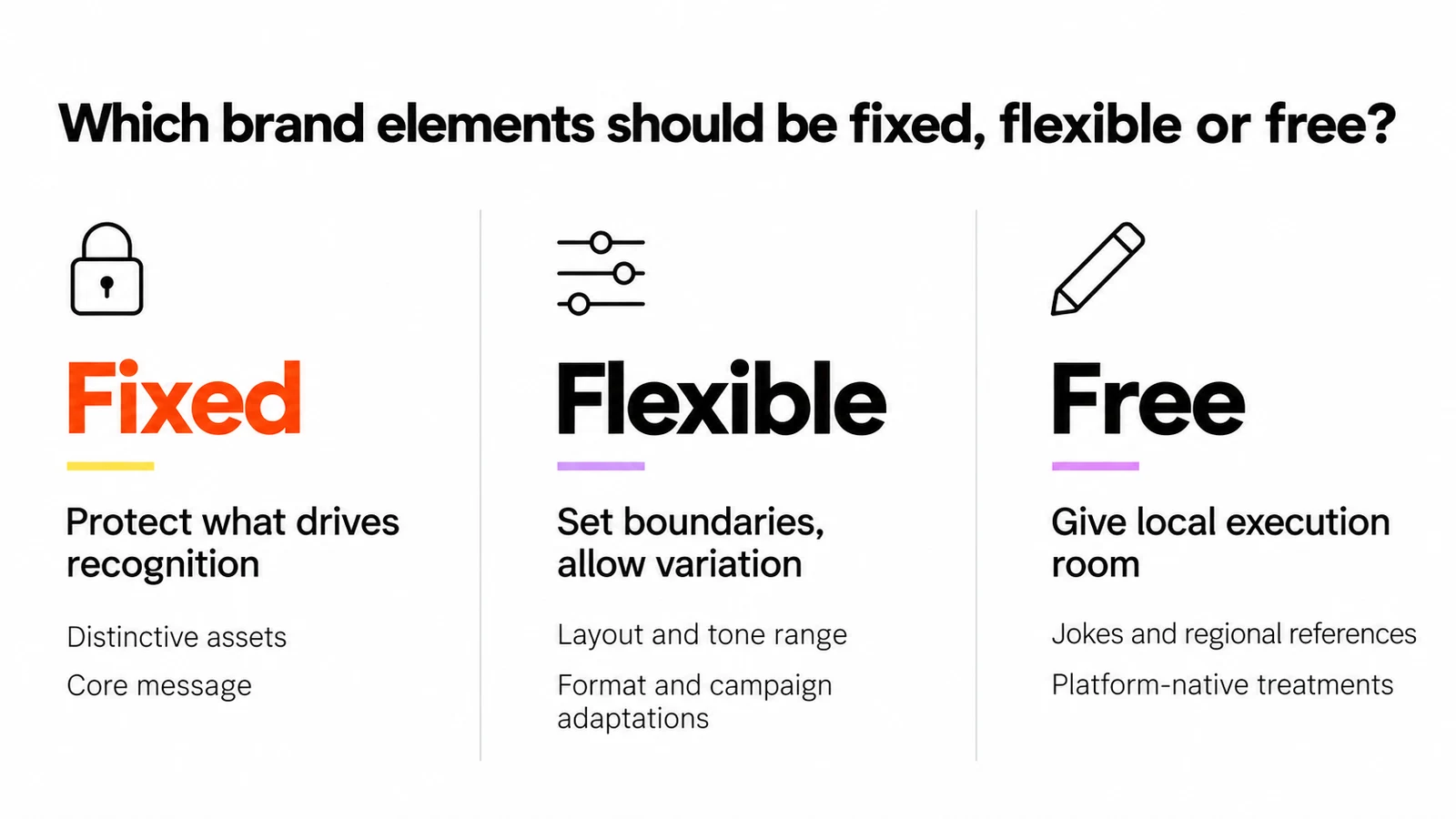
Flexible brand governance means measuring the fixed layer strictly and leaving the rest to judgment. Sort your current guidelines into fixed, flexible and free, then write the deviation protocol for the fixed layer.
Fixed elements are the distinctive assets and core message, the things recognition data says customers use to identify you.
Flexible elements are layout, tone range, format adaptations, and campaign-specific devices, which have agreed boundaries but not prescribed answers.
Free elements are local execution: the specific joke, the regional reference, the platform-native treatment. Strict measurement applies only to the fixed layer. Flexible and free layers get qualitative review, not scores.
Our creative and design teams work best when a client has made this sort explicitly, because it tells everyone which arguments are worth having.
Deviation from the fixed layer should be possible, documented, and tested. The protocol needs three parts:
A hypothetical case: a regional team adapts format and humor for a local platform while keeping the fixed assets and core message. The deviation is logged, the recognition wave in that market is read against the previous one, and the team either keeps the adaptation or reverts. Either outcome is useful.
Rigid templates produce two predictable failures. The first is creative fatigue, where identical executions stop earning attention. The second is local irrelevance, where a global template can't speak to a market.
The Compound Creativity study discussed earlier supports repeated foundations. It says nothing in favor of identical executions, and conflating the two is how consistency becomes a drag on performance. Cross-channel work needs room to adapt by medium.
| Dimension | Compliance policing | Guided governance |
|---|---|---|
| Speed | Slow; every asset waits for review | Fast; only fixed-layer departures need approval |
| Creative quality | Safe and repetitive; fatigue risk | Varied execution on stable foundations |
| Measurement burden | High; every asset scored against every rule | Low; two or three signals, quarterly |
| Drift risk | Hidden; teams work around rules without logging | Visible; deviations are logged and tested |
The comparison reflects the governance model described in this section and the metrics defined earlier; it summarizes our recommended approach rather than a surveyed sample of brands.
Keep guidelines useful by reviewing them on a schedule against evidence, so they don't change every time someone complains. Set an annual guideline review with three change triggers as its agenda.
Three triggers justify a change:
Global brands face a version of all three whenever they enter a market, so adaptation belongs inside a consistency program.
Evolution is documented and tested: a guideline changes because the evidence says so, the change is logged, and the next review checks whether it worked.
Drift is unlogged and accumulated: a hundred small departures that nobody approved and nobody measured, until the brand looks different and no one can say when it happened. When evolution grows into a large-scale rebrand, the same logging discipline applies at a bigger scale.
The recognition and message signals from earlier sections exist largely to catch drift early. Hold the fixed layer firm, let execution move, and change the rulebook deliberately when the data says a foundation has stopped doing its job.
Brand consistency sits in the seam between creative and measurement, and most organizations leave that seam unowned. Creative teams know what the brand should feel like and resist being scored. Measurement teams can produce the scores but rarely sit in the room when the next campaign is briefed. The compliance score is what fills the gap when nobody connects the two.
Fieldtrip is a group of specialist agencies spanning strategy, creative, media and measurement, organized as small autonomous teams working to a shared strategy. We describe that model as a way of keeping these decisions close together: the people judging creative coherence and the people reading recognition data share a brief and a review.
If you want a second opinion, work can start with one defined problem, such as a baseline recognition study or a reclassification of existing guidelines into fixed, flexible, and free, alongside the teams and agencies you already have.
Decide which of those is your next step and who should own it, and if it helps to talk it through, get in touch with Fieldtrip.
Quarterly suits most brands; recognition moves slowly, and more frequent waves add cost without new information. Sample size depends on how many markets and channels you split results by. Ask your research partner for a sample that can detect the smallest change you'd act on, and keep the panel structure stable so waves are comparable.
Yes, and it's where measurement earns its place. Each agency executes within the same fixed layer, the brand team owns the message rubric, and the quarterly review puts all agencies' work side by side. Disagreements about consistency become questions the recognition data can answer rather than arguments about taste.
Treat it as a signal that the rules protect the wrong elements. Check exposure first, since recognition can't grow without reach. If exposure is adequate, review which assets customers actually use to identify you and consider promoting those to fixed status while relaxing rules that aren't earning recognition.
Recognition belongs with the CMO, because it ties to media investment and board conversations. Message and creative consistency scores stay with the brand and creative leads, who can act on them directly. Report exceptions upward, not the full rubric.
Keep a decision log. Each quarterly review records which brief, media plan or guideline changed because of a score, and what the following wave showed. After two cycles, that log is the business case, and it's more persuasive than any circulating uplift percentage.