


























In 2009, Tropicana introduced new packaging for its Pure Premium orange juice with a more modern look. Sales fell by around 20%. In fact, researchers estimated that the packaging redesign cost Tropicana about $27 million. Within weeks, the company reversed course and returned to much of the previous packaging.
That’s a redesign blunder, but you get the gist.
A large-scale rebrand can go wrong when the strategy behind it isn’t sound. Plus, a small design mistake, hasty approval, or weak localization can easily backfire to the tune of millions.
Enterprise brands must coordinate creative teams, regional marketers, agencies, legal reviews, media, packaging, and launch timelines while still maintaining a consistent global identity.
Consider this a handy guide for enterprise marketers on a structured rollout process for rebrands or major multi-country campaigns that ensures brand consistency, regulatory compliance, and effective marketing to achieve the desired results.
It also includes guidelines for working with an international marketing agency on global rebrand or advertising campaigns.
A global rebrand or campaign becomes significantly harder to manage once it involves multiple business units, agencies, channels, and countries.
What might be a relatively straightforward launch in one market can turn into hundreds of interconnected decisions when the same work needs to be approved, adapted, produced, and distributed worldwide.
Let’s dig into the unique circumstances that such rollouts face:
Large international rollouts are not a one-department job. For instance, a global rebrand would usually involve brand leadership, product teams, marketing teams, legal and compliance, sales, procurement, external creative agencies, paid media agencies, etc. Each stakeholder can have different priorities and approval requirements.
That, of course, creates more opportunities for bottlenecks and conflicting feedback.
The World Federation of Advertisers' 2026 research actually shows how cross-functional global marketing has become. Among senior executives surveyed, 92% reported greater cross-functional collaboration to mitigate risk, while 51% said their companies had created dedicated cross-functional risk groups. Among companies with these groups, 89% involved marketing, legal, and strategy.
Without clear ownership and approval rights, regional teams may wait weeks for decisions, senior stakeholders may reopen choices thought to be settled, and different markets may see different interpretations of the same brand.
A global brand needs recognizable visual and verbal characteristics wherever customers encounter it. However, simply exporting the exact same creative into every country doesn’t always work.
Language, humor, cultural references, imagery, customer expectations, product positioning, and even the importance of individual benefits can vary between markets.
Localization matters commercially, too. CSA Research surveyed 8,709 consumers across 29 countries and found that 76% preferred to buy products when information was available in their own language, while 40% said they would not buy from websites in other languages.
But the real challenge is to localize enough to make the campaign relevant without losing the brand's core identity. That requires proper governance and close coordination between regional teams.
Coca-Cola's Share a Coke is a great example of how that balance can work. Its 2025 global relaunch covered more than 120 countries, approximately 10 billion bottles and cans, and more than 30,000 names tailored to individual markets. The core idea and brand identity remained recognizable, but the names and execution were adapted locally.

International rollout plans can also become production challenges. You might need to produce campaign assets for dozens of countries and for several channels.
One master campaign concept might require television and connected TV ads, paid social videos, display ads, retailer materials, outdoor advertising, website updates, and internal communications.
Now multiply those assets by different languages, aspect ratios, platforms, offers, product variations, and local legal requirements.
A campaign with 40 master assets running in 15 markets could theoretically generate hundreds of localized files before teams even consider additional creative testing or channel variations.
Teams must also control versions, manage translations, retire outdated assets, maintain naming conventions, and ensure every market is using the correct approved materials.
Finally, markets don’t operate under identical legal, media, cultural, or commercial conditions. A campaign approved in the US may need changes before it can run in Asian markets.
And we’re not necessarily talking about localization in terms of language or creative, but also how it’s shared.
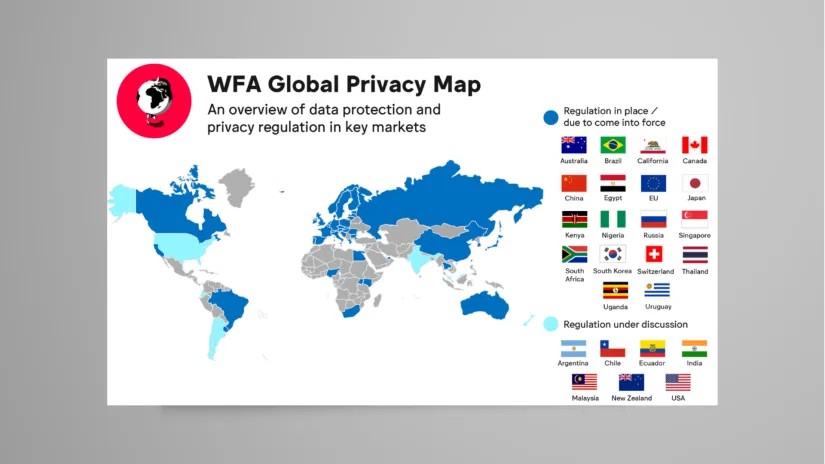
Then there’s the regulation factor, because certain markets have stricter rules on what you can say or show in advertising.
For example:

There are practical differences as well.
Media availability, budget, channel popularity, launch dates, product availability, pricing, agency capabilities, and production resources can all vary by country.
As a result, a large-scale rollout cannot be managed as one global campaign simply copied across markets. It needs a central operating framework that preserves the overall strategy while giving local teams enough flexibility to work within their own market conditions.
Large-scale rebrands and international campaign rollouts require coordinated programs. The strongest rollouts combine clear strategic direction with defined governance, scalable production systems, local market input, and structured approval processes.
Before creative development begins, define exactly what the organization is trying to achieve.
A rebrand may reposition the company, support a merger, modernize an outdated identity, unify several business units, or prepare the brand for international growth. A market-entry campaign may have a different objective, like building awareness, launching a new product, generating demand, or establishing credibility in a new region.
Translate that goal into a clear strategic framework that all markets can work from. This should define:
It’s also important to establish the relationship between global and local strategy at this very stage. Decide which parts of the brand or campaign are non-negotiable globally and which elements markets can adapt.
The final strategy should function as a shared reference point for everyone involved. This aligns management, teams, external agencies, and production partners, and makes it easier to resolve disputes or delays later.
Once the strategy is set, build a detailed market-by-market rollout map before production begins. This identifies what each country actually needs.
For each market, document the launch date, priority audience, products or services being promoted, required channels, languages, local offers, media plan, legal requirements, and any market-specific creative considerations.
This is also where teams should identify operational dependencies. A campaign may be ready creatively but still depend on translated landing pages, localized pricing, product availability, retailer coordination, CRM setup, tracking, or regional sales enablement.
Mapping these requirements early makes it easier to spot markets that need additional lead time and prevents last-minute surprises close to launch.
A rollout matrix can help central teams manage this complexity. At minimum, it should show:
Realistically, you may not be able to launch in every country at the same time (and it doesn’t have to be that way). That’s where creating market tiers by priority can help.
For example:
High-priority or lower-complexity markets can sometimes launch first, followed by markets that require more localization or regulatory review.
More importantly, a phased rollout gives teams time to catch production, messaging, or workflow issues before they repeat across dozens of markets.
Better governance means fewer hiccups. Global campaigns usually slow down because too many entities and people are involved without a clear understanding of who owns what and what the proper flow of decisions is.
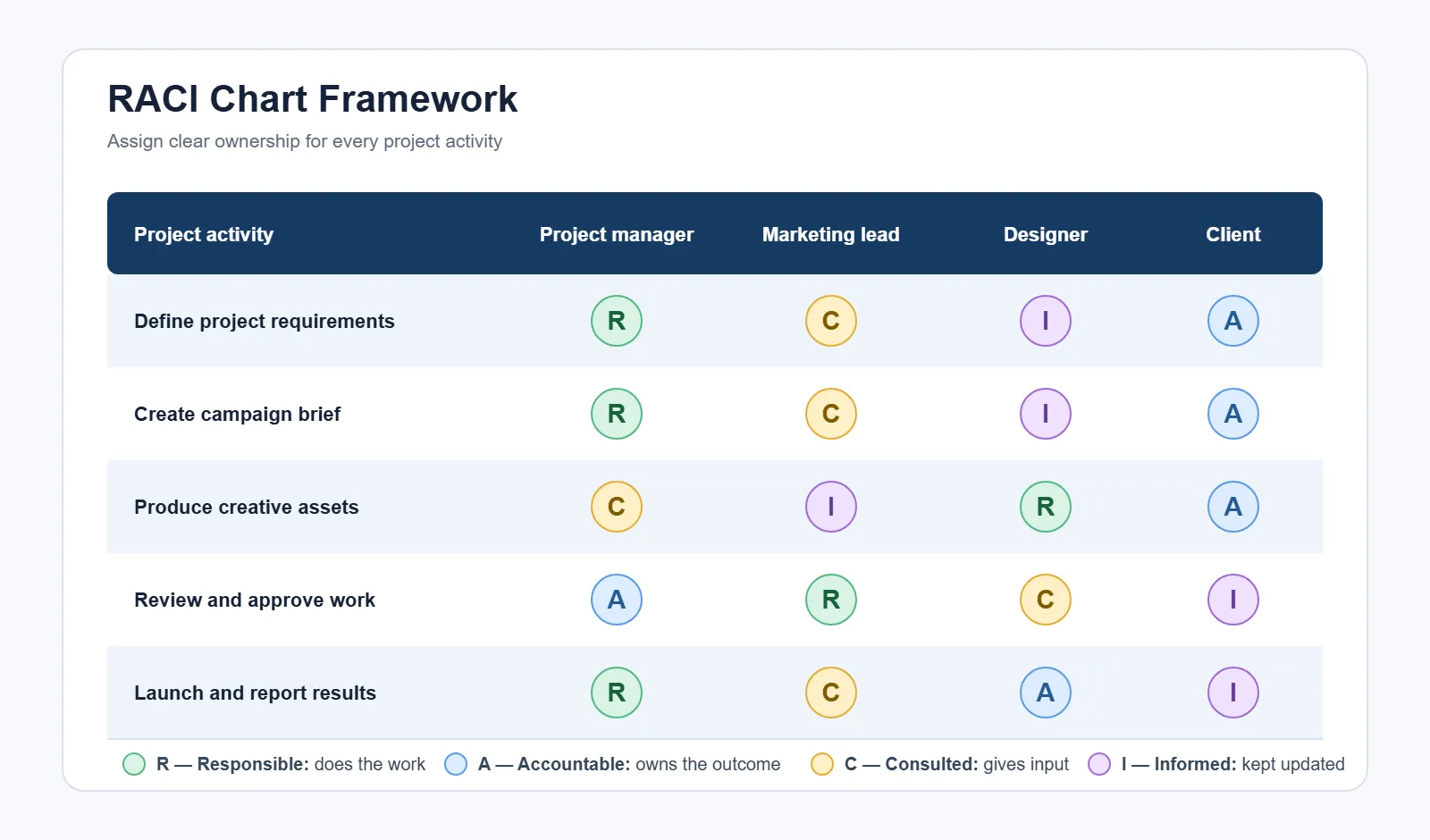
A governance model should define responsibilities before creative work accelerates, so teams know who can decide, who needs to be consulted, and what to escalate. There are three key parts of this:
Assign clear ownership for the overall program as well as the major workstreams within it. One central team or program lead should own the global rollout, with named owners for areas like brand strategy, creative, production, localization, media buying, digital implementation, legal review, and tracking/measurement.
Pro Tip: A RACI-style framework can help with large programs because it clarifies who completes the work, who owns the final decision, who must be consulted, and who only needs to be informed.
Document approval processes before assets start moving between global and regional teams. Define which materials require central approval, which can be approved locally, who reviews legal or regulatory issues, and how many review rounds are permitted.
It also helps to establish approval thresholds. A minor copy adaptation may only need a market lead and local legal review, while a change to the core campaign message or visual identity should go back to the global brand team. This prevents central teams from becoming bottlenecks while also stopping local adaptations from drifting too far from the original strategy.
Each major region or country should have a designated lead who connects the global team with local stakeholders. These leads can validate things like local approvals, external contracts, media buying, and compliance.
With multiple countries, agencies, and internal teams involved, information can quickly become fragmented. One team may be working from an old brand guideline, another may have a newer version of the campaign copy, while a local agency may be adapting an asset that has already been replaced. A centralized source of truth reduces this confusion.
Create one shared location where teams can access the latest approved materials. This could be an asset management platform, brand portal, project management system, or structured cloud workspace.
It should contain resources such as:
Version control is particularly important. Teams should be able to tell immediately which file is current, whether it's approved, where it can be used, and when to retire an older version. Naming conventions, file structures, asset IDs, and clear status labels are incredibly important.
Don’t wait for localization till the end. Build it into the strategy and the rollout plan.
That’s especially true for multi-country campaign rollouts, where you have to account for cultural nuances. Some markets, campaigns, and creatives may need more than copy translation.
Teams need to consider whether the campaign's tone, imagery, humor, examples, calls to action, product claims, and cultural references make sense in each market.
Start by identifying everything that may require localization, including ad copy, video subtitles, voiceovers, images, packaging, social content, and models/influencers.
When inBeat Agency (part of Fieldtrip) partnered with HelloFresh for a multi-country campaign, localization was part of the very strategy. The team shortlisted creators from different countries in Europe to produce native sounding content in seven different languages. Instead of translating the creative later and running geotargeted ads, localization guided creator selection and content briefs.

To manage the high volume of large international campaigns, brands need a repeatable production pipeline, not a separate creative project for every deliverable.
Separate master creative development from adaptation and localization.
A central team can develop the core campaign concept, hero assets, messaging, and design system, while production teams create channel-specific and market-specific versions from those approved masters.
This reduces duplicated work and helps keep the campaign visually and strategically consistent. Where needed, partner with production and design agencies to speed up work or fill gaps in internal teams’ capabilities.
A scalable pipeline should solve creative production challenges with clear workflows for:
Pro Tip: It also helps to design assets in a modular way. Instead of producing every ad from scratch, build reusable components like product shots, end cards, CTAs, background treatments, and video sequences you can recombine across formats. That works out especially well for paid social, influencer, and UGC campaigns.
Legal and regulatory review should happen alongside campaign development.
Bring legal, compliance, privacy, and regulatory teams into the process early enough to influence the campaign before you produce large volumes of assets.
At the market-mapping stage, identify which countries require specialist review and document the rules most likely to affect execution, including advertising claims, data privacy, promotions, influencer disclosures, sustainability messaging, financial or health claims, or how campaign data is collected.
Claims deserve particular attention. In the UK, for example, CAP rules require marketers to hold documentary evidence before publishing objective claims that consumers are likely to regard as capable of substantiation. The Advertising Standards Authority (ASA) says around 70% of the complaints it receives each year are considered under misleading-advertising rules.
As we discussed earlier, establish which approvals occur at the global stage and which can be done locally. This prevents unnecessary bottlenecks where headquarters has to approve everything.
Maintain an approved claims library wherever possible so teams know which statements can be reused and what evidence supports them.
A master rollout calendar brings the entire program together. It should show when each market is launching, which dependencies must be completed beforehand, who owns each milestone, and where deadlines overlap across regions.
The calendar should include more than launch dates. Track key milestones such as:
The calendar should remain a live operational document throughout the rollout. Update it as approvals change, markets move dates, or new dependencies appear, and make sure all central and regional teams are working from the same version.
The way a large-scale rebrand project is managed depends heavily on the industry.
Key factors include the level of regulation, the number of customer touchpoints, the amount of physical infrastructure, the length of the buying cycle, the importance of brand recognition, and how quickly existing assets can realistically be replaced.
Also, how your brand operates and where it markets impacts the rebrand timeline. For instance, a digital-first business may update most of its brand within weeks, but a company with stores, packaging, vehicles, or regulated materials may need a phased rollout that takes much longer.
Here are some more industry-specific nuances you may want to watch out for:
The gist is that your rebrand strategy should reflect how the business actually operates, as the process isn’t standard across industries.
Download our report ‘Brand as a System’ to understand the three archetypes of brand that earn relevance in the digital age and use that in your rebrand strategy.
Measuring a large-scale rebrand requires two levels of reporting. Global key performance indicators (KPIs) show whether the rebrand strengthens the overall brand and contributes to business growth, while local KPIs reveal how effectively the campaign performs in individual markets.
You want to use both, as it prevents strong results in one region from masking weak performance elsewhere.
Global KPIs should focus on broader brand and commercial outcomes, including:
At the local market level, measurement should focus more closely on whether the campaign resonates with audiences and generates efficient commercial results:
Important Note: Avoid judging every market against exactly the same absolute benchmark. Differences in brand maturity, media costs, competitive intensity, market size, and customer behavior may show up in results. Instead, establish a common global measurement framework, then set appropriate targets and baselines for each market.
Global marketing campaigns and their success hinge on the tech stack that backs them. At the enterprise level, that means investing in a wide range of interconnected management, productivity, and analytics tools that teams worldwide can use.
Your organization should cover these major categories:
Check out our detailed guide on transforming enterprise marketing teams with digital tools.
An experienced agency partner can dramatically reduce the operational burden of managing a rebrand or campaign across multiple markets.
Instead of coordinating separate creative, production, localization, and regional teams independently, brands can use an agency to create a more centralized workflow and maintain consistency throughout the rollout.
And when you have extensive strategy, design, and media teams across different locations, agencies can take on specific parts of the rollout to fill gaps or act as an extension.
Depending on the scope, an agency can help with global strategy, campaign development, brand systems, asset production, localization, regional adaptation, project management, and quality assurance.
For these projects, you want to work with agencies that have international capabilities. That’s because you need their local market knowledge. They can coordinate regional partners, manage translation and transcreation, flag cultural issues, and help adapt messaging or creative for different audiences while working within global brand guidelines.
Learn how to vet agency partners for global expansion.
Both models can work, and the best choice depends on how much consistency, local specialization, and coordination the campaign requires.
The biggest advantages of one global marketing agency partner are greater consistency, central accountability, easier coordination, and consolidated production.
But those strengths can become weaknesses if you don’t manage coordination well. For example, localization may become an afterthought.
Local agencies usually bring strong market knowledge, native language expertise, and local media and cultural understanding. That makes them perfect for campaigns that need careful localization and strict compliance.
But they usually don’t have the scale of a global agency. Plus, you’d be working with multiple agencies if you’re running campaigns in different markets, which increases communication.
Here are the differences summed up:
| Factor | One Global Agency | Multiple Local Agencies |
|---|---|---|
| Brand consistency | Easier to maintain one creative direction and set of standards | Requires stronger governance to prevent markets from diverging |
| Local market knowledge | May vary depending on the agency's regional presence and capabilities | Usually stronger because each agency specializes in its market |
| Coordination | Simpler, with fewer partners and workflows to manage | More complex because multiple agencies, timelines, and approvals are involved |
| Speed and scalability | Better for producing and distributing large volumes of assets centrally | Can be faster for highly localized execution but harder to scale consistently |
| Localization | Works well if the agency has strong local teams or partners | Provides deeper language, cultural, and channel expertise |
| Cost management | Easier to consolidate budgets and negotiate a broader scope | Costs may be fragmented across agencies and markets |
| Creative consistency | Stronger control over the core campaign idea and visual identity | Greater risk of inconsistent interpretation between markets |
| Local relationships | May be weaker in markets where the agency has limited presence | Local agencies may have stronger media, creator, production, and partner networks |
We recommend a global agency model when consistency, centralized production, and speed are priorities. It’s particularly good for rebrands because centralized management can ensure consistency.
Also, there’s a third way here, where you work with an international agency on a regular basis to handle most of the marketing work and collaborate occasionally with local agencies for specific needs.
Managing large-scale multinational campaigns and rebrands requires all hands on deck, with strong coordination and governance. Rollouts may still not be perfect, because at this scale, setbacks can happen. But your organization and its teams will be better prepared to tackle any hurdles and run strategically sound, localized campaigns.
As a global full-service marketing agency, Fieldtrip and its team of experts can help make multi-country campaigns and full rebrands a bumpless experience, with strategy, media planning/buying, creative, and measurement covered end-to-end.
Our ecosystem of agencies and multinational teams lets us combine the scale of a truly global agency with the execution of a local one. We’ve helped brands like Mogu Mogu enter new markets and enterprises like Nielsen run international campaigns led by local creators.

With Fieldtrip as your agency partner, you’ll get:
Book a call to talk about rebrand or international campaigns.
Measure the success of a rebranding campaign by comparing brand awareness, customer sentiment, engagement, and retention before and after launch. Establish baseline metrics before rebranding, then track results at 30, 90, and 180 days. Compare performance against predefined targets to determine whether the rebrand achieved its goals.
Promote a rebrand through coordinated announcements across your website, email, social media, PR, advertising, sales materials, and physical locations. Explain what changed, why it changed, and how customers benefit. Update every major brand touchpoint before launch and use paid media to expand reach and reinforce the new identity.
Pick channels based on target market’s audiences, media costs, and regulations. Look at numbers like monthly active users/subscribers/viewers to see if a platform or channel is worth the investment in a country or region. Some platforms are more popular than others and may deserve a higher share of the ad spend.
Review local advertising, privacy, consumer protection, promotion, pricing, and industry-specific laws before launch. Verify requirements for consent, data collection, claims, disclosures, and marketing communications. Where necessary, use qualified local legal counsel to review campaigns and establish approval processes that monitor compliance after launch.