

























Commerce media can be a major revenue opportunity for retailers with large audiences, strong ecommerce traffic, and valuable first-party data.
The numbers show a clear opportunity.
In the US, retail media ad spend is expected to reach roughly $69.3 billion in 2026, up from $58.8 billion in 2025, according to Statista.
For a more specific example, look at Walmart. In its latest reported quarter (Q2 FY27), Walmart Connect advertising sales grew 43% year over year, excluding Vizio.
Creating a commerce media network requires more than opening up ad inventory. Large retailers need technology that can connect retailer data with audience targeting, ad serving, campaign management, measurement, and increasingly on-site, off-site, and in-store media.
This guide compares the commerce media network technology platforms available to large retailers. We’ll cover where each fits within the retail media ecosystem and the capabilities that matter when choosing a platform.
Commerce media network technology is the infrastructure retailers use to turn their owned audience, first-party data, and digital or physical shopping environments into advertising opportunities for brands.
These platforms typically help retailers manage ad inventory, audience targeting, campaign delivery, measurement, and reporting across channels like ecommerce sites, apps, sponsored product placements, display ads, off-site media, and in-store media.
The technology provides a more scalable way to build and operate a commerce media business without developing every part of the advertising stack internally.
For example, a retailer can use the platform to connect shopper data and transaction data with ad campaigns, give brands access to relevant ad units, measure campaign performance and sales impact, and manage everything through a dedicated portal or through a demand-side platform (DSP) like the Trade Desk.
The best platforms for large retailers to create their own commerce media network for advertisers are:
Criteo offers Commerce Yield, an enterprise retail media platform that helps retailers monetize their first-party data and advertising inventory. Retailers can use it to offer sponsored product ads, onsite display and video, and offsite campaigns while controlling which advertisers can access their data and inventory and at what price.
Its onsite capabilities use shopper signals like browsing, search, and purchase behavior to determine relevant placements. And closed-loop reporting can measure performance down to the category, brand, and SKU level.
Criteo also connects retailers to its existing advertiser and agency demand, APIs, and third-party DSPs.
One potential limitation is that Criteo's core Commerce Yield offering centers on digital onsite and offsite media, not so much on physical stores.
Features:

CitrusAd is a retail media platform built around helping retailers monetize their ecommerce traffic and first-party data while maintaining control over the customer experience.
Its core onsite capabilities include sponsored product ads, banner advertising, branded landing pages, and email placements.
The platform uses retailer data and real-time personalization to determine relevant advertising opportunities, while retailers can control where ads appear, how many are served, and the rules advertisers must follow.
With its integration with Epsilon Retail Media, the company has created a unified platform for onsite and offsite activation. Retailers can extend audiences across display and mobile advertising, online video and CTV, email, social media, and in-store digital signage, while using a common identity layer and reporting dashboard.
CitrusAd says its technology supports more than half of the world's top 20 retailers and can be deployed in approximately four to six weeks.
Features:
Koddi provides commerce media technology for retailers that want to build and scale advertising across onsite, offsite, and in-store channels from a unified platform.
Koddi Ads supports sponsored listings, display ads, video ads, and native formats, with AI-powered ad serving and targeting based on signals like purchase intent, co-purchase patterns, and predicted customer lifetime value.
Retailers can manage direct advertiser relationships and self-service campaigns while also bringing in incremental demand through Koddi’s integrations with major DSPs and other advertising platforms.
Koddi’s main strength is flexibility. Its composable technology, customizable APIs, and retailer-controlled infrastructure can support more complex commerce media networks. But that also means retailers may need more internal technical integration and configuration support.
Features:

Topsort provides an AI-powered, omnichannel retail media platform for retailers that want to build advertising into their own commerce ecosystem. Its T-Platform combines ad serving, real-time auctions, advertiser self-service, reporting, attribution, and optimization across a decent variety of formats.
Retailers can use first-party shopper data such as purchase history, loyalty information, and browsing behavior for audience targeting. Configurable auctions, floor pricing, pacing controls, and AI-powered bidding help manage inventory and yield.
Topsort supports both API-driven and low-code implementations. It has a broad approach to onsite, offsite, and in-store media. This makes Topsort a good fit for large retailers looking to develop an omnicommerce media network.
Features:

Kevel takes a more infrastructure-focused approach to retail media. Its Retail Media Cloud gives large retailers APIs and tools to build a customized commerce media network while retaining control over first-party data, advertiser relationships, ad formats, pricing, and user experience.
Retailers can create sponsored listings and native ad units across search results, product pages, the digital shelf, and other owned surfaces, while Kevel handles ad decisioning, auctions, forecasting, targeting, and reporting.
Its audience technology (Kevel Audience) can activate first-party segments through platforms like Meta and Google. Newer integrations connect Kevel-powered onsite inventory with offsite programmatic advertising and unified measurement.
But the trade-off is that Kevel is less turnkey than some alternatives. You’ll need more engineering resources to customize the technology and build advertiser demand yourself.
Features:
| Platform | Core features | Benefits | Limitations | Best for |
|---|---|---|---|---|
| Criteo | Sponsored products, onsite display/video, offsite activation, closed-loop measurement | Mature retail media infrastructure with detailed sales attribution | Less focused on complex physical in-store media | Large retailers wanting a proven, scalable digital retail media network |
| CitrusAd | Sponsored products, onsite display, offsite media, CTV, social, digital signage | White-label experience with strong retailer control | Some in-store formats may require additional technology | Retailers wanting a flexible white-label RMN mostly focused on ecommerce |
| Koddi | Sponsored listings, display, video, programmatic, in-store media, APIs | Customizable omnichannel capabilities and multiple demand connections | More integration and configuration complexity | Enterprises building customized, multi-channel commerce media networks |
| Topsort | Sponsored ads, real-time auctions, offsite media, social, programmatic, in-store activation | Strong automation with flexible API and low-code deployment | Physical in-store hardware must be sourced separately | Retailers wanting an automated onsite, offsite, and in-store commerce media platform |
| Kevel | API-based ad serving, sponsored listings, audience targeting, custom auctions, reporting | High control over data, UX, pricing, and ad infrastructure | Requires retailer-led demand generation | Large retailers wanting to build a differentiated commerce media network |
Large retailers looking for a platform to create a commerce media network for advertisers should primarily focus on relevant ad products, first-party data activation, measurement, integrations, and scalability.
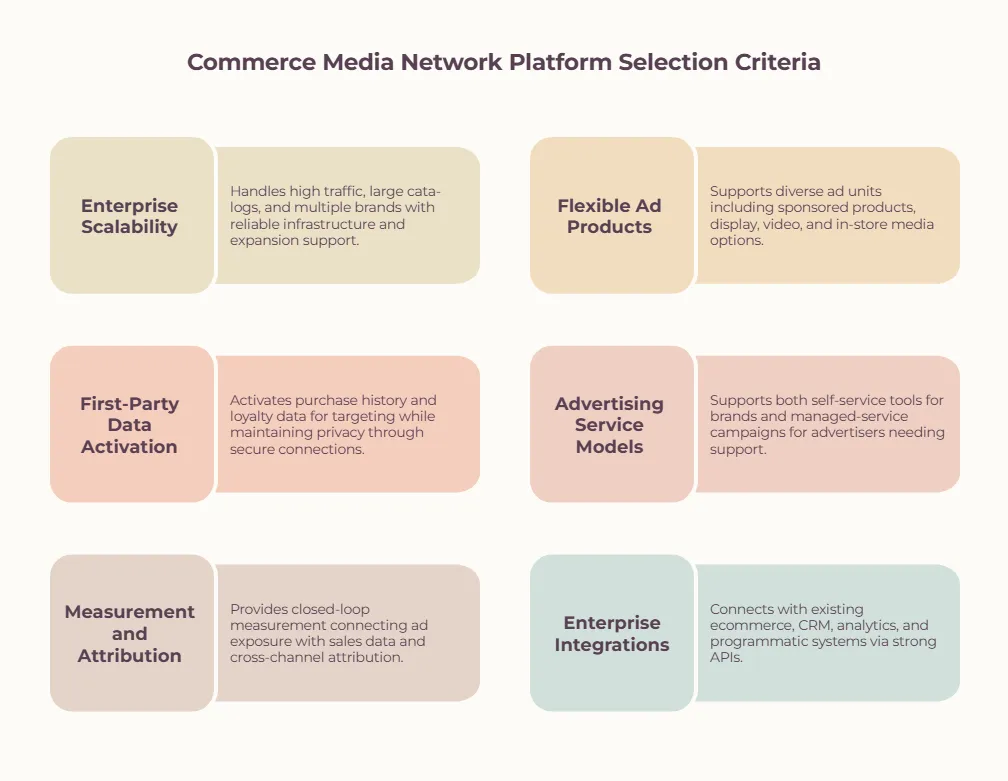
Let’s dive in:
Large retailers need a commerce media platform that can handle high traffic volumes, large product catalogs, multiple brands or business units, and significant advertiser demand without performance issues. That means strong, reliable infrastructure backing the platform.
And for those that foresee expanding off-site, It should also support expansion across external ad platforms, markets, websites, apps, and even physical stores as the network grows.
The platform should ideally support a broad mix of ad units, like sponsored product ads, sponsored search ads, on-site display, off-site display, video ads, and in-store media. Most offer a decent variety, but look for in-store media options, since not every platform integrates them well.
Flexibility matters because retailers may want to monetize different parts of the customer journey, from the digital shelf and search results to digital signage, self-checkout machines, and other point-of-sale promotions.
First-party data, of course, is the foundation of any commerce media network. A strong platform should make it easy to activate retailer data like purchase history, transaction data, browsing behavior, loyalty information, and other first-party signals for sharper audience targeting. That’s what actually attracts advertisers.
More importantly, it should also support a privacy-centric approach through secure connections, data clean rooms, and controls that help retailers adapt to tighter privacy rules.
Large retailers may need to serve advertisers with very different levels of sophistication.
The platform should support self-service tools for brands that want to manage their own advertising campaigns, while also allowing retailer teams or programmatic media agency partners to run managed-service campaigns for advertisers that need more support.
Retailers should look for strong closed-loop measurement that connects ad exposure with sales data and first-party transaction data. Useful capabilities include ROAS reporting, product-level performance, new-to-brand metrics, incrementality testing, and cross-channel attribution across onsite, offsite, and in-store media, with enough attribution fidelity to help advertisers understand what actually drove results.
You want to choose a platform that connects cleanly with your existing technology stack, including ecommerce systems, product and inventory feeds, CRM and loyalty platforms, analytics tools, programmatic networks, and advertising platforms.
Strong APIs and flexible integration options can make it easier to build a secure connection between systems, reduce manual processes, and create a more unified commerce media ecosystem.
Large retailers generally have two ways to approach commerce media technology:
It really comes down to what’s offered and what you’re trying to create.
A full-stack platform can simplify implementation and day-to-day operations by bringing ad serving, audience targeting, campaign management, measurement, billing, and advertiser tools into one ecosystem.
This can reduce the number of integrations a retailer needs to manage and make it easier to launch a commerce media network quickly. The trade-off is that the retailer may have less flexibility over individual components or become more dependent on one technology provider.
A modular approach gives retailers more control over how they build the network.
For example, a retailer might use one platform for onsite sponsored products, a separate data clean room for secure first-party data collaboration, and dedicated technology for in-store digital displays.
This can be a better fit for large retailers with established advertising platforms, data infrastructure, and internal engineering teams that can support the operational needs.
The right model depends on your existing technology stack, internal resources, and long-term ambitions.
For a simpler, quicker launch, a full-stack solution is preferable. But those that want greater control over ad products, data, measurement, and the customer experience may benefit from a more modular architecture.
Large retailers can either build commerce media technology internally or buy and customize an established platform.
Building gives retailers maximum control over first-party data, ad products, auction logic, customer experience, and the technology roadmap. It may make sense when retail media is a major strategic business, and the company already has significant engineering and ad-tech expertise.
The downside could be complexity, maintenance responsibility, and the time it takes to get it up and running. And depending on your technical resources (or lack thereof), cost may be higher.
Buying a platform like Criteo, CitrusAd, Koddi, Kevel, or Topsort can significantly shorten the path to market and give retailers access to technology already developed and tested at scale. It also reduces the amount of specialist engineering required internally.
That’s not to say that creating a commerce media network with a dedicated platform is an entirely plug-in solution. You’d still need resources for setup, integrations, and actually connecting with the demand.
But it’s a more practical approach, one that popular retail media networks already use.
The OBI case study from Topsort supports the argument for using commerce media network technology. The European home-improvement retailer evaluated 15 technology providers before selecting Topsort to modernize its retail media infrastructure. It used real-time auction decisioning, relevance-based sponsored product selection, and AI-powered bidding to improve its program.
Between December 2025 and June 2026, OBI reported:
The example shows how a large retailer can buy the core advertising technology while still operating a retail media network tailored to its own catalog, customers, and commercial model.
For the right retailer, a commerce media network can turn existing customer relationships, first-party data, and owned assets into a new revenue stream.
Plus, industry data shows advertiser demand for retail media networks remains strong. EMARKETER expects US retail media ad spend to reach $71.98 billion in 2026, up 18.7% year over year. That’s a larger figure than Statista’s estimate of $69.3 billion.
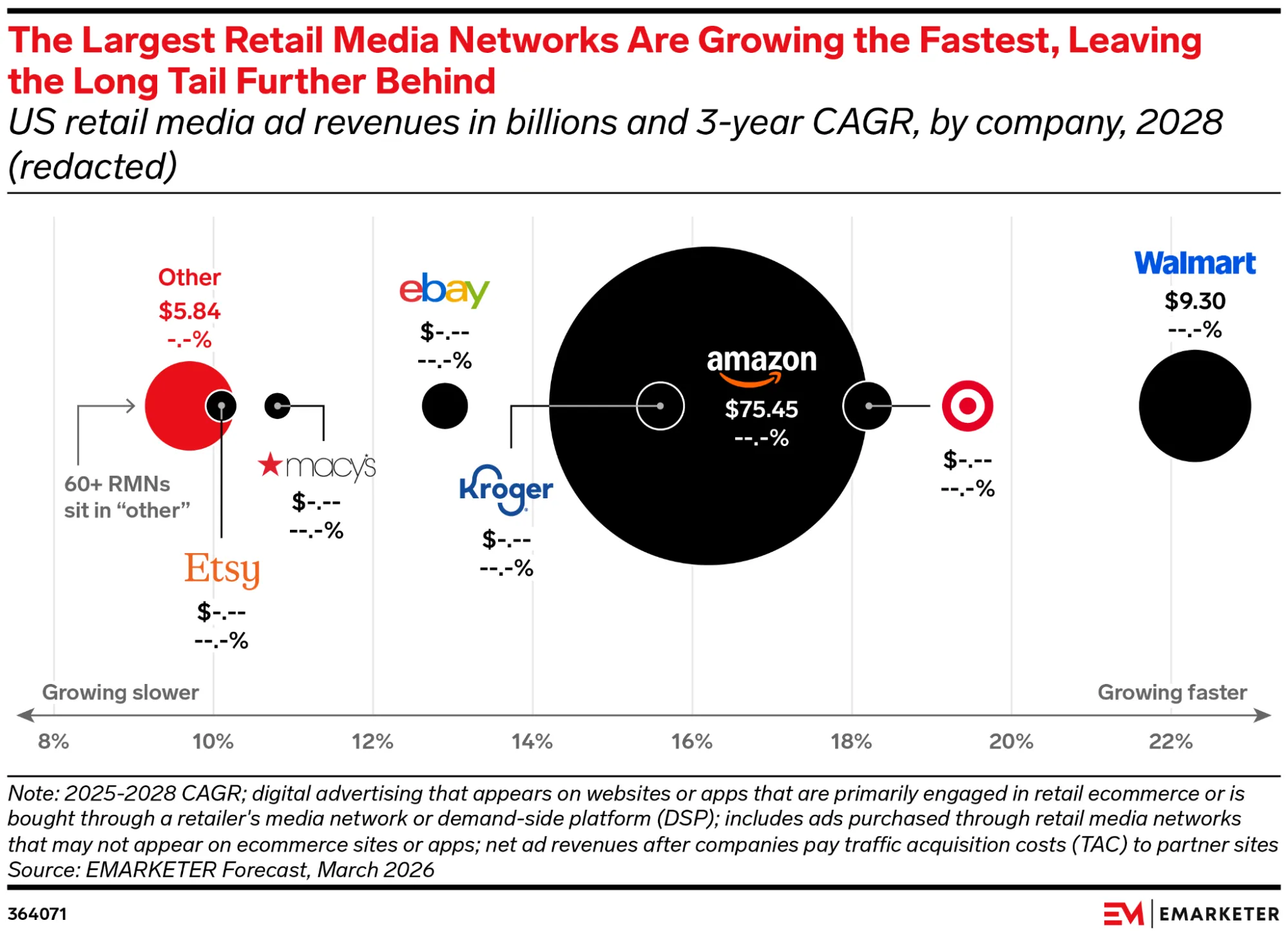
However, scale matters. EMARKETER notes that retail media growth is increasingly concentrating among larger networks, and smaller players fall further behind.
That means retailers should ensure they meet certain conditions before investing in this advertising technology. Based on our research, this is what we’d suggest:
If these conditions are present, building a commerce media network is worth evaluating as more than an additional advertising channel. In fact, it can create a closer connection between brands, retailer data, and customer journeys while monetizing assets that you already own.
But if you lack sufficient audience scale, first-party data, or advertiser demand, we’d recommend strengthening those first, before even considering creating a commerce media network for brands.
In the US, Amazon Ads and Walmart Connect are the two largest retail media networks by a wide margin. Other notable media networks include Target Roundel, Kroger Precision Marketing, and Tesco Media & Insights Program (UK).
A retail media network uses a retailer's first-party shopper data and owned properties to sell advertising across websites, apps, stores, and offsite channels. Commerce media is broader. It includes retail media but can also involve marketplaces, delivery platforms, travel companies, financial services, and other businesses with transaction relationships and commerce data.
Yes, most commerce media technology platforms can manage both onsite formats, such as sponsored products and display ads, and offsite advertising across the open web (social media, CTV, and other digital channels). CitrusAd, for example, explicitly provides a unified platform for onsite and offsite activation and reporting.
The technology itself can sometimes be deployed within a few weeks. However, a full enterprise commerce media network can take longer depending on ecommerce integrations, inventory feeds, measurement setup, advertiser onboarding, privacy requirements, and the media mix.
%2520(1).png)