















Financial brands buy more sports and culture rights than almost anyone. GlobalData's 2026 banking sponsorship report names Chase, Bank of America and Barclays as the sector's biggest sports spenders in 2025.
Proving what those deals return is still the weak spot.
Across the brands in the WFA and Lumency 2025 sponsorship study, less than 1% of sponsorship budgets go to measurement, and nearly three-quarters of practitioners call demonstrating ROI a top challenge.
This guide shows how to give a financial services sponsorship one job, then build the rights, creative, media, compliance plan, and measurement around it.
P.S. Planning a partnership and want an integrated creative team to oversee design, media, and measurement in one room from day one? Fieldtrip's integrated creative team for financial services works that way.
One thing before the mechanics. We think most sponsorship waste comes from the org chart. The partnerships team signs the deal, the creative team hears about it at the announcement, and the media team gets a logo file.
We build those three side by side, because they shape each other. In financial services, that matters more every year: platform rules now limit who a bank can target, so the person on screen and the money question they answer do the audience selection. Paid media is where sponsorship content proves it earned the rights fee.
Financial services sponsorship is a bank, card network, insurer, wealth manager, or fintech paying a property for the right to associate with it. Sponsorship activation is the paid, owned, and product work that turns those rights into a business result.
Financial brands buy sponsorships for three things: trust borrowed from a property people already care about, reach into audiences that are hard to target directly, and a steady supply of content and experiences to put behind products.
GlobalData links the spending to weakening loyalty: as banking moves online, customers can open accounts and shift funds easily, which makes relationships less sticky.
The buyers run very different playbooks.
GlobalData's banking data shows two distinct strategies: Chase, Bank of America and Barclays lead on total spend through a few large deals, while Sparkassen-Finanzgruppe and PNC lead on deal count through many smaller ones. Only Chase, Bank of America, PNC and USAA appear on both lists.
Card networks behave differently again. In 2025, payments brands put nearly half of their sponsorship spend into sports federations, where "official payment provider" status and category exclusivity come bundled.
Sports still dominate, but the property mix is widening. The WFA study found the number of brands investing in music and arts has doubled since 2023.
Two terms share the name and mean something else entirely:
Neither is covered here.
Most underdeliver for three reasons:
The activation gap shows up in market data.
Canadian brands spent about C$2.56 billion on sponsorship rights in 2024, and activation pushed the total only past C$4 billion. Activation spend still came in well below the rights fees it was meant to bring to life.
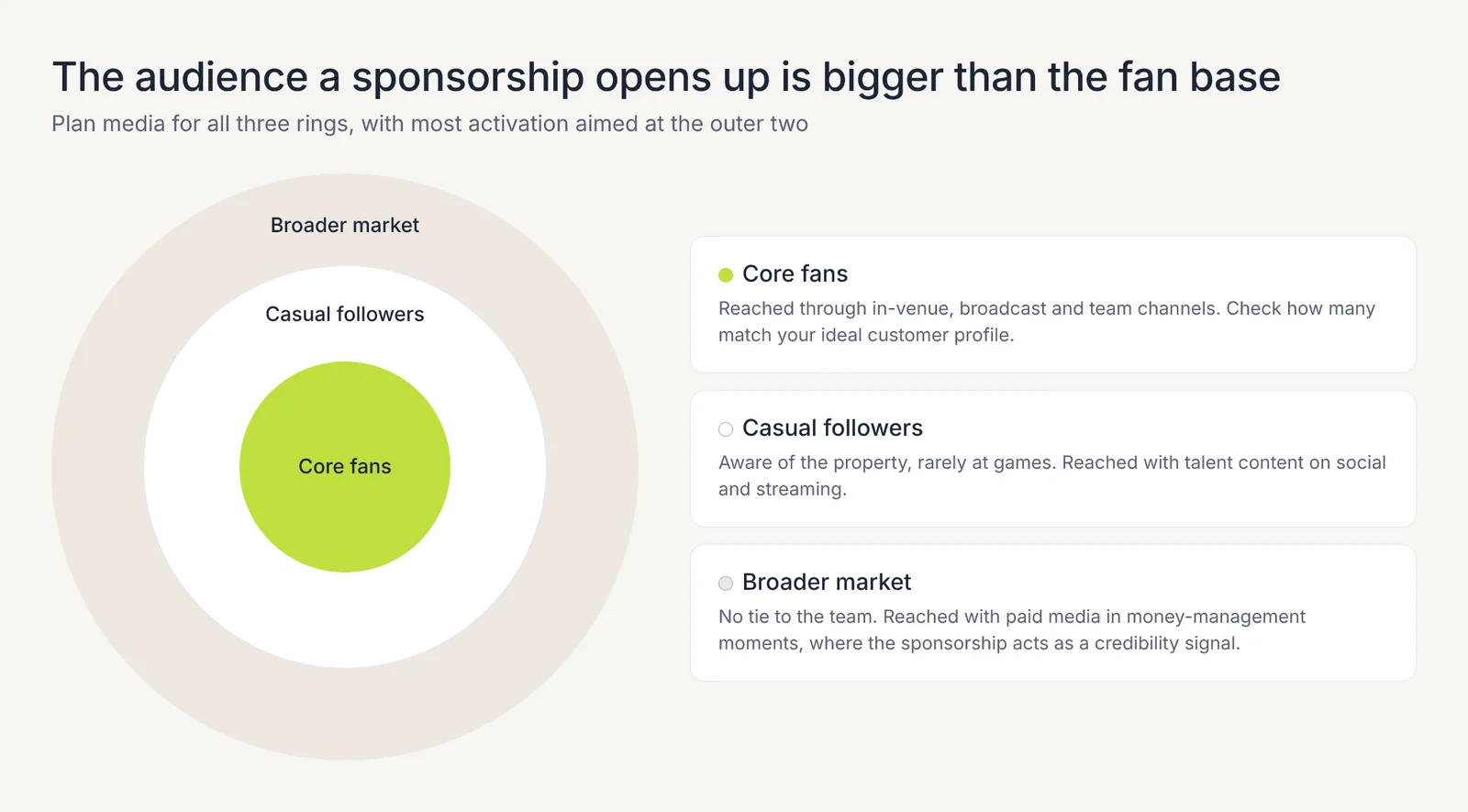
Audience sizing is the second gap.
Writing in The Financial Brand, JXM co-founder Jim Pond points out that a team's core fan base is almost never large enough to justify a deal on its own. Fans at a game they paid to attend aren't thinking about switching banks.
The third gap is ownership.
When a sponsorship sits inside a growth team's budget and gets held to cost-per-acquisition targets, nobody can win. The sponsorship wasn't built to hit those numbers, and the team managing it wasn't given the tools to change that.
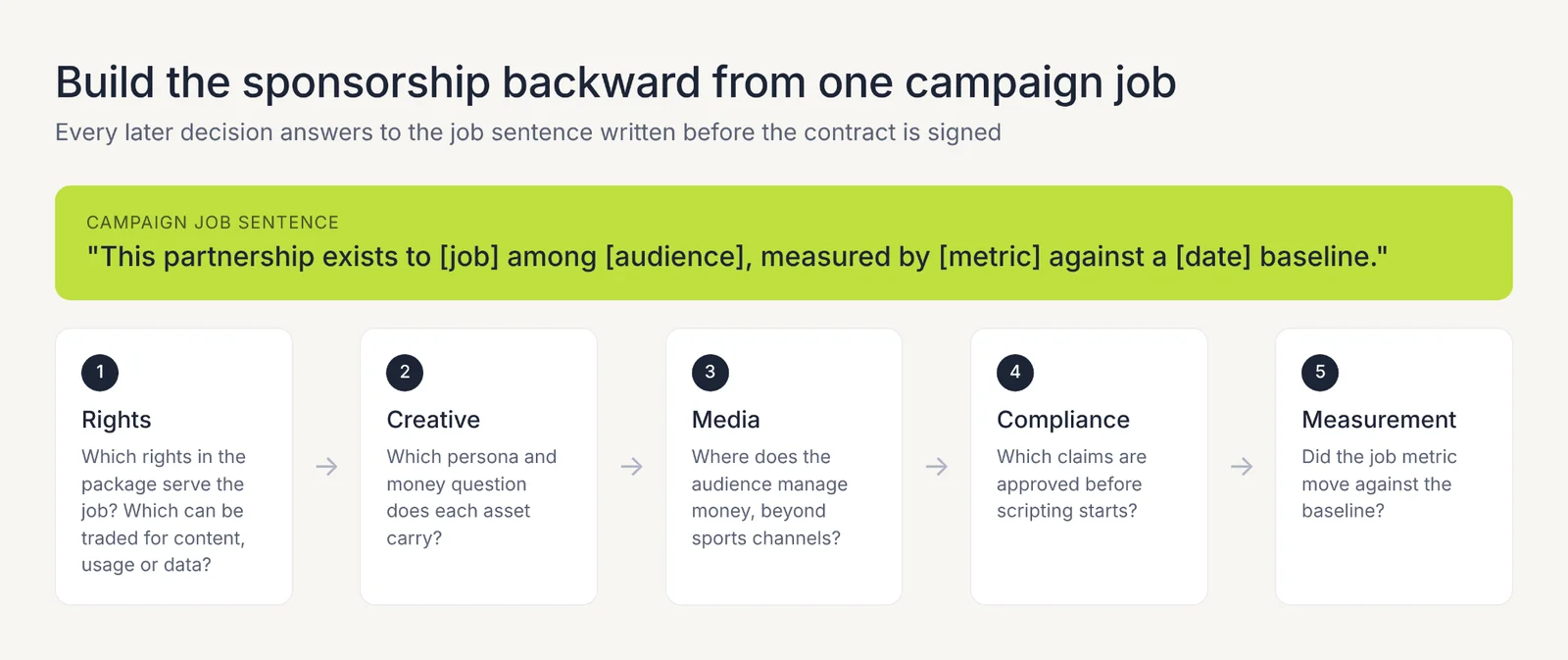
Write one sentence naming the job, the audience, and the metric before rights negotiation starts. Pick one primary job and at most one secondary job.
A sponsorship asked to do everything gets measured on nothing. The job decides which rights matter, what creative gets made, where media runs, and what counts as success.
A useful template: "This partnership exists to [job] among [audience], measured by [metric] against a [date] baseline."
Choose this job when the brand is unknown to a group it needs. A digital bank entering a new region, or an insurer targeting a younger segment, fits here.
Broadcast visibility, social rights, and talent access do most of the work. Measure aided and unaided awareness within the target segment.
Choose trust when the barrier is skepticism, which is common in banking.
Ally's women's sports program is the clearest recent case: women's sports fans are 27% more likely to say they trust Ally than general consumers.
Measure trust and favorability among the property's fans and the wider target audience, tracked over time.
Choose acquisition when the sponsorship needs to open accounts or issue cards. This job only works when the partnership connects to a product moment, such as a fan-exclusive offer, an account bonus, or a co-branded card.
Track product applications from exposed audiences against a matched holdout.
Choose usage when the customers already exist, and the goal is share of wallet. Card networks run this job most visibly. Measure card spend, retention, and engagement with cardholder perks.
Choose relationships when the buyer is a business owner, a corporate treasurer, or a high-net-worth client. Hospitality, private events, and access rights do the work here. Measure meetings held, pipeline influenced, and assets under management linked to invited clients.
Choose community license when the institution needs visible local commitment, often in its branch footprint. Measure community sentiment, local consideration, and recruitment interest.
| Campaign job | Business question it answers | Best-fit rights | Primary KPI | Example |
|---|---|---|---|---|
| Category awareness | Do people in the new segment know we exist? | Broadcast visibility, social rights, talent | Aided and unaided awareness | Digital bank entering a new region |
| Trust | Do people believe we're on their side? | Cause platforms, talent, content rights | Trust and favorability scores | Ally and women's sports |
| Product acquisition | Does the partnership open accounts? | Offers, ticketing data, digital rights | Applications from exposed audiences | Fan-exclusive account offer |
| Cardholder usage | Do existing customers use us more? | Payment exclusivity, experiences, presales | Card spend and retention | Mastercard Priceless |
| B2B and wealth relationships | Does it move the client pipeline? | Hospitality, private access | Pipeline and assets influenced | Client events at tentpoles |
| Community license | Are we seen as part of the community? | Grassroots and community programs | Local sentiment and consideration | Barclays and girls' football |
The right job also depends on scale. A regional credit union does not need category awareness at the national level, and it usually gets more from community license or acquisition inside its footprint. A global card network can afford a federation deal because usage across many markets is the job.
The rights that matter most are the ones that serve the campaign job. For most financial brands, that means content rights, talent access, and paid usage first, with signage last.
Marketers are already moving this way. The Canadian Sponsorship Landscape Study found brands now value content and data rights, such as digital ads, broadcast exposure, logo rights, and database access, more highly. Traditional perks like exclusivity, hospitality, and branded areas have fallen in importance.
The table below works as a rights audit. Run each line against the job sentence from the previous section before you sign.
| Right | What it unlocks | Campaign job it serves | Common contract gap |
|---|---|---|---|
| Marks and "official" designation | Use of property logos and titles in your own ads | Awareness, trust | Marks allowed on signage but not in paid social |
| Category exclusivity | No competing bank or card in the property | All jobs | Category defined too narrowly (e.g., "retail banking" leaves out cards) |
| Media inventory | Broadcast, stadium and digital ad slots | Awareness | Inventory runs only inside sports media |
| Athlete and talent access | Shoot days, appearances, social posts | Trust, awareness, acquisition | Too few shoot days to build a content library |
| Footage and paid usage | Right to run match footage and talent content as ads | All jobs | Usage limited to organic channels or a short window |
| Hospitality | Suites, events, private access | B2B and wealth relationships | No guest data captured for follow-up |
| Ticketing, CRM and data | Pre-sales, fan offers, audience insight | Acquisition, usage | Data shared only as aggregate reports |
| On-site payments | Payment exclusivity at venues and events | Usage | No way to identify cardholders at checkout |
| Community programs | Grassroots, schools, local initiatives | Community license, trust | Program funded but not branded or reported |
Before signing, check five things:
Athlete-specific terms, like approval rounds, raw footage ownership, and morality clauses, need their own negotiation.
Read our guide to casting athletes and creators for brand campaigns to see those contract terms in detail.
A bank sponsorship activation plan runs in seven steps. Finish each step before starting the next.
| Phase | Window | Channels | Job metric to watch |
|---|---|---|---|
| Announcement | 2 to 4 weeks around signing | PR, owned social, talent posts, paid social | Awareness lift against baseline |
| In-season | Weekly through the season | Paid social, CTV, streaming, CRM | Persona-level creative performance, applications |
| Tentpole moments | Finals, playoffs, major events | Broadcast, experiential, presales, offers | Peak consideration and usage |
| Off-season | Between seasons | Content series, community programs, retargeting | Trust and favorability retention |
Step 4 is where most plans thin out. A rights package with athlete access but no content plan produces a launch post and little else.
From our work on retail creator programs, including a nationwide in-store creator activation for 7-Eleven, the volume and variety of assets decide how long a campaign can keep testing before fatigue sets in.
If you'd like a second set of eyes on the media plan behind a partnership, our media team can map where the rights package should run beyond the venue.
Budget at least as much for activation as you pay in rights fees, then present the total sponsorship envelope to leadership as one number.
Two sources point to the same floor.
The Financial Brand's guidance is direct: if a deal costs one million dollars a year, plan to spend at least that again on media and activation, and never present the two numbers separately.
Marketing mix modeling backs the ratio.
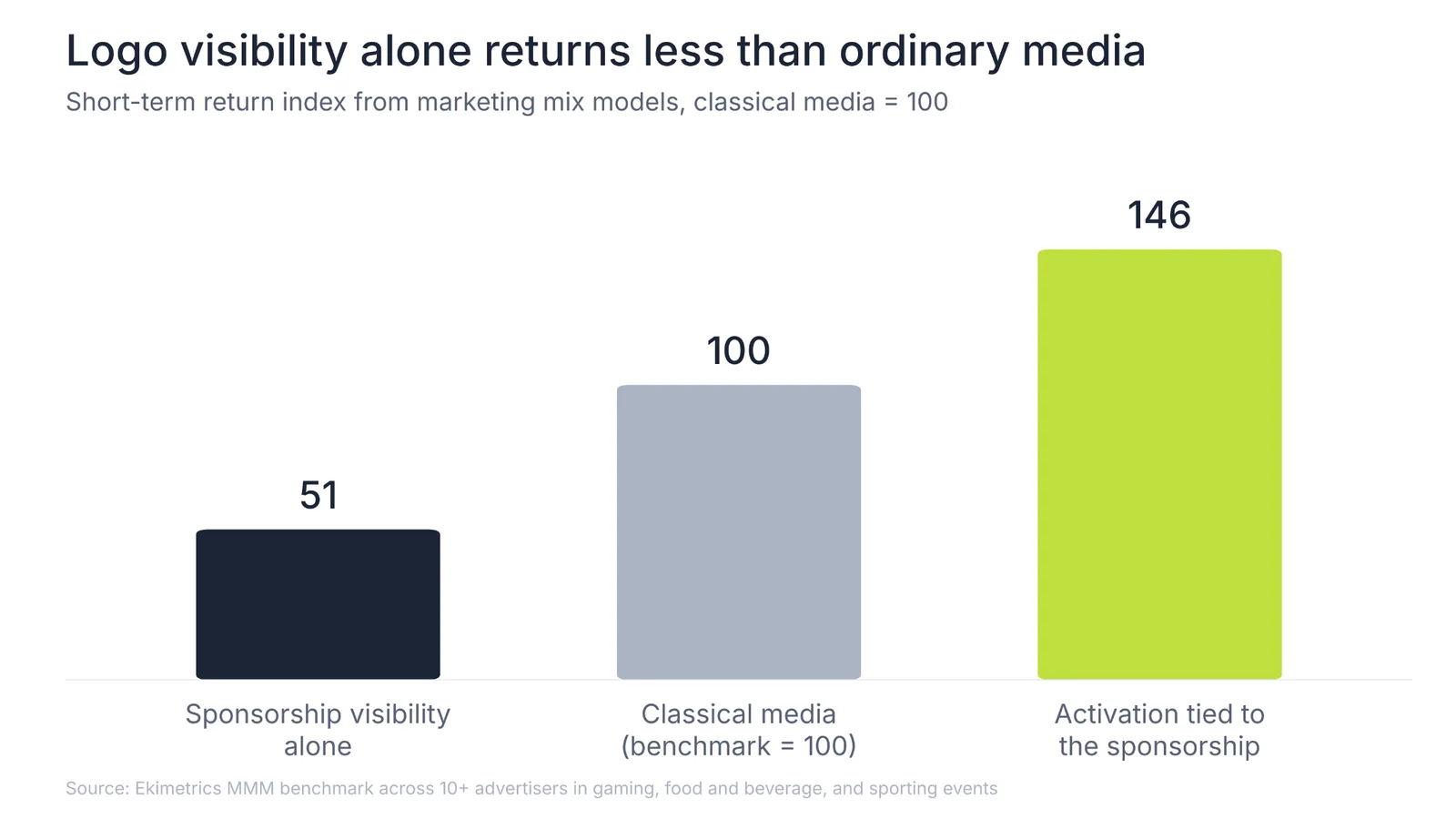
Across its MMM work with more than 10 advertisers in gaming, food and beverage, and sporting event sponsorship, Ekimetrics found sponsorship visibility alone indexed at 51 against classical media at 100. Activation tied to the sponsorship indexed at 146.
Financial services wasn't in that sample, so treat it as directional. The pattern still holds up: a passive logo underperforms ordinary media, and activation is where short-term return shows up.
| Budget line | What it buys | Fieldtrip starting point |
|---|---|---|
| Rights fee | Access, marks, inventory and talent named in the contract | Set by negotiation |
| Paid media | Distribution of sponsorship content beyond sports media | The largest share of activation |
| Content production | Shoot days, editing, cutdowns and talent-native assets | Sized to the asset map from step 4 |
| Product and CRM integration | Offers, landing flows, in-app and email programs | Fixed cost, usually front-loaded |
| Compliance review | Legal and compliance time for every asset and talent post | Built into the production timeline |
| Measurement | Baseline tracker, lift studies, geo tests or MMM inputs | A protected line, well above the sub-1% norm |
The starting points are our own recommendations for structuring a budget. They aren't industry benchmarks.
Smaller deals don't escape the floor. A regional credit union with a modest rights fee still needs paid media and content to reach anyone beyond the venue.
If the total envelope can't be approved, change the strategy. Renegotiate the rights package down to what you can activate, or walk away.
Measure the campaign job against the baseline you took before the announcement, using one method chosen in advance.
Every report starts with that job metric, before impressions or media value.
Most programs measure what's easy. In the WFA study, sponsorship measurement focused on awareness (84%) and consideration (65%), with little commercial attribution.
That suits awareness and trust jobs. It leaves acquisition and usage jobs with no real answer.
Banks have one measurement advantage most sponsors don't: a defined geographic footprint. A regional team sponsorship covers some branch markets but not others, creating a natural test-and-control design.
| Campaign job | Leading indicator | Business outcome | Measurement method |
|---|---|---|---|
| Category awareness | Aided awareness in target segment | Branded search, site visits | Pre/post brand tracker, brand lift study |
| Trust | Trust and favorability scores | Consideration, NPS | Tracker split by fans and non-fans |
| Product acquisition | Offer engagement, applications started | Accounts opened, cards issued | Geo-lift or exposed/holdout comparison |
| Cardholder usage | Perk redemption, presale use | Card spend, retention | Cardholder cohort comparison |
| B2B and wealth relationships | Meetings held with invited clients | Pipeline and assets influenced | CRM attribution on guest lists |
| Community license | Local sentiment, earned coverage | Local consideration, recruitment | Market-level tracker, geo comparison |
For multi-year deals, marketing mix modeling separates the sponsorship's contribution from other media.
Ekimetrics notes multistage models can capture effects for up to 24 months after exposure, which matters for trust and awareness jobs that build slowly.
Use this checklist at renewal:
Pro Tip: Write the renewal checklist into the original activation plan. A team that knows the renewal questions on day one collects the data to answer them.
Financial promotion rules apply to sponsorship activation the same way they apply to any ad. Athlete posts, creator content, and social cutdowns all need review before they run.
Three sets of rules shape most US activation work:
The FCA's finalized guidance on financial promotions on social media (FG24/1) confirms that promotion rules apply on every social channel. It also warns that unauthorized people, including influencers, who promote regulated products without approval from an authorized firm may be committing a criminal offense. An athlete posting about a bank's savings account can fall inside that perimeter.
| Activation asset | Rule that applies | What compliance needs | When to build it in |
|---|---|---|---|
| Athlete or creator social post | FTC disclosure, FCA FG24/1, FINRA (for broker-dealers) | Approved script or claims list, disclosure, retention | Before the shoot |
| Paid social ad with product claims | Financial promotion rules, Meta Special Ad Category | Claims substantiation, required disclosures, category setup | During editing |
| Fan offer or account bonus | Product terms, disclosure rules | Full terms, eligibility, clear conditions | Before the offer is designed |
| Hospitality for clients | Gifts and entertainment policies | Guest limits, logs | Before invitations go out |
| Talent-native content reposted by the brand | Same rules as brand ads once the brand amplifies it | Review of the reposted version | Before whitelisting |
Bring compliance into the brief stage and agree the approved claims list before anyone writes a script. Retrofitting disclosures onto finished talent content usually means reshoots.
We hold to that order in creative work for regulated brands. For a wider view, our guide to marketing risk management covers review workflows across channels.
This section is general information. Run specific activations past your legal and compliance teams.
Ally, Mastercard, and Barclays each run sponsorships built around one clear job. Each picked a different one, and each built the rights and activation around it.
Ally's job was trust and awareness among women's sports fans. In May 2022, it pledged equal advertising spend across men's and women's sports media within five years. It hit the target in April 2026, a year early, growing women's sports media spend more than 4.6x, from 10% of its sports media to 50%.
The activation went well beyond logos. Ally worked with CBS and the NWSL to move the league's championship into primetime network TV, which drew a record 915,000 viewers, up 71% year over year. Since the pledge launched, Ally's brand value is up 40% according to Brand Finance.
Most brands buy the rights first and treat media as the add-on. Ally made the media commitment the centerpiece and bought rights to support it.
Mastercard's job is cardholder usage and loyalty. Its expanded McLaren partnership, leading to a 2026 title sponsorship, turns team access into Priceless experiences for cardholders, per GlobalData. GlobalData also notes that Formula 1's shift toward cashless, app-based commerce gives payments brands a high-volume setting to show off payment tech.
Mastercard hasn't published outcome data for the deal, so we can only describe the mechanism here. The structure is still the lesson: the rights feed a cardholder benefit, and the benefit drives card use.
Barclays' job is community license and brand purpose in the UK. It became WSL title sponsor in 2019.
Its second deal, more than £30 million across 2022 to 2025, doubled its investment and added the Women's Championship and the FA Girls' Football School Partnerships, which reached over 12,000 schools. Nielsen confirmed the first deal as a record investment by a brand in UK women's sport.
The grassroots funding gives the title rights a story about access and opportunity. Signage alone couldn't carry that story.
The most common mistakes are keeping media inside sports channels, attaching no product moment, and producing too little content. Most show up in the data within one season, and the table below pairs each symptom with its usual cause.
| What you see | Likely cause | What to check |
|---|---|---|
| Awareness lifts among core fans but not the wider market | Media stayed inside sports channels | Share of activation spend running outside sports media |
| Strong engagement, flat applications | No product moment attached | Whether every asset links to an offer or account flow |
| Launch spike, then nothing | Content library too thin | Assets produced per talent day, refresh cadence |
| Talent content stuck in organic | Paid usage missing from contract | Usage term, channels and markets in the talent agreement |
| Reports full of impressions and media value | No revenue- or growth-linked job metric or baseline set | Whether a pre-announcement baseline exists |
| Leadership questions the deal mid-term | Rights fee and activation presented separately | How the total envelope was approved |
Pro Tip: When one symptom appears, check the step before it in the activation plan. A flat applications line is usually a step 6 problem showing up in step 7 data.
A sponsorship becomes a campaign when it has a job, rights that serve that job, content made for the audiences the deal opens, media that runs beyond the venue, and a baseline to measure against. Each of those decisions affects the others, which is why they work best made together.
Since we run strategy, creative, media, and measurement as one team, the content plan, the media plan, and the test design share that one goal of the sponsorship from the get-go.
Talk to our team at Fieldtrip, and we'll pressure-test your campaign job, audit your rights package against it, and sketch the measurement plan you'd need to defend the renewal.
Split it. Keep the rights fee in a dedicated sponsorship line with its own owner and success criteria.
Fund the activation media and offers tied to acquisition from performance budgets, and hold that spend to acquisition metrics. That way, the rights fee isn't judged on cost per acquisition, and the activation still is.
Define test markets by media exposure. Fan geography won't give you a clean split.
Run the paid activation in a set of matched markets and hold it back in others, then compare the job metric between them. Fans outside the footprint still see in-venue and broadcast assets, so the test measures the paid layer, which is the part you can control.
Yes, and arguably more strictly. A small rights fee usually buys fewer bundled media assets, so more of the reach has to come from paid distribution. A regional bank can scale down the content library and media plan together, but activation below the rights fee usually leaves the deal visible only to people already at the venue.
Evaluate each job against its own baseline for the period it was active. Then price the renewal against the job you'll actually run next term, auditing which rights serve it. Rights bought for the old job are negotiating room, since you can trade them down or swap them for content and data rights.
Less than it was, but the audience case keeps growing. Nielsen counted 46 billion minutes of women's sports viewed in 2025, up 71% since 2022, and ad spend in women's sports has risen 120% since 2022. Ally has flagged rising costs as the next challenge. Early movers locked in better terms, so new entrants should compete on activation quality, with fewer expectations of a bargain on rights.