






















Deposit growth is back near the top of most bank and credit union marketing plans, and the math behind it has tightened.
In the second quarter of 2026, domestic deposits rose just 0.8%, and uninsured balances accounted for all of that increase. Loans, meanwhile, grew 6.8% year over year. The funding has to come from somewhere.
Most deposit marketing still reports the wrong finish line: accounts opened.
This guide lays out a deposit marketing strategy for planning, buying, and measuring campaigns around funded balances that stay, with the metrics, offers, onboarding steps, and channel rules that get you there.
P.S. Our media team can plan deposit campaigns alongside creative and measurement, so new accounts actually bring in money. Book a call when you're ready.
Our view, before the mechanics. Creative, media, and measurement work as one system in deposit marketing, and the finance ad rules make that truer every year.
With demographic and lookalike targeting gone, the person on screen, the life moment the ad names, and the offer it explains now decide who responds.
Paid media is the lab where those offers prove themselves against real money. The scoreboard is funded by new money still on the books a year later. A cheap application that never funds is spend that taught you nothing.
Bank deposit marketing is the set of campaigns a bank or credit union runs to bring in new, funded balances that ideally stay on the books.
It sits between two disciplines it often gets confused with. Brand marketing builds familiarity over years. Deposit pricing sets the rate.
Deposit marketing decides who gets which offer, through which channel, and what happens between the click and the moment the money arrives and stays.
The goal is core deposits: checking, savings, and money market balances from customers who bank with you for reasons beyond the rate.
Three terms carry the rest of this article:
Deposit marketing is a full-funnel problem with a longer tail than most categories. The conversion that pays the bills happens days or weeks after the click, which is why the reporting has to follow the money past the application.
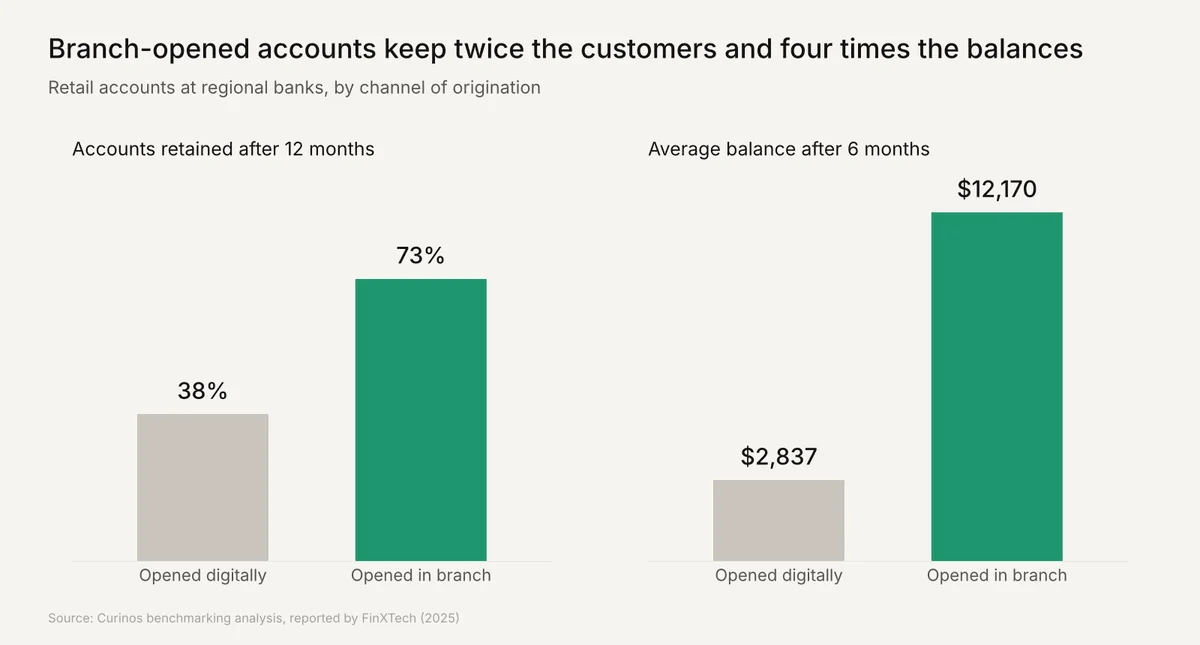
Opened accounts overstate results because many never fund, and those opened digitally hold far less money a year later.
Curinos benchmarked regional banks in 2024 and found that 38% of digitally originated accounts were retained after 12 months, against 73% for accounts opened in a branch.
Six months in, digital accounts averaged $2,837 in balances, compared with $12,170 for branch accounts. Curinos also found that only 20% of unfunded accounts are typically retained.
The leak starts before approval.
Cornerstone Advisors' 2026 benchmarking study found that for every checking account opened digitally in 2025, institutions lost 3.36 applications to abandonment, and the average institution missed 8,904 potential accounts.
A Harris Poll study for Cotribute, published in November 2026, found 46% of people who abandoned a financial application left when asked to fund the account. Only 1 in 10 came back to the same institution.
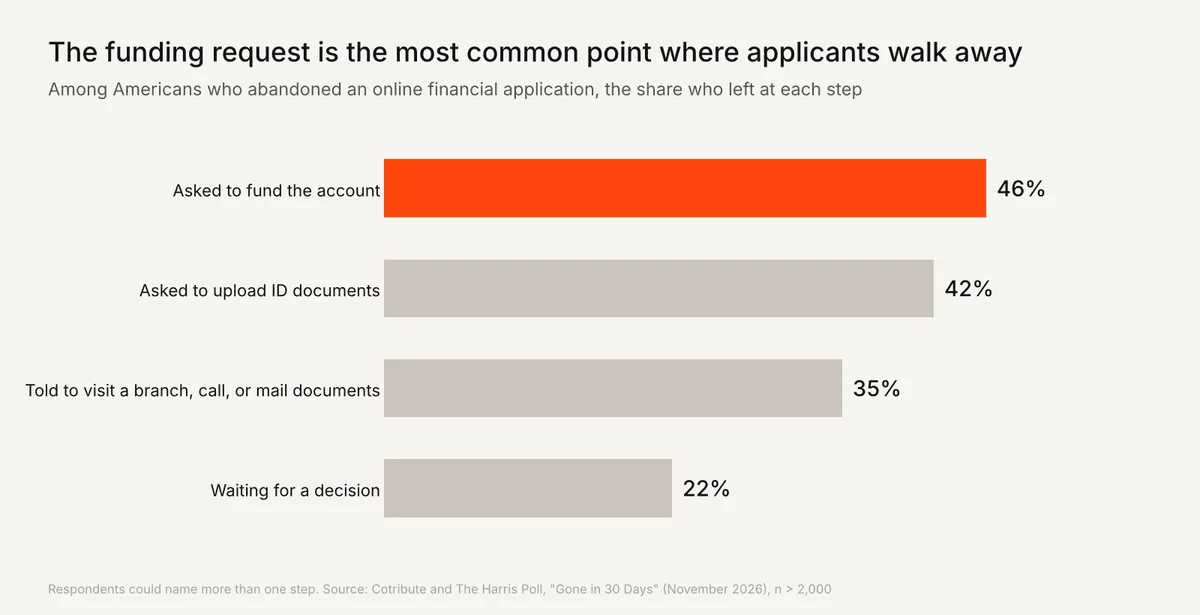
Every extra step between approval and funding adds customer effort, and a campaign optimized to cost per open never sees the bill.
Here's what a typical dashboard reports at each stage, and what it misses:
| Funnel stage | What dashboards usually report | What the number hides |
|---|---|---|
| Application started | Clicks, starts, cost per start | Abandoned applications, which outnumber completed digital accounts |
| Account opened | Opens, cost per open | Accounts that never fund and rarely stay |
| Funded | Rarely reported by channel | Funding amount, and whether it's new money or an internal transfer |
| Direct deposit active | Usually a product metric, absent from campaign reports | Whether the account became the customer's primary account |
| Balance at 12 months | Finance tracks it; marketing rarely sees it | Which campaigns produced durable balances |
Deposit growth marketing pays for new money that stays, while a broad rate promotion pays a premium on every qualifying balance, including balances you already hold.
Curinos data shows bank deposit promotions typically capture just 25% in new money, with the rest cannibalized from the bank's own lower-rate accounts. That pushes the marginal cost of funds on a broad promotion to roughly twice the promotional rate.
The pool of genuinely new money is also small.
Curinos estimates that 75% of an institution's annual deposit growth comes from existing customers. Only 6% of consumers switch providers each year, and just 15% of switchers bring more than $10,000, so roughly 1% of prospects carry meaningful balances.
| Approach | Who it attracts | New-money share | Main cost driver | When the offer ends |
|---|---|---|---|---|
| Broad promotional rate | Rate-sensitive prospects and existing customers | A minority; most balances are cannibalized | Repricing the existing book; marginal cost near 2x the promo rate | Rate-sensitive balances move to the next offer |
| Funded-balance campaign | Prospects and customers with balances elsewhere, chosen by segment | Measured per campaign as the goal metric | Media, creative, and an incentive tied to a behavior | Balances anchored by direct deposit and bill pay stay longer |
Rate still matters. The difference is where it goes: gate a promotional rate to new money from specific segments, and put the rest of the budget into reaching the 1% worth reaching.
That allocation is as much a strategy decision as a pricing one, and it belongs in the same room as treasury.
Measure deposit marketing on cost per funded account, cost per $10,000 in new money, and 12-month balance retention, with funding rate and direct deposit rate as the early signals.
Curinos tracks acquisition the same way, using cost per $10K in balances and 12-month balance retention as the core measures.
| Metric | Formula | What it tells you | When to read it |
|---|---|---|---|
| Funding rate | Funded accounts ÷ opened accounts | Whether the post-click experience works | Weekly |
| Time to fund | Median days from open to first qualifying deposit | Whether onboarding nudges land | Weekly |
| Cost per funded account (CPFA) | Campaign spend ÷ funded accounts | The real acquisition cost per customer | Weekly |
| New-money share | External inflows ÷ total balances in campaign accounts | How much of the result is cannibalized | Monthly |
| Cost per 10K of new money | Spend ÷ (new money ÷ $10,000) | Cost efficiency across products and channels | Monthly |
| Direct deposit rate | Accounts with recurring payroll deposit ÷ funded accounts, at 30 and 90 days | Progress toward primacy | Day 30 and day 90 |
| 12-month balance retention | Campaign balances at month 12 ÷ balances at month 1 | Whether the campaign bought durable money | Quarterly, by cohort |
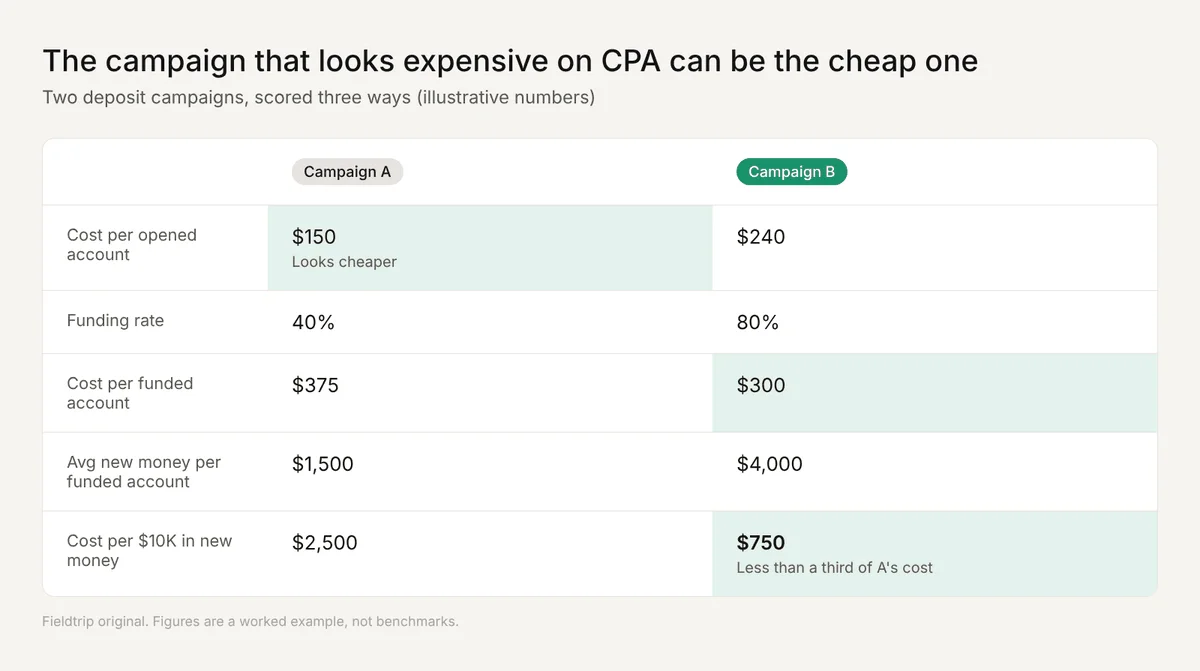
Here's why the switch matters, using illustrative numbers.
If A's funded accounts average $1,500 in new money and B's average $4,000, A costs $2,500 per $10K in new money and B costs $750. The campaign that looked 60% more expensive on a CPA dashboard costs less than a third where it counts.
Platform attribution won't see a deposit that lands three weeks after the click. Pass the campaign ID into your account-opening platform so it travels with the account record, then use marketing mix modeling or incrementality tests for channels that don't pass a click at all.
That join is also how you report marketing's contribution to deposits: net new money from campaign cohorts as a share of total deposit growth for the period.
This is where you may need measurement support, so each campaign shows funded new money alongside applications.
Build the campaign backward from a funded-balance target: set the dollar goal, define what counts as funded, pick audiences by where outside money sits, and fix the funding step before scaling spend.
Each step below depends on the one before it.
Build these segments from first-party data you already hold.
From our own work, the pattern holds outside banking. For Genomelink, a high-output UGC system cut CAC by 73% and lifted registration completion by 124%. Different category, same lesson: count the step after the click, because that's where a cheap acquisition turns expensive.
Pro Tip: Launch with a small budget for two weeks and read funding rate by ad set before reading CPA. An ad set with a low cost per open and a weak funding rate usually means the creative promised something the account flow doesn't deliver.
Structure a new account promotion so the reward pays out only after the behavior you want: a funded balance held for a set period, a recurring direct deposit, or new money above the customer's current balance.
Curinos notes that incentives tend to attract flightier deposits, so the structure has to do the filtering. Here are four bank deposit growth ideas that may work:
Pay a cash bonus once the account receives qualifying direct deposits within a set window. This is the strongest offer for checking because it rewards the behavior that defines a primary account. Set the qualifying amount high enough to require a real paycheck.
Offer an above-market rate on savings, money market, or CD balances funded from outside the institution. This works for balance augmentation among customers and prospects with large outside balances. Without the new-money gate, it reprices your own book.
Pay tiered bonuses for new money held above set thresholds for 60 to 90 days. This rewards larger households and small businesses for bringing operating balances, and the holding period screens out short-term rate shoppers.
Pair a deposit offer with a product the customer already wants: a loan rate discount, a fee waiver, or a business cash management tool.
BankDirector contributor Erin Guthman of PCBB suggests requiring an operating or household checking account for each new credit relationship, accepting slower loan growth for a better margin over time.
| Offer type | Behavior it rewards | Main risk | Best for |
|---|---|---|---|
| Cash bonus tied to direct deposit | Moving payroll | Bonus hunters who leave after payout | New checking relationships |
| Promotional rate on new money | Moving outside savings balances | Repricing if the gate is loose | Savings, money market, CDs |
| Balance-tier bonus | Bringing and holding larger balances | Complexity in disclosures and tracking | Affluent households, small businesses |
| Relationship bundle | Consolidating products | Slower acquisition | Borrowers and business customers |
An ad that states a specific bonus triggers federal disclosures. Banks follow Regulation DD §1030.8(d), and credit unions follow the parallel NCUA rule at §707.8.
Both require the ad to state:
General phrases such as "bonus checking" don't trigger these disclosures, per the CFPB's official interpretation.
Build the disclosure into the creative brief from day one and route it through the same marketing risk review as every other claim, so compliance edits don't arrive the week of launch.
A funded account becomes a primary account once it receives the customer's direct deposit and pays most of their bills.
Ask for direct deposit within the first 30 days, and bill pay right after.
Pinwheel's 2026 consumer study found that:
That anchor is weaker than it used to be. Datos Insights found that only 55% of Gen Zers have direct deposit with their primary institution.
The prize is still large: Curinos data cited in the same analysis puts primary customers at ten times the deposits of non-primary customers.
Run onboarding as a behavior-keyed sequence, with each message triggered by what the customer did or didn't do.
Treat it as one piece of campaign orchestration with the acquisition media, using the same persona and promise.
| Day | Trigger | Message | Success signal |
|---|---|---|---|
| 0 | Account approved | Fund now, in session, with the fastest method available | Funded the same day |
| 1 to 3 | Not yet funded | Reminder with a one-tap funding link and the offer deadline | Funded within 3 days |
| 7 | Funded | Switch your direct deposit, with a payroll-switching tool or prefilled form | Direct deposit set up |
| 14 | First direct deposit received | Move your bills, starting with two or three recurring payments | First bill payment |
| 30 | No direct deposit yet | Restate the bonus requirement and the remaining time | Direct deposit by day 45 |
| 60 | Direct deposit active | Introduce savings automation or a second product tied to the persona | Second product opened |
| 90 | Bonus window closes | Confirm the bonus payout and what the customer has set up | Balance held past payout |
Five channels work for deposit marketing:
Each runs under limits that push audience selection into the creative and the offer.
Meta has required the Financial Products and Services special ad category since January 14, 2025, for campaigns shown to US audiences, and restricted certain customer list audiences from March 2025. Inside the category:
Paid social still works for reaching life-moment audiences at scale, provided the creative names the moment.
Since February 28, 2024, Google has barred consumer finance advertisers in the US and Canada from targeting or excluding users by age, gender, marital status, parental status, or ZIP code.
Search still captures the highest-intent demand, because the query does the targeting: "switch banks," "checking account bonus," and "high yield savings" each signal a different persona and offer.
Rate comparison sites reach savers who are actively shopping for yield. Use them for savings, money market, and CD offers gated to new money, and judge them on CP$10K and 12-month retention, since this audience is the most rate-sensitive you'll buy.
Short-form video from creators and real customers explains a switch better than a rate table can: what moving payroll took, how long funding took, what the bonus required.
Brief the hook around the life moment, since the first seconds decide who keeps watching. Any creator who states a bonus amount or APY triggers the same disclosures as your own ads, so script the disclosure in.
Our creative team produces creator and UGC content for regulated categories, and we test it as described in our creative testing guide.
Email, in-app messages, statements, and branch conversations reach the group that produces most deposit growth. Use them for balance augmentation offers to customers whose transaction data shows money moving to other institutions.
| Channel | Best role in the deposit funnel | Main targeting constraint | KPI to judge it on |
|---|---|---|---|
| Meta paid social | Reaching life-moment audiences | Financial special ad category: no age, gender, or narrow location | CPFA, funding rate |
| Google paid search | Capturing active switching intent | No demographic or ZIP targeting in US and Canada | CPFA, CP$10K |
| Rate comparison listings | Reaching yield shoppers | Audience skews rate-sensitive | CP$10K, 12-month retention |
| Creator and customer content | Explaining the switch and the offer | Bonus and APY disclosures apply | Funding rate, direct deposit rate |
| Existing-customer channels | Balance augmentation | Consent and data-use rules | New-money share, CP$10K |
The funded-balance approach holds across institution types, and the lever that moves funding differs: relationships and branches for community banks, member data for credit unions, and onboarding speed for digital banks.
Community banks win on relationships, and the branch retention gap covered earlier shows why. Route high-balance digital applicants to a banker for a same-week follow-up.
Arm lenders with deposit products, too: at BankPlus, Armour said, "our loan officers effectively became deposit officers."
Credit unions follow NCUA Part 707 for deposit advertising, so build the bonus checklist above around §707.8.
Member data is the advantage.
Transaction histories show which members send paychecks or savings elsewhere, which makes balance augmentation offers precise. Share certificate promotions follow the same new-money gate as bank CDs.
Digital banks face the widest retention gap, since digitally opened accounts retain at about half the branch rate.
Require funding at origination, offer instant funding methods, and make payroll switching part of the approval screen. Rate listings will bring volume. Onboarding decides whether it stays.
If your institution needs the full stack of paid media, creative testing, and funnel reporting in one place, our performance marketing team runs it as one program.
A campaign that opens accounts without growing balances has one of two problems: a funding step that loses people after the click, or an offer and onboarding sequence that don't hold the money.
Funding rate by channel tells you which.
If funding is low, the problem sits after the click. If funding is healthy and balances fade, the problem is the offer or onboarding.
| What you see | What it likely means | What to check next |
|---|---|---|
| Low CPA, low funding rate | Creative promises more than the account flow delivers | Funding methods, session handoff, the ad's promise against the landing page |
| High funding rate, low new-money share | Existing customers are moving balances into the promotion | Eligibility rules and the new-money gate |
| Strong 90-day balances, weak 12-month retention | The offer attracted rate shoppers | Holding periods, offer type, the share of accounts with direct deposit |
| Low direct deposit rate at day 90 | Onboarding asks too late or too vaguely | Day 7 and day 30 messages, payroll-switching tools |
| One channel funds well and scales poorly | Audience saturation | Creative variety by persona, new life-moment angles |
| Results look strong in-platform, flat in finance reports | Attribution is counting opens or assisted clicks | Campaign IDs on account records, a holdout or geo test |
Fix the first broken stage you find and re-read the numbers before touching the next one. Predicting long-term value works only when it stays tied to these funnel decisions.
Deposit marketing works when the people writing the offer, buying the media, and reading the core data share one target: funded new money that stays.
Fieldtrip builds deposit campaigns as one system:
That's the core of our integrated marketing services, applied to the one number your CFO cares about in a funding squeeze. Book a strategy call today.
Pay it after a holding period. Tie payout to qualifying direct deposits or a funded balance held for 60 to 90 days, and state that time requirement in every ad, as Reg DD and NCUA Part 707 require.
Tag each funding transaction by source at the account level. Inbound transfers from external institutions count as new money; transfers from the customer's existing accounts at your institution don't. For existing customers, compare their total relationship balance before and after the campaign and report the net change.
Set the threshold from the product's economics, usually above a nominal opening deposit. A token deposit inflates the funding rate without telling you anything about balances. Report two lines, funded at any amount and funded above your threshold, so the gap is visible.