






















Financial services is about to become one of the most crowded rooms in advertising.
EMARKETER projects the category will pass CPG in 2027 to become the second-largest US ad industry, at $77.12 billion in total media spend. Marketing budgets aren't growing to match: they sit at 7.8% of company revenue, a tenth of a point above 2025, according to Gartner.
In other words, CMOs may need to do more with less as AI also reshapes how consumers choose their banks and finance apps.
This article discusses seven trends that will decide where the marketing money works in 2027, ranked, with a decision table by institution type.
Our view as an integrated marketing agency: In a category where platforms strip out most targeting, the creative does the audience selection. Paid media is where each message proves itself before it earns budget, and compliance belongs in the room when the work is made.
The top financial services marketing trends for 2027 are AI answer engines, creative-led targeting, regulated creator programs, primacy defense, financial media networks, governed AI workflows, and incrementality-based measurement.
| Trend | What's driving it | Where it hits first | CMO action level |
|---|---|---|---|
| AI answer engines become the first stop | Consumers ask chatbots about money before visiting a bank | Organic search and comparison traffic | Act now |
| Creative does the targeting | Meta's financial ad category removes most audience controls | Paid social acquisition | Act now |
| Financial creators become a regulated channel | Coordinated regulator enforcement on social promotions | Gen Z and Millennial acquisition | Build in 2027 |
| Retention defends the primary bank relationship | Customers spread deposits across institutions | Deposit balances | Act now |
| Financial media networks grow | Banks and payment firms sell ads on first-party data | Data and partnerships teams | Build in 2027 |
| AI in the workflow needs compliance gates | AI budgets rise faster than readiness | Content and creative ops | Build in 2027 |
| Incrementality and MMM replace platform attribution | Measurement tools fall short on trust | Budget planning | Act now |
The financial services marketing outlook for 2027 is more category money competing for the same customers. Total media spend is rising fast while marketing budgets stay flat as a share of revenue, so the extra dollars mostly bid against each other.
Three more signals frame the plan:
| Spend signal | Figure | Source | What it means for a 2027 plan |
|---|---|---|---|
| Financial services search ad spend, 2027 | Nearly $22 billion | EMARKETER | Rate and product keywords stay expensive |
| Awareness and conversion share of media budgets | 62.6% | Gartner | Acquisition is crowded across every industry |
| Loyalty and retention share of media budgets | Under 15%, down 29% since 2024 | Gartner | Existing customers get the least protection |
The practical read: category CPMs and CPCs keep climbing, and a plan built on buying more of the same inventory pays more each quarter for the same reach.
Before locking 2027 budgets, run each channel's 2026 cost per funded account against its 2025 figure. Any channel where that cost rose faster than account value is a candidate for reallocation. Our media planning and buying team usually starts there.
The biggest consumer banking trend for 2027 is spread-out loyalty. Customers keep a primary bank but open accounts elsewhere, move money freely, and ask AI tools for advice before they ask their bank.
J.D. Power's 2026 retail banking study found the average checking customer now holds three deposit accounts at different institutions, and 20% have moved money away from their primary bank.
J.D. Power calls this soft switching. The account stays open, and the balance leaves.
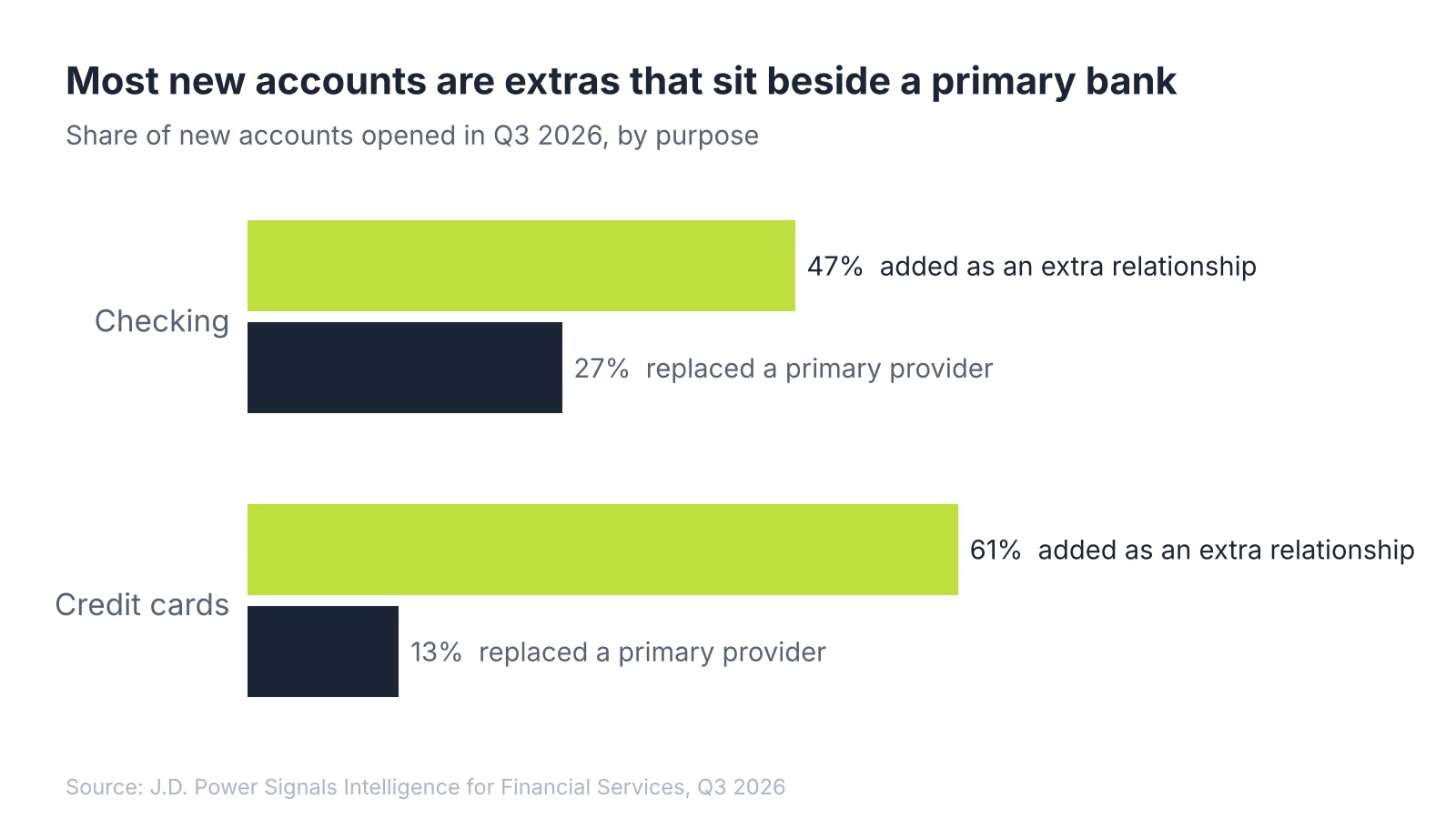
New account data points the same way. In J.D. Power's Q3 2026 tracking, secondary accounts substantially outnumbered replacement accounts across checking, savings, investments and credit cards.
Millennials and Gen Z now generate 67% of all new primary checking accounts in the US, according to a J.D. Power study. Online banks and fintechs held a fifth of this group's existing primary relationships and captured 28% of the new ones.
These customers also hedge. The Financial Brand reported in April 2026 that around 60% of Gen Z spread their banking across multiple providers, and one in five say they're likely to change their primary institution within six months.
TD Bank's second annual consumer survey found 55% of Americans asked a large language model for financial advice, up from 10% a year earlier, with Gen Z at 77%.
The next section covers what that means for visibility.

Trust is the most heavily weighted of the seven factors in J.D. Power's 2026 retail banking satisfaction model, ahead of people, products and digital channels.
Discovery has moved to feeds and chatbots, but the decision to move a paycheck still rests on whether the institution feels safe.
Signals worth tracking monthly as early warnings of soft switching, especially with a customer experience lens on what triggered each one:
AI answer engines now sit between the consumer and the institution's own website.
McKinsey's 2026 banking review found consumers use third-party AI tools for financial guidance about twice as often as their bank's own chatbot.
The click data shows the cost. Ahrefs compared 300,000 keywords that trigger AI Overviews from December 2023 to December 2025 and found Google now keeps 58 of every 100 clicks that once went to top-ranking pages.
The trend isn't one-directional, though. Seer Interactive saw organic CTR on AI Overview queries recover from 1.3% in December 2025 to 2.4% in February 2026, so the brands that get cited still collect traffic.
Click or no click, for a bank, the risk is concrete. When someone searches on Google or asks a chatbot for the best high-yield savings account, the answer names three or four institutions and quotes rates. If yours is missing, or quoted with last quarter's rate, the consideration set closes before your site loads.
The answer to this lies in financial services content marketing that helps you get cited in those recommendations.
The table below shows the type of content that caters to a specific query:
| Query type | AI answer effect | What to publish |
|---|---|---|
| "Best [product] for [situation]" | Answer names a shortlist of providers | Comparison-ready product pages with plain eligibility and fee tables |
| Current rate or fee questions | Answer quotes a number, often from third-party sites | A rates page with dated figures and structured data |
| "How does [product] work" | Answer summarizes; few clicks follow | Short explainers that name your product as the worked example |
| Branded questions | Answer pulls from your site and reviews | Accurate FAQ pages and current review-site profiles |
How to build AI answer visibility in one quarter:

Meta removed most audience controls for financial ads, so the creative now selects the audience. Since January 14, 2025, US campaigns promoting financial products and services must run under Meta's Special Ad Category, which restricts targeting options and, from March 2025, made certain customer-list audiences ineligible.
That leaves the ad itself to do the filtering. Who appears on screen, which life moment they name, and which objection they answer decide who stops scrolling.
In our work on regulated categories, from performance creative for Abbott's Lingo glucose tracker to creator programs for a ketamine therapy brand, the pattern repeats: when targeting narrows, persona-specific creative carries the segmentation.
Build a matrix of personas before you brief a single asset:
| Persona | Life moment | Objection | Creative angle | Compliance flag |
|---|---|---|---|---|
| First-job graduate | First paycheck | "Banks charge fees for everything" | Peer walks through a no-fee account setup | Fee claims need current disclosures |
| New parent | Child's arrival | "Saving for college feels too late" | Parent shows a small automatic transfer | Avoid implied returns on savings products |
| Small business owner | First hire | "Payroll tools are built for big companies" | Owner runs payroll on a phone | Eligibility terms on screen |
| Pre-retiree | Five years to retirement | "I don't know if I've saved enough" | Advisor-led planning check-in | Investment claims need risk language |
Each row becomes a set of concepts, and paid media becomes the test. That’s how the creative team briefs three to five concepts per row, launches them as a matrix, and moves budget toward the persona and angle combinations that produce funded accounts at the lowest cost.
Pro Tip: Write the compliance flag column with your compliance team in the first briefing session. Reviewers who helped shape the matrix approve finished assets faster, because they already agreed on the claims.
Regulators now treat creator posts that promote financial products as financial promotions.
In April 2026, the UK's FCA led a coordinated action with 16 other regulators, made 120 account takedown requests and identified 1,267 illegal financial adverts that reached at least 2.3 million UK accounts.
Regulations aren’t the end of creator programs. The channel still works because the audience trusts it.
Edelman's 2026 Trust Barometer found that among people who trust a financial influencer, 57% would trust or consider trusting a company they currently distrust if that influencer vouched for it.
Smaller institutions have proven it can work on modest budgets. In Filene's 2025 FiLab credit union test, Redwood Credit Union's creator campaign drove 297 click-throughs, 29% of its website traffic on launch day, and participating credit unions spent an average of $4,300 per campaign.
The following quick guide recommends the best use for different creator and influencer models:
| Creator model | Brand control | Compliance burden | Best use |
|---|---|---|---|
| Organic sponsored post | Low | High: post lives on the creator's account | Awareness among a creator's existing audience |
| Whitelisted ad from the creator's handle | High: brand controls targeting and spend | Medium: brand approves every version | Acquisition with a trusted face |
| Brand-owned content made by creators | Full | Low: runs through standard ad review | High-volume testing on paid social |
| Long-term creator ambassador | Medium | High: ongoing review of unscripted content | Education series and community trust |
How to run a compliant creator program:
Global influencer content production goes deeper on running this at volume across markets.
Soft switching makes rate-led acquisition leaky, so 2027 budgets need a real retention line. The customers most likely to drift are the ones a bank paid the most to acquire, and, as the outlook table shows, loyalty and retention now get the smallest share of media budgets.
Two moves protect the primary bank relationship:
A 60-day onboarding sequence that targets primacy:
Alongside these steps, track brand health with brand tracking tied to media decisions.
Financial media networks are bank, card, and payment ad businesses that sell targeting built on transaction data.
In a May 2025 forecast, EMARKETER put US financial media network spend at $1.22 billion in 2026, nearly double 2025's $640 million, led by programs such as Chase Media Solutions.
For financial services CMOs, the channel cuts both ways:
| Financial media network role | Who it fits | Data and consent consideration |
|---|---|---|
| Seller: launch your own network | Large banks and card issuers with high app engagement | Privacy notices, consent scope, and how transaction data is aggregated |
| Seller: offer card-linked offers | Regional banks and credit unions with active debit users | Merchant partner vetting and offer disclosure |
| Buyer: advertise on another network | Insurers, wealth firms and fintechs targeting spending behavior | Whether the network's audiences fit your own fair-lending and marketing rules |
Selling ads is as much a revenue decision as a marketing one, and it depends on a clean first-party data strategy.
Buying is simpler to start: treat a network like any new channel, with a holdout test before scale.
CMOs are funding AI faster than they can run it safely. Gartner found CMOs allocate 15.3% of marketing budgets to AI, while 70% say their processes aren't mature enough to scale it.
For financial institutions marketing in Europe, the rules are already live.
The EU AI Act's Article 50 transparency obligations, covering chatbot disclosure, deepfake labeling, and marking AI-generated content, apply from August 2, 2026.
The Digital Omnibus left that date in place. Only the machine-readable marking duty for systems already on the market got a grace period, to December 2, 2026.
AI-generated creative raises a narrower problem in finance: a model can write a rate, a return, or an eligibility claim that no one approved. Plus, audience perception of AI ads is mixed.
Even with strict human review in place and strong compliance, generative AI cannot make up for weak strategy, especially when targeting is limited on paid social and search platforms.
If you are relying on AI workflows, especially in marketing, it helps to build compliance gates in the very process:
Financial marketers should use MMM to set the budget split, incrementality and geo-lift tests to prove what caused growth, and platform attribution only for daily optimization.
Platform-reported attribution can't settle budget decisions on its own, and most marketers already know it.
The IAB's State of Data 2026 found that 75% of marketers say attribution, incrementality, and media mix modeling fall short on speed, accuracy, or trust.
Financial products make this even harder. Consideration windows run weeks or months, many conversions finish in a branch or on a call, and account value shows up in balances long after the click.
For more comprehensive measurement, financial institutions will need to incorporate different methods that essentially answer different questions.
| Method | Question it answers | Financial services use case | Cadence |
|---|---|---|---|
| Marketing mix modeling (MMM) | How much does each channel contribute to funded accounts? | Annual budget split across TV, search, social, and direct mail | Quarterly refresh |
| Incrementality testing | Did this channel cause accounts that wouldn't have happened anyway? | Proving paid social or a financial media network before scaling | Per test, 4 to 8 weeks |
| Geo-lift testing | What happens when spend changes in one market? | Branch-market campaigns and regional launches | Per test, 6 to 10 weeks |
| Platform attribution | Which ad drove the click? | Day-to-day creative and bid optimization | Daily |
How to build the stack:
If your team needs this built quickly, Fieldtrip’s measurement practice sets up the data connections, the first MMM, and the test calendar together.
CMOs should rank 2027 investments by institution type, funding measurement first, then the trend that threatens their largest revenue line.
A national bank and a neobank face different risks, so the same seven trends land in a different order.
| Institution type | Top priority | Second priority | Deprioritize | Primary KPI |
|---|---|---|---|---|
| National bank | Retention and primacy defense | AI answer engine visibility | Broad rate-led acquisition campaigns | Primary account share |
| Regional bank or credit union | Creative-led paid social with creators | Geo-lift testing in branch markets | Building a financial media network | Funded accounts per market |
| Fintech or neobank | Incrementality testing across channels | Converting secondary accounts to primary | Scaling channels that only show platform-reported results | Cost per primary account |
| Insurer | AI answer engine visibility | Buying on financial media networks | Generic awareness without measurement | Quote-to-bind rate by channel |
| Wealth or brokerage | Regulated creator programs | AI compliance gates | Unreviewed AI-generated content | Net new assets |
A 90-day plan for Q1 2027:
Before any 2027 proposal gets budget, score it against these questions:
In our opinion, two popular financial marketing trends deserve less 2027 budget than they're getting.
The 2027 plan that wins in financial services makes creative do the targeting, earns trust through creators and AI answers, protects existing customers and proves every dollar with incrementality.
Fieldtrip can be a partner in each of those crucial undertakings. As an integrated ecosystem of nimble teams and specialist agencies, we run strategy, creative, media, and measurement as one connected system.
That interconnectedness across levels and layers is especially important for financial services, as they explore AI in workflows and content while navigating stringent regulations.
We've built performance, creative, and analytics systems for ClearScore and run compliant creative programs in regulated categories.
Book a 2027 strategy call for financial services marketing.
Run broad targeting and let the creative do the selection. Build ads around specific personas, life moments, and objections, then let Meta's delivery find the people who respond. Because customer-list audiences are restricted, first-party data works better for measurement and onboarding than for paid targeting.
Whitelisting moves control to the institution, and with it, responsibility. When the ad runs from the creator's handle under your ad account, your institution approves the claims, sets the targeting, and owns the live version. The creator still needs clear disclosure of the paid relationship. Confirm specific obligations with counsel in each market you run in.
Geo-lift testing is often enough for smaller institutions. If spend sits mostly in a few channels across a defined branch footprint, matched-market tests can show what each channel adds. A full MMM pays off once spend spreads across five or more channels with enough history to model.
Track trends over time with a fixed prompt set. Run the same 20 prompts on the same day each week, across the same AI engines, from the same location. Record whether your institution appears, its position, and whether the quoted rate is current. Week-to-week noise is high, so read monthly averages.
It can. The AI Act reaches providers and deployers outside the EU when their AI output is used in the EU, so AI-generated ads running to EU audiences may need disclosure or labeling. Treat any EU-facing campaign as in scope until counsel confirms otherwise, and apply the same labeling rules there that you use for EU-based teams.