

























Marketing budgets are barely growing. Gartner's 2026 CMO Spend Survey puts marketing budgets at 7.8% of company revenue, compared with 7.7% the year before.
That puts more pressure on teams to show where marketing spend is working, where it is being wasted, and what should change. Yet only 52% of senior marketing leaders surveyed by Gartner said they could prove marketing's value and receive credit for its contribution to business outcomes.
A strategic marketing audit helps answer those questions before more budget is committed.
This guide explains what a strategic marketing diagnostic covers, how the process moves from kickoff to roadmap, and what to prepare before day one.
P.S. If you'd rather start with a conversation, our strategy team scopes every audit on a free call. We use that conversation to understand your priorities, identify the questions the diagnostic needs to answer, and determine the right scope before any audit work begins.
A useful marketing diagnostic starts by looking at the connections between creative, media and measurement. We run them as one system because each one shapes the others. Waste shows up where those connections break down: reports nobody acts on, creative built for channels that have lost budget, or agencies optimizing their own line item without considering the wider mix.
So our audit looks at how the parts work together. What comes out is a short list of tests worth running next, each with an owner and a reason, because learning compounds only when the next decision is clear.
A strategic marketing audit is a time-boxed review of how your channels, content and measurement work together, ending in a prioritized roadmap tied to business goals. It looks at all your marketing activities as one system and asks which of them move revenue.
Some agencies call the same work a marketing diagnostic, framing it as the step before treatment. The label matters less than the scope.
Textbook models, including Kotler’s marketing audit framework, divide the review into six areas: environment, strategy, organization, systems, productivity and marketing functions.
In practice, those areas come back to one question: is the marketing system aligned with business goals, and can its contribution be measured?
It's easy to confuse with two neighbors.
| Strategic marketing audit | Channel or digital marketing audit | Monthly reporting | |
|---|---|---|---|
| Scope | All channels, content, data and team structure | One channel, or a website audit of your online presence | Performance of live campaigns |
| Question it answers | Is the whole digital marketing system set up to grow? | Is this channel or site built correctly? | What happened last month? |
| Who runs it | Senior strategists, with finance and sales input | Channel specialists | In-house team or agency |
| Output | Prioritized roadmap and testing plan | Fix list for that channel | Dashboard and commentary |
| Cadence | At key moments, roughly yearly | As needed | Weekly or monthly |
If you want to run the full method in-house, our enterprise guide to running a strategic marketing audit covers the seven steps and frameworks. This article covers the other side: what happens when a partner runs it with you.
A business usually needs a marketing diagnostic before a major budget, agency, measurement, market-entry or leadership decision.
Five situations make the case strongest:
In each case, the value is a baseline everyone agrees on before money moves. For performance symptoms, such as rising CAC, see the performance gaps section below.
A strategic marketing audit typically reviews four areas:
Each one answers a different business question, and together they show where the biggest opportunities and constraints sit across the customer journey.
| Area | What we review | The question it answers | What it feeds into the roadmap |
|---|---|---|---|
| Channel structure | Budget split, account setup, ownership | Is spend organized to learn and scale? | Budget moves and account rebuilds |
| Content output | Volume, speed, variety, placement fit | Can you produce enough testable creative? | Production plan and creative tests |
| Reporting quality | Tracking, metric definitions, decision flow | Can your data support a decision? | Measurement fixes and KPI definitions |
| Performance gaps | Funnel drop-offs, efficiency, opportunity sizing | Where is growth leaking, and what is it worth? | Ranked opportunities with owners |
We review reporting quality before sizing performance gaps. If the underlying data is unreliable, the opportunity estimates will be unreliable too.

Channel structure is the first area to review because it shows whether the budget is set up to learn or simply to spend. The review usually covers three layers.
Compare each channel's share of budget with its share of results. Social media, email marketing, search, paid advertising and offline channels like trade shows all go on the same sheet, with spend next to pipeline or revenue.
Data shows that customers use an average of four channels in a single brand interaction, so a channel can matter without getting last-click credit. The aim is to find channels kept on habit and channels starved of budget, then flag both for testing.
The next step is to review the account structure inside each digital advertising platform. Key checks include:
The final layer is budget ownership. When search sits with one agency, paid social with another and marketing automation with an in-house ops team, each optimizes its own number. Handoffs break, and nobody owns the blended result.
| What shows up | What it usually means | What to check next |
|---|---|---|
| One channel takes most of the budget for years | Allocation is on autopilot | Incrementality or holdout data for that channel |
| Dozens of small campaigns with tiny budgets | Algorithms can't exit learning | Consolidation options by objective |
| Two partners claim the same conversions | Overlapping attribution | Deduplicated totals against CRM |
| Retargeting spend rises while prospecting falls | Short-term ROAS is driving decisions | New-customer share over time |
For the next step after the audit, our guide to optimizing paid media spend across multiple channels covers reallocation in depth.
Content output is the second area, and it measures whether your team can produce enough creative to feed the channels you pay for. Content marketing and paid creative get reviewed together, since both draw on the same people and approvals.
Start with what actually ships: assets per month by channel, email campaigns per quarter, and the time from brief to launch. Then map the approval path. A content marketing strategy that plans weekly releases means little if marketing campaigns wait three weeks for legal review.
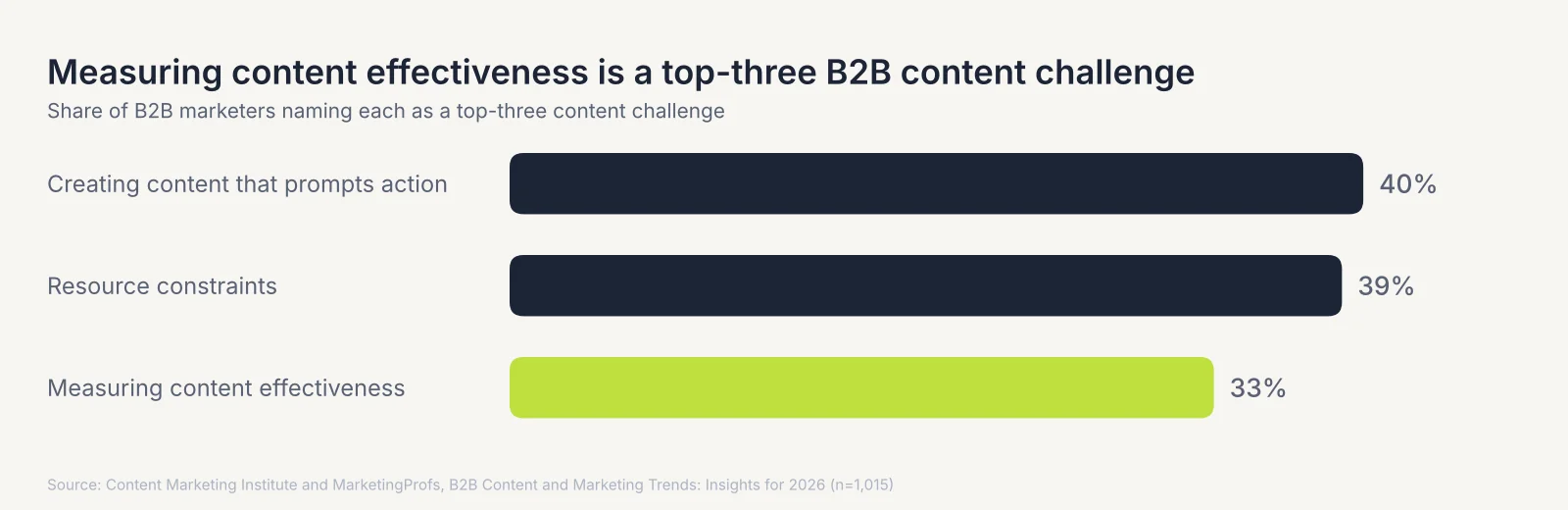
This is a common constraint. In CMI's latest B2B research, 39% of marketers named resource constraints among their top content challenges.
The aim is a predictable production rhythm that can sustain the testing volume each channel requires.
Volume alone says little if every asset repeats the same idea. Live creative should be grouped by concept and then compared with customer personas and the Ideal Customer Profile.
Key questions include:
In our view, the persona carried inside the creative now does much of the targeting that platform settings used to do. So a thin creative library limits who you can reach, whatever the budget.
Check our guide on creative production challenges at large brands to see how teams add variety without adding headcount.
The final check is placement fit. Each asset should be reviewed for format, length, framing and aspect ratio based on where it runs. Organic content can also be assessed for paid reuse when it has already demonstrated audience interest.
A vertical placement created by simply cropping a widescreen TV spot is a common miss. Important visual information can disappear, pacing can feel wrong, and the asset may have been built for a very different viewing context.
In the same CMI survey, just 12% of B2B marketers rate their content as highly effective, and poor fit is one of the easier causes to fix.
When creative gaps are identified, they should feed directly into the testing roadmap: what needs to be produced, which audience or proposition it should test, and what result will determine the next move.
Read next: Creative Testing and Measurement for Large Brands [+ In-House Matrix Templates]
Reporting quality is the third area, and it decides how much you can trust everything else in the audit. If tracking is broken, every number downstream is a guess.
The first step is to review the data collection system itself. In Google Analytics, check which events are marked as key events and whether they match what the business considers a meaningful outcome. In Google Search Console, confirm that every relevant domain and subdomain is covered.
The CRM should then be reviewed for lifecycle stages, duplicate records and whether offline conversions are passed back to advertising platforms.
Trust is a real issue here. Salesforce's data leaders estimate that 26% of their organizations' data is untrustworthy. An analytics setup review shows where that applies to you.
The next step is to make sure every KPI has one clear definition across the business. These definitions should then carry through the rest of the audit and roadmap:
Consistent definitions matter because 80% of digital marketing leaders struggle to define a consistent set of metrics across channels.
At Fieldtrip, our team also flags soft signals carrying too much weight. Engagement rates rarely predict revenue, and email open rates are inflated now that over half of opens happen on devices with Apple's Mail Privacy Protection. The marketing and sales metrics that matter should reconcile with finance.
Our comparison of multi-touch attribution vs. marketing mix modeling helps if the audit shows your attribution model needs replacing.
The final check is whether reporting leads to a decision and whether ownership is clear. Recent reports should be reviewed to see what action followed, who made the call and whether the same issue keeps appearing without resolution.
A useful reporting system does more than surface numbers. Marketing, sales and analytics need shared definitions, clear decision rights and an agreed process for acting when performance changes.
If your reporting needs rebuilding, our measurement team can help you build that system.
Performance gap analysis is the fourth area. It brings the earlier reviews together by identifying where results are falling short and estimating what closing each gap could be worth.
The conversion funnel should be traced stage by stage, from website traffic to closed revenue.
For a B2B team, this includes lead generation volume, lead quality and how leads move through the sales process. And for ecommerce, it includes sessions, add-to-cart activity and purchases.
At each stage, conversion rates can be compared with historical performance to identify drop-offs and broken conversion pathways.
Page speed and user experience can contribute to those losses. After T-Mobile cut its Largest Contentful Paint by 42%, its visit-to-order rate for shopping-intent visits rose 60% over the same period.
Using the metric definitions established in the reporting review, efficiency can be tracked over time through measures such as CAC payback, frequency and the gap between blended and paid CAC. Acquisition performance should also be considered alongside customer retention, since low-cost customers can still be unprofitable if they churn quickly.
This is where campaign problems usually surface. 87% of CMOs reported campaign performance issues in the past year, and 45% said they at least sometimes ended campaigns early.
For a demand signal outside ad platforms, Google search volume can also be compared with competitors using share of search.
Each gap can be scored so the roadmap reflects business value, evidence and execution difficulty. Three questions help determine priority:
| Gap | Estimated impact | Confidence | Effort | Priority |
|---|---|---|---|---|
| Example: retargeting overlap across two platforms | Medium | High | Low | Now |
| Example: no persona-specific creative for second ICP | High | Medium | Medium | Next quarter |
| Example: CRM stages don't sync to ad platforms | High | High | High | Now (start) |
The point is to separate problems that merely look important from those worth acting on first. A high-impact gap with strong evidence may move to the front of the roadmap, even if the fix takes longer. A low-confidence idea may become a test before it earns more budget.
You need three things ready before kickoff: read access to your ad, analytics and CRM platforms; two to four quarters of reports, budgets and margins; and a short list of stakeholders.
The full marketing audit checklist falls into three groups: platform access, business and performance data, and the people involved in key decisions.
The first step is making sure you can see the systems where marketing activity and outcomes are recorded. Read-only access is enough for most audits, and it lets you review structure, tracking and performance without changing anything in the account.
Set it up for these platforms:
| Item | Why we need it | Usual owner | Format |
|---|---|---|---|
| Ad accounts: Google, Meta, LinkedIn, TikTok and any others with spend | Review structure and spend | Channel leads or agencies | Read-only user |
| Google Analytics 4 and Google Search Console | Check tracking and key events | Analytics or web team | Viewer access |
| CRM and marketing automation platform | Trace leads to revenue | Sales or revenue ops | Read-only user or CSV |
| Attribution, MMM or BI tools | Compare models with platform data | Analytics team | Viewer access |
| Social channels, CMS and email platform | Check content output and tracking | Content or web team | Viewer access |
Platform data shows what happened. These documents explain why decisions were made, how success is defined and which commercial constraints matter. They also help us size opportunities in business terms.
| Item | Why we need it | Usual owner | Format |
|---|---|---|---|
| The last two to four quarters of performance reports | See what decisions are based on | Marketing leads | PDF or dashboard link |
| Budget by channel, planned and actual | Compare spend with results | Finance or marketing ops | Spreadsheet |
| Margins and unit economics by product or segment | Size opportunities in profit terms | Finance | Summary sheet |
| Brand guidelines and creative library | Count concepts and formats | Brand or content team | Shared folder |
| Existing market research, personas and ICP documents | Check creative against the audience | Strategy or insights team | Doc or deck |
| Previous audits from any agency or consultant | Avoid repeating known findings | Marketing leadership | Doc or deck |
| Approval paths for creative, budget and launches | Map bottlenecks | Marketing leadership | Slide or doc |
If you already have a documented first-party data strategy, include it here. It can clarify how customer data is collected, governed and used across the marketing stack before the audit begins.
The audit needs a few voices beyond marketing. An organizational chart of the marketing team, with agencies marked, helps us map ownership quickly.
A strategic marketing audit typically runs in six steps and takes about four weeks, or roughly 20 business days, from kickoff to readout. Depending on access and stakeholder availability, the audit and planning phase can usually begin within 10 to 15 business days of the first conversation.
The inputs come from the checklist above.
The phases overlap, so analysis can continue while stakeholder input and supporting data are still coming in.
| Phase | Business days | What happens | Your time commitment |
|---|---|---|---|
| 1. Kickoff and goals | Days 1-2 | Scope and success criteria agreed | 60-minute kickoff with marketing lead |
| 2. Access and data pull | Days 2-5 | Access granted, data checked | A few hours from analytics and ops |
| 3. Interviews | Days 4-8 | Stakeholder conversations | 30-45 minutes per stakeholder |
| 4. Analysis | Days 6-15 | Review of all four areas | Ad hoc questions over Slack or email |
| 5. Synthesis | Days 14-18 | Scoring and roadmap draft | None |
| 6. Readout | Days 19-20 | Findings and roadmap session | 90-minute readout with leadership |
Once the roadmap is set, it needs an operational owner. Our guide to marketing operations for enterprise teams covers how that role keeps priorities moving.
The final deliverable is a findings document and a prioritized roadmap that turns the audit into clear next steps. It typically includes five components: findings by review area, a prioritization scorecard, a roadmap, testing priorities and assigned ownership.
The table below shows what each component contains and how it is used.
| Deliverable | What it contains | How you use it |
|---|---|---|
| Findings by area | Each of the four areas, rated by severity | Shared view of what's working and what isn't |
| Prioritization scorecard | Every gap scored on impact, confidence and effort | Decide what to fund first |
| Roadmap | Moves grouped into now, next quarter and 12 months | Plan budget and headcount |
| Testing priorities | The first tests, each with a hypothesis and success metric | Start learning right away |
| Team assignments | A named owner for each action | Clear accountability |
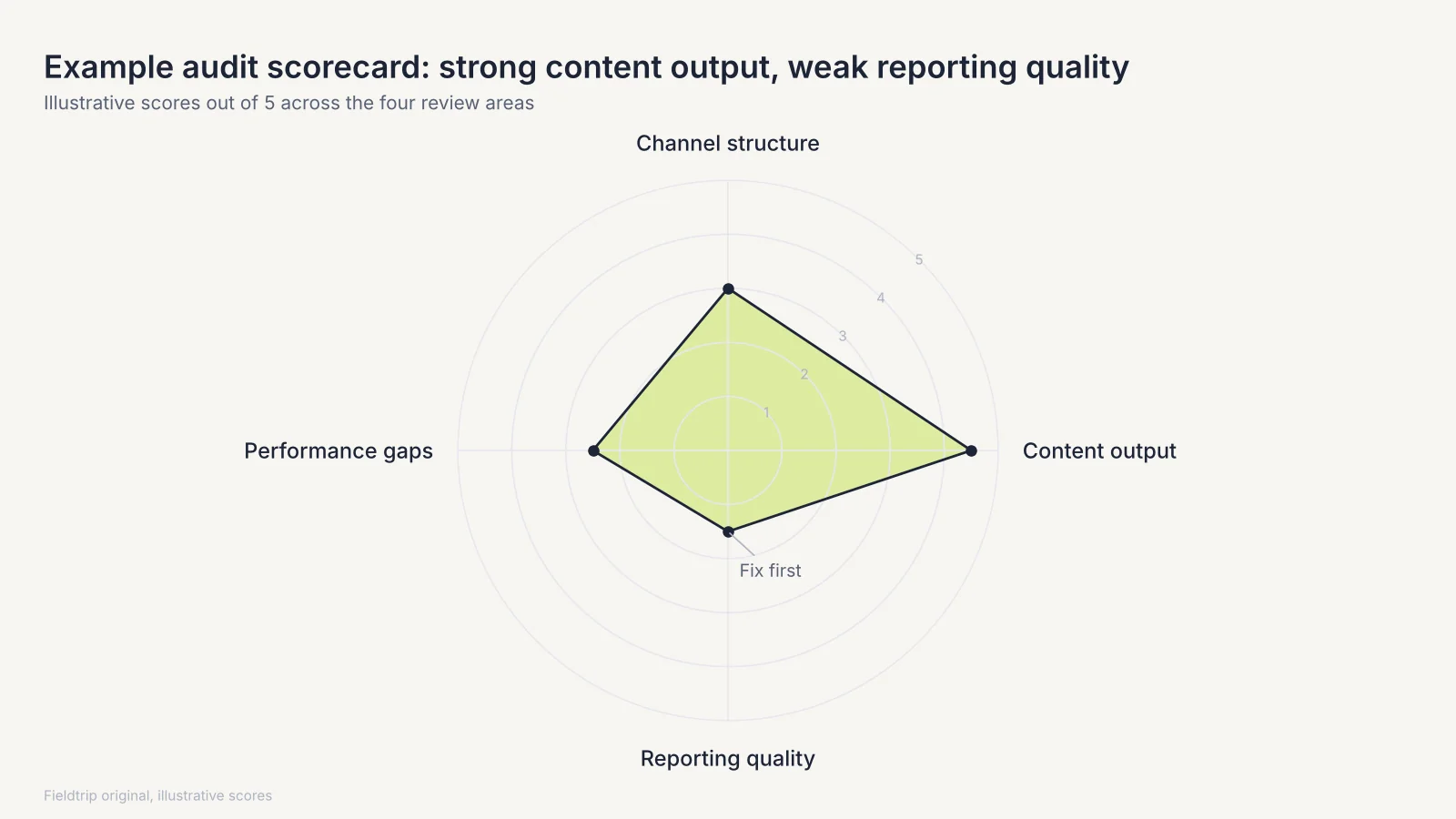
The four review areas can also be summarized on a spider graph, with one axis for each area. This gives leadership a quick view of where the marketing system is strong and where gaps are concentrated.
For example, a team with strong content output but weak reporting quality will need a different roadmap from one with reliable measurement but limited creative capacity.
A strong marketing diagnostic asks for real data, connects findings to business outcomes and gives enough context to prioritize what matters. This checklist can help evaluate the quality of any audit:
A useful diagnostic should help clarify what needs to change, regardless of who eventually does the work. That is one of the clearest differences between a strategic audit and a free pitch audit.
A free audit usually relies on public information and limited account access, so it can identify visible issues but may not reveal problems inside tracking, reporting, CRM data or internal decision processes.
How the relationship runs after the audit matters as much. Our piece on high-performing agency-client relationships covers what to expect.
Marketing audit pricing varies widely because scope can range from a focused channel review to a multi-market diagnostic involving interviews, customer research and complex data analysis.
Cost usually depends on the number of channels, markets, data sources and stakeholders involved.
At Fieldtrip, we scope each audit on an initial strategy call, then we share a proposal.
The table below shows what typically pushes an engagement toward the lower or higher end of the range.
| Driver | Lower cost | Higher cost |
|---|---|---|
| Channels in scope | Two or three | Six or more, including offline |
| Markets | One country | Several regions with local teams |
| Data access | Clean, connected, documented | Fragmented across tools and agencies |
| Interviews | A handful | Many stakeholders across business units |
| Depth | Diagnostic and roadmap | Adds competitive intelligence and customer research |
Preparing the checklist above is the simplest way to keep cost down, since less time goes into finding data.
A strategic audit gives leadership one shared view of how marketing is working and a roadmap for what should happen next. At Fieldtrip, strategy, creative, media and measurement are reviewed together so gaps can be understood in the context of the wider marketing system.
The audit is typically the first phase of a Fieldtrip engagement. The readout identifies testing priorities, clarifies ownership and shows which opportunities deserve attention first.
Discuss your marketing audit scope with our team on a free strategy call. The conversation covers your goals, the channels in play and the access required, then defines the right scope for the diagnostic.
Most teams solve this with a mutual NDA and a scoped data export, then add live access later. A CSV of leads, opportunities and closed deals for the last few quarters, with personal data removed, is enough to trace the funnel. Read-only access to the live CRM can follow once the contract is signed.
Yes. Broken tracking becomes the first finding, and the audit continues around it. We work from platform and CRM data where analytics is unreliable, and the reporting quality section of the roadmap gets top priority. The analysis phase may take a few extra days while we reconcile sources.
Yes, and we review their channels with the same checklist as everything else. Findings describe structure and results. If your current agency should keep a channel, the roadmap says so, which is part of the evaluation checklist above.
It can, and live campaigns often show problems more clearly. The main cost is stakeholder time, so we schedule interviews around launch dates. We avoid recommending structural account changes until the peak period ends.
Yes. You pay for the audit, so the findings, scorecard and roadmap are yours to keep. They are written so your own team or any other partner can act on them.
We audit a lead market in full, then review other markets against the same four areas at lighter depth. Shared issues, such as tracking setup or creative approval, get one fix; local issues get local owners. Interviews include at least one regional lead per market in scope.
%2520(1).png)